One Delay Can Cost Your Entire Cruise
A quick coverage check now protects you from the problems no one sees coming
Short Excerpt
- Worried about seasickness, safety drills, or not knowing what to expect on your first cruise? Learn which concerns deserve preparation.
- Understand how motion sickness prevention works and why complimentary seasickness pills aren’t guaranteed onboard.
- Use an interactive checklist to organize your health preparations and safety briefing responsibilities.
- Discover what muster drills actually involve, when to ask for help, and how to approach your first sailing with greater confidence.
Quick Take
- First-cruise nerves are understandable. Unfamiliar ship movements, emergency signals, and safety procedures can feel intimidating before you’ve experienced them.
- Prepare for seasickness before departure. Ask your doctor or pharmacist about appropriate prevention options, especially if you’ve experienced motion sickness before.
- Don’t rely on free Guest Services medication. Onboard remedy availability and pricing vary. Bring an appropriate supply of any recommended medication.
- Complete your required muster briefing. Know your assigned station, understand the instructions, and follow your cruise line’s approved process.
- Don’t confuse a muster drill with a lifeboat drill. Passenger safety briefings and crew exercises serve different purposes.
- Know where to get help. Guest Services can help locate onboard resources, while the medical team handles clinical concerns and crew members explain safety procedures.
Feeling Nervous About Your First Cruise? Focus on What You Can Prepare For
Your first cruise comes with plenty to look forward to, from exploring the ship to discovering ports you’ve never visited.
But when you’re unfamiliar with life at sea, ordinary questions can quickly become bigger worries.
Will you feel sick when the ship starts moving?
What happens if an alarm sounds?
Will you know where to go during the mandatory safety briefing, or will everyone else seem to understand something you don’t?
You don’t need to know everything about cruise ships before boarding.
You do, however, benefit from understanding the difference between an unfamiliar experience and a situation that requires action.
Seasickness and passenger safety procedures are good examples.
Motion sickness is a physical response to movement, and your experience depends on individual sensitivity and sea conditions.
Modern stabilizers reduce some ship movement, but they don’t eliminate the possibility of nausea.
The CDC recommends considering motion sickness prevention before travel, because many medications work better before exposure to movement than after symptoms develop. (CDC Yellow Book — Motion Sickness)
Safety drills require a different kind of preparation.
You don’t need to learn how to operate a lifeboat or memorize the ship’s emergency procedures.
Your responsibility is to complete the passenger safety briefing, understand where your assigned muster station is, and follow the crew’s instructions.
International maritime rules require newly embarked passengers on qualifying voyages to muster before or immediately upon departure. (International Maritime Organization — Passenger Ship Safety)
One additional distinction is worth understanding before you sail.
A passenger muster introduces guests to emergency instructions and assembly arrangements.
Crew lifeboat drills are separate exercises involving crew training and lifesaving equipment.
Knowing that difference can prevent you from misinterpreting ordinary safety preparations as evidence of an emergency.
Rather than trying to predict every uncomfortable or unexpected moment, prepare for the decisions that are actually yours to make.
The following checklist brings those preparations together.
Interactive First-Cruise Confidence Checklist
Use this checklist to prepare for motion sickness, confirm your safety briefing responsibilities, and identify where to ask for assistance onboard.
It deliberately avoids recommending medication doses or interpreting emergency alarms.
Those decisions require medical guidance or official instructions from your ship.
My First-Cruise Readiness Checklist
Check off each step before departure or during embarkation.
You can copy your checklist to keep a record of your preparations.
My First-Cruise Readiness Checklist
Prepare for seasickness and learn the safety responsibilities that matter on embarkation day.
Preparation aid only. This is not medical advice, proof of muster completion, or an emergency instruction. Always follow your ship’s official procedures.
Why a Simple Plan Helps With Two Very Different First-Cruise Worries
Seasickness and emergency procedures can feel equally intimidating before your first sailing, but they require different responses.
For motion sickness, preparation means understanding your personal sensitivity and having suitable remedies available if needed.
For safety drills, preparation means learning your assigned muster station and following the ship’s instructions rather than relying on assumptions about what an alarm means.
Once you’ve completed those preparations, you don’t need to spend the rest of the voyage anticipating either problem.
The article below explains why these worries are so common, what motion sickness feels like, how cruise safety briefings work, and which habits can help you feel more comfortable aboard your first ship.
Why Seasickness and Safety Drills Feel Intimidating Before Your First Cruise
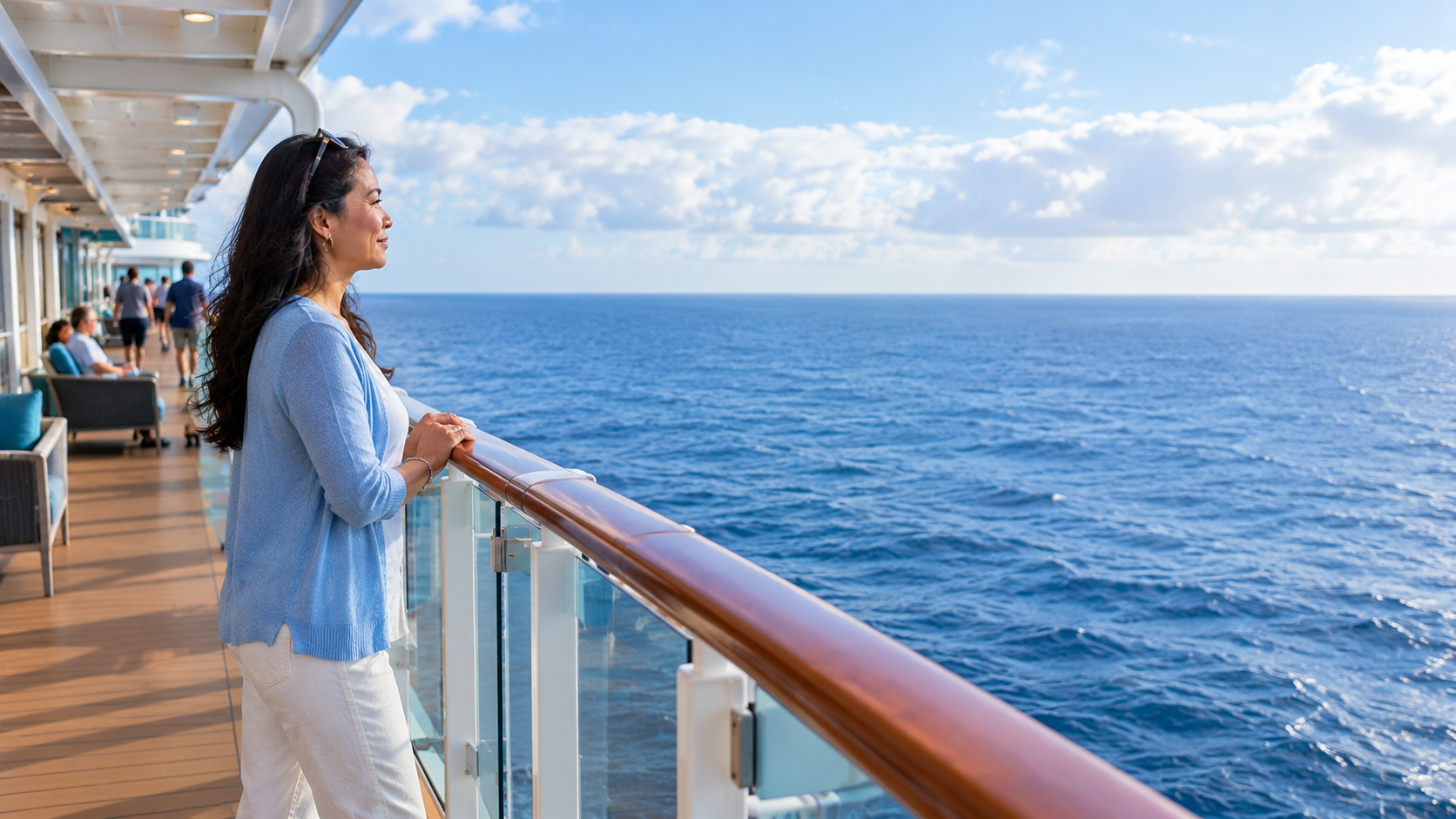
Feeling nervous about seasickness or safety drills before your first cruise is completely normal.
If you are planning your first cruise and feel a little nervous about seasickness, safety drills, or what happens if something goes wrong, you are in very good company.
Plenty of confident, experienced cruisers started out exactly where you are now.
They were excited about the vacation.
They were also quietly worried about getting sick, messing up the safety drill, or not knowing what is “normal” at sea.
Top Cruise Deals From Trusted Cruise Lines
Compare exclusive online offers and find the fare that fits your trip and your budget
You might be picturing yourself turning green the moment the ship moves.
You might imagine loud alarms and confusing instructions during the safety briefing.
You might worry that if something serious happened, you would not know where to go or what to do.
Those thoughts can feel intense.
They are also completely normal.
Modern cruise ships are designed to handle motion, emergencies, and nervous first-timers with layers of planning behind the scenes.
Once you understand how seasickness prevention really works, what muster stations and lifeboat drills actually look like, and which feelings are just your brain trying to protect you, those fears start to shrink into something manageable.
Why First-Time Cruise Fears Are So Normal
Before your first cruise, there is a gap between what you imagine and how it really feels to be on board.
Your brain hates that gap.
It fills it with whatever examples it has.
That might mean disaster movies, dramatic news stories, or one bad experience on a small ferry years ago.
If you know you are prone to motion sickness on buses or in the back seat of a car, your mind may jump straight to “What if I am miserable the entire time.”

If you have never taken part in a safety drill at sea, the idea of alarms, instructions, and crowds can sound overwhelming.
If you do not understand how help works on a ship, it is easy to imagine yourself stuck with no support far from shore.
In reality, most first-time fears come down to three things.
You are facing something unfamiliar.
You are handing some control to the crew.
And you care a lot about the people traveling with you.
Your Brain Is Trying To Keep You Safe
Every anxious question in your head is your brain running “what if” scenarios.
It is not proof that cruising is unsafe.
It is proof that you are paying attention.
Other Passengers Feel The Same Way
You are not the only one with butterflies on embarkation day.
You just cannot see everyone else’s worries on their faces.
Information Shrinks Fear
Once you know what to expect from seasickness prevention and safety drills, vague dread turns into specific steps you can actually take.
Seasickness Basics On Modern Ships
Seasickness is usually the first fear people name when they talk about cruising.
Understanding how it works gives you power over it.
Motion sickness happens when your inner ear, your eyes, and your brain disagree about what is going on.
On a moving ship, your inner ear feels motion.
Your eyes may be looking at something that appears still, like a hallway, a phone screen, or a book.
Your brain gets mixed signals.
That mismatch can trigger nausea, dizziness, and a general sense of unease.
Modern cruise ships are large and heavily stabilized.

They are designed to reduce motion as much as possible, especially on common routes and in normal conditions.
You will still feel the ship move sometimes.
Usually it feels like a gentle sway.
On certain days and routes, that motion can be stronger.
The key is that you are not helpless against it.
You can take concrete steps that dramatically cut your chances of feeling sick.
Why You Should Visit Guest Services For Seasickness Pills Immediately
One of the smartest first-day moves you can make is incredibly simple.
After you board and find your cabin, take a short walk to Guest Services.
Ask if the ship provides seasickness pills.
On many mainstream cruise lines, the answer will be yes.
They will offer basic motion sickness tablets at no extra charge.
Too many first-time cruisers wait until they already feel bad before asking for help.
By that point, the medication has to play catch-up.
You can end up spending hours feeling miserable while your body absorbs the medicine.
There are two very important reasons to talk to Guest Services about seasickness pills as soon as you are on board.
The first reason is alcohol.
Many motion sickness medicines do not mix well with drinking.
Online‑Only Cruise Offers You Won’t Find Elsewhere
Unlock special pricing and start planning the sailing that matches your perfect itinerary

The staff or medical team will tell you that you should not drink alcohol while you are taking them.
You want to know that before you start ordering cocktails or committing to a drinks package.
The second reason is timing.
These medications work best when they are in your system before symptoms start.
Taking them proactively, exactly as directed, helps prevent your body from sliding into full-blown seasickness.
You are essentially setting up a shield in advance.
You do not want to be reading the instructions for the first time while you are already leaning over a trash can.
Planning Seasickness Prevention Before You Ever Sail
Your preparation does not start at Guest Services.
It starts at home.
Talk with your own doctor or pharmacist before your trip.
Explain that you are planning a cruise and are worried about motion sickness.
Ask what type of remedy fits your health background.
They may recommend an over-the-counter option, a prescription patch, or another approach.
You can pack what they suggest and still plan to use the free pills on board under the crew’s guidance if needed.
Travel insurance from companies like VisitorsCoverage, World Nomads, Ekta, or Insubuy can also lower the stress in the background.
If you do end up needing care at the medical center, you will know you have some protection for covered expenses instead of worrying about every dollar before you even knock on the door.
Seasickness Prevention: Anchor Ideas
Medication Works Best As Prevention
You want seasickness medicine in your system before symptoms start, not after you already feel awful.
Alcohol And Seasickness Pills Do Not Mix
If you are taking motion sickness medication, plan to skip drinking while it is in your system.
A Quick Stop At Guest Services Is A Game Changer
Asking about free seasickness pills right after boarding is one of the simplest, smartest moves you can make.
Seasickness Remedies That Actually Help
Medication is important, but it is only one part of the picture.
Your habits, where you spend time on the ship, and even what you eat can make a real difference.
Ships tend to move less in the middle and on the lower decks.
If you are very sensitive, midship cabins on a lower deck are often the most comfortable.
Heavy, greasy meals and lots of alcohol make nausea more likely.
So does staring at a phone or book in a small interior space where your eyes cannot see the horizon.
Fresh air, a view of the water, and simple meals help your brain and body agree on what is happening.
That agreement makes motion easier to handle.
Simple Habits That Support Your Stomach
Spend time on deck where you can see the horizon, especially if you start to feel off.
Your eyes and inner ear will finally be reading the same thing.
Eat lighter meals on days when the water is rougher.

Luxury Cruise Experiences at Smarter Prices
See premium sailings and upgraded cabins priced for travelers who know how to book well
Grilled chicken, bread, plain rice, fruit, and crackers are kinder to your stomach than heavy fried foods.
Sip water regularly.
Dehydration makes dizziness and headaches worse.
Avoid mixing seasickness medication with alcohol, not just because of the label warnings, but because alcohol itself affects balance and hydration.
Consider supportive tools like ginger candies, ginger tea, or acupressure bands if your doctor agrees they are safe for you.
Many travelers find that they take the edge off mild queasiness, especially when used alongside a proper medication plan.
If you start to feel symptoms, do not shut yourself in a dark interior cabin right away.
Try going outside, breathing slowly, and looking at the horizon.
Often that combination plus rest will start to turn the tide in your favor.
When To Visit The Ship’s Medical Center
Most seasickness cases on big ships are mild and short-lived.
Medication, fresh air, hydration, and time usually fix them.
There are times when it makes sense to visit the medical center.
If you cannot keep fluids down.
If you feel faint, confused, or very weak.
If symptoms are not getting better after reasonable self-care.
The ship’s medical team is used to seeing motion sickness, especially early in the cruise or on particularly active sea days.
They can check that nothing more serious is going on and offer treatment matched to your situation.
Having travel insurance in place makes it easier to walk into that office early instead of waiting and worrying about the bill.
If disruptions on the way to the ship made your travel more stressful, tools like Compensair and AirHelp can help you seek eligible airline compensation.
Recovering some of those costs frees up mental space to focus on feeling better instead of tallying every setback.
Seasickness Remedies: Helpful Truths
Small Adjustments Add Up
Light meals, steady water, and fresh air can significantly reduce symptoms when you combine them with medication.
The Horizon Is Your Friend
Looking at the water line helps your inner ear and eyes agree, which often eases nausea.
Asking For Medical Help Is A Smart Choice
Visiting the medical center early is taking care of yourself, not overreacting.
Safety Drills, Muster Stations, And Lifeboat Procedures
The second big category of first-time fears revolves around safety.
Loud alarms, crowds, and the idea of emergencies at sea can stir up a lot of emotion.
Understanding the structure behind all of it makes a huge difference.
There are two key terms you will hear.
A muster station is your assigned emergency gathering place on the ship.
Think of it as your official meeting point if the crew ever needs to assemble passengers.
It is labeled with a letter or number.
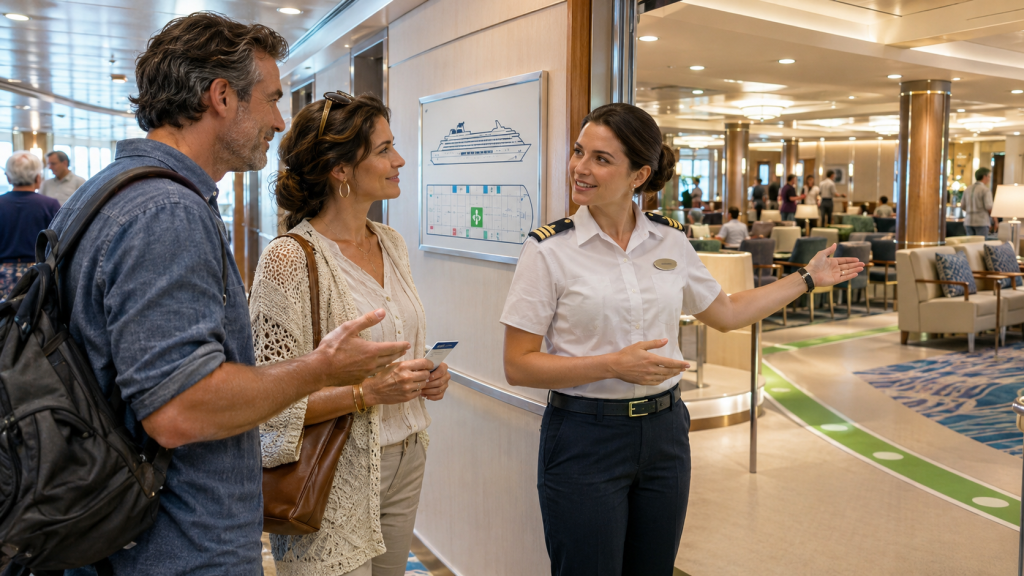
You will see it on the back of your cabin door, on your keycard or wearable, and on ship diagrams in public spaces.
A lifeboat drill is the mandatory safety drill every passenger must complete at the start of the cruise.
People also call it the safety drill, muster drill, or boat drill.
The purpose is simple.
The crew needs to know that you understand where your muster station is and what to do if you ever hear certain signals.
What The Modern Safety Drill Actually Looks Like
Many cruise lines now use a system sometimes called e-muster or a simplified drill.
In that format, you may watch a safety video on your cabin TV or in the cruise app.
The video covers life jackets, alarms, and basic procedures.
Then you walk to your muster station at some point during a set window on embarkation day.
Crew members scan your card or wearable and give you a brief in-person explanation.
On other ships, the drill still happens at one set time.
You hear an announcement.
You hear the emergency signal.
Everyone walks to their muster stations at once.

Sail Away to Paradise Without Overpaying
Find cruise deals that make it easy to escape, relax, and enjoy the ocean without stretching your budget
Crew line the stairwells and corridors to guide you.
At the station, someone explains procedures over the loudspeakers and in person.
In both formats, you are not acting out an emergency.
You are learning the route and the expectations in a controlled, organized way.
What Is Normal During A Drill
You will hear a loud signal that sounds different from regular announcements.
You will hear the captain or safety officers speaking over the public address system.
You will see crew in safety vests posted along your route ready to answer questions.
You may or may not be asked to bring your life jacket, depending on the line’s current procedures.
Many ships keep life jackets at the muster station instead of in cabins.
You must bring your keycard or device so the crew can record that you completed the drill.
Skipping the drill or ignoring instructions is not an option.
International rules require that every guest participates.
Safety Structure: What Really Matters
Muster Stations Create Order
Knowing your station means the crew has a clear plan for counting and caring for everyone if they ever need to.
Drills Are Short And Rehearsed
The crew completes some version of this drill on every sailing, so they know how to move large groups steadily and safely.
Feeling Nervous Is Normal
A small spike in anxiety during the drill does not mean you are in danger.
It means your body is listening closely.
Avoid Seasickness And Safety Mistakes That Trip Up First-Time Cruisers
Most first-time mistakes come from waiting too long, downplaying worries, or treating safety information as background noise.
The most common seasickness mistake is hoping you will not need any medication and then scrambling once symptoms hit.
The second is taking seasickness pills and still going straight to heavy drinking, even when labels and crew say not to.
On the safety side, some guests treat the muster drill as a formality to be endured instead of a moment to genuinely learn where to go and what to do.
Others ignore the safety videos in the app or on the cabin TV, assuming they will “just follow the crowd” if anything ever happens.
Those patterns are understandable.
They are also easy to fix once you see them clearly.
Small Choices That Create Big Problems
Waiting to visit Guest Services until you already feel sick, instead of asking for seasickness pills shortly after boarding.
Choosing a high, forward cabin even when you know you are very motion-sensitive, then being surprised by extra movement.
Heading straight into heavy, rich meals and strong drinks on night one without seeing how you handle the ship’s motion.
Tuning out safety briefings because they feel repetitive or uncomfortable to think about.
Assuming that you will never need to know where your muster station is because “nothing ever happens on cruises.”
Better Alternatives You Can Choose Instead
You can treat seasickness prevention like sunscreen.
You apply it early, not after the damage is done.
You can see the drill as a five to fifteen minute investment in your own confidence instead of a time-waster.
You can pick cabin locations, first-night habits, and questions for Guest Services that support your comfort instead of fighting it.
Mistakes And Fixes: Key Insights
Waiting Makes Seasickness Harder To Treat
Getting ahead of symptoms is almost always easier than trying to recover once they peak.
Safety Instructions Are For You, Not Just For The Rule Book
Paying attention gives you tools that guessing will never match in a real emergency.
Honest Preparation Beats Pretending Nothing Could Ever Go Wrong
Simple steps now make it much easier to relax later.
What’s Truly Normal At Sea: Reassurance For First-Time Cruisers
At some point you may ask yourself a very simple question.
“Is it normal to feel this nervous about a vacation.”
The answer is yes.
You are leaving solid ground, entering an unfamiliar environment, and trusting a ship and its crew to carry you safely.
Your brain is allowed to notice that.
What matters is what you do with that feeling.
You can use it as a cue to prepare.
Make a small plan for seasickness prevention.
Talk to your doctor.
Plan to stop at Guest Services on day one.
Write your muster station letter or number in a note on your phone.
Commit to finishing the drill early in the embarkation window so it is done and off your mind.
Think through your travel logistics as well.
If you are flying in on connections from services like Kiwi.com, Omio, CheapOair, or Aviasales, consider arriving the day before or adding travel insurance from VisitorsCoverage, World Nomads, Ekta, or Insubuy so you have support if something goes wrong in transit.
If an airline causes serious delays or cancellations, tools like Compensair and AirHelp can help you pursue eligible compensation, which makes it easier to focus on salvaging the fun parts of the trip.
You can also give yourself permission to start small once on board.
You do not have to attend every event.
You can choose quieter spaces, like the library or a low-traffic lounge, until your body and your nerves both feel settled.
You can lean on the cruise app and the daily schedule to find shows, trivia, or live music on nights when you feel ready, instead of forcing yourself into the busiest spaces right away.
Reframing Your First-Cruise Nerves
Worry Shows You Where To Prepare
The topics that scare you the most are the ones where a few clear actions help the most.
Simple Routines Build Real Confidence
Stopping at Guest Services, completing the drill, and following basic seasickness habits give you evidence that you are ready.
You Are Absolutely Allowed To Enjoy This
You have taken your concerns seriously and set up support, which means you have earned the right to lean into the good parts of the trip.
FAQ – What Should First-Time Cruisers Know About Seasickness, Safety Drills, and Feeling Safe at Sea?
FAQ – Is It Normal to Feel Nervous Before Your First Cruise?
Yes, many first-time cruisers have questions about ship movement, safety procedures, and what to expect once they’re at sea.
Being unfamiliar with those experiences doesn’t mean something is wrong or that your voyage will be uncomfortable.
Learning about motion sickness prevention and the required safety briefing can make those concerns more manageable.
You don’t need to anticipate every possible problem to prepare responsibly.FAQ – Will You Get Seasick on Your First Cruise if You Experience Motion Sickness in Cars?
Experiencing motion sickness in cars may indicate that you’re sensitive to certain movements, but it doesn’t guarantee you’ll become seasick on a cruise.
Large ships move differently from smaller boats and road vehicles, and sea conditions vary throughout a voyage.
If you’ve experienced motion sickness before, discuss prevention options with your doctor or pharmacist before departure.
Having a suitable plan is more useful than assuming you’ll either definitely become sick or have no symptoms at all.FAQ – Can You Get Free Seasickness Pills From Guest Services?
Some cruise lines may provide basic motion sickness remedies through Guest Services, but complimentary medication isn’t guaranteed.
Other operators sell tablets or direct passengers to their onboard medical center or another department.
The arrangements can vary by cruise line and ship.
Check your operator’s procedures before traveling and bring an appropriate supply of any medication recommended for you.FAQ – Should You Take Seasickness Medication Before Your First Cruise Leaves Port?
Many motion sickness medications work more effectively when taken before exposure to movement rather than after nausea develops.
However, the correct timing depends on the medication, its formulation, and your individual medical circumstances.
Ask a doctor or pharmacist which treatment is suitable and follow the specific product directions.
Don’t take medication earlier or more frequently than instructed simply because you’re worried about rough seas.FAQ – Can You Drink Alcohol While Taking Seasickness Pills on a Cruise?
Alcohol can increase the drowsiness, dizziness, and impaired coordination associated with many motion sickness medications.
It may also aggravate motion sickness independently of medication use.
The specific interaction depends on the product and your health circumstances.
Read the medication warnings and ask a qualified healthcare professional before drinking while taking seasickness medication.FAQ – What Should You Do if You Start Feeling Seasick During Your First Cruise?
If you begin feeling nauseated, stop reading or looking at your phone and consider focusing on a visible horizon from a safe location.
Resting, limiting unnecessary head movement, and taking small amounts of water may also help.
Use medication according to its instructions rather than taking additional doses to speed up relief.
Contact the ship’s medical center if symptoms persist, become severe, or prevent you from keeping fluids down.FAQ – What Is a Muster Station on a Cruise Ship?
A muster station is a designated assembly location where passengers may be directed during an emergency.
Depending on the ship, it could be in a lounge, theater, or another approved area rather than directly beside a lifeboat.
Your cruise line provides information identifying your assigned station and the relevant instructions.
Confirm your station during embarkation and ask a crew member if you’re unsure where to go.FAQ – What Is the Difference Between a Muster Drill and a Lifeboat Drill?
A passenger muster drill introduces guests to important safety instructions and their assigned assembly locations.
A crew lifeboat drill involves trained personnel practicing responsibilities associated with lifesaving equipment and emergency procedures.
The activities serve different purposes, even though both are connected to maritime safety.
Passengers should concentrate on completing their required briefing and following the directions of authorized crew rather than trying to perform technical lifeboat procedures.FAQ – Do You Have to Complete the Muster Drill Before Your First Cruise Departs?
Passenger muster is a mandatory safety requirement under applicable maritime regulations.
For voyages where passengers are scheduled to remain onboard for more than 24 hours, SOLAS requires newly embarked passengers to muster before or immediately upon departure.
Cruise lines may use different approved methods to deliver safety instructions and verify passenger participation.
Follow the procedures for your specific ship and complete every required step.FAQ – What Happens During an Electronic Muster Drill on a Cruise Ship?
An electronic muster process may include watching safety instructions through the cruise line’s app or cabin television.
Depending on the operator, passengers may also need to visit their assigned muster station and have their participation verified.
Completing a video alone doesn’t necessarily mean you’ve satisfied every requirement.
Follow the instructions provided for your specific sailing rather than assuming all cruise lines use an identical procedure.FAQ – Will You Have to Board a Lifeboat During Your First Cruise Muster Drill?
A routine passenger muster briefing does not ordinarily involve boarding or launching a lifeboat.
Its purpose is to introduce guests to essential emergency information, including assembly locations and lifejacket instructions.
Crew members conduct separate exercises involving lifesaving equipment under applicable requirements.
Follow your cruise line’s actual safety process rather than assuming you’ll take part in a simulated evacuation.FAQ – What Should You Do if You Hear an Emergency Alarm on a Cruise Ship?
Stop what you’re doing and pay attention to official announcements and instructions from the crew.
Don’t assume the sound is only a drill, even if you’ve previously heard alarms during a training exercise.
Likewise, an alarm doesn’t automatically mean passengers should proceed directly to lifeboats or abandon ship.
Follow the actions explained during your safety briefing and any additional directions issued during the incident.FAQ – Is It Safe to Ignore a Cruise Ship Alarm if You Think It’s Only a Drill?
No, passengers shouldn’t ignore an alarm simply because they believe the crew may be conducting an exercise.
Ships can carry out training while passengers are aboard, but genuine incidents can also occur during a voyage or while docked.
Listen carefully for announcements clarifying the situation.
If you’re uncertain about the instructions, ask an authorized crew member rather than making assumptions.FAQ – What if You Forget Your Muster Station or Don’t Understand the Safety Instructions?
Ask a crew member to confirm your assigned muster station and explain the instructions relevant to you.
Your station information may also appear in the safety materials supplied by your cruise line, although the exact location of that information varies between operators.
It’s better to ask during embarkation than rely on another passenger’s station assignment.
If you require assistance or have accessibility needs, confirm the applicable arrangements with the crew.FAQ – Are Cruise Ships Prepared to Handle Emergencies at Sea?
Cruise ships operate under maritime safety requirements that address lifesaving equipment, passenger instructions, emergency procedures, and crew training.
Personnel have assigned duties, and ships conduct drills to maintain readiness for different situations.
These protections matter, but no safety system guarantees that an incident cannot occur.
As a passenger, your practical role is to complete the safety briefing, understand your assigned station, and follow crew instructions.FAQ – Can Children Become Seasick or Feel Frightened During Cruise Safety Drills?
Children can experience motion sickness, and unfamiliar alarms or crowded safety briefings may also feel intimidating.
Parents should discuss age-appropriate motion sickness prevention with a pediatrician rather than assuming adult medication can be given at a reduced dose.
Explain the muster process in simple language and show children where the family is expected to assemble.
If children are enrolled in supervised youth activities, ask the cruise line about its emergency procedures and family reunification arrangements.FAQ – When Should You Visit the Cruise Ship Medical Center for Seasickness?
Seek assistance when nausea or dizziness persists, becomes severe, or prevents you from keeping fluids down.
Repeated vomiting, significant weakness, and signs of dehydration deserve medical assessment, while fainting, confusion, or unusual neurological symptoms require urgent attention.
Not every episode of nausea on a ship is caused by ordinary motion sickness.
Medical services may involve additional charges, but concerns about cost shouldn’t delay necessary care.FAQ – Can Travel Insurance Help if You Need Medical Care on Your First Cruise?
Some travel insurance policies cover eligible onboard medical expenses, subject to their terms, limits, and exclusions.
Cruise ship medical consultations and treatments may require direct payment, with reimbursement considered afterward when applicable.
Insurance doesn’t prevent seasickness or guarantee that every medical charge will be covered.
Review your policy before departure so you understand the financial arrangements if medical attention becomes necessary.FAQ – What Should You Do if You Feel Overwhelmed on Embarkation Day?
Focus first on the tasks that genuinely need your attention, particularly completing the required safety briefing and understanding your assigned muster station.
Allow time to find your cabin, identify useful onboard services, and familiarize yourself with the ship’s layout.
You don’t need to explore every deck or attend every activity immediately.
Starting with a manageable schedule can help you become more comfortable with the environment without neglecting important preparations.FAQ – How Can You Enjoy Your First Cruise Without Constantly Worrying About Seasickness or Emergencies?
Prepare for the situations where you have a meaningful role instead of trying to predict every possible problem.
Discuss motion sickness prevention before sailing, complete your muster briefing, and learn where to obtain help when necessary.
Once those responsibilities are handled, you can explore the ship and enjoy your vacation without continuously monitoring every movement or announcement.
Preparation is useful because it gives you practical options, not because it means something bad is expected to happen.
Plan Your Next Cruise!

Sail Smart: Discover The Real Cost of Luxury Cruises and Maximize Your Travel Value
One Delay Can Cost Your Entire Cruise A quick coverage check now protects you from the problems no one sees coming….

Sail Into Modern Luxury: Celebrity Cruises for Design, Culinary Excellence, and Destination‑Rich Voyages
One Delay Can Cost Your Entire Cruise A quick coverage check now protects you from the problems no one sees coming….

Sail in Style: Oceania Cruises’ Culinary Excellence, Cultural Immersion, and Refined Luxury
One Delay Can Cost Your Entire Cruise A quick coverage check now protects you from the problems no one sees coming….

Experience the Perfect Blend of Disney Magic, Luxury Cruising, and Family Adventure at Sea
One Delay Can Cost Your Entire Cruise A quick coverage check now protects you from the problems no one sees coming….
Explore More

Avoid Costly Mistakes: Cruise Cancellation Rules You Must Know Before Paying

Are There Babysitting Services on Cruise Ships?
Sail Into Modern Luxury: Celebrity Cruises for Design, Culinary Excellence, and Destination‑Rich Voyages