

One Delay Can Cost Your Entire Cruise
A quick coverage check now protects you from the problems no one sees coming.
Short Excerpt
- Follow a practical preparation timeline from 30 days before departure through embarkation morning.
- Know when to review travel insurance, check documents, organize medications, and confirm transportation.
- Learn which hurricane forecasts are useful before departure and when cruise-line instructions should take priority.
- Use an interactive pre-cruise countdown checklist to track your preparation without overlooking important tasks.
Quick Take
- Start with arrangements that take time to change. Travel documents, prescriptions, insurance terms, and flights deserve attention well before departure.
- Review your actual cruise booking conditions rather than assuming weather-related changes are automatically free.
- Prepare a compact carry-on with required identification, medications, essential medical equipment, and important travel details.
- Monitor official tropical weather information as departure approaches, but don’t treat long-range projections as confirmed itinerary changes.
- If weather threatens the embarkation port, follow local safety authorities and the cruise line’s official boarding instructions.
- Leave enough room in your plans for uncertainty. Preparation improves your options; it cannot guarantee a storm-free cruise.
How Early Should You Prepare for a Cruise During Hurricane Season?
Your cruise is getting closer, your suitcase is waiting in the bedroom, and you’re starting to imagine the first afternoon aboard.
Then you notice a tropical disturbance on a weather map.
Should you call the cruise line?
Change your flight? Start shopping for emergency supplies?
Or continue preparing as planned?
The right response depends on how close your departure is and whether an official change has actually occurred.
A tropical system appearing in a forecast isn’t the same as a canceled voyage.
But waiting until embarkation morning to check your travel arrangements isn’t a particularly good strategy either.
The most effective hurricane-season preparation happens in stages.
Some tasks, including travel insurance decisions and prescription refills, need attention early.
Other tasks, such as checking the latest boarding instructions and flight status, are most useful shortly before you leave.
The Atlantic hurricane season officially runs from June 1 through November 30, with the historical peak around September 10.
Those seasonal patterns help explain when tropical cyclones are more common, but they don’t predict the conditions for one cruise departure. (National Hurricane Center — Tropical Cyclone Climatology)
This guide gives you a preparation schedule you can actually follow.
Rather than trying to anticipate every possible storm, you’ll focus on what needs to be ready at each stage of your trip.
Your 30-Day Hurricane-Season Cruise Preparation Planner
Use this interactive countdown to identify what deserves attention now, based on how much time remains before your sailing.
It includes four preparation stages and a checklist you can copy for your own travel planning.
The time frames are organizational recommendations, not cruise-line deadlines.
Your specific final-payment, check-in, insurance, medical, and cancellation dates may be different.
Hurricane-Season Cruise Preparation Countdown
Choose how much time remains until departure. Check off preparations and copy your full list.
30 days or more
Organizational guide only. Actual cruise-line, insurance, and travel-document deadlines may differ. Does not provide live forecasts or send reminders. Follow official instructions.
The countdown runs locally in the browser and doesn’t require an API or user account. It does not automatically save progress after reloading the page.
30 Days Before Your Cruise: Resolve the Decisions That Take Time
A month before departure is a useful checkpoint for decisions that may be difficult to resolve at the last minute.
Some travelers begin much earlier, particularly when international documentation, special medical arrangements, or insurance deadlines are involved.
The purpose of this stage isn’t to forecast the weather a month ahead.
It’s to make sure ordinary travel requirements won’t become problems if weather creates additional complications.
Confirm Your Travel Documents and Entry Requirements
Check your passport, boarding documentation, and any required travel authorizations.
Requirements differ according to your citizenship, itinerary, embarkation port, and cruise operator.
Some qualifying closed-loop cruises allow certain U.S. citizens to travel using approved alternative identification.
Top Cruise Deals From Trusted Cruise Lines
Compare exclusive online offers and find the fare that fits your trip and your budget

However, the U.S. Department of State strongly recommends a valid passport book for international cruises because an unexpected flight home from a foreign country may require it. (U.S. Department of State — Cruise Ship Travel)
If your passport needs renewal or you’re traveling with children who require additional documentation, don’t wait for the final week.
Review the Coverage You’ve Actually Purchased
Travel insurance can be useful for certain qualifying cancellations, interruptions, delays, and medical emergencies.
It is not a guarantee that every missed port, hotel stay, or flight change will be reimbursed.
Review the actual terms, including exclusions, benefit limits, notification requirements, and any conditions involving named storms.
The National Association of Insurance Commissioners warns that coverage purchased after a storm has already been named may exclude claims resulting from that event. (NAIC — Travel Insurance Guidance)
Optional Cancel For Any Reason benefits also have eligibility conditions and generally provide only partial reimbursement.
Don’t assume that buying a policy automatically allows you to cancel a cruise whenever the forecast becomes unfavorable.
Arrange Prescription Supplies and Medical Equipment
Essential medication deserves early attention.
If your voyage is unexpectedly extended, you may need enough medication to remain on your treatment schedule until you can return home.
The appropriate reserve depends on the prescription and your circumstances.
Speak with your healthcare professional or pharmacist about the amount you should carry and any restrictions that apply.
Passengers using oxygen equipment, refrigerated medication, electrical medical devices, or other specialized equipment should contact the cruise line well in advance.
The CDC advises travelers with significant medical needs to understand the capabilities and limitations of their ship’s medical facilities before sailing. (CDC Yellow Book — Cruise Ship Travel)
Check Your Transportation Plans
If you’re flying to the embarkation port, review the timing of your arrival and the consequences of a missed connection.
Arriving before embarkation day can provide time to manage ordinary transportation delays, although it cannot prevent widespread disruptions caused by a major storm.
If you’re driving, consider where you’ll park and whether your plans allow for a delayed return.
For transfers, identify the provider’s cancellation and rescheduling conditions.
The strongest preparation isn’t necessarily the most expensive arrangement.
It’s the one whose limitations you understand.
14 Days Before Sailing: Build Your Travel Backup Plan

With approximately two weeks remaining, turn your attention to the details that become important when arrangements change.
You don’t need to make speculative cancellations because a long-range weather model shows possible tropical development.
Instead, organize information and review what you would do if the cruise line later confirms a disruption.
Identify Your Most Important Contacts
Save your cruise line’s travel-update page, airline contact details, hotel confirmation, transfer provider, and any independent excursion bookings.
Know whether the cruise line or another travel company is responsible for servicing each reservation.
If you booked through a travel advisor, confirm who handles itinerary changes and after-hours assistance.
Online‑Only Cruise Offers You Won’t Find Elsewhere
Unlock special pricing and start planning the sailing that matches your perfect itinerary
Keep a secure offline copy of important contact information.
A simple list of names and booking references is more useful than an elaborate folder you can’t navigate when connectivity is limited.
Check the Flexibility of Separate Reservations
An itinerary change may affect more than the cruise itself.
Your flight, pre-cruise hotel, ground transfer, independent excursions, and post-cruise arrangements may all have separate conditions.
A provider that offers free cancellation until a certain date could be more flexible than one requiring full nonrefundable payment in advance.
Identify those deadlines now.
You don’t necessarily need to change anything.
You need to know which reservations require action if the schedule changes.
Keep Family and Travel Companions Informed
Share the name of your ship, cruise line, scheduled departure and return dates, and an appropriate emergency contact method.
If you have elderly relatives, children, or others who depend on your return schedule, consider what arrangements might be necessary if you arrive home later than planned.
Don’t promise that you’ll always have mobile service while at sea.
Agree on a practical way to communicate important changes when connectivity is available.
Seven Days Before Sailing: Start Monitoring Relevant Weather
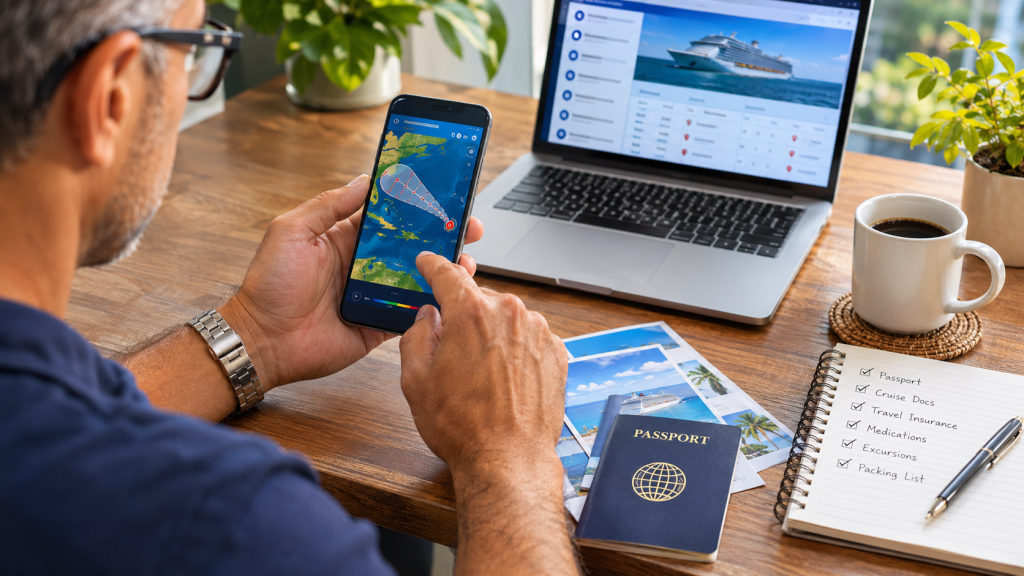
As departure approaches, official tropical weather forecasts become more useful.
The National Hurricane Center publishes tropical weather outlooks, advisories, forecast tracks, and other products for the Atlantic basin.
A seven-day outlook can identify areas where tropical cyclone development may occur, but it isn’t a seven-day forecast of conditions at every cruise port.
Use it to understand whether tropical weather warrants closer attention.
For the latest information, visit the National Hurricane Center.
Understand the Difference Between a Weather Forecast and a Cruise Decision
A storm forecast may show possible impacts near your itinerary.
That doesn’t mean the cruise line has confirmed a cancellation or route change.
Cruise operators evaluate operational factors beyond what passengers can see on a consumer weather map.
These can include marine conditions, port access, timing, and other navigational considerations.
If the cruise line issues a confirmed change, that official communication should guide your travel arrangements.
Avoid Overreacting to Early Forecast Models
Individual computer weather-model projections can shift substantially over several days.
A model showing a possible track near a cruise destination isn’t an official itinerary notice.
The National Hurricane Center’s forecast cone represents uncertainty in the predicted path of a tropical cyclone’s center; hazardous conditions may extend beyond it. (National Hurricane Center — Forecast Cone)

Luxury Cruise Experiences at Smarter Prices
See premium sailings and upgraded cabins priced for travelers who know how to book well
When a storm is active, focus on the latest official advisory, its issuance time, and the potential hazards described.
Don’t rely on an outdated screenshot or one speculative model run.
Identify the Cruise Line’s Official Communication Channels
Before traveling, confirm how your cruise operator communicates schedule changes.
This may include its website, reservation emails, mobile app, telephone support, or specific travel-alert pages.
Different operators use different systems.
Install the cruise line’s app if appropriate and make sure you can access your booking.
However, don’t assume every app automatically sends every weather advisory or that app notifications replace other official instructions.
Three Days Before Departure: Pack for Ordinary Weather and Possible Delays

Your final packing decisions should account for the destinations and activities you’ve planned.
For a warm Caribbean itinerary, breathable clothing, comfortable walking shoes, sun protection, and a lightweight rain jacket may be appropriate.
For Alaska, Northern Europe, or another cooler region, weather-resistant outerwear and suitable layers may be more important.
Storm-season preparation should never mean assuming that one tropical packing list works for every destination.
Keep the Embarkation Carry-On Separate
Your carry-on should contain items you cannot conveniently replace while waiting for checked luggage.
Prioritize required identification, boarding documents, essential medications, medical equipment, valuables, and a charged phone.
A small toiletry pouch and change of clothes can also be useful.
Do not put your passport or necessary prescription medication into a suitcase that will be handled separately by porters.
Pack Only Electrical Accessories Your Cruise Line Allows
Extra charging cables and a modest portable power bank can be useful.
But cruise lines may prohibit power strips, extension cords, and multi-outlet electrical accessories.
Royal Caribbean, for example, restricts these categories under its prohibited-items policy. (Royal Caribbean — Prohibited Items)
If you’re flying, the FAA requires spare lithium batteries and power banks to travel in carry-on baggage, not checked luggage. Lithium-ion batteries are generally limited to 100 watt-hours per battery without special airline approval. (FAA — PackSafe Lithium Batteries)
Check the exact restrictions for both transportation providers.
Prepare for Motion Sickness Before Symptoms Begin
Even when a ship avoids hazardous storm conditions, passengers may still experience noticeable movement.
If you’re prone to seasickness, discuss suitable prevention measures with your healthcare professional before sailing.
Some medications work better when taken before motion exposure, but they can cause drowsiness or have contraindications.
The CDC provides guidance on motion sickness prevention and treatment, including the limitations and potential adverse effects of different medications. (CDC Yellow Book — Motion Sickness)
Ginger and wristbands should not be presented as guaranteed replacements for effective medication.
Save Your Important Information Offline
Download the files you may need while disconnected.
Your reservation, travel confirmations, emergency contacts, relevant medical information, and insurance assistance numbers are practical priorities.
Use secure storage for sensitive information.
Then test that essential files actually open without internet access.
A cached hurricane map isn’t a live forecast, so don’t rely on previously downloaded weather information for current decisions.
The Day Before Embarkation: Confirm the Trip You Are Actually Taking
The day before departure is not the time to assume every original arrangement remains unchanged.
Check your cruise line’s latest travel instructions, transportation details, and relevant local conditions.

Sail Away to Paradise Without Overpaying
Find cruise deals that make it easy to escape, relax, and enjoy the ocean without stretching your budget
If severe weather threatens the embarkation area, official port or public safety restrictions may affect whether passengers can reach the terminal.
A confirmed change to boarding times or terminal access deserves immediate attention.
If Your Flight Is Delayed or Canceled
Check the airline’s current flight status and available alternatives.
Contact the responsible booking provider if the disruption could prevent you from reaching the ship.
For flights covered by U.S. Department of Transportation rules, a canceled or significantly changed flight may create a refund entitlement if you don’t accept the replacement travel or qualifying credit.
That is different from automatic compensation for additional expenses. (U.S. Department of Transportation — Refunds)
Do not assume that an airline’s replacement flight will still allow you to embark.
If the Cruise Line Changes the Departure
Read the complete official notice.
Confirm the departure date, embarkation location, boarding time, and any instructions concerning transfers or lodging.
Contact independently booked providers only when you understand how the confirmed change affects your reservations.
Save relevant communications and receipts.
Insurance benefits, cruise refunds, and other reimbursements depend on their respective terms and circumstances.
If a Local Evacuation Order Is Issued
Follow the relevant authorities.
Don’t travel toward a restricted or evacuated area merely because your original cruise documents show a particular boarding time.
Public safety instructions take priority over ordinary vacation plans.
Use official cruise-line communication to establish what the operator is doing about the voyage.
Embarkation Day: Five Checks Before You Leave for the Terminal
Most passengers won’t face a weather-related change on embarkation morning.
Nevertheless, a brief final check can help avoid preventable problems.
Confirm the boarding instructions and check the status of your transportation.
Make sure every traveler has the required original identification.
Keep your medication and necessary medical supplies accessible.
Verify the correct terminal and arrival arrangements.
Finally, check whether the cruise line has issued any new operational instructions.
Once aboard, complete the required safety procedures and learn how the ship communicates important announcements.
Find Your Muster Station
Your muster station is the designated gathering location assigned by the ship for particular emergency procedures.
Cruise lines have different methods for conducting the mandatory passenger safety orientation.
Follow the operator’s instructions and understand the route from your cabin to the relevant assembly area.
A muster orientation is not necessarily a special hurricane briefing.
Its primary purpose is to explain general emergency procedures and required passenger actions.
Understand What Changes During Rough Weather
If the ship encounters uncomfortable or hazardous conditions, the crew may restrict access to outdoor areas or provide additional movement and safety instructions.
Follow those directions.
Don’t attempt to use a balcony or exposed deck when access is restricted.
Move carefully around the vessel, use handrails as appropriate, and contact the crew if you need assistance.
If the Itinerary Changes After Departure
Not every disruption can be resolved before sailing.
A cruise may substitute a destination, omit a port, alter the order of visits, or adjust its arrival time after the voyage begins.
Your preparation should make those changes easier to handle without assuming they’re always enjoyable or financially harmless.
Confirm the New Schedule
Listen to the captain’s or crew’s announcement and check the cruise line’s official information.
Identify which ports and times have changed.
If you need clarification, contact guest services or the appropriate onboard department.
Don’t assume a publicly displayed vessel position or weather app track confirms the ship’s intended itinerary.
Review Shore Excursions
When a scheduled port is missed, cruise-line-operated excursions may be canceled or handled under the operator’s terms.
Independent providers have their own cancellation and refund rules.
Keep relevant booking details and contact the provider once the itinerary change is confirmed.
A missed port does not automatically guarantee reimbursement for every separately purchased activity.
Prepare for Changes to Your Return
A delayed return can affect flights, transfers, medical appointments, and other commitments.
Keep enough essential medication for an appropriate contingency period and maintain access to your travel contact information.
If extra accommodation or transportation expenses arise, keep receipts.
Insurance may cover qualifying expenses, but coverage isn’t automatic.
After the Cruise: Close Out Any Outstanding Travel Changes
If your cruise ends as scheduled, your preparation checklist can be archived for the next trip.
If weather affected the journey, collect relevant records before they become difficult to find.
Keep official itinerary notices, receipts for additional expenses, communications with airlines or excursion providers, and any insurance correspondence.
Review the actual terms before submitting refund or reimbursement requests.
There is no universal requirement that all travel insurance claims be filed within the same number of days.
Once outstanding matters are resolved, securely discard or archive temporary copies of sensitive travel documents.
This keeps your records organized without leaving unnecessary personal information scattered across multiple devices and folders.
Preparation Gives You Options, Not Control Over the Weather
A cruise during hurricane season can still offer beautiful destinations, memorable shipboard experiences, and an enjoyable vacation.
But preparation shouldn’t be measured by how many gadgets, apps, or backup plans you collect.
It should be measured by whether you can answer the questions that matter when something changes.
Do you have the documents needed to travel?
Are your prescriptions and essential equipment arranged?
Do you understand your booking conditions?
Can you find the cruise line’s official instructions?
Do you know whom to contact if transportation is disrupted?
If those questions have clear answers, you’ve accomplished the most useful part of hurricane-season preparation.
You cannot control a storm’s path, guarantee a particular port visit, or prevent every inconvenience.
You can make your travel arrangements more resilient and reduce the number of decisions you’ll have to make under pressure.
That’s the real benefit of preparing before you sail.
FAQ – How Should You Prepare for a Cruise During Hurricane Season?
When should I start preparing for a hurricane-season cruise?
Begin as soon as you book, particularly if you need travel documents, medical arrangements, or insurance benefits with purchase deadlines.
A month before departure is a useful time to review the arrangements that may take longer to change.
During the final week, focus more closely on current transportation conditions and official cruise-line updates.
The appropriate timeline depends on your itinerary and circumstances.Can cruise ships operate safely during hurricane season?
Cruise operators monitor weather and may adjust routes, ports, or schedules when conditions warrant it.
These capabilities allow voyages to operate during the hurricane season, but they don’t eliminate every marine hazard or guarantee smooth seas.
Individual sailing decisions depend on operational circumstances. Passengers should follow the captain’s instructions and official communications.When is the Atlantic hurricane season?
The official Atlantic hurricane season runs from June 1 through November 30.
Its historical activity peak occurs around September 10, with much of the activity concentrated between mid-August and mid-October.
Tropical cyclones sometimes develop outside the official dates.
Seasonal patterns are useful for planning but cannot predict the weather for an individual cruise.Should I avoid booking a cruise during the peak hurricane months?
That depends on how much itinerary and schedule flexibility you have.
A peak-season sailing may still encounter favorable weather throughout the voyage, but the historical activity level deserves consideration.
If you must visit one particular port or return home on an exact date, that uncertainty may carry more weight.
Compare the vacation with your personal priorities rather than relying on the calendar alone.How far in advance can I know if a hurricane will affect my cruise?
Weather forecasts become more useful as departure approaches, but there isn’t a fixed period when a hurricane’s impact on a particular cruise can be established with certainty.
The NHC publishes official forecasts and outlooks, while the cruise operator makes decisions about its own sailing.
Early projections may change as more information becomes available.
Follow the latest official updates rather than relying on one long-range model.Should I cancel my cruise if a tropical disturbance appears?
A tropical disturbance doesn’t automatically mean the cruise will be canceled or its itinerary changed.
Review the current official forecast and check whether the cruise line has issued a relevant announcement.
Before making a voluntary cancellation, examine the financial consequences under your fare and insurance terms.
Follow official safety instructions if the disturbance poses an immediate threat to your location.Do I need travel insurance for a hurricane-season cruise?
Travel insurance is worth considering if you have significant nonrefundable expenses, medical concerns, or exposure to transportation disruptions.
The appropriate coverage depends on your personal circumstances and existing protections.
Policies vary in their definitions of covered events, limitations, exclusions, and deadlines.
Buying insurance doesn’t guarantee reimbursement for every weather-related change.When should I buy insurance for a hurricane-season sailing?
Review available policies soon after your first trip payment, especially if you’re considering time-sensitive benefits.
Certain pre-existing condition waivers and Cancel For Any Reason options have eligibility deadlines.
Purchasing after a storm has become a known event can affect coverage for losses related to that storm.
The applicable rules depend on the exact policy, not a universal 14-day deadline.How many extra days of prescription medication should I bring?
The appropriate reserve depends on your medication, medical condition, travel duration, and the possibility of delayed transportation home.
A healthcare professional or pharmacist can help you determine a suitable amount and address restrictions on early refills.
Keep essential medication in your carry-on during embarkation.
Don’t rely on the ship’s medical center to stock or replace every prescription.What should I pack differently for a storm-season cruise?
Consider a lightweight rain jacket, weather-appropriate footwear, and a compact protective pouch for essentials.
You’ll also want accessible medication, useful charging supplies, and a change of clothes in your carry-on.
Match the clothing and equipment to your actual destinations instead of assuming every storm-season cruise has tropical conditions.
Check cruise-line and airline restrictions before adding electrical accessories.Should I bring a portable power bank?
A portable power bank can help keep your phone charged during travel and ordinary delays.
It must comply with the cruise line’s rules and, when flying, applicable airline battery restrictions.
The FAA requires spare lithium batteries and power banks in carry-on baggage rather than checked luggage.
Having battery power doesn’t guarantee connectivity if a network is unavailable.What should I do if I’m prone to seasickness?
Discuss motion sickness prevention with your healthcare professional before departure.
Some medicines are more effective when used before exposure, while others have important side effects or restrictions.
A ship can experience noticeable motion even when it avoids a tropical cyclone’s center.
Choose a suitable cabin and follow professional guidance rather than assuming one remedy works for everyone.Should I fly to the cruise port the day before departure?
Arriving before embarkation day can provide additional time to handle ordinary flight delays or missed connections.
It doesn’t guarantee success if severe weather closes airports, roads, or ports for an extended period.
Compare the cost of early arrival with the consequences of reaching the cruise terminal late.
Travelers with complicated connections may find the additional time particularly useful.What happens if a hurricane closes my embarkation port?
A port closure can affect terminal operations, boarding arrangements, and the ship’s schedule.
The cruise operator will need to communicate the arrangements applicable to your particular sailing.
Follow local safety authorities and don’t travel toward an area under evacuation or access restrictions.
Check official instructions before changing transportation or accommodation plans.Can my cruise change ports after I board?
Yes, cruise operators may alter port calls or sailing schedules when weather or other operational circumstances require it.
Passengers may receive a substituted destination, an additional sea day, or another revised arrangement.
The exact change depends on the situation and isn’t always known far in advance.
Follow the ship’s official announcements and check how the change affects independent excursions.Do I need several hurricane tracking apps?
Most passengers don’t need multiple apps offering overlapping forecasts.
The National Hurricane Center provides official Atlantic tropical cyclone information, while the cruise line communicates decisions affecting your sailing.
A supplementary weather application may help with visualization, but it cannot confirm operational changes.
Cached offline data should not be treated as a current forecast.Will my cruise line refund a skipped port?
A skipped port doesn’t automatically entitle every passenger to a cruise-fare refund.
The operator’s contract, applicable law, and the circumstances determine any available adjustment or reimbursement.
Separately purchased shore excursions may have their own refund conditions.
Save the official notice and review the relevant terms before making a claim.How much time should I allow between disembarkation and my flight?
Allow enough time for the ship’s scheduled arrival, disembarkation procedures, transportation, airport check-in, and security.
The appropriate interval depends on the port, airport, flight type, and cruise line’s guidance.
No single six-hour rule guarantees that an itinerary will work during hurricane season.
If your return arrangements are difficult to change, consider a later flight or additional accommodation where practical.What should I do if my return flight is canceled because of weather?
Check the airline’s official notice and available alternatives.
For flights subject to U.S. DOT refund requirements, a cancellation or significant change may entitle you to a refund if you reject the replacement travel or applicable credits.
Other expenses, such as hotels or meals, are not automatically covered simply because weather caused the disruption.
Review insurance terms and retain documentation of qualifying costs.What is the single most useful hurricane-season cruise preparation step?
What is the single most useful hurricane-season cruise preparation step?
Organize your preparations around the decisions that become difficult to resolve at the last minute.
Confirm travel documents, medications, transportation, booking restrictions, and essential contacts before departure.
Then use current official forecasts and cruise-line announcements as your sailing approaches.
This approach improves practical flexibility without pretending that preparation can control tropical weather.
Plan Your Next Cruise!

Sail Into Sophistication: Holland America Cruises for Luxury, Culture, and Unforgettable Journeys
One Delay Can Cost Your Entire Cruise A quick coverage check now protects you from the problems no one sees coming….

Discover Regent Seven Seas Cruises: Opulent Suites, Gourmet Dining, and Exclusive Destinations
One Delay Can Cost Your Entire Cruise A quick coverage check now protects you from the problems no one sees coming….

Discover Princess Cruise Line: Elegant Ships, Immersive Voyages, and World‑Class Experiences
One Delay Can Cost Your Entire Cruise A quick coverage check now protects you from the problems no one sees coming….

Unlock The Viking Ocean Experience: Elegant Ships, Cultural Immersion, And Unrushed Travel
One Delay Can Cost Your Entire Cruise A quick coverage check now protects you from the problems no one sees coming….
Explore More

Dine Like Royalty: Cruise Room Service Secrets for Every Cabin & Budget

Sail into Love: Romantic Cruises That Blend Intimacy, Luxury, and Unforgettable Journeys

Turn the Ocean into Your Dance Floor: Cruises for Non‑Stop Nightlife