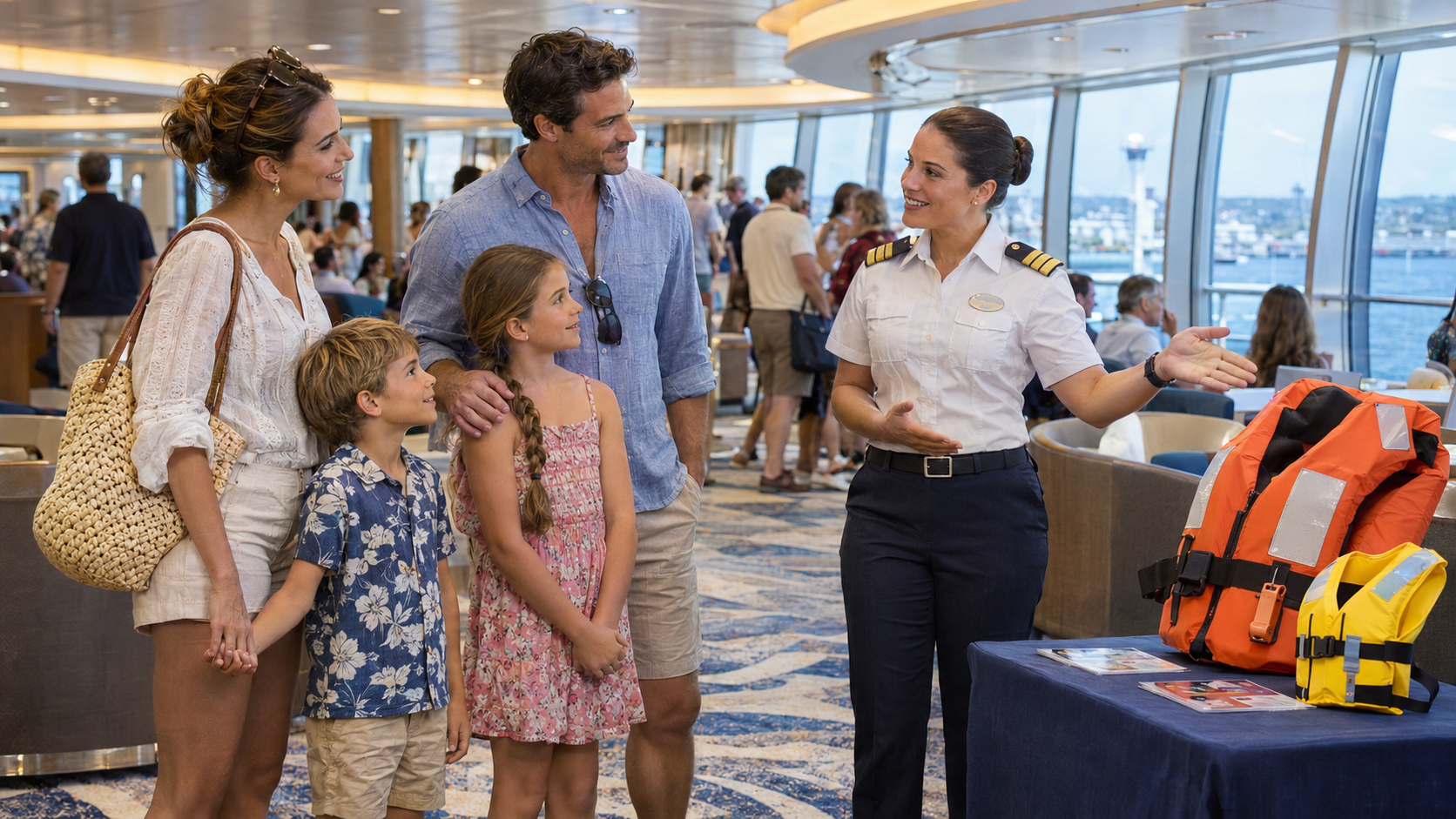

One Delay Can Cost Your Entire Cruise
A quick coverage check now protects you from the problems no one sees coming
Short Excerpt
- Family cruise emergencies become easier to manage when everyone understands muster drills, onboard safety procedures, and how to get help.
- A practical family plan covers medical concerns, separation, shipboard alarms, and unexpected problems during port visits.
- Preparing children with simple instructions, emergency contacts, and familiar meeting arrangements helps protect your family without making the vacation feel stressful.
Quick Take
- Complete the required muster drill and identify your family’s assigned assembly station.
- Teach children how to find crew assistance if they become separated from their parents.
- Keep medical information and essential medications accessible throughout the cruise.
- Follow official announcements during emergencies rather than assuming every alarm requires immediate evacuation.
- Build extra time into port days and return before the ship’s published all-aboard deadline.
Prepare Your Family for Cruise Emergencies Without Making Safety the Focus of Your Vacation
One of the biggest advantages of taking a family cruise is having accommodations, dining, entertainment, and activities in one place.
However, the size of a modern cruise ship can also raise questions that parents rarely face during an ordinary hotel vacation.
What happens if your child becomes separated from you on a crowded deck?
How do you contact medical personnel if someone becomes seriously ill? Where should your family go if an emergency announcement interrupts dinner or an afternoon activity?
These are reasonable questions, and answering them before something happens makes the ship feel much easier to navigate.
The most effective preparation begins with understanding that different emergencies require different responses.
A missing child, a medical emergency, and a shipboard evacuation warning should not trigger the same actions.
For example, a child who becomes separated from their family needs prompt crew assistance and a coordinated search.
Parents should not delay notifying staff while visiting several possible meeting locations.
An onboard medical emergency requires a different approach.
Every adult in your group should know how to contact the ship’s medical team and understand when immediate professional assistance is necessary.
Shipboard alarms introduce another important distinction.
Not every alarm means passengers should proceed directly to their muster stations.
Some signals are intended for crew members, while others may be followed by announcements explaining what passengers should do.
Your family should follow the emergency instructions provided during the safety briefing and any subsequent directions from the captain or crew.
Knowing the assigned muster station is essential, but recognizing when to use it is just as important.
Children benefit from preparation that matches their ages.
Younger passengers may need to recognize an official crew member, remember their cabin number, and understand that they should never leave the ship without an authorized adult.
Older children and teenagers can take on additional responsibility.
They should know where to find Guest Services, how to contact their parents using available onboard communication methods, and what to do when plans change unexpectedly.
Families traveling with grandparents or anyone who has mobility limitations should consider accessibility as part of their preparations.
Identify the assistance arrangements available during emergencies rather than assuming everyone can use stairs or move quickly through crowded corridors.
Top Cruise Deals From Trusted Cruise Lines
Compare exclusive online offers and find the fare that fits your trip and your budget
Port visits deserve attention, too.
A ship’s all-aboard deadline may be earlier than its scheduled departure, and transportation delays can quickly become serious when several family members are involved.
Planning a realistic return margin helps, but the appropriate amount of extra time depends on how far you travel, the transportation involved, and whether tender boats are required.
Finally, remember that preparation does not require a complicated emergency manual.
Most families benefit from a small set of familiar routines, a reliable way to contact the crew, accessible medical information, and an understanding of the ship’s official safety procedures.
The goal is not to anticipate every possible emergency.
It is to make sure each family member knows how to get help, follow instructions, and respond appropriately when an unexpected situation occurs.
With those fundamentals established, the rest of your vacation can revolve around exploring ports, enjoying the ship, and spending time together instead of constantly worrying about what might go wrong.
Why Understanding Cruise Ship Emergency Procedures Helps Families Feel Safer at Sea
Emergencies on cruises are rare, yet the fear of “what if” feels real for first-time families.
That fear spikes because you do not know the ship’s safety routine yet.
A cruise ship is actually one of the more structured travel environments you can be in.
Structure matters because structure tells you what to do when you feel uncertain.
Once you understand the emergency drill, your brain stops filling gaps with worst-case stories.

You also start noticing how many layers of safety are built into daily operations.
The truth: cruise ships are structured environments with clear systems that keep you safe.
Structure matters because it turns uncertainty into predictable steps you can follow.
This guide gives you a family-ready plan that feels simple, steady, and easy to use under stress.
This article is for general informational purposes only, does not provide medical advice, and you should consult a licensed clinician and follow official crew instructions for any safety or medical decisions during travel.
Understand the Emergency Drill and Why It Builds Family Confidence
An emergency drill is a required safety briefing that teaches you what to do if something serious happens.
Cruise lines run it so every passenger understands the ship’s alert signals, assembly process, and key safety rules.
You may hear it called a muster drill, muster station, or safety drill depending on the cruise line.
Online‑Only Cruise Offers You Won’t Find Elsewhere
Unlock special pricing and start planning the sailing that matches your perfect itinerary

The goal is not to scare you.
The goal is to make you predictable, and predictability is what prevents panic.
Families benefit the most because kids take emotional cues from adults.
When you look steady and prepared, children often follow your lead immediately.
That is why your job is not memorizing everything.
Your job is knowing the few steps that keep your family together and moving.
What You Will Usually Do
Most drills include watching a short safety video and checking in at your assigned muster location.
Crew members confirm you are present and that you know where to go if alarms sound.
You may also be shown how to put on a life jacket and what not to do during an alarm.
The most important outcome is knowing your muster station and your fastest route to it.
A route matters because you will not want to think through directions under stress.
You will also learn that elevators are not used during many emergency scenarios.
Stairs become the default, which is why you should know at least one stair route near your cabin.
Knowing the route creates relief, and relief creates confidence.
Why The Drill Reduces Anxiety
Anxiety grows when a brain believes it has no plan.
A drill gives you a plan even before you build your personal family routine.
It also gives kids a script that feels like a game, not a threat.
That game-like script can be as simple as “we walk together to our station.”
Repeating that phrase once or twice makes it feel familiar.
Familiar actions are easier than new actions under pressure.
That is the real value of the drill for first-time cruisers.
You are turning unknowns into routines.
Drill Confidence Notes
Knowing your muster station removes the biggest unknown in one step.
A simple phrase your kids can repeat creates quick cooperation under stress.
Learning one stair route near your cabin is a practical family advantage.
Build a Strong Family Emergency Foundation Before You Sail
The best family emergency plan starts before you board.
Pre-cruise preparation works because it reduces the number of moving parts onboard.
Moving parts are what make families feel scattered.

Luxury Cruise Experiences at Smarter Prices
See premium sailings and upgraded cabins priced for travelers who know how to book well
A solid foundation is not complicated.
It is mostly documents, contact info, and a few “what if” decisions made early.
Those early decisions prevent arguments during stressful moments.
They also reduce the chance of someone freezing because they do not know the next step.
When everyone has one shared plan, you feel steadier as a unit.
Create A Family Contact Card
Make a simple card with names, allergies, medications, and emergency contacts.
Include the name of your child’s pediatrician and your primary care clinician.
Add a list of medications with doses if anyone in your family uses them.
Keep one copy in each adult’s wallet and one copy in your day bag.
A photo of the card on your phone adds a backup layer.
Backups are not paranoid.
Backups are what keep small disruptions from becoming big stress.
A contact card also speeds up help if you need to visit the medical center.
Decide Your Meeting Rule
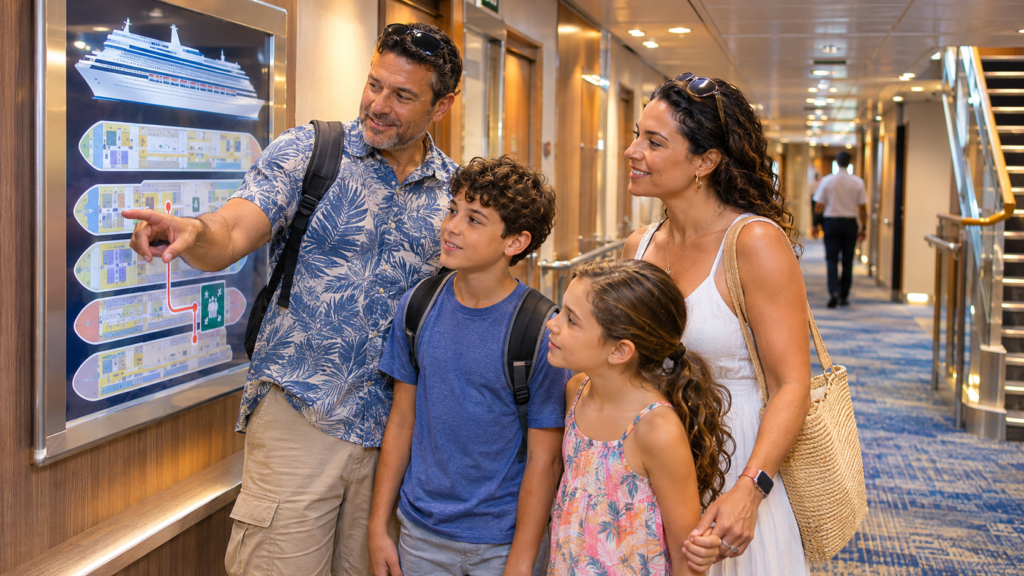
Families need a simple meeting rule for separation.
Pick one onboard meeting point near your cabin area.
Pick a second meeting point in a public space, like a specific lounge.
Use names that are easy for kids to remember, not deck numbers alone.
Deck numbers are easy to forget when a child is nervous.
A “two meeting points” rule reduces the chance of everyone searching randomly.
Random searching creates panic.
A clear meeting rule creates movement with less emotion attached.
Use Planning Tools That Reduce Stress
Travel-day disruptions are where family anxiety often spikes first.
A pre-cruise hotel night can reduce the rush and protect your morning mood.
Booking.com, Trip.com, Agoda, and Tripadvisor can help you choose a port hotel with reliable breakfast and quieter rooms.
Radical Storage can help if you arrive early and want to explore without dragging bags.

Sail Away to Paradise Without Overpaying
Find cruise deals that make it easy to escape, relax, and enjoy the ocean without stretching your budget
Travelpro luggage helps when you want organization that does not fall apart mid-trip.
Travel protection options like VisitorsCoverage, World Nomads, EKTA, and Insubuy can help you compare coverage choices for family travel.
If flights go sideways, Compensair or AirHelp can be relevant in some situations for eligible compensation claims.
When logistics feel handled, families feel steadier before the ship even starts.
Foundation Takeaways
A contact card turns an emergency into a faster, clearer conversation with help.
Two meeting points prevent frantic searching when someone gets separated.
Travel-day tools reduce the stress spikes that families mistake for “bad omens.”
Take Smart Safety Steps on Embarkation Day for a Stress-Free Week
Embarkation day is busy even when everything goes right.
Busy days are where first-time cruisers make avoidable safety mistakes.
A better approach is focusing on a few high-impact tasks early.
Early tasks reduce your mental load for the rest of the day.
They also make your family’s movements more predictable.
Predictable movement reduces separation risk.
Separation risk is what worries parents the most on day one.
A few smart habits solve most of that fear.
Do A Five Minute Cabin Briefing
Once you reach your cabin, pause before unpacking everything.
Point out the nearest stairwell and the nearest elevator bank.
Show your kids how to read the deck number signs in the hallway.
Explain that elevators may not be used during certain emergencies.
Keep the tone simple and steady.
Kids do not need dramatic details.
Kids need a short script that makes them feel capable.
That script can be “we stay together and follow crew directions.”
Set Your “Together Rule”
Pick one rule that applies everywhere onboard.
A useful rule is “one adult always has eyes on the kids in public areas.”
Another useful rule is “kids hold hands in elevators and stairwells.”
If you have teens, use a check-in rule instead of a hand-holding rule.
A check-in rule might be “text before changing locations.”
Rules work best when they are few and clear.
Too many rules become noise.
Clear rules become routine, and routines reduce parent worry.
Learn The Two Fastest Routes
Choose the two routes you will use most often.
One route is cabin to dining.
One route is cabin to muster station area.
Walk them once on day one when your family is not tired.
Walking routes once creates familiarity.
Familiarity lowers stress fast.
It also reduces the chance of getting lost during a crowded moment.
Crowded moments are when families get separated accidentally.
A known route prevents the “we wandered into the wrong place” issue.
Day One Takeaways
A short cabin briefing makes kids feel capable without overwhelming them.
One clear family rule prevents separation more than a long list ever will.
Walking key routes once creates comfort that lasts all week.
Follow This Family Emergency Plan Chart for Cruise Confidence
Families do best when they have a simple decision table.
The point of the table is not predicting every emergency.
The point is giving you default moves that work in most scenarios.
Default moves reduce panic.
Default moves also reduce arguing, which is common under stress.
This chart keeps your priorities clear.
It fits the most common “what if” fears families carry onboard.
Use it as a quick reference and adjust it for your crew’s actual instructions.
Family Emergency Plan Chart
| Scenario | First Move | Second Move | Family Priority |
|---|---|---|---|
| Alarm sounds | Stop what you are doing and gather family. | Walk to muster station via stairs, not elevators. | Stay together and follow crew directions. |
| Separation onboard | Go to meeting point one. | If not reunited, go to meeting point two and notify crew. | Reunite quickly without random searching. |
| Child feels unwell | Move to fresh air and seated position. | Contact medical center if symptoms escalate or persist. | Safety and hydration first. |
| Injury or bleeding | Apply basic first aid and keep child still. | Contact crew or medical center for evaluation. | Prevent shock and get proper help. |
| Fire or smoke smell | Leave the area immediately and close doors behind you. | Move toward muster route and notify crew. | Distance from hazard and clear air. |
| Port emergency | Return toward ship area with buffer time. | Contact ship staff if transport delays risk return. | Do not miss all-aboard time. |
| Severe weather change | Follow announcements and adjust plans early. | Keep essentials packed and ready. | Flexibility without panic. |
How To Use This Chart Under Stress
Read the “First Move” column like a script.
Scripts reduce freezing.
Freezing is what makes situations feel scarier than they are.
Then read the “Family Priority” column so your mindset stays aligned.
Aligned mindsets reduce arguments.
Arguments are common when people feel powerless.
Power returns when a plan exists.
That is why charts work so well for first-time cruisers.
Chart Takeaways
A script-like first move reduces freezing and speeds up action.
A shared priority prevents family members from pulling in different directions.
A port buffer plan reduces the most common off-ship emergency stress.
Handle Medical Emergencies Calmly with a Clear Cruise Plan
Medical fears are the most common family anxiety trigger on cruises.
It is not because ships are unsafe.
It is because you are away from home routines and familiar doctors.
A simple medical plan keeps you steady.
It starts with documentation and it ends with knowing when to escalate.
Escalation means seeking professional help sooner rather than later.
Sooner action often creates better options and less stress.
A clear approach also helps kids feel safer because you look purposeful.
Know When To Go To The Medical Center
Go when symptoms are severe, escalating, or concerning for your family’s situation.
Examples include breathing difficulty, severe dehydration, allergic reactions, or injuries that need evaluation.
Do not wait because you feel embarrassed.
Embarrassment is not a safety strategy.
Bring your family contact card and medication list if you have them.
A list reduces the need to recall details under stress.
If your child is vomiting, focus on small sips and keeping them seated safely.
Then seek guidance if they cannot keep fluids down or seem unusually sleepy.
Pack A Practical Kit
A basic kit supports comfort until you get professional help.
Include bandages, antiseptic wipes, and a small thermometer if you like having one.
Include electrolyte packets for hot ports and active days.
Include any child-safe items your clinician recommends for travel.
Keep the kit in your day bag, not buried in luggage.
Access matters more than perfection.
Perfection is not the goal during a stressful moment.
Safety and steady action are the goal.
Use Protection Tools Wisely
Travel protection choices can reduce the fear of unexpected costs.
VisitorsCoverage, World Nomads, EKTA, and Insubuy are options families often compare for travel coverage.
The right choice depends on your itinerary, health needs, and comfort level.
Reading policy details early helps you avoid assumptions later.
Assumptions are what create frustration in stressful moments.
If you handle the paperwork and coverage questions before sailing, you reduce mental load onboard.
Reduced mental load makes you more present with your kids.
Presence is what families remember, not paperwork.
Medical Takeaways
Seeking help early is a confidence move, not a dramatic move.
A small kit supports comfort while you get the right level of care.
Coverage planning reduces cost anxiety and clears mental space for family time.
Prevent Family Separation and Respond Confidently If It Happens
Separation is one of the scariest thoughts for parents on a ship.
The fear is understandable because ships feel large and busy at first.
Prevention is mostly habit, not technology.
Habits work because they repeat without you thinking.
A simple plan also protects you if your phone does not work.
Phones can fail at sea or in crowded indoor spaces.
A separation plan should work even in low-tech conditions.
That is how you build real confidence.
Use High-Visibility Habits
Dress kids in easily recognizable colors on busy days.
Take a quick photo each morning so you remember what they are wearing.
Agree on one rule for stepping away, even for teens.
A simple rule is “tell an adult before changing venues.”
Reinforce the rule before you leave the cabin.
Short reminders work better than lectures.
Lectures create resistance.
Quick reminders create cooperation.
What To Do If You Lose Sight
Stop moving and scan for ten seconds instead of running.
Running increases chaos and can move you farther apart.
Go to your meeting point one immediately.
Use crew members as helpers, not as a last resort.
Crew members are trained for family assistance scenarios.
Share your child’s name, age, and what they are wearing.
Use your morning photo if needed.
Then follow the crew’s instructions without splitting your adults into separate searches.
Teach Kids A Simple Script
Kids freeze when they feel unsure.
Give them a script like “find a crew member and stay in one place.”
Tell them what crew uniforms look like on your ship.
Show them where guest services is located early in the week.
Make it feel like a confidence game, not a scary warning.
Confidence language helps kids remember steps.
Fear language makes kids shut down.
Your tone shapes their response.
Separation Takeaways
High-visibility habits reduce separation risk in busy spaces.
A stop-and-plan response works better than frantic searching.
A kid script gives children a confident action when they feel lost.
Respond to Fire, Smoke, and Alarms with Calm, Clear Actions
Fire and smoke are the scenarios that create the strongest fear for many families.
The ship’s systems are designed to detect issues quickly and compartmentalize risk.
Your role is not fighting hazards.
Your role is moving away from risk and following instructions.
That is why drills emphasize routes and muster points.
Kids need short, clear actions they can remember.
Adults need to avoid adding confusion.
Simple actions are what make families effective in emergencies.
What To Do If You Smell Smoke
Leave the area right away and move into fresher air.
Close doors behind you if you can do so safely.
Closing doors can help limit smoke spread in corridors.
Notify a crew member as soon as possible.
Avoid returning to a cabin for items if alarms are active.
Items are replaceable.
People are not replaceable.
That mindset keeps you from making risky choices under stress.
What To Do When An Alarm Sounds
Gather your family and head toward your muster station using stairs.
Move with purpose, not with pushing.
Pushing increases falls and increases fear.
Keep kids between adults when walking through crowded areas.
Bring a life jacket only if crew instructions tell you to do so.
Follow announcements and crew signals even if others are moving differently.
Crowds can behave unpredictably under stress.
Your job is staying together and following trained guidance.
How To Talk To Kids
Use short phrases that describe actions, not dangers.
Say “we walk together to our station,” not “something bad might happen.”
Action language keeps kids moving.
Threat language can make kids freeze or cry.
Explain that drills and alarms are part of ship safety systems.
Safety systems exist so everyone knows what to do.
Kids find comfort in systems.
You can borrow that comfort too.
Alarm Takeaways
Leaving quickly and notifying crew is more important than gathering belongings.
Action language helps kids cooperate faster during stressful signals.
Staying together prevents the most common family risk during alarms.
Stay Safe on Port Days and Handle Off-Ship Emergencies with Ease

Port days create a different kind of emergency fear.
Families worry about getting stranded.
Families worry about injuries away from the ship.
Families worry about transportation delays that create a frantic sprint back.
Most of these fears are reduced by one habit.
Return earlier than you think you need to.
An early return creates buffer time for traffic, tender lines, and confusion.
Buffer time is your best stress reducer in any port environment.
Build Your Port Buffer Rule
Plan to be back on the ship no later than one hour before all-aboard time.
All-aboard time is the ship’s final deadline for passengers to be onboard.
It is not the time the ship leaves.
The ship can close access before departure time, and late arrivals can be left behind.
That is why experienced cruisers treat all-aboard time as sacred.
A one-hour buffer protects you from traffic and long pier lines.
It also protects your kids from the stress of rushing.
Rushing is where arguments and tears happen.
Choose Low-Friction Activities
Structured tours reduce logistical uncertainty.
When you book reputable tours, timing and meeting points are clearer.
That clarity reduces the chance of getting lost in a new place.
If you plan your own day, keep it simple and keep the return route obvious.
A simple day can still be memorable.
Memories come from shared moments, not from exhausting itineraries.
Exhaustion makes families short with each other.
Short tempers ruin ports faster than rain ever will.
Prepare For Minor Injuries
Bring a small day bag kit for ports.
Include bandages, wipes, and sunscreen.
Include water and electrolyte packets.
Heat and dehydration make minor issues feel bigger.
Bigger feelings lead to worse decisions.
A small kit prevents a small scrape from becoming a meltdown.
Meltdowns steal time and attention.
Time and attention are your real port-day currency.
Port Takeaways
A one-hour buffer before all-aboard reduces the biggest port-day fear.
Low-friction plans protect family energy and improve moods.
A small port kit prevents minor injuries from derailing the day.
Avoid Common Family Emergency Mistakes That Increase Stress
Most emergency mistakes come from emotion, not from logic.
Fear makes people rush.
Rushing makes people separate.
Separation makes fear spike again.
Breaking that cycle is the goal.
The best way to break it is committing to a few principles.
Principles become defaults when your brain is stressed.
Defaults are what keep families moving together.
Mistake One, Splitting Up
Splitting up feels productive, yet it often makes situations worse.
Two adults searching in different directions can miss each other’s updates.
Kids can move while you are searching, which increases confusion.
A meeting point system works better than free searching.
Crew support works better than solo searching.
Choose togetherness over speed.
Togetherness is safer than speed in almost every scenario.
Safety is the priority, not winning a race.
Mistake Two, Ignoring Announcements
Announcements exist because the ship wants you informed.
Ignoring announcements forces you to guess.
Guessing increases panic.
Listening gives you instructions that match the actual situation.
Actual information is more powerful than imagined risk.
Turn down music and stop side conversations when announcements start.
Teach kids that announcements mean “pause and listen.”
That simple habit is a family superpower onboard.
Mistake Three, Overcomplicating The Plan
Families sometimes create elaborate emergency plans that no one remembers.
Elaborate plans fail under stress.
Simple plans succeed under stress.
A simple plan is two meeting points, one together rule, and one port buffer rule.
That is enough for most realistic scenarios.
Add the drill knowledge and you are ahead of most passengers.
Confidence comes from simplicity, not from complexity.
Simplicity feels steadier during travel.
Mistake Takeaways
Staying together usually creates better outcomes than splitting up.
Announcements reduce fear because they replace guessing with real instructions.
Simple rules are easier for kids to remember when they feel stressed.
Feel Cruise Confidence Without Slipping Into Hypervigilance
Confidence is not scanning for danger all day.
Confidence is knowing you will respond well if something happens.
That difference matters because hypervigilance steals joy.
Joy is why you booked the cruise.
A good family plan should disappear into the background.
It should support you without taking over your week.
That is why routines matter more than constant checking.
Routines let you relax while still being responsible.
Use A One-Minute Daily Check
A daily check can be quick and light.
Confirm your kids know the meeting points.
Confirm adults know the day’s port return buffer.
Confirm your day bag has essentials.
Then stop thinking about emergencies.
You did the work.
Now you get the benefit.
Benefits should feel like freedom, not like more tasks.
Teach Confidence Language
Kids mirror adult language patterns.
Use phrases like “we know what to do” and “we stay together.”
Avoid dramatic language that creates fear.
Fear language makes kids clingy or rebellious.
Confidence language makes kids cooperative.
Cooperation is what makes family travel easier.
Easy travel creates better memories.
Better memories are your real goal.
Let The Ship Carry Its Share
Crew members are trained for emergencies and family assistance.
Safety systems exist for detection, communication, and response.
Your responsibility is following instructions and staying together.
You do not need to invent a new safety program.
You need to plug into the one that already exists.
That mindset reduces overwhelm.
Reduced overwhelm helps you be present with your family.
Presence is what makes cruising feel special.
Confidence Takeaways
A one-minute daily check supports readiness without feeding anxious scanning.
Confidence language helps kids cooperate when they feel uncertain.
Trusting ship systems keeps you present instead of hyper-alert.
Sail With Family Confidence And Enjoy The Trip
Emergencies are rare, yet preparation is one of the best gifts you can give your family.
The emergency drill gives you a structure that reduces fear quickly.
A pre-cruise foundation keeps your documents and routines ready.
Embarkation day habits prevent the separation stress that ruins day one.
A family chart gives you defaults that work when emotions are high.
Port buffers protect you from the most common off-ship stress scenarios.
When your plan is simple and shared, your week feels lighter.
That lighter feeling is how your first cruise becomes a memory you want to repeat.
FAQ – How Can Families Prepare for Cruise Ship Emergencies, Protect Their Children, and Know What to Do When Something Goes Wrong?
How Safe Are Cruise Ships for Families Traveling with Children?
Cruise ships operate under established maritime safety requirements that address emergency procedures, crew training, firefighting equipment, and passenger evacuation arrangements.
Families also have access to onboard personnel who can assist with medical concerns, security incidents, and other unexpected situations.
However, no travel environment is completely free of risk, and parents should continue supervising children according to their ages and circumstances.
Completing the muster drill, understanding the ship’s safety instructions, and identifying how to contact crew members provide a practical foundation for a safer vacation.What Is a Cruise Ship Muster Drill and Why Must Families Complete It?
A muster drill is a required passenger safety procedure that explains essential emergency information, including where to assemble and how to respond to emergency signals.
Depending on the cruise line and ship, passengers may complete portions through a safety video, an in-person demonstration, or another approved process.
Families should confirm their assigned muster station and pay particular attention to life jacket instructions and evacuation procedures.
Completing the drill early helps ensure that both adults and children understand what to do if the crew directs passengers to assemble.Do You Go Straight to Your Muster Station Whenever a Cruise Ship Alarm Sounds?
Not necessarily, because cruise ships use different alarms and announcements for different situations.
Passengers should learn the general emergency alarm signal and required response during the muster drill, including when to proceed to their assigned assembly station.
Some alerts may require passengers to remain in place or await additional instructions rather than immediately moving through the ship.
Follow the crew’s directions and published safety procedures instead of assuming that every sound means evacuation.What Should Parents Do If Their Child Goes Missing on a Cruise Ship?
Notify a crew member or Guest Services immediately when you cannot locate your child.
Provide the child’s name, age, cabin number, last known location, and a description of what they are wearing.
A recent photograph can help staff identify the child and coordinate assistance through the ship’s established procedures.
Avoid having adults conduct disconnected searches without communicating with the crew, because coordinated information is especially important when a child may be moving between decks.How Can You Teach Young Children What to Do If They Become Separated on a Cruise?
Teach children to stop wandering and seek help from an identifiable crew member rather than searching unfamiliar areas of the ship independently.
Practice a short statement such as, “I can’t find my family. Please help me contact them.”
Younger children should know their parents’ names and, when developmentally appropriate, their cabin number or another way staff can identify their reservation.
Show them what official crew uniforms or identification look like and explain that they should not leave the ship or follow an unfamiliar passenger.Should Families Choose Two Meeting Points on a Cruise Ship?
Having familiar meeting locations can help families coordinate ordinary activities when phone communication becomes unreliable.
Choose places that are easy to recognize and appropriate for the ages and independence levels of your children.
However, a routine family meeting point must not replace the assigned muster station or official emergency instructions.
If a child is missing, parents should notify crew members promptly rather than delaying assistance while checking multiple locations.How Can Parents Prepare Teenagers to Explore a Cruise Ship Independently?
Start by reviewing the cruise line’s policies for minors and deciding which onboard areas your teenager may visit without direct supervision.
Establish clear check-in expectations, communication methods, and rules about changing locations or going ashore.
Teenagers should know how to reach Guest Services and request crew assistance if they feel unsafe or cannot contact their family.
Match the amount of independence to the child’s maturity, the ship’s environment, and any applicable cruise line restrictions.What Should You Include on a Family Cruise Emergency Contact Card?
Include each traveler’s name, the ship and cabin information, emergency contact details, and important medical information that may be needed during an urgent situation.
Relevant medication names, allergies, and essential health considerations can be particularly useful when speaking with onboard medical personnel.
Protect sensitive information by keeping the card somewhere secure rather than displaying personal medical details openly.
Adults should also know where to find more complete documentation if a serious medical issue requires additional information.What Happens If Your Child Gets Sick or Injured During a Cruise?
Cruise ships generally provide onboard medical services capable of evaluating and treating a range of illnesses and injuries, although available facilities vary by vessel.
Parents should contact the medical team when symptoms are severe, worsening, or otherwise concerning, rather than waiting until the next port.
Serious problems such as breathing difficulty, severe allergic reactions, or loss of consciousness require immediate emergency assistance through the ship’s designated contact procedure.
Keep relevant medications and medical information accessible, and remember that onboard treatment may involve charges or insurance reimbursement requirements.What Medical Supplies Should Families Pack for a Cruise Vacation?
A compact travel health kit can include adhesive bandages, antiseptic wipes, a thermometer, oral rehydration supplies, and any age-appropriate products recommended by your clinician.
Bring sufficient prescription medication in its original labeled packaging when practical, along with additional supplies for reasonable travel delays.
Families should also consider their planned activities, such as beach excursions or extended walking in hot weather, when deciding what to carry ashore.
A personal kit is useful for minor concerns but does not replace professional medical assistance when symptoms or injuries require evaluation.What Should Families Do If There Is a Fire or Smoke Emergency on a Cruise Ship?
Move away from smoke or flames immediately and alert a crew member or use the ship’s designated emergency reporting procedure.
Avoid entering smoky corridors or returning to a cabin for belongings when doing so could expose your family to danger.
If it is safe to leave the affected area, follow the marked escape routes and any instructions given by crew members.
Do not assume the safest response is always to head toward your muster station, since smoke conditions and official directions may require a different route or temporary location.Can Families Use Elevators During a Cruise Ship Emergency?
Elevator use may be restricted during certain onboard emergencies, particularly when fire or evacuation procedures are involved.
During the muster drill, identify the stair routes that passengers are expected to use and review alternatives if someone in your family cannot safely manage stairs.
Passengers with mobility limitations should ask the cruise line or onboard staff about the assistance arrangements available for their specific needs.
Follow crew instructions during an actual emergency rather than relying on assumptions about which elevators or stairways remain usable.How Can Families Avoid Missing Their Cruise Ship During a Port Visit?
Begin by confirming the ship’s published all-aboard time, which may be earlier than its scheduled departure.
Allow enough time for transportation delays, traffic, tender operations, and unexpected interruptions, especially when traveling with younger children.
Returning approximately an hour before all-aboard can provide a useful additional margin in some ports, but longer excursions or complicated transfers may require considerably more time.
Keep the ship’s port contact information and necessary identification accessible, and do not assume the vessel will wait for independent travelers who arrive late.What Should You Do If a Family Member Has a Medical Emergency During a Shore Excursion?
Seek appropriate local emergency medical assistance immediately when a family member suffers a serious illness or injury ashore.
Contact the excursion operator, cruise line port representative, or ship’s emergency contact using the information provided for that destination.
Depending on the circumstances, local medical treatment may take priority over returning to the vessel before departure.
Notify the cruise line about the situation as soon as reasonably possible and preserve medical records, receipts, and any insurance assistance information for follow-up.Does Family Cruise Travel Insurance Cover Medical Emergencies and Evacuation?
Some travel insurance policies include emergency medical treatment and medical evacuation benefits, but coverage limits and exclusions vary significantly.
Travelers should examine whether treatment aboard a cruise ship, care at foreign ports, and medically necessary transportation are covered under the specific policy.
Medical evacuation arrangements may require advance authorization or coordination through the insurer’s assistance provider.
Compare these conditions before sailing, especially when visiting remote destinations or traveling with family members who may need specialized care.How Can Families Prepare for Severe Weather or Unexpected Cruise Itinerary Changes?
Follow official cruise line announcements and keep informed about revised schedules, canceled port visits, or changes to shore excursions.
Pack appropriate clothing and essential medication so your family can manage unexpected weather and activity adjustments comfortably.
Parents should explain changes to children using simple, practical information rather than emphasizing frightening possibilities.
Reviewing the cruise line’s itinerary policies and your travel insurance terms before departure can also help you understand how qualifying disruptions may affect prepaid expenses.What Are the Biggest Emergency Preparation Mistakes Families Make on Cruises?
A common mistake is assuming that every emergency has the same response, such as automatically heading to the muster station whenever an alarm sounds.
Other problems include failing to identify how to contact crew members, allowing children to search independently when separated, and keeping important medication or medical information in inaccessible luggage.
Parents may also underestimate port transportation delays or rely entirely on phones for communication.
A simple plan based on official safety instructions and age-appropriate family routines helps address these weaknesses.How Can Parents Help Children Feel Safe on Their First Cruise Without Making Them Anxious?
Introduce safety procedures as ordinary parts of learning how the ship works, rather than presenting them as warnings that something bad is likely to happen.
Practice a few useful actions, such as recognizing crew members, locating the muster station, and knowing what to do if separated from family.
Keep explanations appropriate to each child’s age and avoid repeatedly reviewing frightening scenarios throughout the vacation.
Once everyone understands the basic expectations, shift your attention toward the activities and experiences your family came to enjoy.
Plan Your Next Cruise!

From Icon to Oasis: Explore Royal Caribbean’s Groundbreaking Ships and Unforgettable Voyages
One Delay Can Cost Your Entire Cruise A quick coverage check now protects you from the problems no one sees coming….

Sail Into Italian Elegance: Costa Cruises for Culture, Cuisine, and Unforgettable Voyages
One Delay Can Cost Your Entire Cruise A quick coverage check now protects you from the problems no one sees coming….
Discover Princess Cruise Line: Elegant Ships, Immersive Voyages, and World‑Class Experiences
One Delay Can Cost Your Entire Cruise A quick coverage check now protects you from the problems no one sees coming….

Sail Boldly: Experience Virgin Voyages’ Adults‑Only Cruises With Style, Freedom, And Fun
One Delay Can Cost Your Entire Cruise A quick coverage check now protects you from the problems no one sees coming….
Explore More

Doctors and Nurses on Cruises: Understanding the Medical Staff to Passenger Ratio
Discover Cruise Cinemas for Blockbusters, Open‑Air Screens, and Movie Magic

Unlock Your Creative Eye: Master Photography Skills While Cruising to Stunning Destinations