
One Delay Can Cost Your Entire Cruise
A quick coverage check now protects you from the problems no one sees coming.
Short Excerpt
- Understand how cruise lines monitor hurricanes, adjust itineraries, and prepare their crews for severe weather.
- Learn what older travelers should verify about onboard medical care, mobility assistance, accessible cabins, and emergency procedures.
- Discover how to prepare for missed ports, delayed arrivals, motion sickness, and possible changes to your journey home.
- Use a practical hurricane-season cruise readiness planner to identify important arrangements before departure.
Quick Take
- Hurricane-season cruising doesn’t automatically mean encountering a hurricane. Cruise lines monitor tropical weather and may alter routes, but no ship or itinerary can promise storm-free conditions.
- The Atlantic hurricane season runs from June 1 through November 30. Your particular destination, month, and travel arrangements matter more than the season’s name alone.
- Onboard medical centers can treat many illnesses and emergencies, but they aren’t equivalent to fully equipped land-based hospitals.
- If you use a wheelchair, scooter, walking aid, oxygen equipment, or another accommodation, contact the cruise line before booking or sailing.
- Travel insurance deserves special attention, particularly medical evacuation, pre-existing medical condition exclusions, and coverage for hurricane-related interruptions.
- A flexible itinerary, accessible stateroom, appropriate medical preparation, and clear communication plan can make cruising during hurricane season more manageable.
Is Cruising During Hurricane Season Safe for Older Travelers?
If you’ve been looking forward to a Caribbean cruise but the words hurricane season make you hesitate, there’s a useful distinction to understand: traveling during hurricane season is not the same as sailing into a hurricane.
Most cruise voyages during the season won’t encounter a hurricane directly.
Cruise lines monitor developing tropical systems and can adjust their schedules, destinations, and routes when weather threatens normal operations.
However, those capabilities don’t remove every risk.
A hurricane can affect your departure airport before the ship sails, close a scheduled port, disrupt your return arrangements, or create uncomfortable sea conditions even when the ship stays away from the storm’s center.
For travelers over 60, these uncertainties may raise additional questions.
What if you have difficulty walking when the ship moves?
Will your medications last through an unexpected delay?
Can the medical center handle an emergency?
What happens if your accessible shore excursion is canceled?
These are reasonable concerns with practical answers.
The goal isn’t to convince you that hurricanes are harmless or that modern ships are immune to severe weather.
It’s to help you understand which protections exist, which limitations deserve attention, and which preparations can make a real difference.
Royal Caribbean, for example, states that it closely monitors tropical systems and tries to avoid operating ships near them.
It directs passengers to official travel updates for itinerary changes.
That is a valuable operating practice, though it isn’t a guarantee that every passenger will avoid rough seas or disruption. (Royal Caribbean — Hurricane Operating Policy)
Before we examine the ship’s safety systems, medical facilities, and itinerary policies, it’s worth organizing the arrangements that matter most to your own trip.
Hurricane-Season Cruise Readiness Planner for Older Travelers
A hurricane-season cruise is easier to prepare for when you separate ordinary travel arrangements from needs that require advance coordination.
This interactive planner identifies priorities based on your travel circumstances.
It doesn’t collect medical details, predict hurricanes, determine your fitness to travel, or assess whether a cruise is safe.
Hurricane-Season Cruise Readiness Planner
Build a practical checklist for your sailing. No account, personal health details, or live weather connection required.
0 of 5 steps complete
Additional priorities for your trip
Planning tool only. Does not predict storms, determine medical fitness, assess route safety, or guarantee insurance coverage. Confirm decisions with your cruise line and relevant professionals.
How Cruise Ships Monitor Hurricanes and Change Their Routes
Modern cruise operators use marine forecasts, weather-routing information, and communications between ships and shore-based operations teams to monitor developing tropical systems.
This helps them evaluate potential hazards and consider changes before conditions become more difficult.
But hurricanes can change speed, strength, and direction, and weather forecasts become less certain farther into the future.
A cruise line’s ability to adjust an itinerary is an important precaution—not a guarantee that passengers will encounter no storms or uncomfortable conditions.
Why Cruise Ships May Change Ports Before a Storm Arrives
A hurricane doesn’t have to pass directly over a cruise ship to affect its itinerary.
Tropical systems can produce strong winds, large waves, dangerous coastal conditions, and disruptions to port operations well away from the storm’s center.
The National Hurricane Center emphasizes that its forecast cone describes uncertainty in the storm center’s predicted path.
Hazardous conditions can extend outside that cone. (National Hurricane Center — Forecast Cone Information)
Consequently, a captain may need to avoid an area even when a storm’s projected center appears far from the planned route.
A port may also become unavailable because local authorities restrict vessel movements, the terminal closes, or docking conditions become unsuitable.
That could mean spending another day at sea, visiting a different port, or adjusting the ship’s arrival time.
How Far in Advance Will You Know About a Reroute?
There is no universal notification period.
Some changes can be communicated before departure when a developing storm makes the original itinerary impractical.
Others may happen after embarkation as the forecast changes.
You might receive an email, an update through your cruise line’s app, or an announcement from the captain.
If you have mobility needs, prearranged assistance, or independently booked excursions, ask guest services how revised instructions will be communicated.
The most useful approach is to distinguish between a possible weather concern and a confirmed itinerary change.
Don’t cancel your own arrangements simply because a forecast map suggests a destination might be affected.
What Safety Training Does a Cruise Ship Crew Receive?

Cruise ships operate under maritime safety requirements that address emergency preparedness, passenger information, and crew responsibilities.
These requirements are important, particularly when conditions change unexpectedly.
Crew members participate in ship-specific emergency training and drills, while passengers receive muster instructions explaining their emergency assembly arrangements.
The International Maritime Organization’s SOLAS framework establishes important international requirements for ship safety, including emergency procedures and drills. (International Maritime Organization — SOLAS Convention)
Why the Muster Drill Matters for Older Passengers
Treat the muster process as more than a boarding formality.
Before the ship sails, make sure you understand where your assigned assembly station is, how to reach it, and what instructions to follow during an emergency.
If you use a walking aid, wheelchair, or other mobility equipment, ask how your particular circumstances would be managed.
Don’t assume that the elevators will remain available during every emergency or that your usual route through the ship will always be the appropriate one.
If an accessible route or additional assistance is necessary, establish the arrangements with the cruise line and confirm them onboard.
What to Expect During Severe Weather
The crew may announce temporary restrictions on exposed decks, swimming pools, or other areas when conditions warrant them.
You might also be advised to remain inside, avoid unnecessary movement around the ship, or follow instructions about accessing certain facilities.
The specifics depend on the circumstances and the captain’s assessment.
Rather than expecting the crew to provide individual assistance automatically, make sure any arrangements you need have been discussed in advance.
Ask questions early, while ordinary conditions allow time to resolve uncertainties.
How Much Medical Care Is Available on a Cruise Ship?
One of the most important decisions for an older cruise passenger is understanding the capabilities—and limits—of onboard medical care.
Large cruise ships typically have medical centers staffed by healthcare professionals who can evaluate and treat a variety of illnesses and injuries.
However, these facilities shouldn’t be confused with full-service hospitals.
The CDC Yellow Book explains that shipboard medical centers generally provide care comparable to ambulatory care centers, while some ships offer additional capabilities.
It recommends that passengers with pre-existing medical conditions or special needs ask the cruise operator about the healthcare services available on the specific vessel. (CDC Yellow Book — Cruise Ship Travel)
What a Ship’s Medical Center May Be Able to Treat
Onboard clinicians may assess common travel illnesses, motion sickness, dehydration, minor injuries, and certain urgent medical problems.
The equipment and treatment capabilities vary by ship.
Some facilities can stabilize patients while arranging more advanced treatment ashore, but specialized procedures, intensive care, and ongoing treatment may not be available.
If you have a condition that might require specialized medical support, don’t assume every cruise ship can provide the same services.
Contact the cruise line before booking and discuss your plans with your healthcare professional.
What Happens if You Need Hospital Care Ashore?
If an illness or injury exceeds the ship’s capabilities, the medical team may recommend transfer to an appropriate facility ashore.
The timing and method depend on the patient’s condition, the ship’s location, available resources, and operational circumstances.
Evacuation isn’t automatically immediate, and there is no guarantee that an aircraft or rescue vessel can reach a ship under every sea or weather condition.
This is particularly relevant during severe weather.
The possibility of needing land-based care is one reason to review medical evacuation coverage carefully rather than assuming the ship’s medical center can handle any emergency.
Prepare Your Medical Information Before Sailing
The CDC recommends that travelers with medical conditions carry relevant health information, including medication lists, allergies, important medical history, and contact details for their healthcare professionals. (CDC Yellow Book — Cruise Ship Travel)
Keep essential medications in your carry-on rather than relying on checked luggage arriving promptly.
Carry enough medication for your scheduled trip and an additional supply where appropriate, in case travel is delayed.
Carnival, for example, recommends bringing an extra ten days’ supply and keeping prescription medication in its original packaging. (Carnival — Shipboard Medical Services)
If a medicine needs refrigeration, electrical equipment, or another special arrangement, contact the cruise line beforehand.
Will Medicare Cover Medical Treatment During a Cruise?
This is an especially important question for U.S. travelers who rely on Medicare.
Original Medicare generally doesn’t cover medical services outside the United States, although limited exceptions exist.
For cruise-ship care, Medicare explains that qualifying services may be covered when the ship is in a U.S. port or within six hours of arriving at or departing from a U.S. port, provided the other applicable requirements are met. (Medicare — Travel Outside the U.S.)
Coverage may differ depending on whether you have Original Medicare, Medicare Advantage, a Medigap policy, or other insurance.
Don’t assume an ordinary Medicare card guarantees coverage for a shipboard medical visit in the Caribbean.
Before departure, ask your insurer how emergency treatment aboard the ship and medical care in foreign ports would be handled.
Also confirm whether your policy pays providers directly or requires you to pay upfront and request reimbursement afterward.
Can Older Cruise Passengers Move Safely Around the Ship in Rough Weather?
Large cruise ships may have stabilizer systems that reduce rolling under suitable operating conditions.
However, stabilizers cannot eliminate all movement, and their effectiveness varies with the ship, speed, sea conditions, and system design.
A cruise ship can still pitch, roll, or experience noticeable motion in uncomfortable weather.
For passengers concerned about balance, the priority is reducing unnecessary movement and understanding what assistance is available.
Choose Your Cabin With Motion in Mind
Many motion-sensitive travelers prefer cabins near the center of the ship and on lower passenger decks because these locations often experience less pronounced movement than cabins high above the waterline or near the bow.
This is a useful general preference, not a guarantee.
If you’re choosing between several cabins, also consider distance from elevators, accessible routes, bathroom layout, and other features that may affect comfort.
A centrally located cabin isn’t helpful if it doesn’t accommodate equipment you need to use safely.
Walking, Stairs, and Elevators During Unsettled Seas
When a ship is moving noticeably, walking through long corridors or using stairs may become more difficult.
Wear supportive shoes, use available handrails, and avoid carrying heavy or awkward items when the ship is moving.
If you’re concerned about balance, ask the crew for guidance rather than relying on another passenger to steady you.
Follow any restrictions on outdoor decks or other areas.
And if you use a mobility aid, make sure it remains accessible when you need it.
What Accessibility Arrangements Should You Confirm Before Booking?
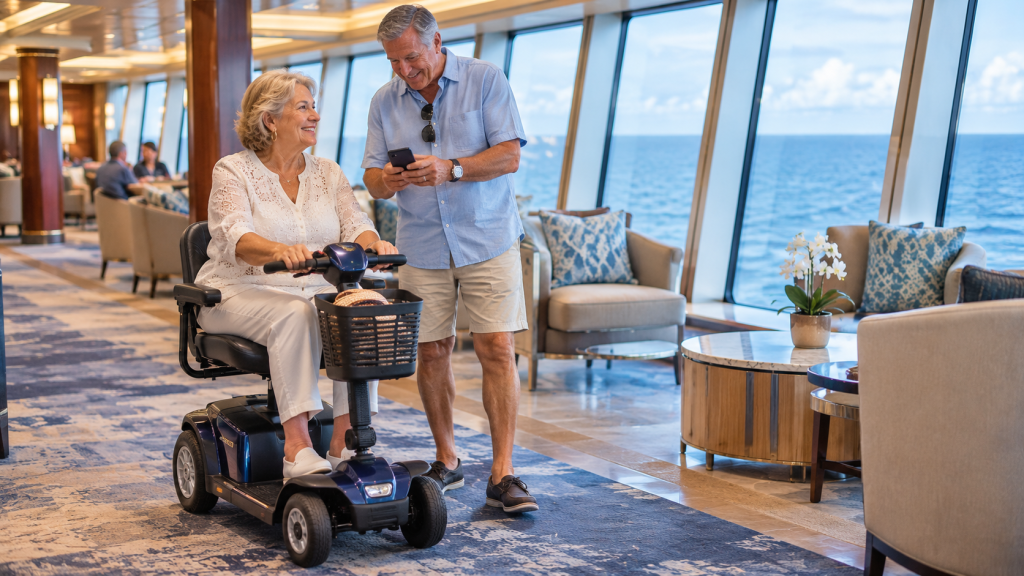
The most useful accessibility questions are specific to the ship, itinerary, and assistance required.
Not every accessible cabin has identical features, and the availability of suitable shore excursions may vary significantly between destinations.
Royal Caribbean, for example, provides information about accessible staterooms, boarding assistance, mobility services, and arrangements for guests who need additional support.
It also asks passengers to provide advance notice for certain services. (Royal Caribbean — Accessible Cruising)
Accessible Cabins and Mobility Equipment
Before choosing a cabin, confirm the features you actually need.
These might include a roll-in shower, suitable doorway width, accessible bathroom layout, grab bars, room to turn a wheelchair, or adequate space to store a scooter.
If you bring a mobility scooter, check its dimensions, battery requirements, and storage rules.
Royal Caribbean states that assistive devices, including scooters, must be stored and recharged in the stateroom rather than obstructing corridors and elevator lobbies. (Royal Caribbean — Mobility Disabilities)
Don’t assume that staff will be able to lift a passenger or equipment whenever assistance is needed.
Ask exactly which services are available, whether advance notice is necessary, and what arrangements apply during an emergency.
Tender Ports Can Create Additional Challenges
Some destinations require passengers to transfer from the cruise ship to a smaller boat rather than walking directly onto a pier.
These transfers can be difficult or impossible for some wheelchair or scooter users, depending on the vessel, transfer arrangement, sea conditions, and local facilities.
Royal Caribbean’s accessibility guidance specifically notes that tendering, gangway conditions, weather, tides, and shore-side facilities can affect whether passengers and mobility equipment can disembark. (Royal Caribbean — Additional Assistance)
This is particularly relevant during hurricane season, when changing sea conditions may affect tender operations.
If a particular port is important to you, confirm whether it requires tendering and whether your accessibility needs can be accommodated.
How to Manage Seasickness Without Creating Other Problems
Seasickness can be uncomfortable at any age, but older passengers may need to pay particular attention to medication side effects and balance.
The CDC discusses several motion sickness treatments, including antihistamines and scopolamine, but notes that medications can cause side effects and may be unsuitable for some travelers. (CDC Yellow Book — Motion Sickness)
Ask About Medication Before You Sail
Some commonly used motion sickness medicines can cause drowsiness, which may increase the difficulty of navigating a moving vessel.
Other treatments can have specific precautions related to conditions such as glaucoma or urinary retention.
Discuss your options with a healthcare professional who understands your medical history and current medications.
Don’t wait until the ship is experiencing heavy movement to discover that a treatment makes you dizzy or unusually sleepy.
Practical Ways to Reduce Discomfort
Spending time in an area of the ship where motion is less noticeable may help.
Looking toward a stable horizon can sometimes reduce motion-related symptoms, although it won’t work for everyone.
Rest, fresh air when conditions permit, and avoiding activities that worsen symptoms may also help.
If you’re experiencing severe vomiting, dehydration, dizziness, or symptoms that seem unusual, contact the ship’s medical center rather than assuming everything is ordinary seasickness.
Is Travel Insurance Worth Considering for a Hurricane-Season Cruise?

Travel insurance is worth careful consideration when you’re booking a cruise during hurricane season, particularly if you have nonrefundable expenses, medical concerns, or a lengthy journey to the departure port.
However, insurance isn’t a guarantee that every weather-related problem will be covered.
Different policies provide different benefits, and exclusions can materially change the protection available.
The U.S. Department of State recommends reviewing travel medical and evacuation insurance for cruise travel, while the National Association of Insurance Commissioners advises consumers to understand exclusions, coverage limits, and the effect of purchasing insurance after a storm becomes a known event. (U.S. Department of State — Cruise Ships) (NAIC — Should You Get Travel Insurance?)
The Coverage Questions That Matter Most
| Coverage consideration | What to verify before purchasing |
|---|---|
| Trip cancellation | Which hurricane-related events qualify, and whether your reason for canceling is covered |
| Trip interruption | Whether qualifying disruptions can reimburse unused arrangements or additional transportation |
| Travel delay | Minimum delay requirements, covered expenses, and maximum benefits |
| Emergency medical care | Geographic coverage, exclusions, deductibles, and whether shipboard treatment qualifies |
| Medical evacuation | Benefit limits, authorization requirements, and eligible evacuation destinations |
| Pre-existing conditions | Whether an exclusion applies and whether a time-sensitive waiver is available |
| Missed ports | Whether any specific missed-port benefit exists rather than assuming every itinerary change is covered |
Why Buying Early May Matter
Some travel insurance benefits are sensitive to when the policy was purchased.
Pre-existing medical condition exclusion waivers, for example, may have eligibility requirements tied to the date of your initial trip payment, the insured trip cost, and other conditions.
Storm-related claims may also be excluded if the policy was purchased after the relevant hurricane became a known event.
The NAIC cautions that buying travel insurance after a storm has already been named is unlikely to cover claims arising from that storm. (NAIC — Travel Insurance Consumer Guidance)
It is useful to compare coverage soon after booking, but purchasing early doesn’t guarantee every exclusion will be waived.
How to Compare Insurance Providers Without Relying on Brand Names
Travelers may encounter marketplaces such as VisitorsCoverage and Insubuy, along with insurers or distributors offering travel-related coverage.
The important distinction is that a marketplace may help you compare products, but the actual benefits depend on the policy you select and the insurer underwriting it.
Other providers may offer different types of travel insurance or assistance services, so they shouldn’t automatically be treated as interchangeable.
Flight-compensation services such as AirHelp or Compensair have a different purpose: they may assist with eligible passenger claims under applicable air-passenger laws.
They aren’t substitutes for travel medical insurance or hurricane-related cruise interruption coverage.
For this article, the reader’s best next step is to compare written policy terms rather than assume that a particular company will handle every medical or weather-related expense.
What If a Hurricane Changes Your Cruise Itinerary?
An itinerary change can be disappointing, particularly if you’ve booked a special excursion or planned a reunion at a particular destination.
But a changed port isn’t automatically a failed vacation.
Cruise operators can sometimes substitute another destination or adjust the number of sea days to respond to weather, port restrictions, or other operational circumstances.
What happens next depends on the revised itinerary and the terms of the bookings you’ve made.
Ask the Questions That Affect Your Actual Plans
When a change is announced, confirm whether you will be visiting a different port, spending another day at sea, or returning on a different schedule.
If you use accessible transportation or have booked a mobility-friendly excursion, ask whether equivalent arrangements will be available at the replacement destination.
For independently booked tours, contact the provider and review the cancellation policy.
If the ship’s return date changes, determine which flights, hotel reservations, and ground transportation arrangements will be affected.
Don’t Assume a Reroute Includes Compensation
A cruise line may offer certain refunds, credits, or goodwill arrangements in particular circumstances, but these are not universal.
A skipped port doesn’t automatically guarantee an onboard credit, free excursion, or upgraded accommodation.
Check the cruise contract and any written announcement from the operator.
If you need to request reimbursement from an excursion provider or insurer, keep relevant notices, receipts, and booking documentation.
How to Choose a Cruise Line and Itinerary That Fit Your Needs
For an older traveler, the right cruise line is not necessarily the company operating the newest or largest ship.
The more useful question is whether the specific vessel and itinerary accommodate your needs.
A newer ship may offer sophisticated technology, but that alone doesn’t establish that it will provide a more comfortable or safer experience for every passenger.
Medical facilities, accessible cabins, crew assistance, shore excursion arrangements, and operational policies deserve direct attention.
Compare Individual Ships, Not Just Cruise-Line Reputations
Before booking, identify the ship and look at its accessible cabin options, onboard medical services, and the location of key facilities.
If you’re concerned about motion, investigate suitable cabin positions rather than relying exclusively on marketing descriptions of stabilizers.
For destinations that require tendering, review the accessibility requirements.
If a particular cruise is appealing because of a single must-see port, consider how much an itinerary substitution would affect your enjoyment.
A voyage with several destinations you’d enjoy may provide more flexibility than one whose appeal depends almost entirely on a particular stop.
Consider Your Departure and Return Arrangements
For many travelers, the greatest storm-related disruption happens before boarding or after disembarkation.
A hurricane may affect airports, highways, hotels, or access to the cruise terminal.
If you’re flying to the port, consider whether your itinerary gives you adequate time to handle a delay.
Arriving before embarkation day can reduce exposure to some ordinary travel disruptions, although it cannot eliminate hurricane-related problems.
Review what happens if your return is delayed and whether you have access to additional medication, accommodation, and transportation if necessary.
When Should You Reconsider a Hurricane-Season Cruise?

There is no age at which hurricane-season cruising automatically becomes unsuitable.
A healthy, active traveler in their seventies may have different needs from someone younger who relies on specialized medical equipment or requires substantial mobility assistance.
The decision should reflect individual circumstances rather than age alone.
Consider seeking further guidance before booking if you depend on medical treatment that cannot be interrupted, need specialized equipment that the ship cannot accommodate, or would struggle with an extended delay away from medical care.
Likewise, if a particular accessible destination or exact return date is essential, be realistic about the possibility of itinerary changes.
Your healthcare professional can help assess medical travel considerations, while the cruise line should clarify its capabilities and operational requirements.
Travel insurance may address some financial consequences, but it cannot ensure that medical services, evacuation transport, or a particular port will always be available.
A Final Hurricane-Season Cruise Checklist for Travelers Over 60
Before booking, review the cruise itinerary, ship accessibility, medical facilities, cancellation rules, and the availability of appropriate travel insurance.
If you have medical or mobility requirements, contact the cruise line directly and obtain confirmation of the relevant arrangements.
Before departure, carry your important documents, medications, and emergency contact information where you can access them.
Check the official National Hurricane Center forecasts and your cruise line’s travel updates, particularly when a tropical system threatens your departure area.
Once onboard, pay attention to your muster instructions and ask about accessibility arrangements before an emergency occurs.
If the captain announces a weather-related change, follow the official instructions and review how it affects your personal arrangements.
You don’t need to predict the weather or solve every possible disruption in advance.
You need a reasonable plan for the circumstances that would matter most to you.
Cruising During Hurricane Season Can Still Be a Wonderful Experience
There is no reason to treat hurricane season as an automatic barrier to enjoying a cruise after 60.
Modern cruise operations include weather monitoring, trained crews, onboard medical services, and procedures for responding to changing conditions.
Those measures are valuable, though they have limits.
A cruise can still encounter uncomfortable seas, miss a destination, experience a medical emergency, or return later than planned.
Knowing that doesn’t have to make the vacation less appealing.
It helps you prepare in a way that protects the experiences you’re looking forward to.
Choose a ship that meets your needs, verify the assistance available, understand your insurance, and build flexibility into the journey.
Then you can board with greater confidence—not because every risk has disappeared, but because you’ve made informed decisions about the things that matter most.
FAQ – Can Older Travelers Cruise Confidently During Hurricane Season?
Is cruising during hurricane season safe for seniors?
Cruising during hurricane season isn’t automatically unsafe, and cruise lines monitor developing tropical systems and may adjust routes when conditions warrant it.
However, no cruise can guarantee the absence of storms, rough seas, delays, or medical emergencies.
Older travelers should consider their individual health, mobility, and tolerance for itinerary uncertainty rather than relying on age alone.
Reviewing the specific ship’s capabilities and preparing for possible disruptions can help you make a more informed decision.What months are considered hurricane season in the Caribbean?
The Atlantic hurricane season officially runs from June 1 through November 30.
Tropical cyclone activity varies throughout the season and from year to year, with the historical Atlantic peak occurring around September.
Hurricanes can occasionally form outside the official dates, so the calendar doesn’t eliminate the need to review forecasts.
Check the National Hurricane Center for current conditions and tropical weather outlooks as your departure approaches.Do cruise ships sail directly into hurricanes?
Cruise operators generally seek to avoid hazardous tropical cyclone conditions and may change itineraries to reduce exposure.
However, storms can change unexpectedly, and a ship may still experience uncomfortable weather or rough seas despite precautions.
The forecast cone doesn’t show every area affected by a cyclone’s winds or waves.
Follow the captain’s instructions rather than using a personal weather app to judge the ship’s route.Can a cruise captain change the itinerary to avoid a storm?
Yes, cruise lines can change planned destinations, port sequences, and arrival or departure times when weather or operating conditions make adjustments necessary.
Some changes may be announced before sailing, while others happen after passengers are onboard.
Alternative ports depend on availability and conditions, so a replacement destination isn’t guaranteed.
Review official notices and check any independently booked arrangements affected by the new schedule.How can older passengers prepare for rough seas?
Choose appropriate footwear, keep essential items accessible, and follow the crew’s guidance when movement around the ship becomes difficult.
Passengers concerned about balance may prefer a cabin in a more central location and should ask about available assistance before sailing.
Discuss seasickness medication with a healthcare professional because certain treatments can cause drowsiness or other side effects.
If the ship restricts access to outdoor areas, respect those instructions regardless of how mild the weather may appear.Do cruise ship stabilizers prevent seasickness?
Stabilizers can reduce some rolling movement when operating under suitable conditions, but they cannot eliminate all ship motion.
Passengers may still experience seasickness during rough weather, particularly when the vessel pitches or encounters prolonged swells.
A cabin near the middle of the ship may help reduce perceived movement for some travelers.
If you are prone to motion sickness, discuss suitable prevention strategies before departure.Which cruise cabin is best for seniors concerned about motion?
A lower passenger deck near the middle of the ship is often a useful starting point because movement may feel less pronounced there.
However, cabin location alone does not determine whether you’ll experience discomfort.
Also consider distance from elevators, accessibility features, bathroom design, and proximity to facilities you expect to use frequently.
The most appropriate choice balances motion sensitivity with your practical needs.Can cruise medical centers handle emergencies involving older passengers?
Cruise medical centers can assess and treat many illnesses and injuries, and some can provide emergency stabilization.
However, capabilities vary by vessel, and these facilities are not equivalent to fully equipped hospitals.
Certain conditions may require transfer to a hospital ashore, which can be complicated by distance, weather, or available transportation.
Ask the cruise line about the specific ship’s medical capabilities if you have ongoing treatment requirements or significant concerns.What happens if a senior passenger needs medical evacuation?
The ship’s medical team may recommend evacuation when necessary treatment exceeds onboard capabilities.
The arrangements depend on the passenger’s condition, ship location, weather, available rescue or transport resources, and local medical facilities.
An evacuation cannot always happen immediately, particularly in severe weather.
Review medical evacuation insurance terms and confirm how assistance, authorization, and payments would be handled.Does Medicare cover medical treatment on a Caribbean cruise?
Original Medicare generally has limited coverage outside the United States, with specific exceptions.
Qualifying medical services aboard a cruise ship may be covered when the vessel is in a U.S. port or within six hours of arriving at or departing from one, subject to applicable requirements.
Coverage through Medicare Advantage or Medigap may differ, so the same answer doesn’t apply to every traveler.
Contact your plan before sailing to clarify shipboard treatment, foreign hospitals, and emergency transport.Should travelers over 60 buy medical evacuation insurance?
Medical evacuation coverage is worth evaluating, particularly for international itineraries or cruises far from appropriate hospital facilities.
Whether a policy is suitable depends on your existing insurance, destinations, benefit limits, and the policy’s definition of a covered evacuation.
Some plans have authorization requirements or restrictions on where a patient can be transported.
Compare written terms rather than assuming the phrase medical evacuation guarantees transportation to your preferred hospital.Will travel insurance cover hurricanes that disrupt a cruise?
Some travel insurance policies cover qualifying cancellations, delays, interruptions, or other expenses connected with severe weather.
Coverage is conditional and may depend on the cause of the disruption, purchase date, required waiting periods, and exclusions.
A missed port or personally inconvenient forecast doesn’t automatically qualify for reimbursement.
Read the policy’s hurricane provisions before purchasing and keep records of official changes.Can seniors get travel insurance that covers pre-existing medical conditions?
Some travel insurance plans offer waivers of pre-existing medical condition exclusions when specific eligibility requirements are met.
These requirements may involve purchasing within a certain period after the initial trip payment, insuring the appropriate trip cost, and meeting other policy conditions.
A waiver isn’t available automatically with every policy.
Review the exact wording and seek clarification before purchasing if coverage for an existing condition is important.What medications should older travelers bring on a hurricane-season cruise?
Bring your prescribed medications, necessary medical supplies, and an appropriate additional supply when possible in case your return is delayed.
Keep essential medication in carry-on luggage, along with relevant prescriptions and a current medication list.
Check any special storage, refrigeration, or controlled-medication requirements before travel.
Your healthcare professional can advise on suitable quantities and what to do if treatment is interrupted.Can cruise ships accommodate wheelchairs and mobility scooters?
Many cruise ships offer accessible cabins and assistance services, but their specific capabilities and equipment restrictions vary.
Scooters and other mobility aids may need to meet dimensional, storage, and charging requirements.
Some shore activities or tender transfers can remain inaccessible despite onboard accommodations.
Contact the cruise line before booking to confirm the arrangements you need for both the vessel and itinerary.What happens if elevators are unavailable during an emergency?
Emergency procedures may restrict the use of certain elevators or require passengers to follow designated routes.
Guests who cannot use stairs should discuss their needs with the cruise line before departure and confirm the ship-specific arrangements onboard.
Crew assistance and accessible evacuation procedures depend on the vessel and circumstances.
Don’t assume the ordinary route from your cabin to the dining room will also be the correct emergency route.Can seniors with mobility needs visit tender ports?
It depends on the transfer equipment, sea conditions, local infrastructure, and the passenger’s mobility needs.
Some tender operations may accommodate certain assistive devices, while others are unsuitable for passengers who cannot manage steps or transfers.
Wind and waves can further limit access even when the itinerary originally included the port.
Confirm the accessibility arrangements for each tender destination rather than relying on general statements about the ship.Will a cruise line compensate passengers if a hurricane causes a missed port?
A missed port does not automatically entitle passengers to a particular onboard credit, excursion, refund, or other compensation.
The outcome depends on the cruise contract, relevant laws, booking terms, and any arrangement the cruise line announces.
Independently purchased shore excursions may have separate cancellation policies.
Keep written notices and receipts, and request clarification about the specific expenses affected.Is September a bad month for older travelers to cruise the Caribbean?
September falls near the historical peak of Atlantic hurricane activity, so the possibility of tropical weather deserves attention.
However, a particular September sailing isn’t guaranteed to encounter a hurricane or experience an itinerary change.
Consider your willingness to accept uncertainty, your travel and medical needs, and how important particular ports are to you.
A flexible booking and realistic preparation may make the trip suitable, while travelers who require a fixed schedule may prefer another period.What is the best way to prepare for a hurricane-season cruise after 60?
Begin by reviewing the itinerary, ship accessibility, onboard medical capabilities, and travel requirements that apply to you.
Confirm medication supplies, emergency contacts, any required assistance, and the terms of your travel insurance.
Monitor official storm forecasts and your cruise line’s updates as departure approaches.
With those arrangements established, you can focus on enjoying your trip while remaining prepared for possible changes.
Plan Your Next Cruise!

Sail Into Freestyle Freedom: Norwegian Cruise Line for Adventure Thrills, Gourmet Dining, and Destination‑Rich Voyages
One Delay Can Cost Your Entire Cruise A quick coverage check now protects you from the problems no one sees coming….

Sail Into Italian Elegance: Costa Cruises for Culture, Cuisine, and Unforgettable Voyages
One Delay Can Cost Your Entire Cruise A quick coverage check now protects you from the problems no one sees coming….

Discover Silversea Cruises: Ultra‑Luxury Voyages to the World’s Most Exclusive Destinations
One Delay Can Cost Your Entire Cruise A quick coverage check now protects you from the problems no one sees coming….

From Icon to Oasis: Explore Royal Caribbean’s Groundbreaking Ships and Unforgettable Voyages
One Delay Can Cost Your Entire Cruise A quick coverage check now protects you from the problems no one sees coming….
Explore More

Cruise Ship Zip Line Weight Limits — What Passengers Must Know Before Riding

Anchor Big Ideas at Sea: Corporate Cruises That Drive Collaboration & Results

Recharge at Sea: Luxury Cruise Spa Packages for Deep Relaxation and Lasting Wellness