
One Delay Can Cost Your Entire Cruise
A quick coverage check now protects you from the problems no one sees coming
Short Excerpt
- Your first cruise can cost more than expected when drink packages, Wi-Fi, excursions, specialty dining, and other upgrades accumulate.
- Saving money doesn’t mean skipping memorable experiences. It’s about understanding what’s included and choosing extras you’ll genuinely enjoy.
- Use the interactive first-cruise budget planner to estimate your total vacation cost, identify optional spending, and see how much room you have for the experiences that matter most.
Quick Take
- Calculate your true cruise cost. Include your fare, transportation, hotel, gratuities, and expected onboard spending.
- Choose your favorite upgrades. Prioritize one or two categories rather than buying every package promoted before sailing.
- Enjoy what’s already included. Dining, entertainment, pools, and activities can deliver an excellent first cruise without additional purchases.
- Plan port-day spending. Compare excursions, transportation, and independent activities before booking.
- Use a realistic spending limit. A simple budget gives you more freedom to enjoy your vacation without worrying about the final bill.
How to Enjoy Your First Cruise Without Letting Extra Costs Take Over
You’ve booked your first cruise, and the advertised fare made the vacation seem surprisingly affordable.
Then you begin exploring the cruise planner and discover an entire collection of optional purchases waiting for you.
There are beverage packages, specialty dining reservations, Wi-Fi plans, shore excursions, spa treatments, and other upgrades promising to make your vacation even better.
Individually, some of those prices don’t seem unreasonable.
However, once you multiply them by the number of travelers and the length of your sailing, your affordable vacation can become considerably more expensive than you expected.
For first-time cruisers, the difficult part is separating expenses you genuinely need from extras you’re considering because you don’t yet know what the onboard experience will be like.
You might wonder whether the included restaurants will be good enough, whether you’ll need internet throughout the sailing, or whether exploring a port without an expensive excursion means missing the best experiences.
Those questions are worth answering before you purchase another package.
A cruise already includes much of the vacation experience you’ve paid for.
Depending on the ship and fare, that can mean multiple dining options, live entertainment, swimming pools, activities, and opportunities to relax without additional spending.
The smarter approach isn’t refusing every upgrade.
It’s understanding your complete budget first and then choosing which optional experiences deserve your money.
Build Your First-Cruise Budget Before Buying Another Upgrade
One of the easiest ways to avoid overspending is to separate expenses you’ve already committed to from purchases you can still control.
Your cruise fare, transportation to the departure port, and any required pre-cruise hotel stay form the foundation of your vacation budget.
Depending on your booking, gratuities and certain other charges may also need to be included.
Top Cruise Deals From Trusted Cruise Lines
Compare exclusive online offers and find the fare that fits your trip and your budget
After that, you can consider optional spending.
Perhaps you want a memorable shore excursion and one specialty dinner.
You might also appreciate a modest beverage budget without purchasing an expensive unlimited package.
Seeing those choices together makes the tradeoffs easier to understand.
The interactive planner below allows you to estimate the cost of your first cruise, compare it with your available budget, and identify how much you’re allocating to optional experiences.
Interactive First-Cruise Vacation Budget Planner
First-Cruise Budget Planner
See what your first cruise could really cost. Enter amounts for your entire travel party unless a field specifically says per guest.
Please enter valid nonnegative amounts and at least one traveler and one cruise night.
Illustrative budget estimates only. Enter the total cruise fare including taxes and fees. Enter 0 for gratuities already included in your fare. Add insurance, parking, transfers, and any unlisted expenses into an appropriate field. Avoid counting bundled costs twice.
Use Your Budget Results to Choose What Really Matters
Once you’ve entered your expected expenses, look at how much of your budget is committed to essential costs and how much remains available for optional experiences.
If transportation, accommodation, and the cruise fare consume most of your available funds, that doesn’t mean you need to cancel every enjoyable extra.
Instead, identify which purchases will make the biggest difference to your vacation.
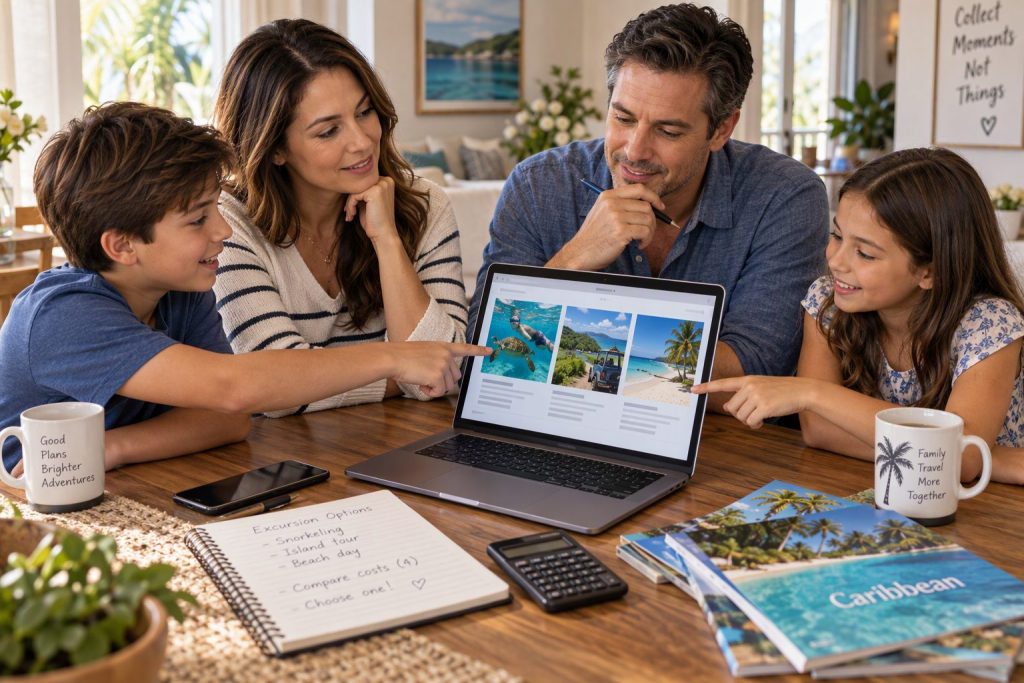
Perhaps you’ve dreamed of snorkeling in the Caribbean.

You might choose one excellent excursion and skip the specialty dining package.
Another traveler may prefer a romantic dinner onboard while enjoying independent sightseeing at most ports.
The value comes from knowing what you care about before the cruise line presents another offer.
A useful strategy is choosing two spending categories that matter most, then treating everything else as optional.
You can also set aside a modest amount for spontaneous purchases so your budget doesn’t feel restrictive.
If your planner shows that your intended purchases exceed your limit, consider reducing the expenses that add the least value rather than automatically eliminating your favorite experience.
This is how budgeting becomes a tool for improving your first cruise rather than limiting it.
Keep Your First-Cruise Spending Plan Realistic
It’s tempting to create a budget that looks perfect on paper by assuming you won’t buy any additional beverages, souvenirs, or services.
However, a realistic estimate is more useful than an unrealistically low one.
Consider how you typically spend money on vacation.
Online‑Only Cruise Offers You Won’t Find Elsewhere
Unlock special pricing and start planning the sailing that matches your perfect itinerary

Do you enjoy shopping for souvenirs?
Will you want an occasional cocktail by the pool? Are you likely to purchase a few specialty coffees?
Include those preferences honestly.
Then review which services are already included in your booking so you don’t count the same expense twice.
Some fares or bundles include gratuities, Wi-Fi, drinks, or other benefits that would otherwise require separate purchases.
A well-planned first-cruise budget should reflect the actual terms of your reservation, not generalized assumptions about what cruise lines charge.
Use Included Experiences Before Paying for Upgrades

One of the easiest ways to save money without feeling deprived is to explore what your cruise already provides.
The main dining room, buffet, and other included restaurants may offer plenty of variety for your entire sailing.
Entertainment can also be surprisingly extensive, with live music, theatrical performances, games, and activities included in many cruise fares.
Rather than purchasing multiple upgrades before you’ve experienced the ship, identify which included options you’d like to try.
That gives you a better foundation for deciding whether additional purchases are worthwhile.
For example, one specialty dinner might be a memorable highlight without requiring a package covering several restaurants.
Likewise, enjoying included entertainment may leave more room in your budget for a destination experience you couldn’t enjoy at home.
The goal isn’t to avoid spending.
It’s to use the vacation you’ve already purchased before paying to expand it.
Protect Your Budget From Last-Minute Decisions
Cruise vacations introduce unfamiliar routines, and unfamiliarity can make offers feel more urgent than they are.
A beverage package might appear essential because you’re worried about the onboard bill.
A specialty dining offer may seem necessary because you don’t know what the main dining room will be like.
Those concerns can lead to purchases that don’t actually improve your vacation.
Before adding an optional upgrade, consider whether it addresses something you genuinely want or merely something you’re uncertain about.
For nonessential purchases, taking time to review the terms can help you avoid an impulsive decision.
Just remember that some promotions and reservations have genuine deadlines, so don’t assume every offer will remain available tomorrow.
Your spending plan should make it easier to recognize which opportunities are worthwhile.
The stronger your understanding of the included vacation experience, the less pressure you’ll feel to buy additional services simply to avoid missing out.
Let Your First Cruise Feel Generous Without Spending Constantly
A memorable cruise isn’t necessarily the one with the most packages, paid activities, or specialty reservations.
You may discover that your favorite moments happen during a leisurely dinner, an evening show, a conversation overlooking the ocean, or a simple walk around a beautiful port city.
Those experiences can be part of the vacation you’ve already paid for.

Luxury Cruise Experiences at Smarter Prices
See premium sailings and upgraded cabins priced for travelers who know how to book well
Intentional spending makes room for the upgrades that genuinely add something special.
A shore excursion you’ve been excited about for months may be worth prioritizing over several smaller purchases you’ll barely remember.
Similarly, someone who values uninterrupted connectivity may find a suitable Wi-Fi package essential while another traveler is perfectly happy spending most of the sailing offline.
The purpose of your first-cruise budget isn’t to make your vacation smaller.
It’s to protect the experiences you care about from being crowded out by unnecessary spending.
How to Save Money on Your First Cruise While Still Enjoying Everything That Matters
If you are planning your first cruise and worried that saving money means missing out, you are not alone.
Cruise pricing can feel confusing when extras like drink packages, Wi-Fi, and excursions start popping up.
That’s when uncertainty creeps in.
One screen talks about your fare, and the next one offers drink packages, dining upgrades, Wi-Fi, excursions, and “limited time” bundles that seem like they must be important.
If you’re new to cruising, it’s natural to wonder whether saving money means having a weaker experience.
It doesn’t.
The ship already includes a full vacation framework, and it’s bigger than most first-time cruisers expect.
The goal is learning where the real value lives so you can spend with intention instead of spending to reduce nerves.
Here’s what tends to happen on a first cruise.
You don’t want to miss the best food, so you look at specialty dining.
You don’t want to be bored in port, so you start stacking excursions.
You don’t want to feel “unreachable,” so you consider the biggest Wi-Fi plan.
Then a package shows up labeled “discount,” and suddenly the safest move feels like buying more.
That’s the trap.
Not because cruising is sneaky, but because uncertainty makes everything feel urgent.
This guide shows you how to keep costs under control without sacrificing the fun that makes cruising special.
Why First-Time Cruisers Overspend and How to Stop It
Cruise pricing is built around a baseline experience and a premium layer.
The baseline is meant to be complete enough that you can enjoy the ship without paying for upgrades all day.
The premium layer exists so you can customize the trip based on what you actually care about.

Sail Away to Paradise Without Overpaying
Find cruise deals that make it easy to escape, relax, and enjoy the ocean without stretching your budget
First-time cruisers overspend when the premium layer starts to feel like the baseline.
That mindset shift usually comes from unfamiliar wording, unfamiliar routines, and a fear of making the “wrong” choice.
Once you recognize that pattern, you can interrupt it before it becomes your onboard bill.
Saving money on a cruise isn’t about saying no to fun.
It’s about refusing to pay for uncertainty.
Hidden Spending Momentum
Spending onboard is frictionless by design.
You sign for a drink, not because you’re reckless, but because it feels like part of the experience.
You book a specialty dinner, not because you need it, but because you want a sure thing.
You add a package, not because you did the math, but because the word “discount” sounds like protection.
Momentum builds when every choice is presented as a limited opportunity.
That is why the best time to save money is before you board.
A plan removes urgency, and urgency is what inflates first-cruise totals.
Once your decisions are made, upsells lose most of their power.
Discount Packages
A “discount package” is a bundle of extras sold together for less than buying each extra individually.
Drink packages, dining packages, Wi-Fi bundles, and excursion credits are common examples.
The discount is only real when the package matches what you naturally do.
If you buy a drink package and start drinking more just to justify it, you’re not saving money.
If you buy a dining package and skip included dining you would have enjoyed, you’re not saving money.
The package didn’t fail you.
The fit was wrong, and first-time cruisers are the most likely to buy the wrong fit.
Uncertainty Is The Cost
Most “extra spending” is actually anxiety spending.
You spend because you’re trying to avoid disappointment.
You spend because you’re trying to avoid embarrassment.
You spend because you’re trying to avoid mistakes.
That spending rarely improves the trip as much as you hope it will.
Clarity improves the trip more than upgrades do.
Once clarity is in place, upgrades turn into highlights instead of safeguards.
That is how you save money and still have a cruise that feels rich.
Overspending Has Patterns
Most first-cruise budget blowups follow predictable categories and predictable emotions.
Discount Needs Fit
A package only saves money when it fits your habits without forcing new ones.
Clarity Protects Fun
When uncertainty drops, you stop paying for “just in case” choices.
Use This Simple Budget Framework So Your First Cruise Feels Easy
Cruise budgeting becomes simple when you stop tracking everything and start sorting everything.
Repeat cruisers do this naturally.
They separate fixed costs from optional costs.
Fixed costs are the costs you pay regardless of how you behave onboard.
Optional costs are the costs you can control with choices.
That separation is the single most confidence-building thing you can do before your first cruise.
It turns a confusing total into a predictable one.
It also makes saving money feel practical instead of restrictive.
Lock The Baseline
Start with your fare, taxes, and port fees shown at booking.
Then confirm whether daily gratuities are included or charged to your onboard account each day.
If gratuities are charged daily, multiply that rate by the number of nights and the number of people.
That number is not an “extra.”
It’s part of the true cost of taking the cruise.
Next, add transportation to the port, including flights, transfers, and a pre-cruise hotel night if you need it.
Now you have a baseline total that is honest.
Once the baseline is known, your optional spending stops feeling like a threat.
Choose Two Levers
Most first-time cruisers try to optimize everything.
That’s where the overwhelm starts.
A better approach is choosing two upgrade categories to spend on and letting everything else be optional.
Beverages and excursions are common choices.
Specialty dining and Wi-Fi are common choices for couples.
Soda and one memorable port experience are common choices for families.
The specific categories matter less than the limit.
A limit makes saying no effortless because it removes debate in the moment.
Set A Daily Guardrail
Pick a daily amount you feel good spending on optional items.
This is not a strict rule that ruins vacation.
It’s a guardrail that prevents the end-of-cruise bill from shocking you.
Checking your onboard account in the cruise line app every day or two supports the guardrail.
If you notice you’re running hot, you can adjust early instead of feeling trapped later.
A guardrail keeps spending aligned with intention, which is where confidence lives.
The best part is that the guardrail doesn’t prevent fun.
It prevents regret.
Plan One Highlight
Pick one upgrade that will be your intentional splurge.
This might be one specialty dinner, one premium excursion, or one spa treatment.
Planning one highlight reduces the urge to buy many small extras.
It gives your cruise a moment you’re excited about, which reduces FOMO spending.
A planned highlight also feels better psychologically because it’s a decision you made, not a decision you were pushed into.
This is how you save money without feeling like you’re missing out.
You’re not saying no to everything.
You’re saying yes to something on purpose.
Baseline Beats Guessing
A known baseline cost reduces uncertainty and prevents reactive purchases.
Two Categories Work
Limiting upgrades keeps the trip special without opening the spending floodgates.
Highlights Replace Impulse
A planned splurge often delivers more joy than scattered add-ons.
Plan Smart Before You Sail So Saving Money Feels Effortless
The easiest money you will ever save on a cruise is the money you never spend onboard.
That saving happens before embarkation day, when you’re still thinking clearly and comparing options calmly.
This is not about building a complicated itinerary.
It’s about removing the most common causes of last-minute premium pricing.
When your basics are handled, your choices onboard become lighter.
That’s when the cruise starts feeling easy.
A first-time cruiser’s best savings strategy is controlled preparation.
Controlled preparation means fewer surprises and fewer “emergency” purchases.
Arrive Like A Pro
Arriving the same day you sail can be risky.
A delayed flight can turn into a scramble that costs far more than one night in a nearby hotel.
Arriving the day before gives you breathing room and often saves money in the long run.
To price that hotel night, checking major booking platforms like Booking.com, Agoda, Trip.com, or Tripadvisor can help you compare reviews and locations quickly.
A predictable pre-cruise night also improves your embarkation day, because you’re not rushing and making expensive decisions under pressure.
If luggage is part of your stress, a reliable carry-on from Travelpro can prevent the “zipper broke at the airport” problem that leads to emergency shopping.
That kind of prevention feels boring until you’ve seen how expensive chaos can be.
Then it feels like the smartest money you spent.
Pack To Avoid Markups
Ships sell essentials, but ships do not sell essentials at a discount.
Sunscreen, basic toiletries, simple motion remedies, and small convenience items are usually cheaper at home.
For a first cruise, a small “don’t buy it onboard” bag can save surprising amounts.
Think of it as removing an entire category of impulse purchases.
It also removes the frustration of paying premium prices for something you would have tossed in your suitcase without thinking.
Even little items like lanyards, clips, or a small power strip can cost more onboard than they should.
A small prep list prevents that.
Prepared does not mean overplanned.
Prepared means you kept your money for the things you actually want.
Use Smart Connectivity
Wi-Fi on ships is often priced per day and sometimes per device.
That structure can surprise first-time cruisers, especially couples and families.
If you mainly need maps, messaging, and quick checks in port, a travel eSIM like Airalo or Yesim can handle a lot without paying for full-time ship internet.
For travelers who prefer flexibility across destinations, Drimsim can be another option to consider.
When you do connect to public Wi-Fi in terminals or cafés, using NordVPN is a practical way to reduce risk.
Digital safety may not feel like “saving money” until something goes wrong.
Then it becomes obvious how expensive identity and account problems can be.
A secure and intentional connectivity plan prevents both overspending and stress.
Store Bags, Save Energy
Ports and pre-cruise cities are easier when you’re not dragging luggage around.
If you arrive early and want to explore, services like Radical Storage can help you drop bags and move freely.
Freedom leads to better decisions.
Better decisions lead to fewer expensive “I’m exhausted, let’s just take a taxi” moments.
The money adds up, but the bigger win is energy.
Energy is what makes your first cruise feel fun instead of draining.
Spending less is easier when you’re not operating on fumes.
This is a small tactic with outsized impact.
Prep Prevents Premium
Small pre-cruise choices remove common causes of high onboard spending.
Pack For Control
Bringing basics keeps you from buying overpriced essentials in vacation mode.
Connectivity With Purpose
Using eSIMs and secure Wi-Fi reduces the need for expensive internet plans.
Enjoy Your Cruise While Saving Money Without Feeling Restricted
Onboard saving works best when it’s invisible.
Invisible saving means you’re enjoying the cruise while your plan quietly protects you.
The ship is already full of included dining, included entertainment, and included spaces to relax.
When you treat included experiences as your default, the cruise feels abundant without extra spending.
Extras can still be part of your trip.
They just become highlights instead of habits.
That is how you save money without sacrificing fun.
A first cruise should feel free, not tightly controlled.
Eat Included First
Included dining is stronger than many first-timers expect.
The main dining room can feel like a full service restaurant experience, especially when you lean into the rhythm of ordering courses and enjoying the pace.
Buffets often shine at breakfast and lunch, which simplifies your day and reduces paid temptations.
Casual included venues like grills or pizzerias can cover snack moments without turning them into purchases.
A common mistake is booking specialty dining before you even taste what’s included.
Trying included dining first is not cheap behavior.
It’s smart behavior.
Once you know the baseline quality, choosing one specialty dinner becomes a joyful upgrade instead of an anxiety purchase.
Make Drinks A Decision
Beverage spending is one of the biggest levers in cruise budgets.
A drink package can be an excellent fit for someone who drinks consistently and wants a predictable total.
Pay-as-you-go can be a better fit for someone who drinks lightly or prefers a few specific moments.
A third option often works well for first-timers.
Focus on included beverages for most of the day, then choose premium drinks as intentional highlights.
One practical step prevents accidental overspending.
Check a receipt early in the sailing to see whether an automatic gratuity is already added to drinks.
That simple check helps you avoid double tipping without turning you into someone who worries about every transaction.
Use The Schedule
Daily schedules on ships are loaded with included fun.
Trivia, live music, comedy sets, deck events, game shows, demonstrations, and theme nights can fill your days without costing anything extra.
First-time cruisers sometimes miss these options because they assume the best experiences are paid.
That assumption leads to boredom spending.
Instead, pick two or three included activities per day and treat them like your cruise “anchors.”
Anchors create rhythm.
Rhythm makes the cruise feel full.
A full schedule reduces the urge to buy entertainment just to feel like you’re making the most of the trip.
Pause Upsells
Spa tours, tastings, jewelry events, and photo packages are built to trigger impulse decisions.
Some of these offers are genuinely fun.
The danger is buying them because they feel urgent.
A simple habit protects your budget without making you feel restrictive.
Wait one day before buying anything that isn’t essential.
If you still want it tomorrow, buy it and enjoy it.
If the urge fades, you just saved money without feeling deprived.
That one-day pause is especially powerful for first-time cruisers because everything feels new and tempting.
Included Is Abundant
Treat included dining and entertainment as your default and the ship feels generous.
Drinks Need Strategy
A beverage plan prevents the most common first-cruise budget drift.
Pausing Saves Big
A 24-hour pause stops impulse purchases without reducing enjoyment.
Make Port Days Memorable Without Overspending
Port days are where budgets can swing wildly.
A first-time cruiser often wants to do everything, because each stop feels like a rare opportunity.
That mindset can lead to booking too many tours, paying too many transportation costs, and spending more than the port day actually needed.
A better port plan is simple.
Choose one meaningful experience, then keep the rest of the day flexible.
Flexible days feel less rushed and often feel more enjoyable.
They also cost less because you’re not stacking paid activities back to back.
Port value comes from intention, not from volume.
Choose One Anchor
Pick one main experience per port.
This might be snorkeling, a city highlights tour, a beach day, or a food walk.
When you pick an anchor, you stop shopping for excitement all day.
Comparison platforms like Viator and GetYourGuide are useful here because they let you see reviews, durations, and typical pricing before you sail.
Klook can also be helpful in destinations where tickets and activities are common, especially when you want to price an attraction without guessing.
In big cities, Big Bus Tours can be a cost-effective structure because one ticket can replace multiple taxis while still helping you cover key sights.
If biking is part of the plan, checking BikesBooking.com ahead of time can reduce the risk of overpaying at the pier.
Your anchor turns the port into a story instead of a scramble.
Protect Return Time
Port day savings are meaningless if you miss the ship.
All-aboard time is the deadline to be physically back on the ship, not just near the pier.
A strong first-time habit is returning no later than one hour before all-aboard time.
That buffer protects you from traffic surprises, tender delays, long lines, and “we lost track of time” moments.
This is not a conservative rule meant to scare you.
It’s a practical rule that protects your vacation investment.
Missing the ship can create expenses that dwarf anything you saved on a cheaper tour.
Early returns are a budget strategy, and they also protect your peace of mind.
Keep Logistics Cheap
Transportation is where port spending hides.
A few taxis, a rushed ride share, and an emergency purchase can quietly become your biggest port cost.
Simple planning reduces those leaks.
Having a working data connection in port helps, because maps and messaging prevent expensive confusion.
A travel eSIM like Airalo or Yesim can help you stay connected without paying for full-time ship Wi-Fi.
If you’re exploring a city before embarkation or after disembarkation, storing bags with Radical Storage can reduce the temptation to pay for convenience transportation just because you’re tired.
Lower friction leads to better decisions, and better decisions usually cost less.
Logistics planning is not glamorous, but it keeps your port days fun.
One Anchor Wins
A single main experience creates a memorable day without stacking expenses.
Timing Protects Everything
Returning early prevents the most expensive cruise mistake a beginner can make.
Logistics Leak Money
Maps, data, and a simple route plan can save you more than you expect.
Avoid These Common Money Mistakes on Your First Cruise
Cruise overspending rarely looks dramatic in the moment.
It looks like small choices that feel normal.
A paid coffee here.
A photo print there.
A few small souvenirs that feel like “vacation essentials.”
Then you check the account on day five and feel your stomach drop.
Avoiding that moment is not about perfection.
It’s about knowing the predictable mistakes that catch beginners.
When you know them, you can enjoy the cruise without that lingering worry.
Buying Wi-Fi By Habit
Many travelers buy internet because it feels like a normal travel requirement.
Cruising changes that quickly because the ship schedule fills your day and the environment makes screen time less tempting.
A first-time cruiser often ends up using Wi-Fi far less than expected.
A smaller plan or port-only connectivity can be enough for many people.
If constant connectivity is essential for your work or family needs, budget for Wi-Fi confidently and move on.
The mistake is buying the largest plan without matching it to your real use.
Right-sizing the plan is where savings live.
The bonus is that less connectivity often makes the cruise feel more immersive.
Overtipping Unknowingly
Some cruise purchases include automatic service charges.
Beverages are a common example.
A generous traveler may tip again every time without realizing the service charge is already included.
That can mean double tipping on every drink.
Checking one receipt early in the sailing clarifies the policy fast.
From there, tip extra when you truly want to, not when you feel uncertain.
Intentional generosity feels better than accidental overspending.
Your budget will notice the difference over a week.
Upgrading Dining Too Early
Specialty dining can be excellent.
The problem is buying it before you know whether you need it.
Included dining is usually better than a beginner expects, especially in the main dining room.
Trying included venues first gives you a real baseline.
From that baseline, one specialty dinner becomes a highlight rather than a reaction to fear.
Multiple specialty meals can be enjoyable, but they can also become expensive without adding proportionate value.
Taste first, then upgrade.
That sequence protects both your wallet and your satisfaction.
Shopping As Entertainment
Gift shops and onboard sales events can feel like part of the cruise vibe.
That’s fine when you have a plan.
Without a plan, shopping becomes a form of entertainment spending.
A simple souvenir cap prevents regret.
Decide what you want to spend per person before you board.
When you hit that number, switch to photos and memories instead of purchases.
This approach protects your budget while still letting you bring something home.
Spending with a cap feels more satisfying than spending with uncertainty.
Habits Drive Bills
Most onboard overspending comes from habits, not from one dramatic splurge.
One Receipt Check
A quick policy check can prevent accidental double tipping all week.
Taste Then Upgrade
Trying included dining first prevents fear-based spending that doesn’t add joy.
Defuse the Fears That Make First-Time Cruisers Overspend
First-time cruisers don’t just manage money.
They manage emotions.
The ship is new, routines are unfamiliar, and it’s easy to feel like everyone else already knows what to do.
That feeling can push you into spending for the wrong reasons.
Naming the fear is powerful because it turns a vague pressure into a solvable problem.
Once the fear is defused, your decisions become cleaner.
Cleaner decisions protect your budget and improve your experience.
Saving money becomes a side effect of confidence.
Fear Of Missing Out
FOMO shows up fast on ships.
Someone mentions a specialty restaurant, and suddenly it feels like you must go.
Someone posts a photo in a cabana, and it looks like the “right” way to cruise.
The fix is choosing your highlights in advance.
Pick one or two upgrades you truly care about and treat them as wins.
Then let everything else be optional without guilt.
A planned highlight reduces the urge to chase other people’s experiences.
Your cruise becomes your cruise.
Fear Of Looking Inexperienced
Some first-time cruisers spend because they don’t want to look new.
They buy packages because they assume veterans do.
They book excursions because they assume that’s what you’re supposed to do.
In reality, veteran cruisers spend selectively.
They know what they enjoy, and they ignore what doesn’t matter to them.
That is the standard you should copy, not the spending itself.
Selective spending is what experience looks like.
The quickest way to look experienced is to make decisions calmly and stick to them.
Fear Of Making A Mistake
A beginner might buy “protection” upgrades.
They buy a dining package to avoid disappointment.
They buy Wi-Fi to avoid being unreachable.
They book too many excursions to avoid wasting port days.
That spending is understandable, but it’s rarely the best value.
A simple plan is the real protection.
Once your baseline is calculated and your upgrade categories are chosen, you are prepared.
Prepared people spend less because they do not need the ship to reassure them.
Fear Of Saying No
Saying no can feel awkward when someone is selling an experience.
A simple phrase makes it easier without confrontation.
Use, “I’m going to think about it and decide tomorrow.”
That line buys you space.
Space reduces impulse spending.
If the offer is genuinely worth it, it will still be worth it tomorrow.
If the offer was emotional, it often fades overnight.
A pause protects you without making you feel restrictive.
Highlights Quiet FOMO
Choosing your own upgrade wins reduces the urge to chase everything.
Selective Is Skilled
Spending intentionally is what experienced cruisers do, even when they spend less.
A Pause Protects You
A one-day delay stops impulse buys without reducing enjoyment.
Savings Infographic Blueprint You Can Use
A savings infographic works best when it feels like a quick plan, not a lecture.
The point is giving first-time cruisers a one-glance strategy they can follow.
This blueprint is designed to be easy to read and easy to remember.
It also keeps the focus on fun, because fun is the outcome you’re protecting.
Use this structure for a graphic, a Pinterest pin, or a simple printable.
The more you see the plan, the more likely you are to follow it.
Following it is what keeps your cruise affordable without feeling limited.
A simple visual can do what long explanations sometimes cannot.
Infographic Sections
Section 1: “Baseline First” with a checklist for fare, taxes, port fees, gratuities, and transport.
Section 2: “Pick Two Upgrades” with examples like beverages plus excursions, or dining plus Wi-Fi.
Section 3: “One Highlight” with a note to plan one splurge and enjoy it fully.
Section 4: “Default To Included” with icons for dining, shows, pools, and daily activities.
Section 5: “Port Day Rule” with the one-anchor experience idea and the return one hour early rule.
Section 6: “Pause Purchases” with a 24-hour rule for photos, spa, and shopping.
Section 7: “Quick Checks” with “check one receipt for drink gratuities” and “check account every 1–2 days.”
This layout creates a full plan without turning it into a wall of text.
Visual Plans Work
A simple infographic makes the strategy easier to follow in real life.
Defaults Save Money
When included experiences are your default, spending naturally drops.
One Rule Prevents Regret
The one-hour-early return rule protects both budget and vacation momentum.
Enjoy More Cruise for Less Money
Saving money on your first cruise is not about shrinking the experience.
It’s about getting full value from what you already paid for and upgrading only where it truly improves your trip.
Once your baseline cost is clear, your upgrade categories are chosen, and your highlight is planned, the rest becomes much easier.
Included dining, included entertainment, and ship life can carry the entire vacation without feeling like a compromise.
Then a few intentional upgrades add sparkle without wrecking your budget.
That combination is how first-time cruisers finish a sailing proud of both the memories and the numbers.
FAQ – How Can First-Time Cruisers Save Money Without Missing the Best Parts of Their Vacation?
How Can You Save Money on Your First Cruise Without Missing Out?
Start by understanding what your cruise fare already includes, then prioritize the additional experiences you’ll genuinely enjoy.
Many ships provide included dining, entertainment, pools, and activities that can fill your vacation without constant upgrades.
Establishing a budget for excursions, specialty restaurants, drinks, and other extras helps you choose intentionally.
Saving money becomes easier when you concentrate on experiences that matter to you rather than purchasing every optional package.What Costs Should You Include in Your First-Cruise Budget?
Include the total cruise fare, applicable taxes and port fees, transportation, accommodations before sailing, and any required expenses not already covered by your reservation.
You should also account for gratuities, shore excursions, beverages, Wi-Fi, specialty dining, and other optional spending.
Some cruise packages include services that other operators charge separately, so review your booking details carefully.
Calculating these expenses before departure helps prevent the final cost from becoming a surprise.What Is Already Included in the Price of Your First Cruise?
Many cruise fares include your cabin, selected dining venues, entertainment, and access to various shipboard facilities.
However, the exact inclusions depend on the cruise line, fare category, and ship.
Specialty restaurants, alcoholic beverages, internet access, excursions, and certain activities may require additional payment.
Reviewing what’s included before boarding helps you take full advantage of the vacation you’ve already purchased.Do First-Time Cruisers Need to Buy Drink Packages to Save Money?
No, a drink package isn’t automatically necessary or economical on your first cruise.
Its value depends on the total package price, the eligible beverages, applicable service charges, and what you’d ordinarily purchase individually.
Travelers who prefer included drinks and occasional specialty beverages may spend less by paying as they go.
Compare realistic costs before buying rather than trying to justify a package by consuming more than you normally would.Can You Enjoy Cruise Dining Without Paying for Specialty Restaurants?
Yes, included dining can provide an enjoyable experience without purchasing additional restaurant reservations.
Many cruise ships offer a main dining room, buffet, and other casual venues as part of the fare.
Specialty restaurants may be worthwhile for a particular cuisine, occasion, or dining experience, but they aren’t required for a satisfying first cruise.
Consider trying the included options before deciding whether a paid dinner would meaningfully improve your vacation.Is Cruise Wi-Fi Worth Paying for on Your First Sailing?
That depends on how much internet access you’ll need while the ship is at sea.
Some travelers require regular connectivity for work or family communication, while others can rely on selected free cruise-app functions and occasional connections ashore.
Internet plans may differ in supported services, device limits, and overall cost.
Before purchasing, confirm what your cruise line provides without charge and select a package only if its features match your needs.How Can You Save Money on Shore Excursions During Your First Cruise?
Compare cruise-line excursions with suitable independent tours and opportunities to explore a port yourself.
Consider transportation, entrance fees, equipment, meals, cancellation conditions, and the time required to return to your ship.
A less expensive tour isn’t necessarily better if it involves complicated transfers or an unreliable schedule.
First-time cruisers can often save money by choosing one meaningful activity per port and arranging simpler experiences where practical.Should You Buy Cruise Packages and Upgrades Before Boarding?
Advance purchases can offer discounts or better availability for certain services, but they don’t automatically represent good value.
Review whether a package includes things you’d otherwise purchase and calculate the actual total cost.
Booking a useful excursion early may be worthwhile, while purchasing multiple optional packages simply because they’re promoted as deals can increase spending unnecessarily.
Make decisions around your itinerary, interests, and budget rather than assuming every limited-time offer deserves attention.How Much Money Should You Budget for Extras on Your First Cruise?
Your optional spending allowance should reflect your cruise length, traveling party, itinerary, and personal preferences.
A traveler who enjoys included activities and dining may need a relatively small allowance, while someone planning premium excursions and specialty experiences should budget more.
Rather than relying on a single universal amount, estimate each category using actual prices where available.
An interactive budget planner can help you see how those choices affect the total cost before you sail.Can You Take Your First Cruise Without Spending Much Money Onboard?
Yes, it’s possible to enjoy a first cruise while keeping additional onboard spending relatively low.
Included dining, entertainment, and shipboard activities can provide plenty to enjoy, depending on your fare and vessel.
However, you should still plan for any required charges and optional expenses that matter to you.
Understanding your booking’s inclusions helps you distinguish between costs you must pay and purchases you can comfortably skip.How Can You Avoid Unexpected Gratuity Charges on Your First Cruise?
Check whether your booking includes prepaid or bundled gratuities and whether additional daily service charges will appear on your onboard account.
Some purchases, including certain beverages and services, may also have automatic gratuities added.
Reviewing the applicable terms and an itemized receipt helps you understand what’s already been charged.
Additional tipping may be appropriate when you choose, but knowing the existing service charges prevents accidental duplication caused by uncertainty.Is Arriving the Day Before Your First Cruise Worth the Hotel Expense?
Arriving the day before sailing can provide a useful buffer against flight delays, cancellations, and other transportation disruptions.
Although a hotel adds to your initial costs, it may reduce the risk of missing embarkation because of same-day travel problems.
Compare accommodation prices and transportation options when calculating your complete cruise budget.
For passengers flying to their departure port, a pre-cruise hotel is often a sensible planning expense rather than an unnecessary upgrade.How Can You Avoid Buying Overpriced Essentials During Your First Cruise?
Prepare a packing checklist that includes the everyday items you’ll realistically need during your sailing.
Sunscreen, toiletries, appropriate clothing, and other permitted travel essentials may be more expensive or harder to find onboard.
However, check your cruise line’s prohibited-items policy before packing electrical accessories or other restricted products.
Bringing suitable supplies from home helps prevent small convenience purchases from accumulating throughout the vacation.How Can First-Time Cruisers Save Money on Phone and Internet Costs?
Begin by checking which ship-app functions are available without purchasing a paid internet package.
If you need mobile data while visiting ports, compare international roaming coverage with suitable travel eSIM options for your destinations.
Remember that ordinary land-based cellular plans generally don’t replace shipboard satellite internet while at sea.
Using airplane mode and manually enabling Wi-Fi can also help prevent an unintended connection to expensive maritime cellular services.Should You Choose Only One or Two Paid Upgrades for Your First Cruise?
Prioritizing one or two upgrade categories can be a useful strategy when you want to control optional spending.
For example, you might choose a memorable shore excursion and one specialty dinner while enjoying included entertainment and dining during the rest of your vacation.
Another traveler may prefer a beverage package and internet access because those services support their personal needs.
The exact number isn’t a rule, but concentrating your spending on meaningful experiences can prevent unnecessary purchases.How Can You Enjoy Cruise Entertainment Without Paying Extra?
Many cruise lines include live entertainment, games, scheduled activities, and access to selected recreational facilities in the fare.
The available options depend on the ship and itinerary, so review your daily activity schedule to see what’s offered.
First-time cruisers can plan enjoyable evenings and sea days around these included experiences rather than purchasing entertainment simply to fill time.
Confirm whether any particular attraction requires reservations or an additional fee before assuming it’s included.How Do You Avoid Impulse Purchases on Your First Cruise?
Set a realistic optional spending allowance before sailing and identify the experiences you’re most interested in purchasing.
When you encounter an unexpected offer, consider whether it adds meaningful value or simply feels appealing because it’s new.
Taking time to review the price and conditions can help, although genuine booking deadlines and availability limits should still be respected.
Checking your onboard account regularly also makes it easier to recognize spending patterns before they affect your budget.How Can Families Save Money on Their First Cruise Together?
Families can reduce costs by reviewing included activities, children’s programs, dining options, and suitable entertainment before purchasing upgrades.
Group expenses deserve particular attention because excursion tickets, beverage plans, and other services may multiply across several travelers.
Choosing a few activities everyone will genuinely enjoy can provide better value than booking separate paid experiences throughout the sailing.
A complete family budget also helps prevent unexpected charges from accumulating across multiple onboard accounts.What Are the Biggest Money Mistakes First-Time Cruisers Make?
Common mistakes include budgeting only for the advertised fare, purchasing packages without calculating their value, and assuming paid experiences are necessary for an enjoyable vacation.
Some first-time cruisers also overlook transportation costs, gratuities, or the amount of money spent across several port visits.
Impulse purchases can further increase the onboard bill when guests aren’t checking their account balances.
A realistic budget and a clear understanding of included services can help prevent these problems.What Is the Simplest Money-Saving Plan for Your First Cruise?
Start by calculating the total cost of your fare, transportation, accommodations, and other essential expenses.
Next, identify which included dining, entertainment, and shipboard activities you’d like to experience before purchasing upgrades.
Choose the optional experiences that matter most, establish a spending allowance, and compare package prices with realistic usage.
Review your onboard spending periodically so you can enjoy your first cruise without being surprised by the final bill.
Plan Your Next Cruise!

From Icon to Oasis: Explore Royal Caribbean’s Groundbreaking Ships and Unforgettable Voyages
One Delay Can Cost Your Entire Cruise A quick coverage check now protects you from the problems no one sees coming….

Sail in Style: Oceania Cruises’ Culinary Excellence, Cultural Immersion, and Refined Luxury
One Delay Can Cost Your Entire Cruise A quick coverage check now protects you from the problems no one sees coming….
Discover Regent Seven Seas Cruises: Opulent Suites, Gourmet Dining, and Exclusive Destinations
One Delay Can Cost Your Entire Cruise A quick coverage check now protects you from the problems no one sees coming….
Sail Boldly: Experience Virgin Voyages’ Adults‑Only Cruises With Style, Freedom, And Fun
One Delay Can Cost Your Entire Cruise A quick coverage check now protects you from the problems no one sees coming….
Explore More
Sail the World in Style: MSC Cruises’ Innovative Ships, Luxury Amenities, and Global Adventures

Unlock Your Creative Eye: Master Photography Skills While Cruising to Stunning Destinations

Feel the World Differently: Cultural Cruises That Transform Every Port into a Story