

One Delay Can Cost Your Entire Cruise
A quick coverage check now protects you from the problems no one sees coming
Quick Take
- Locate the medical center early. Check the deck plan or ask Guest Services where the clinic is located on your particular ship.
- Save the emergency number. The correct contact procedure is ship-specific, so verify it during embarkation or the safety briefing.
- Know when to call instead of walking. Serious symptoms or injuries require immediate contact with the ship’s emergency response team.
- Understand medical costs. Shipboard consultations, medications, tests, and treatment may result in charges that aren’t included in your cruise fare.
- Prepare for more serious emergencies. Cruise medical facilities have limitations, and patients needing advanced treatment may require transfer ashore.
How to Get Medical Help Quickly If Something Happens on Your First Cruise
You’ve booked your first cruise, chosen the excursions you want to experience, and started imagining everything you’ll enjoy onboard.
Then a practical question occurs to you: what happens if you or someone traveling with you gets sick in the middle of the ocean?
Perhaps you’re thinking about seasickness, an unexpected fever, a fall on the stairs, or a medical problem that needs attention before the ship reaches its next destination.
You know the ship has a medical center, but that doesn’t necessarily mean you know where to find it.
Unlike a hotel on land, where you might drive to an urgent care facility or call local emergency services, a cruise ship has its own medical response procedures.
The good news is that major oceangoing cruise lines maintain medical facilities and emergency response arrangements for passengers and crew.
Cruise Lines International Association (CLIA) explains that its oceangoing member lines follow medical facility guidelines that include having qualified medical personnel available around the clock.
These facilities are intended to provide reasonable emergency care, stabilize patients, and arrange shoreside treatment when necessary.
However, there’s an important difference between knowing that medical assistance exists and knowing exactly how to reach it.
The location of the clinic, the emergency contact number, and the procedures for requesting help can vary between ships.
You shouldn’t assume the medical center will always be on a particular deck or that a number used on another cruise line will work on yours.
For your first sailing, the best approach is to establish a simple medical-contact plan when you board.
That preparation doesn’t require extensive research.
You need to identify where to go for routine care, know how to contact the medical team in an emergency, and understand what information you’ll be asked to provide.
Your First Five Minutes of Medical Preparation on Embarkation Day
Once you’ve reached your cabin, identify the emergency instructions provided by the cruise line.
Look for information near your stateroom telephone, in the cabin materials, or in the ship’s safety information.
The correct emergency number is especially important because you may need it when someone cannot safely walk to the medical center.
Next, locate the clinic on the ship’s deck plan or ask Guest Services for directions.
Don’t assume every medical facility is near the front or back of a lower deck.
Ship designs differ, and the exact location needs to be confirmed for your sailing.
You should also find out how to request routine medical assistance.
Some ships offer posted consultation hours, while medical staff remain available for urgent situations outside those hours.
For example, Carnival and Holland America describe routine medical center hours alongside 24-hour availability for urgent and emergency care.
Finally, identify where you’re supposed to call if an emergency occurs in a restaurant, theater, cabin, or other area of the ship.
Those few details give you a practical starting point if something goes wrong.
Interactive First-Cruise Medical Contact Card
Use this card to create a ship-specific reference for your first sailing.
Enter the information you verify onboard rather than relying on numbers or locations from another vessel.
My Cruise Medical Contact Card
On embarkation day, verify your ship’s emergency procedures and fill in this quick reference. Never use an unverified emergency number.
My Onboard Medical Reference
SHIP EMERGENCY NUMBER
NOT YET VERIFIED- Ship
- —
- Cabin
- —
- Medical center deck
- Unconfirmed
- Medical center location
- Unconfirmed
- Routine medical contact
- Unconfirmed
- Routine clinic hours
- Unconfirmed
SERIOUS EMERGENCY: Follow the ship’s verified emergency procedure immediately. Do not wander the ship looking for the clinic or move an unstable patient unnecessarily.
Reference tool only. This card cannot verify emergency numbers, call for help, or assess medical symptoms. Confirm the information using your ship’s official safety instructions. Your entries are not saved between visits. For a serious emergency, seek assistance immediately rather than completing this form.
Find the Medical Center Without Assuming It’s on a Particular Deck
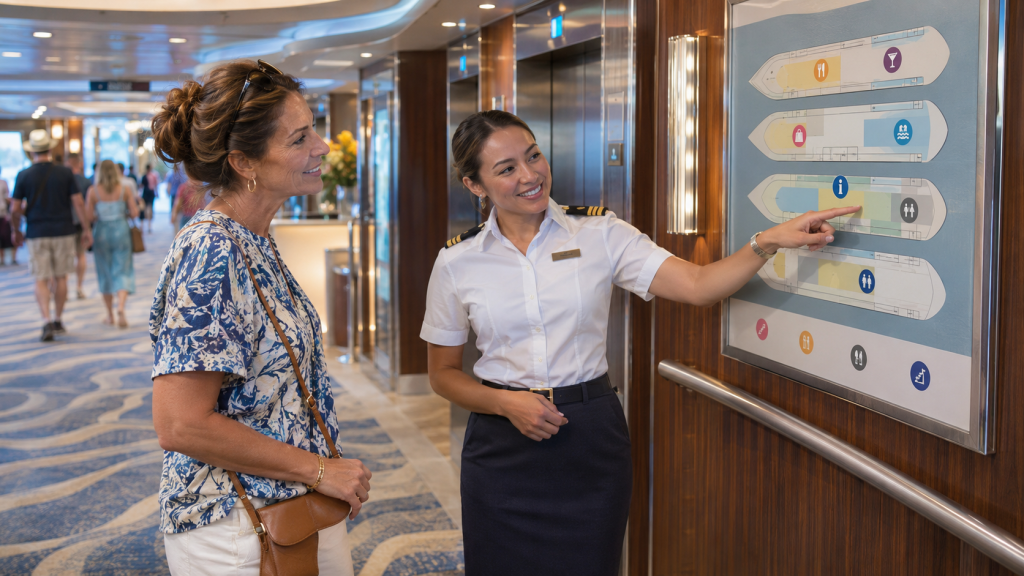
Some cruise medical centers are on lower passenger decks, but their precise locations differ between vessels.
You shouldn’t tell a first-time cruiser to head toward Deck 2 Forward, for example, unless that’s the confirmed location on the ship they’re actually sailing.
A more reliable approach is to consult the ship’s official deck plan and safety instructions.
Many ships also provide maps through their onboard information systems, although not every cruise app has a searchable medical-center listing.
If the location isn’t obvious, ask Guest Services or a nearby crew member.
You might simply say that you’d like to know where the medical center is located and which number to call if someone needs medical attention outside routine consultation hours.
That information can be recorded on your medical-contact card.
Understand the Difference Between Routine Visits and Emergencies
A routine medical visit might involve a concern that needs professional attention but doesn’t appear immediately life-threatening.
On some ships, the medical center has consultation hours for these visits and may offer appointments or walk-in care.
An emergency is different.
Top Cruise Deals From Trusted Cruise Lines
Compare exclusive online offers and find the fare that fits your trip and your budget

Serious chest pain, difficulty breathing, signs of a stroke, severe bleeding, loss of consciousness, or a major injury should trigger immediate use of the ship’s emergency procedure.
You should not try to escort someone who is seriously unwell through several decks while searching for the clinic.
Carnival, Holland America, and Royal Caribbean describe round-the-clock availability for urgent medical needs, even though routine consultation arrangements differ.
In a medical emergency, call the ship’s verified emergency number or summon a crew member who can activate the response.
Give your location, explain what’s happening, and follow the instructions you receive.
Know What the Ship’s Medical Team Can and Cannot Provide
Modern cruise medical facilities can handle many illnesses and injuries.
Depending on the vessel, they may have equipment for examination, laboratory testing, imaging, emergency stabilization, and other treatments.
However, a cruise medical center isn’t equivalent to a fully equipped land-based hospital.
The CDC explains that medical capabilities vary considerably according to the ship, itinerary, and passenger population.
Medical teams may treat certain conditions onboard while arranging shoreside consultation or evacuation when more comprehensive care is necessary.
This distinction is particularly important for travelers with established medical conditions.
Before booking a cruise, ask the operator whether the specific ship can accommodate your health requirements.
Discuss travel suitability and necessary supplies with your clinician rather than assuming a medical center can provide every specialized service you might require.
Prepare for Medical Expenses That Aren’t Included in Your Cruise Fare
It’s worth knowing how onboard medical billing works before you need treatment.
In general, medical consultations, medication, tests, and other treatments are separate from the cruise fare.
The CDC specifically notes that onboard clinical examinations, medications, and diagnostic services normally involve additional costs.

Carnival states that guests may be charged separately for professional services, pharmacy items, laboratory testing, imaging, and supplies.
It also explains that guests receive itemized documents that may be submitted to their insurance provider, rather than the ship billing the insurance plan directly.
Your own cruise line may handle payments differently.
If you purchase travel insurance through VisitorsCoverage, World Nomads, EKTA, Insubuy, or another provider, examine the policy’s medical coverage, exclusions, reimbursement process, and evacuation benefits.
Don’t assume that coverage automatically means the ship will directly bill the insurer.
Keep a copy of your policy details accessible, along with a payment method suitable for unexpected medical expenses.
Save Emergency Information Somewhere You Can Reach Without Internet
Your smartphone can be useful for storing emergency information, but it shouldn’t be your only method.
The cruise line’s app may provide shipboard services through its internal network without a paid internet package.
However, specific medical contact information and emergency communication features aren’t guaranteed to appear in every app.
Online‑Only Cruise Offers You Won’t Find Elsewhere
Unlock special pricing and start planning the sailing that matches your perfect itinerary

Save the verified medical center details as a screenshot or note that works offline.
A paper copy in your cabin can be helpful as well.
Make sure anyone traveling with you knows where that information is located.
If you’re caring for a child or traveling with someone who may require assistance, agree in advance on who will contact the medical team and who will stay with the person needing care.
These preparations take little effort but remove unnecessary decisions when something urgent happens.
Don’t Delay Reporting Symptoms That May Affect Other Passengers
Certain illnesses deserve additional attention on a cruise because passengers and crew share enclosed spaces.
Vomiting, diarrhea, fever, and respiratory symptoms can have different causes, but they may also involve contagious infections.
The CDC advises travelers who become ill during a cruise to seek care through the medical center and follow the team’s recommendations, including infection-control measures when appropriate.
If you’re feeling unwell, contact the appropriate onboard staff for guidance rather than continuing to shared dining venues or activities while trying to determine the cause yourself.
Medical staff can assess the situation and provide instructions relevant to the symptoms.
Don’t assume every case of vomiting is simply seasickness or that a fever will resolve without attention.
The appropriate response depends on your condition and the medical team’s assessment.
Have a Backup Plan for Medical Care in Port
If your medical situation requires treatment beyond what the ship can provide, the medical team may recommend evaluation or transfer to a shoreside facility.
That can involve additional transportation, medical expenses, and changes to your itinerary.
Your options depend on the seriousness of the condition, available medical resources, and the ship’s location.
Before departure, consider how your insurance addresses overseas treatment, emergency evacuation, and trip interruption.
The medical team and cruise line can help coordinate aspects of necessary care, but insurance arrangements and reimbursement aren’t guaranteed.
For first-time cruisers, this is another reason to understand the limits of onboard medical facilities without assuming a ship is equipped to handle every possible emergency.
Let Preparation Do the Work Before You Need Assistance
Knowing how to reach medical help doesn’t mean expecting something bad to happen.
It means making sure a manageable question doesn’t become more difficult because you don’t know whom to contact.
Locate the clinic, verify the emergency number, learn how routine appointments are arranged, and save the details somewhere accessible.

Luxury Cruise Experiences at Smarter Prices
See premium sailings and upgraded cabins priced for travelers who know how to book well
Then you can focus on the activities and destinations that brought you onboard.
You may never need the medical center during your first cruise, but knowing how to reach it is one of the most useful preparations you can make.
How to Locate the Medical Center and Contact Emergency Staff on Your First Cruise

If you are preparing for your first cruise and wondering how to find medical help onboard, you are not overthinking—you are planning smart.
You might be thinking about that “what if” cold that shows up on day three, a twisted ankle on the stairs, or a sudden fever after a long, sunny port day.
You might also be picturing a huge floating hotel with endless hallways and asking yourself, “If I needed help right now, would I even know where to go.”
Maybe you have seen the words medical center in the brochure, but you have no idea where it is on the ship or how to reach it from your cabin.
You might not know what a medical desk is, or how you are supposed to use the ship’s emergency hotline from your stateroom phone or the cruise app.
That uncertainty can quietly sit in the back of your mind and make you feel just a little on edge, even when everything is going perfectly.
The good news is that cruise lines expect these questions.
The truth is, cruise ships have clear systems for medical care, and once you know where the clinic is and how to reach the hotline, you can relax and enjoy your trip with real confidence.
Gain Confidence by Knowing Where Cruise Medical Help Lives
Most first-time cruisers treat health questions as background noise.
They tell themselves they will worry about it only if something happens.
Your brain, however, likes to know where the exits are, even when you never use them.
That is why a simple mental map of medical help on board can do so much for your peace of mind.
On a cruise ship, the medical center is your main hub for health care.
It is a dedicated clinic on one of the lower decks, usually near other functional spaces rather than in the middle of the pool deck or atrium.
The medical desk is the reception area inside that center.
It is the front counter where you check in, ask questions, schedule visits, and handle paperwork or payments.
The ship’s emergency hotline is the special phone number you can call from your cabin or from ship phones when something feels urgent or potentially serious.
It connects you quickly to either the medical team or a duty officer who coordinates with them.
Once you understand how these three pieces fit together—where the clinic is, where the medical desk sits inside it, and which number to call when you need help—the ship stops feeling like an unknown maze and starts feeling like a place you can navigate with purpose.
Why This Matters Before Anything Goes Wrong
When your body does something unexpected, your brain already has enough to process.
You do not want to add “figure out where to go” to that list in the moment.
Confidence Comes From Clarity, Not Guessing
Knowing the location, desk, and hotline now means that if you ever need them later, you can act instead of hesitate.
A Simple Plan Shrinks The Background Worry
You might never use the medical center, but just knowing how to find it makes the whole trip feel more secure.
Locate the Medical Center Quickly on Your Cruise Ship
Cruise ships are designed like small cities, and just like cities, the “hospital” is not usually in the middle of the shopping district.
The medical center is almost always on a lower deck, toward the front (forward) or back (aft) of the ship.
You will often find it near crew spaces, storage areas, or other operational rooms, tucked away from the main pools and lounges.
You will not have to guess, though.
Its location is:
Printed on the deck plan you get at check-in or see on the ship’s website.
Shown clearly in the cruise app under sections like “Medical,” “Health,” or “Guest Services.”
Listed on wall maps and elevator lobby diagrams throughout the ship.
Mentioned in the information booklet or safety card inside your cabin.
If you scan those materials early in the trip, you will usually see something like “Medical Center – Deck 4 Forward” or “Medical Facility – Deck 2 Midship.”
From there, it is just a matter of following signs.

Sail Away to Paradise Without Overpaying
Find cruise deals that make it easy to escape, relax, and enjoy the ocean without stretching your budget
On board, directional signage will point you toward the correct stairwells and corridors.
Once you are on the right deck, look for signs with a red cross symbol, the word “Medical,” or a similar icon.
The entrance door will often be marked clearly and may have posted hours next to it.
Using The Cruise App As Your Map
Most modern cruise lines now put the medical center right into the app alongside restaurants, bars, and theaters.
You can tap the “Map” or “Deck Plans” section, search for “Medical,” and see exactly where it is in relation to your cabin, the dining rooms, and the atrium.
Some apps even offer little route suggestions that show which stairs or elevators to use, especially on newer ships.
If you are using a travel eSIM from companies like Airalo, Drimsim, Yesim, or Sally Sim to stay connected in port, remember that the onboard app usually works over the ship’s internal network even if you do not buy an internet package.
That means you can still access maps and basic info about the medical center without paying for full Wi-Fi.
Asking Crew For Directions (Any Time, Any Place)
If you are not sure where to go, the fastest route is a human one.
Any crew member—from your cabin steward to a bartender to Guest Services—can point you toward the medical center.
You can say something as simple as, “Can you show me how to get to the medical center from here.”
They will either give you step-by-step directions or walk you to the nearest elevator and point out the signs to follow.
If the center is closed for routine hours and your need is urgent, they can also tell you what to do next, including which number to call.
Locating The Medical Center: Key Reminders
Check The Deck Plan On Day One
Circle or star the medical center on your printed or app-based map while you are still feeling great.
Use The App As A Health Compass
Even without an internet plan, the ship’s app often shows you exactly where the clinic is and how to reach it.
Crew Are Moving Maps
You never have to wander in circles; asking any crew member is part of how the system is meant to work.
Master the Medical Desk and Hotline Before You Need Them
Knowing where the medical center is gives you a destination.
Knowing how to use the medical desk and the emergency hotline tells you how to start the conversation once you arrive or pick up the phone.
The medical desk is the reception counter inside or just outside the clinic.
During posted hours, this is where you check in, ask about appointments, confirm whether walk-ins are allowed, and handle payment or insurance questions.
Think of it like the front counter at a small urgent care.
If you have a non-urgent issue—like a minor rash, a lingering cough, or a twisted ankle that hurts but does not feel critical—you will usually:
Walk to the medical center during open hours.
Check in at the medical desk by giving your name and cabin number.
Fill out any quick forms they provide.
Sit in the waiting area until a nurse or doctor is ready to see you.
If you are not sure whether the issue is urgent, you can also call from your cabin first.
The number for the medical desk or general medical line is often printed near the phone, listed in the app, or included in the cabin information booklet.
Understanding The Emergency Hotline
The emergency hotline is different.
This is the number you call when something feels serious, sudden, or scary—either for you or someone in your cabin.
The specific number varies by ship, but it is always clearly labeled in your stateroom.
You will usually see it in bold near the phone with wording like “Medical Emergency” or “Ship Emergency Number.”
If someone has chest pain, trouble breathing, severe bleeding, sudden confusion, a serious fall, or any symptom that would send you straight to the ER at home, you use this hotline.
When you call, stay as steady as you can and be ready to say:
Your name and cabin number.
Who is sick or injured.
What happened and when it started.
Whether the person is awake and breathing.
The crew member on the line will ask questions to assess how urgent the situation is.
They may send medical staff directly to your cabin, ask you to bring the person to the medical center immediately, or dispatch both crew and a wheelchair or stretcher if needed.
After-Hours Access
The medical center has posted hours for routine visits, but health issues do not always keep office hours.
That is where the emergency hotline and after-hours protocols come in.
Even when the doors are closed, you can always:
Call the medical emergency number from your cabin.
Call Guest Services and say you need medical assistance.
Use a house phone in a hallway and follow the posted instructions.
You might see a sign on the medical center door that explains this, reminding you to call instead of waiting outside.
If the situation is urgent, do not wait for regular hours.
The ship is staffed for overnight emergencies.
Medical Desk And Hotline: Practical Anchors
Use The Desk For Routine, The Hotline For Urgent
If it feels like an ER situation at home, treat it like one at sea and use the emergency number.
Keep Key Numbers Where You Can See Them
Take a photo of the emergency hotline and medical desk numbers or store them in your phone notes on day one.
Words Matter Less Than Reaching Out
You do not need perfect medical language; you only need to call, explain what you see, and let the team guide you.
Avoid These Mistakes When Searching for Medical Help Onboard
Even with good systems in place, first-time cruisers sometimes make choices that slow down care or increase stress.
Most of these mistakes come from hesitation, pride, or the belief that they are “bothering” the staff.
Wandering The Ship Instead Of Calling
One common mistake is trying to physically search for the medical center while you or someone with you feels awful.
Guests wander up and down decks, ride elevators back and forth, and get more exhausted while trying to spot a sign they vaguely remember.
In a true emergency, this wastes precious time.
In a minor situation, it just adds extra strain.
Calling Guest Services or the emergency hotline from your cabin gets you accurate directions, clear instructions, and, if appropriate, staff coming toward you instead of you trying to find them.
Treating Medical Help Like A Last Resort
Some people think, “I’ll only go if I really cannot stand it anymore.”
They push through serious symptoms for the sake of not “ruining” the trip or not spending money.
By the time they arrive at the medical desk, they are much worse than they needed to be.
On a ship, you are in a closed environment with limited outside resources.
Acting a bit earlier—especially with high fever, persistent vomiting, chest discomfort, or breathing issues—gives the medical team better room to help you.
Assuming The App Will Not Work Without Wi-Fi
Another mistake is assuming the cruise app is useless if you did not buy an internet package.
In reality, many lines allow the app to function on the ship’s internal network without a paid plan.
That means you can still see deck plans, medical center location, and contact options even if you never log into social media once.
Not Having Insurance Details Handy
When people do not plan for sick days, they also forget about the financial side.
They show up at the medical desk with no idea what their travel insurance covers, no policy number, and no plan for how to handle bills.
Providers like VisitorsCoverage, World Nomads, Ekta, and Insubuy are designed for exactly this.
If you purchased coverage before your trip, keep your digital card or policy number saved in your phone and a backup screenshot in your photo roll.
That way, you can give information to the medical desk quickly and later submit claims for covered expenses without piecing things together from memory.
Confusing Guest Services With Medical Staff
Guest Services can connect you to the medical team and explain how to reach them, but they are not your doctors.
If you try to use the front desk alone to manage a serious medical issue—asking them to diagnose you, insisting on handling everything through them—you will slow down the process.
Their job is to route you and support logistics, not to replace the clinic.
Mistakes And Better Paths
Call First, Walk Second
Use the phone or app to get clear directions and instructions before you start roaming the ship.
Treat Symptoms With Respect, Not Denial
Going a little earlier to the medical center can prevent a short problem from turning into a long ordeal.
Let Each Team Do Its Job
Guest Services guides and connects, the medical desk manages visits, and the medical team treats you; using them together keeps everything smoother.
Ease Your Biggest Cruise Health Fears With Simple Truths
Even if you know where the medical center is and how to reach it, you might still have strong emotions around the idea of getting medical help on a ship.
Those feelings are valid and worth unpacking.
Fear: “What If I Show Up And They Turn Me Away”
Some first-time cruisers picture a busy clinic where staff are annoyed with anyone who is not in a full emergency.
In practice, the medical team would much rather see you when symptoms are still manageable than wait until they are critical.
They might tell you that something is minor and can be handled with rest and over-the-counter options, but that response is a good thing.
It means you got reassurance early instead of avoiding care until things became serious.
Fear: “What If I Cannot Explain What’s Wrong Clearly”
You might worry that you will forget details, minimize or exaggerate symptoms, or not know the right words.
The ship doctor and nurses are used to this.
They know how to ask questions to get the information they need.
You can help by sharing basics—when it started, what it feels like, what you have taken already—and letting them fill in the gaps.
Fear: “What If It Is Too Expensive To Even Ask”
It is true that onboard medical care is not free.
But ignoring a true medical issue almost never saves money in the long run.
Travel insurance from companies like VisitorsCoverage, World Nomads, Ekta, and Insubuy exists specifically to help with covered medical costs, trip interruptions, and changes when health problems show up mid-travel.
If you know you have coverage, you can approach the medical desk thinking “How do we handle this properly” instead of “I cannot afford to do anything.”
Tools like Compensair and AirHelp can also help with eligible compensation if flight changes or delays connect to your situation after the cruise, giving you extra support on the travel side.
Fear: “What If Getting Sick Completely Derails My Trip”
Sometimes, yes, illness means missing a shore excursion you booked through Viator, GetYourGuide, or Klook, or skipping a day you planned to use a Go City pass or a BikesBooking.com rental.
That is frustrating.
It is also not the same as the entire trip being ruined.
Often, a day or two of proper rest and treatment lets you enjoy the rest of your cruise far more than if you had forced yourself to keep going.
Hotel platforms like Booking.com, Trip.com, Agoda, or Tripadvisor-listed stays near ports can also help if you need to extend time ashore for follow-up before flying home.
Emotional Anchors For Medical Worries
You Deserve Care, Even On Vacation
Being on holiday does not make your health less important; it just changes where you receive care.
The System Is Built Around Helping You
Medical centers, desks, and hotlines are not afterthoughts; they are core parts of how cruising works safely.
One Tough Day Does Not Define Your Whole Cruise
With support and treatment, many guests bounce back and still enjoy a big portion of their trip.
FAQ – How Can First-Time Cruisers Find Medical Help and Get Emergency Care Onboard?
Do Cruise Ships Have Medical Centers for Passengers?
Most major oceangoing cruise ships have medical facilities where passengers can receive care for illnesses and injuries.
These facilities may offer consultations, basic diagnostic testing, medications, and emergency stabilization, depending on the vessel.
However, their resources aren’t identical to those of a full-service hospital on land.
Before your first cruise, confirm what medical services are available on your particular ship, especially if you have specific healthcare needs.Where Is the Medical Center Located on a Cruise Ship?
The medical center’s location varies by ship, so there isn’t one deck or section that applies to every vessel.
You can usually find its location through the ship’s deck plan, safety information, or Guest Services.
Some onboard digital systems may also provide medical facility information.
First-time cruisers should confirm the location on embarkation day rather than relying on directions from another ship.How Do You Contact the Medical Center During Your First Cruise?
For routine medical concerns, check the ship’s instructions for contacting the medical center or arranging a consultation.
You may be directed to visit during posted hours, telephone the medical reception area, or contact Guest Services.
The procedure varies by cruise line and vessel.
Confirm the routine contact method after boarding and keep the information accessible throughout your sailing.What Number Should You Call for a Medical Emergency on a Cruise Ship?
Use the emergency telephone number or contact procedure officially provided by your ship.
Emergency numbers differ between vessels, so you shouldn’t assume a number mentioned online will work during your sailing.
Look for the information in your cabin’s emergency instructions or confirm it with Guest Services.
Save the verified number before an emergency occurs and make sure your traveling companions know how to use it.Is Cruise Ship Medical Assistance Available 24 Hours a Day?
Major oceangoing cruise operators generally provide medical personnel who can respond to urgent situations around the clock.
However, the medical center may have separate hours for routine consultations and appointments.
These arrangements differ between ships and cruise lines.
First-time cruisers should confirm both the regular clinic schedule and the procedure for receiving emergency assistance outside those hours.What Should You Do if Someone Has a Medical Emergency in Their Cabin?
Call the ship’s verified emergency number immediately and explain the person’s symptoms and exact location.
Tell the responding staff whether the individual is conscious, breathing normally, or experiencing serious bleeding or another urgent problem.
Follow the medical response team’s instructions rather than attempting to transport an unstable person through the ship.
If you cannot reach a telephone, urgently summon a crew member to activate the ship’s emergency procedure.Should You Walk to the Medical Center During a Serious Emergency?
No, you shouldn’t delay emergency assistance by searching for the clinic or trying to move someone who is seriously unwell.
Call the ship’s emergency number or alert a crew member who can activate the appropriate response.
Medical staff can determine whether the patient should remain where they are, receive assistance nearby, or be transferred to the clinic.
For your first cruise, learning how to call for help is just as important as knowing the clinic’s location.What Is the Medical Desk on a Cruise Ship?
The term medical desk generally refers to the reception or check-in function associated with a ship’s medical facility.
Depending on the operator, passengers may use it to ask about appointments, register for care, or handle administrative questions.
Not every ship uses the same terminology or provides a separate reception desk.
Ask the crew about routine medical check-in procedures rather than assuming every vessel has an identically arranged facility.Can You Use a Cruise Line App to Find Medical Help?
Some cruise apps provide deck plans, shipboard service information, or ways to contact Guest Services.
However, the availability of medical-center locations and emergency contact features differs between operators and app versions.
You shouldn’t rely exclusively on an app during an emergency.
Confirm the official emergency telephone procedure onboard and keep the information available without requiring internet access.Can You Access the Ship’s Medical Center Without Buying Wi-Fi?
Access to medical care doesn’t depend on purchasing a cruise internet package.
You can follow the ship’s instructions, use available ship telephones, or contact a crew member to request help.
Some routine app functions also work through internal networks without paid internet, although features vary.
First-time cruisers should confirm how to contact medical staff directly rather than assuming internet access is necessary.Does It Cost Money to See a Doctor on a Cruise Ship?
Yes, onboard consultations and medical treatment commonly involve additional charges beyond the cruise fare.
Depending on the situation, separate fees may apply to examinations, medications, diagnostic testing, imaging, or other services.
Payment arrangements differ between cruise lines.
Before your first cruise, review your insurance coverage and ask the medical facility about billing procedures when it’s appropriate to do so without delaying urgent treatment.Will Your Travel Insurance Cover Medical Treatment on a Cruise Ship?
Travel insurance may cover eligible medical treatment received during a cruise, but benefits depend on the particular policy.
Coverage limits, exclusions, pre-existing condition provisions, and reimbursement requirements can affect claims.
Some cruise medical facilities require passengers to pay for care and later seek reimbursement rather than billing insurers directly.
Review the policy’s medical and evacuation provisions before departure and retain the documentation needed for a claim.Can Cruise Ship Doctors Treat Serious Medical Emergencies?
Cruise medical teams can provide emergency assessment and stabilization within the capabilities of their facilities.
However, some serious conditions require equipment, specialists, or treatment unavailable onboard.
In those situations, the medical team may recommend transfer to a suitable shoreside facility.
Your cruise itinerary and the vessel’s location can affect how quickly additional care can be reached.What Happens if You Need to Be Evacuated from a Cruise Ship for Medical Care?
When onboard care is insufficient, the medical team may arrange consultation or transfer to a shoreside medical facility.
Depending on the location and circumstances, evacuation may involve a port call, boat transfer, or other transport arrangements.
The process and expenses can be substantial, and insurance coverage isn’t automatic.
Travelers with particular medical risks should consider these possibilities with their clinician and review appropriate medical evacuation coverage before sailing.Should You Visit the Medical Center for Seasickness?
Persistent or severe seasickness may require medical assessment, especially if you’re unable to keep fluids down or have symptoms that could indicate another condition.
Mild motion sickness can sometimes be managed using measures recommended by your clinician or pharmacist before travel.
However, vomiting or dizziness shouldn’t automatically be assumed to be seasickness.
Contact the ship’s medical team if symptoms are severe, worsening, unusual, or accompanied by other concerning signs.What Should You Do if You Develop a Fever or Stomach Illness on Your First Cruise?
Contact the ship’s medical team for guidance, particularly if you have persistent vomiting, diarrhea, fever, or symptoms that are worsening.
Some illnesses can spread easily in shared cruise environments, making prompt reporting important.
Follow the medical team’s instructions regarding examination, treatment, hygiene, and any temporary activity restrictions.
Avoid assuming you should continue participating in dining and group activities while potentially contagious.Can You Get Prescription Medication from a Cruise Ship Medical Center?
Cruise medical centers may stock medications for common illnesses and emergencies, but their inventories are limited.
You shouldn’t assume that your specific prescription, brand, formulation, or dosage will be available onboard.
Bring an adequate supply of necessary medication in accordance with travel requirements and your clinician’s advice.
For important ongoing treatment, discuss your needs with the cruise line before booking or departure.Should You Tell the Cruise Line About Medical Conditions Before Sailing?
Passengers with specific medical requirements should contact the cruise line to learn whether the ship can accommodate their needs.
This is particularly important when travel involves specialized equipment, treatment, accessible arrangements, or conditions requiring close medical management.
You should also consult your treating clinician about the suitability of the itinerary.
Advance planning can identify limitations that would be difficult to address after the ship leaves port.What Information Should You Keep Ready for a Medical Visit on Your First Cruise?
Keep your relevant medical information, medication list, allergy details, and travel insurance information accessible when appropriate.
It can also be useful to have contact information for your treating clinician and details of any important recent treatment.
For routine care, the medical team may ask when symptoms started and what treatment you’ve already used.
In a serious emergency, contacting medical assistance takes priority over gathering paperwork.What Is the Simplest Medical Emergency Plan for Your First Cruise?
On embarkation day, confirm the medical center’s location and the ship’s official emergency telephone number.
Find out how routine consultations work and what to do when the clinic isn’t open for ordinary visits.
Save the information offline, keep prescribed medication accessible, and explain the emergency procedure to anyone traveling with you.
If serious symptoms occur, call for medical assistance immediately instead of trying to find the clinic yourself.
Plan Your Next Cruise!

Experience the Ultimate Vacation with Carnival Cruise Line’s Fun Ships, World‑Class Entertainment, and Relaxation
One Delay Can Cost Your Entire Cruise A quick coverage check now protects you from the problems no one sees coming….
From Icon to Oasis: Explore Royal Caribbean’s Groundbreaking Ships and Unforgettable Voyages
One Delay Can Cost Your Entire Cruise A quick coverage check now protects you from the problems no one sees coming….

Discover Silversea Cruises: Ultra‑Luxury Voyages to the World’s Most Exclusive Destinations
One Delay Can Cost Your Entire Cruise A quick coverage check now protects you from the problems no one sees coming….

Sail Into Timeless Luxury: Cunard Cruises for Transatlantic Elegance and Destination‑Rich Voyages
One Delay Can Cost Your Entire Cruise A quick coverage check now protects you from the problems no one sees coming….
Explore More

Dine Like Royalty: Cruise Room Service Secrets for Every Cabin & Budget

Make The Most Of Your Cruise Sea Day: From Poolside Fun to Gourmet Evenings

Avoid Costly Losses: Cruise Refund Rules, Cancellation Deadlines, and Insurance Recovery