Cruising during hurricane season doesn’t mean chaos—it means confidence.
Behind the scenes, cruise lines use advanced weather intelligence, agile rerouting, and nonstop communication to keep every guest safe.
From satellite tracking to predictive analytics, these systems transform uncertainty into precision, letting you enjoy your voyage without fear.
Understanding these safeguards turns worry into trust, letting you enjoy your voyage without fear.
Cruise guests may only see clear skies and calm waters, but behind the scenes, teams of meteorologists, captains, and shore-based command centers are making split-second decisions to protect thousands of lives.
The safety playbook used by modern cruise lines is both complex and surprisingly reassuring.
From real-time satellite monitoring to agile itinerary rerouting, the system is built on redundancy, foresight, and unwavering communication.
In this guide, you’ll discover exactly how cruise lines prepare for hurricanes, what happens when one forms mid-voyage, and how technology has made today’s cruising safer than ever.
You’ll also learn what guests can expect if their itinerary shifts, how compensation is handled, and why weather-related diversions often create unexpected travel rewards.
Decode Hurricane Risks Using Real-Time Weather Intelligence
Cruise lines don’t rely on luck.
They rely on data—massive, continuous streams of atmospheric information collected from satellites, radars, and ocean buoys across the world’s storm belts.
Every major cruise operator employs full-time meteorologists who monitor global weather models 24/7, sometimes even weeks in advance of potential storm formation.
Unlock Your Dream Cruise with Exclusive Online Deals!
These experts analyze high-resolution forecasts from agencies such as the National Hurricane Center, the European Centre for Medium-Range Weather Forecasts, and private maritime data networks.
The goal is to detect not only the path of a storm but also its potential intensity and speed.
Once a tropical disturbance forms, cruise lines immediately flag it for observation, creating daily forecast updates that feed directly to ship captains and route planners.
Most cruise ships now receive direct satellite uplinks that stream weather overlays onto their navigation systems.
Captains can visualize real-time storm cells, pressure changes, and wind patterns within seconds.
This means that even if a hurricane shifts unexpectedly, ships have the information they need to adjust course hours or days before encountering danger.
Cruise weather tracking is a seamless fusion of technology and human expertise.
It represents one of the most advanced forms of civilian meteorology in the world—rivaling the forecasting precision used by airlines and global shipping companies.
How Cruise Lines Keep Seas Calm and Guests Confident During Storms
- You are safer at sea than most people realize, even during hurricane season.
- Modern forecasting allows ships to completely avoid direct hurricane impact zones.
- Onboard systems refresh data constantly, ensuring up-to-the-minute decision-making.
- Cruise meteorologists collaborate with global agencies for redundant verification.
- The process runs continuously, 24 hours a day, throughout the voyage.
Reroute With Confidence: How Cruises Avoid Hurricanes Smoothly
When a hurricane forms, the first and most important response from cruise lines is route flexibility.
Ships rarely, if ever, attempt to “ride out” a storm.
Instead, they pivot—often days in advance—redirecting to calmer seas or safer ports.
These adjustments are handled with remarkable agility.
Cruise lines maintain multiple pre-approved itineraries for each ship, allowing them to substitute ports and sailing paths almost instantly.

Grab Your Ticket to Paradise with These Deals!
The captain, in collaboration with the cruise line’s operations center, evaluates potential alternatives using three criteria: distance from the storm, port availability, and guest experience quality.
For example, if a ship was scheduled for the Eastern Caribbean but a storm develops near the Bahamas, the itinerary might shift toward the Western Caribbean, visiting ports like Cozumel or Grand Cayman instead.
Guests still enjoy their vacation while the ship stays well clear of hazardous weather.
These decisions are not made lightly.
Each rerouting involves coordination with port authorities, excursion providers, and onboard logistics teams.
Yet for passengers, the process feels nearly effortless—most learn about the change via a calm announcement from the captain, followed by an updated itinerary on their stateroom televisions.
Cruise lines also use their sheer size and global presence to provide flexible alternatives.
Sister ships in the same fleet may trade port calls or stagger arrivals to ensure all guests receive comparable experiences despite last-minute shifts.
Key Takeaways for Travelers
- Cruise lines never sail directly into a storm; rerouting is standard practice.
- Itineraries can be switched with minimal disruption to guests.
- Backup ports are pre-vetted for smooth transitions.
- Decisions are data-driven and based on real-time forecasts.
- Guest safety always overrides schedule commitments.
How Cruise Captains Navigate Hurricanes to Protect Your Voyage
Every cruise ship captain undergoes rigorous training not only in navigation but also in emergency meteorology.
These are not passive overseers—they are hands-on decision-makers responsible for interpreting meteorological data and translating it into real-world action.
Captains use advanced bridge technology that integrates wind mapping, wave height predictions, and ocean current analysis.
Combined with constant communication from shore-based command centers, they maintain an evolving mental map of the surrounding weather environment.
Click for Exclusive Offers on Top Cruise Lines!
When a storm intensifies, captains can adjust course degrees at a time, optimizing distance and comfort simultaneously.
Communication with passengers plays a critical role in maintaining calm.
The best captains know that confidence is contagious.
They address guests with clarity, explaining why a route has changed and what the new itinerary offers instead.
This transparent approach prevents panic and reinforces trust.
Behind the scenes, bridge officers monitor the ship’s performance continuously—tracking stabilization systems, propulsion efficiency, and hull stress levels.
Today’s cruise ships are marvels of balance, capable of counteracting even rough seas through automated stabilizers that reduce motion by up to 90%.
Why Captains Inspire Confidence
- Each captain is trained for hurricane navigation and emergency rerouting.
- Decision-making is always proactive, never reactive.
- Communication with passengers is transparent and steadying.
- Stabilization technology keeps motion minimal even in rough waters.
- Crew drills ensure all departments know their storm response roles.
Inside the Command Centers That Outsmart Hurricanes and Protect Cruises
What passengers rarely see is the command center that supports every ship at sea.
These facilities resemble high-tech war rooms—filled with digital maps, weather projections, and communication consoles linking to every vessel in real time.
A cruise line’s Global Maritime Operations Center (GMOC) operates around the clock.
Staffed by navigators, meteorologists, engineers, and safety officers, it monitors every ship’s position relative to global weather systems.
When a hurricane emerges, the GMOC becomes a nerve center of analysis and coordination.
The center compares data from multiple forecasting agencies, simulates possible storm paths, and recommends course adjustments.

Experience Luxury Cruises at Unbeatable Prices Today!
They coordinate with regional governments, port authorities, and coast guards to pre-clear any itinerary changes.
This allows the fleet to move with remarkable fluidity—redirecting ships to alternate ports before the public even realizes a storm is coming.
These teams also handle guest logistics such as travel advisories, embarkation timing, and airport coordination if departures are delayed.
It’s an intricate ballet of communication that ensures minimal disruption while maintaining total safety.
Behind the Curtain Insights
- Each ship is tracked 24/7 through real-time satellite and AIS systems.
- Operations centers are staffed by experts in weather science and navigation.
- Coordination with global port authorities allows seamless rerouting.
- Data simulation predicts storm paths days before they’re visible on news maps.
- Every decision is guided by safety protocols refined over decades of practice.
Turn Hurricane Detours Into Unforgettable Cruise Adventures
The idea of a hurricane diversion may sound disruptive, but for many travelers, it becomes one of the most memorable parts of their cruise.
Cruise lines are experts at turning unexpected detours into seamless experiences.
When an itinerary changes, the onboard entertainment and activities teams adapt instantly.
Shows, excursions, and themed events are rescheduled or replaced to match new destinations.
Dining teams source local ingredients from alternate ports, ensuring menus still feel regionally inspired.
Communication remains constant.
Guests receive updates through the ship’s app, cabin announcements, and printed bulletins.
Many cruise lines even host informational sessions where officers explain weather updates and answer questions directly.
This transparency transforms uncertainty into assurance.
Financially, guests are often protected by flexible compensation policies.
Depending on the cruise line and situation, travelers may receive partial refunds, onboard credits, or discounted future cruises.
The goal is always fairness and guest satisfaction, even when nature intervenes.
Hurricane Diversion Highlights
- Onboard teams re-engineer experiences for smooth transitions.
- Real-time communication keeps guests informed and confident.
- Culinary menus shift dynamically with port availability.
- Compensation is handled transparently and generously.
- Diversions often introduce guests to new, unexpected destinations.
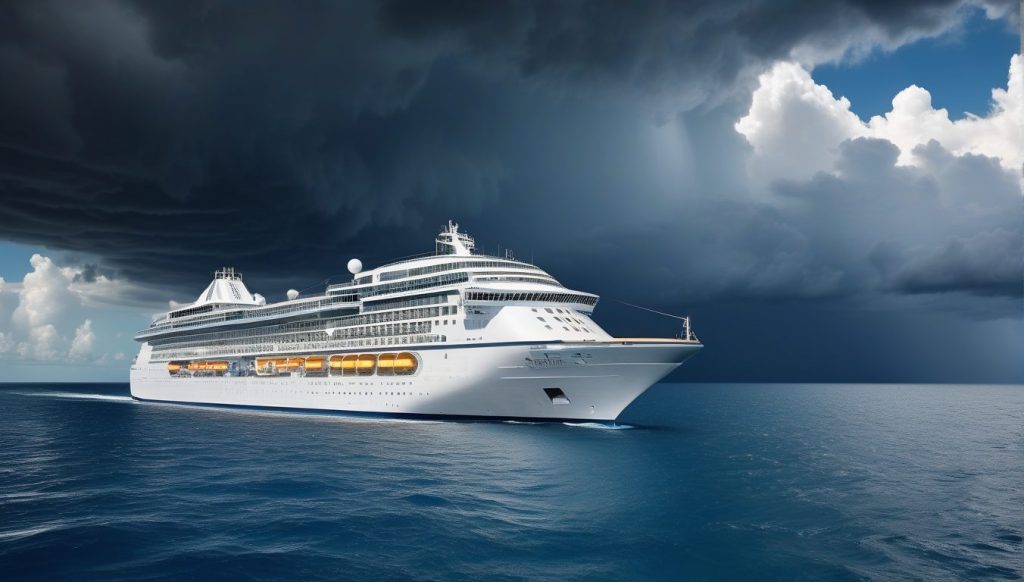
Cruise Tech That Outsmarts Hurricanes and Protects Your Journey
Over the past two decades, technological evolution has transformed hurricane avoidance from educated guesswork into scientific precision.
Cruise ships now integrate predictive analytics, AI-driven forecasting, and real-time ocean modeling into every voyage.
Computer systems aboard modern ships combine multiple data streams, creating digital twins of the surrounding ocean environment.
These simulations project wave behavior, temperature gradients, and wind shear levels—all critical elements in predicting storm movement.
Some cruise lines even use machine learning algorithms to study decades of historical storm data.
This allows predictive software to estimate likely routes long before storms officially form.
Combined with direct communication links between ship and shore, the result is a proactive, nearly foolproof safety network.
In recent years, advancements in propulsion and stabilizer technology have further enhanced safety.
Newer ships feature azipod propulsion, which provides 360-degree maneuverability—critical for fine-tuning course adjustments away from storm zones.
What Technology Means for You
- AI and predictive analytics allow days of advance storm avoidance.
- Ships are equipped with full redundancy in communication and navigation.
- Modern stabilizers dramatically reduce passenger discomfort in rough seas.
- Propulsion systems enable rapid, precise maneuvering.
- Data sharing between ships and shore ensures total situational awareness.
What Happens When Hurricanes Cancel Cruises—and How Lines Keep You Covered
In rare cases where a hurricane makes embarkation impossible, cruise lines follow established contingency plans designed to protect travelers and staff.
These plans include port closures, delayed departures, or even voyage cancellations—but always with clear communication and customer support.
Guests are typically notified via email, text alerts, and direct phone calls from the cruise line.
Flexible rebooking options are provided immediately, often with generous credits or full refunds.
Some lines even help rebook flights or hotel stays for affected guests.
The decision to cancel is never taken lightly.
Cruise lines weigh meteorological data, port readiness, and coast guard advisories before making any announcement.
Transparency remains central—customers are kept informed every step of the way.
Storm Cancellation Key Facts
- Cancellation is a last resort, triggered only by official advisories.
- Guests receive prompt rebooking and compensation options.
- Safety and comfort always take precedence over revenue.
- Communication channels stay open until the situation resolves.
- Most cancellations occur before embarkation, not mid-voyage.
Why Cruise Lines Thrive During Hurricane Season—and Keep Guests Confident
Despite the challenges of hurricane season, the cruise industry continues to thrive.
Its resilience lies in preparation, adaptability, and technology.
Over decades, cruise lines have refined a playbook that transforms nature’s unpredictability into a controlled, predictable operation.
What’s more, the industry invests heavily in safety innovation.
From advanced hull designs to environmental sensors, each generation of cruise ships becomes more capable of navigating volatile weather.
This dedication ensures not only operational continuity but also guest confidence.
For travelers, this means that cruising remains one of the safest, most regulated forms of leisure travel on Earth.
Even during hurricane season, the odds of major disruption are extraordinarily low.
Resilience Insights
- Cruise ships are engineered for both comfort and survival.
- Decades of experience drive every operational decision.
- Investment in weather technology continues to expand yearly.
- Passenger confidence is built through transparency and reliability.
- The system’s efficiency is a testament to maritime innovation.
Cruise Without Fear: How Ships Stay Secure During Hurricane Season
For travelers who hesitate to book a cruise between June and November, understanding how hurricanes are handled changes everything.
The combination of technology, training, and global coordination ensures that no ship is ever left vulnerable.
Booking during hurricane season can even have benefits—lower prices, fewer crowds, and access to unique itineraries.
With modern rerouting systems, most passengers never experience a storm at all.
Cruise lines have mastered the art of adapting to nature without sacrificing luxury or safety.
Whether the ship sails east, west, or simply delays departure for a few hours, every choice is made with precision and care.
Sailing in hurricane season isn’t about risk.
It’s about trust—trust in an industry that has turned centuries of maritime wisdom into seamless modern protection.
FAQ – Cruise Safety and Hurricane Season Confidence
What happens if a hurricane forms during my cruise?
Cruise lines immediately activate rerouting protocols to avoid storm zones.
Captains receive real-time weather data and adjust course well before impact.
Guests are notified calmly and clearly, often with upgraded itineraries.
Safety always overrides schedule, and diversions often lead to unexpected travel rewards.Will my cruise be canceled if a hurricane hits the departure port?
Cruise lines only cancel voyages when port closures or coast guard advisories make embarkation impossible.
Guests receive prompt updates via email, text, and phone.
Flexible rebooking, refunds, or credits are offered immediately.
Some cruise lines even assist with flight and hotel changes to support affected travelers.How do cruise ships avoid hurricanes at sea?
Cruise ships use satellite weather overlays, predictive analytics, and onboard meteorologists to track storms.
Captains reroute days in advance using alternate itineraries and port substitutions.
Ships never sail into hurricanes and maintain wide buffers from storm paths.
Technology and training ensure proactive, not reactive, decision-making.Will I feel the storm if my cruise is rerouted?
Modern cruise ships use automated stabilizers that reduce motion by up to 90%.
Rerouting keeps ships in calm waters, far from storm impact zones.
Guests often report smooth sailing even during hurricane season.
Onboard systems constantly monitor wave height and propulsion efficiency for comfort.What kind of compensation is offered if my itinerary changes?
Cruise lines offer onboard credits, partial refunds, or future cruise discounts depending on the situation.
Compensation is communicated transparently and fairly.
Guests are kept informed through apps, announcements, and printed updates.
The goal is always guest satisfaction, even when nature intervenes.How do captains make decisions during hurricanes?
Captains are trained in emergency meteorology and storm navigation.
They interpret weather data and collaborate with shore-based command centers.
Decisions are made proactively to optimize safety and comfort.
Clear communication with passengers builds trust and prevents panic.Are cruises safe to book during hurricane season?
Cruising during hurricane season is safer than most travelers realize.
Ships are equipped with advanced weather tracking and flexible rerouting systems.
Lower prices and fewer crowds make this season attractive for savvy travelers.
Cruise lines have mastered storm avoidance without sacrificing luxury or safety.How do cruise lines track storms before they form?
Cruise meteorologists monitor global weather models and satellite data 24/7.
They analyze forecasts from agencies like the National Hurricane Center and ECMWF.
Potential storms are flagged early, and ships receive daily updates.
This predictive system rivals the precision used by airlines and global shipping firms.What role do shore-based operations centers play during hurricanes?
Global Maritime Operations Centers track every ship in real time.
They simulate storm paths and recommend rerouting strategies.
These centers coordinate with ports, governments, and coast guards for seamless transitions.
Their goal is total situational awareness and uninterrupted guest safety.Can I get travel insurance that covers hurricane disruptions?
Yes, travel insurance providers like VisitorsCoverage, Ekta, Insubuy, and Compensair offer hurricane-related coverage.
Policies may include trip cancellation, delay protection, and emergency assistance.
Booking insurance adds peace of mind during storm season.
Always review policy details to ensure hurricane coverage is included.
Plan Your Next Cruise!
Escape To Paradise: Inside The Exclusive World of Cruise Line Private Islands
A cruise line’s private island isn’t just another stop on your itinerary—it’s a curated slice of paradise designed exclusively for guests….

Experience the Perfect Blend of Disney Magic, Luxury Cruising, and Family Adventure at Sea
Disney Cruise Line transforms every voyage into a seamless blend of luxury cruising and beloved Disney storytelling. Each ship in the…

Sail in Style: Oceania Cruises’ Culinary Excellence, Cultural Immersion, and Refined Luxury
Oceania Cruises offers a refined, all‑inclusive cruise experience that blends world‑class dining, immersive cultural exploration, and elegant ship design. With intimate…

Sail Boldly: Experience Virgin Voyages’ Adults‑Only Cruises With Style, Freedom, And Fun
Virgin Voyages is rewriting the rules of cruising with ships designed exclusively for adults who crave style, freedom, and unforgettable experiences….