One Delay Can Cost Your Entire Cruise
A quick coverage check now protects you from the problems no one sees coming.
Short Excerpt
- Discover why midship cabins on lower passenger decks are often preferred by travelers concerned about rough seas.
- Understand how forward, aft, and higher-deck cabins differ in movement, views, and possible noise.
- Compare inside, ocean-view, and balcony cabins without assuming that one category prevents seasickness.
- Use an interactive cabin comparison planner to evaluate your choices before booking.
Quick Take
- A midship cabin on a relatively low passenger deck is generally a sensible starting point if you’re concerned about ship movement.
- Cabin location can influence how much pitching and rolling you feel, but no cabin can eliminate motion or guarantee a comfortable voyage.
- An ocean view may help some passengers manage motion sickness by providing a visible horizon.
- Higher decks, forward cabins, and aft cabins may offer attractive views, but they involve different motion and noise considerations.
- Choosing your exact cabin is preferable to a guarantee booking when its location is especially important to you.
- Hurricane-season weather can change cruise itineraries, but your cabin choice does not determine whether the ship can safely avoid a storm.
Can the Right Cruise Cabin Make Hurricane-Season Sailing More Comfortable?
You find an appealing Caribbean cruise, choose your dates, and begin browsing the available cabins.
Then a familiar concern appears: What happens if the seas become rough?
If you’re traveling during hurricane season, it’s understandable to give that question extra attention.
The good news is that you can make an informed cabin choice without trying to predict exactly what the ocean will do.
Where your cabin sits along the ship and how high it is above the waterline can influence the movement you experience.
A thoughtfully chosen location may make resting, sleeping, and spending time in your stateroom more comfortable.
For passengers prone to motion sickness, midship cabins on lower passenger decks are often a useful starting point.
But there’s an important qualification: no cabin is immune to the movement of the ocean, and the effects of ship motion vary with the conditions, the vessel, and the individual traveler.
The Atlantic hurricane season officially runs from June 1 through November 30.
Cruise lines monitor developing tropical systems and may adjust itineraries, but weather changes can still produce swells, wind, delays, and uncomfortable sea conditions. (National Hurricane Center — Tropical Cyclone Climatology)
Choosing the right cabin won’t prevent a hurricane or control a captain’s route.
What it can do is help you avoid some unnecessary discomfort while selecting a stateroom that suits your budget, sleeping preferences, and travel needs.
Let’s begin with the part of the decision you can control: cabin location.
Cruise Cabin Comfort Comparison Planner
Not sure whether a lower-deck midship interior cabin is a better choice than a higher balcony near the bow?
Use this interactive planner to compare up to three cabins.
Enter their locations and key features, then review which option better matches common motion-comfort considerations.
The planner does not measure actual ship movement, predict seasickness, or assign a safety rating.
It provides a transparent comparison of the cabin features you’ve selected.
Cruise Cabin Comfort Comparison Planner
Compare up to three staterooms using location, deck height, cabin type, and possible noise. Results are planning guidance, not guarantees.
Your comparison result
Midship and lower-deck locations are preferred for motion comfort. The chosen priorities adjust the comparison. No cabin can guarantee less seasickness or safe conditions.
Review actual ship deck plans, cabin access, and nearby facilities. This tool does not assess weather, vessel safety, medical needs, or price.
Why Midship Cabins on Lower Decks Are Often More Comfortable
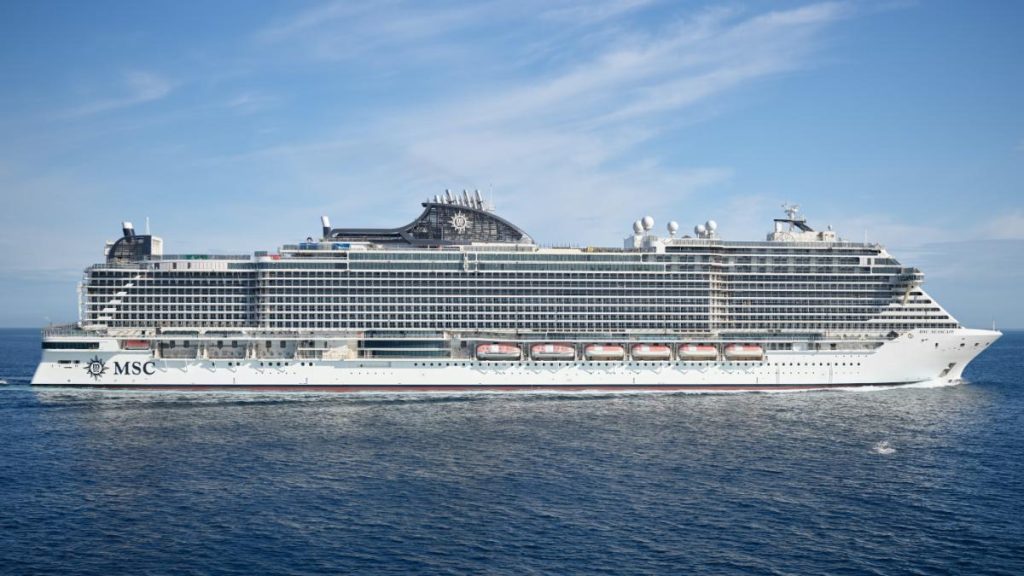
To understand the cabin-location advice, it helps to picture how a ship moves through the water.
A cruise ship can experience several kinds of movement, including rolling from side to side, pitching as the bow and stern rise and fall, and vertical movement caused by passing waves.
The amount of movement depends on wave height, wave direction, vessel characteristics, speed, and other conditions.
A cabin’s position determines how some of these movements are experienced.
Midship Reduces the Effects of Pitching
Pitching occurs when the bow and stern rise and fall in response to the sea.
Cabins toward the ends of the vessel can experience greater vertical movement from pitching than cabins located closer to the middle.
Think of a seesaw: the ends travel farther than positions nearer the pivot.
A cruise ship is considerably more complex, but the analogy helps explain why midship cabins are often preferred by passengers concerned about motion.
Cruise cabin guides commonly recommend choosing a lower-deck midship location for passengers prone to seasickness. (Royal Caribbean Blog — Best Cabin Locations)
Lower Decks Can Reduce the Effects of Rolling
Rolling is the side-to-side tilting motion of a ship.
When the ship rolls through an angle, locations higher above its roll axis can move through a greater side-to-side distance.
This is one reason lower passenger decks are commonly recommended for people who dislike noticeable movement.
However, lower doesn’t automatically mean better in every respect.
Top Cruise Deals From Trusted Cruise Lines
Compare exclusive online offers and find the fare that fits your trip and your budget
The lowest available passenger deck may be close to machinery, service areas, gangways, or other operational spaces.
Cabin suitability depends on the actual ship layout.
Choose a reasonably low passenger deck with an acceptable surrounding environment rather than automatically booking the lowest numbered deck.
Why a Midship Location Is a Preference, Not a Guarantee
The ship’s movement isn’t determined by one simple pivot point, and its different motions can occur simultaneously.
A midship cabin may reduce the sensation associated with pitching, while a lower deck can reduce certain rolling effects.
But the ship can still move noticeably in rough conditions.
Some passengers feel motion sickness even in the most central available cabin, while others remain comfortable in forward or aft staterooms.
The objective is to improve your chances of comfort—not to identify a supposedly motion-proof room.
Forward, Midship, and Aft Cabins: What Changes?
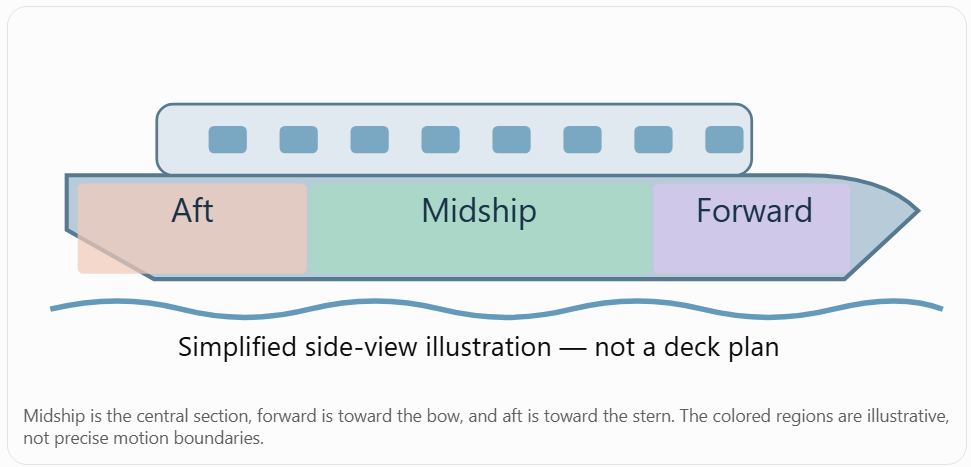
Every location has advantages and compromises.
A forward cabin might offer appealing views and proximity to certain public spaces.
An aft balcony might provide a distinctive ocean perspective, while midship cabins can make it easier to reach facilities distributed across the vessel.
If motion sensitivity is your main concern, however, those trade-offs deserve careful attention.
Forward Cabins: Attractive Views With More Pitching Potential
The forward section is near the bow, where the ship meets approaching water.
During certain sea conditions, forward cabins can experience pronounced vertical movement as the bow rises and falls.
Depending on the ship and cabin location, passengers may also notice sounds or vibration associated with wave impacts or other ship operations.
These effects aren’t constant, and a forward cabin may feel perfectly comfortable in favorable conditions.
But if you already know that up-and-down movement makes you nauseated, an extreme forward location is generally less appealing than a comparable midship option.
Aft Cabins: Excellent Views, With Different Movement and Noise Considerations
Aft cabins sit toward the stern.
Some passengers particularly enjoy aft-facing balconies because of their expansive views over the water behind the ship.
However, these cabins may experience greater pitching movement than central locations.
Certain aft cabins can also be affected by vibration or other operational sounds, although this varies considerably by ship.
Online‑Only Cruise Offers You Won’t Find Elsewhere
Unlock special pricing and start planning the sailing that matches your perfect itinerary
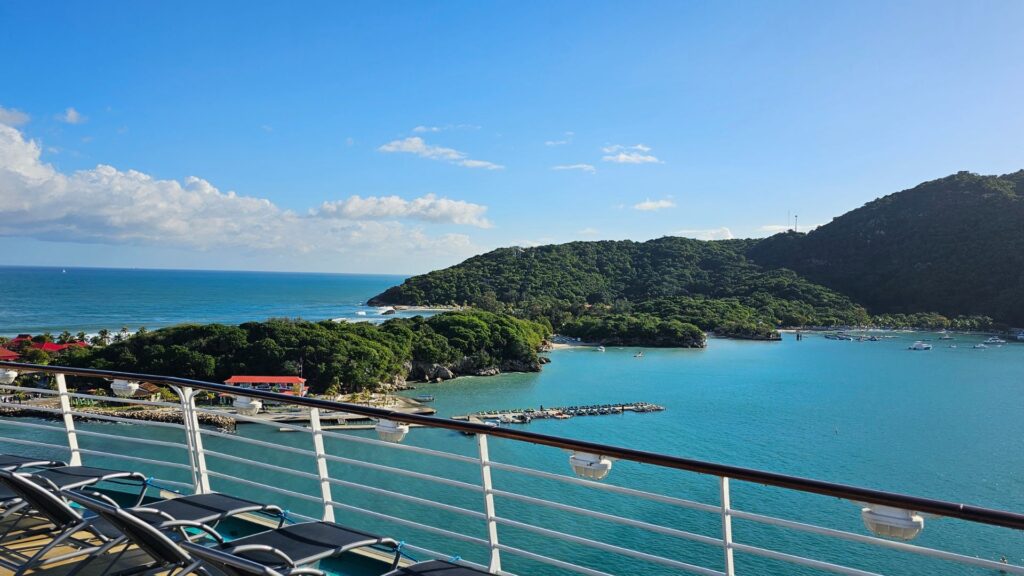
An aft cabin isn’t automatically noisy, and the visible wake shouldn’t be confused with the cause of all movement passengers feel there.
If you’re considering one, inspect the actual deck plan and look for reliable information about the cabin’s specific location.
Midship Cabins: A Practical Starting Point for Motion-Sensitive Travelers
Midship cabins often provide the most useful compromise for passengers who want to minimize pronounced movement.
A location near the ship’s central section reduces distance from the ends of the vessel, while lower passenger decks can limit some of the side-to-side movement associated with rolling.
Midship also frequently places passengers within reasonable walking distance of different onboard facilities.
However, don’t assume every cabin labeled midship has identical characteristics.
A cabin near a busy elevator lobby, nightclub, theater, or other activity area may introduce noise even if its location is otherwise appealing.
For a better decision, compare the exact cabin number and surrounding decks.
Is an Inside, Ocean-View, or Balcony Cabin Better for Seasickness?
Cabin category introduces another choice: do you want to see the ocean while you’re inside your room?
The answer can matter because motion sickness involves the relationship between movement sensed by the body and visual information received by the eyes.
According to the CDC, looking at a stable horizon can help reduce motion sickness in some situations, while reading or focusing on close objects during movement can make symptoms worse. (CDC Yellow Book — Motion Sickness)
This complicates the common claim that inside cabins are automatically the best option for motion-sensitive passengers.
Inside Cabins: A Budget-Friendly Option That Can Work Well
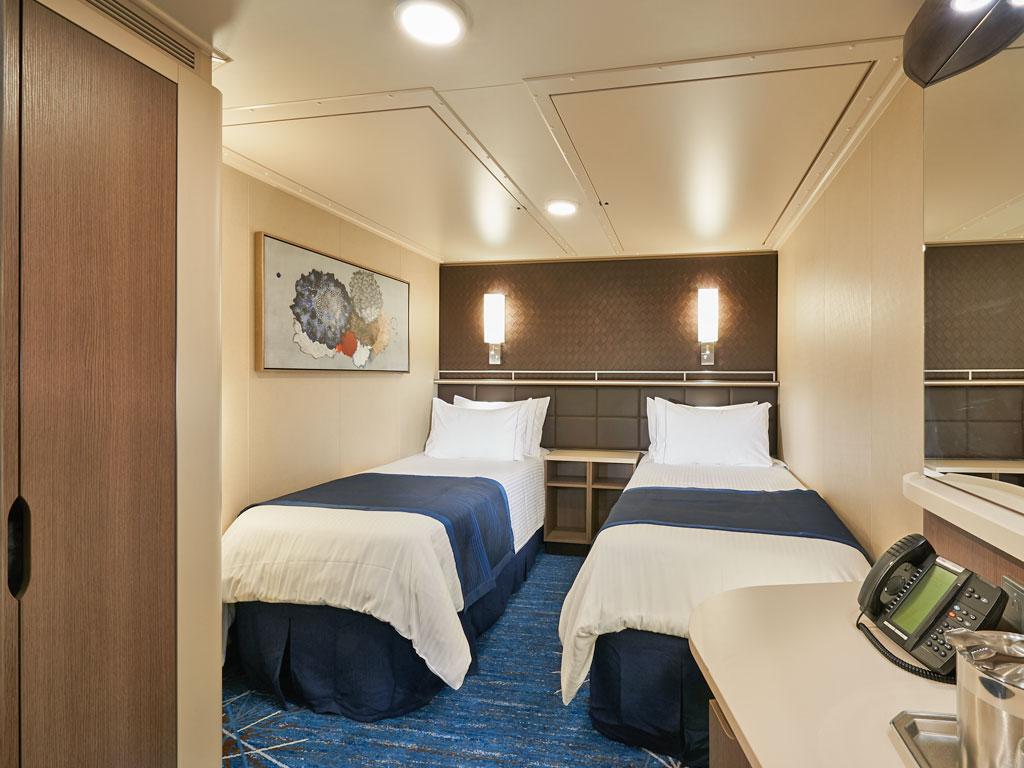
An inside cabin has no conventional exterior ocean-view window.
Many are available on lower passenger decks, sometimes in central parts of the ship.
If your priority is spending less while choosing a favorable location, a lower-deck midship inside cabin may be an attractive option.
The trade-off is that you can’t look toward the horizon from the room.
Some passengers prefer the enclosed, dark sleeping environment, while others find the absence of an outside visual reference uncomfortable when the ship moves.
There’s no universal answer.
Ocean-View Cabins: A Useful Compromise
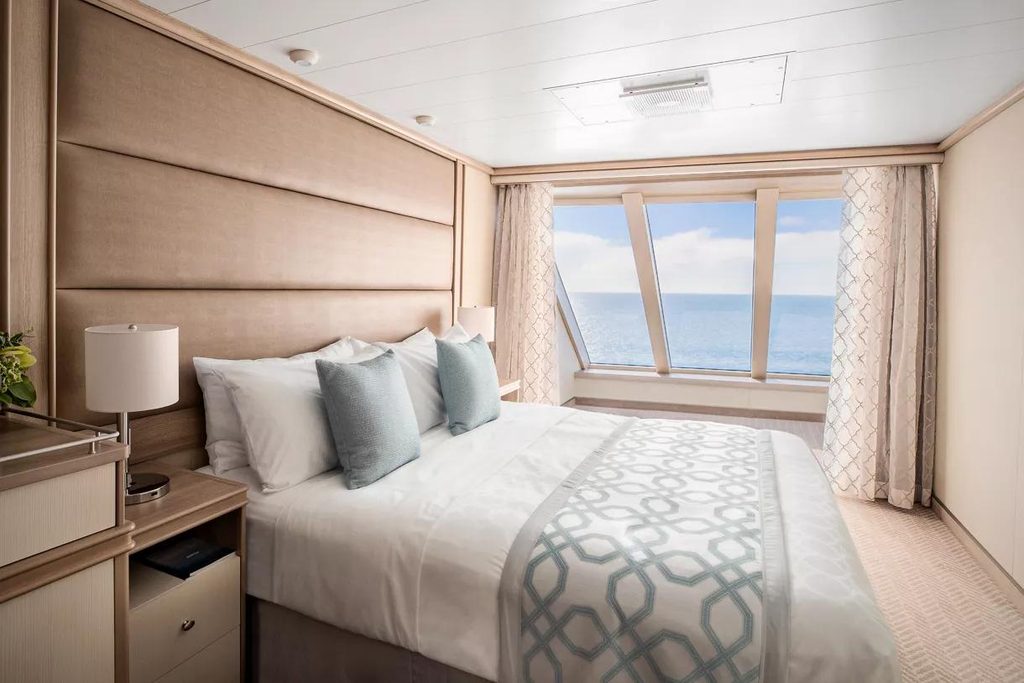
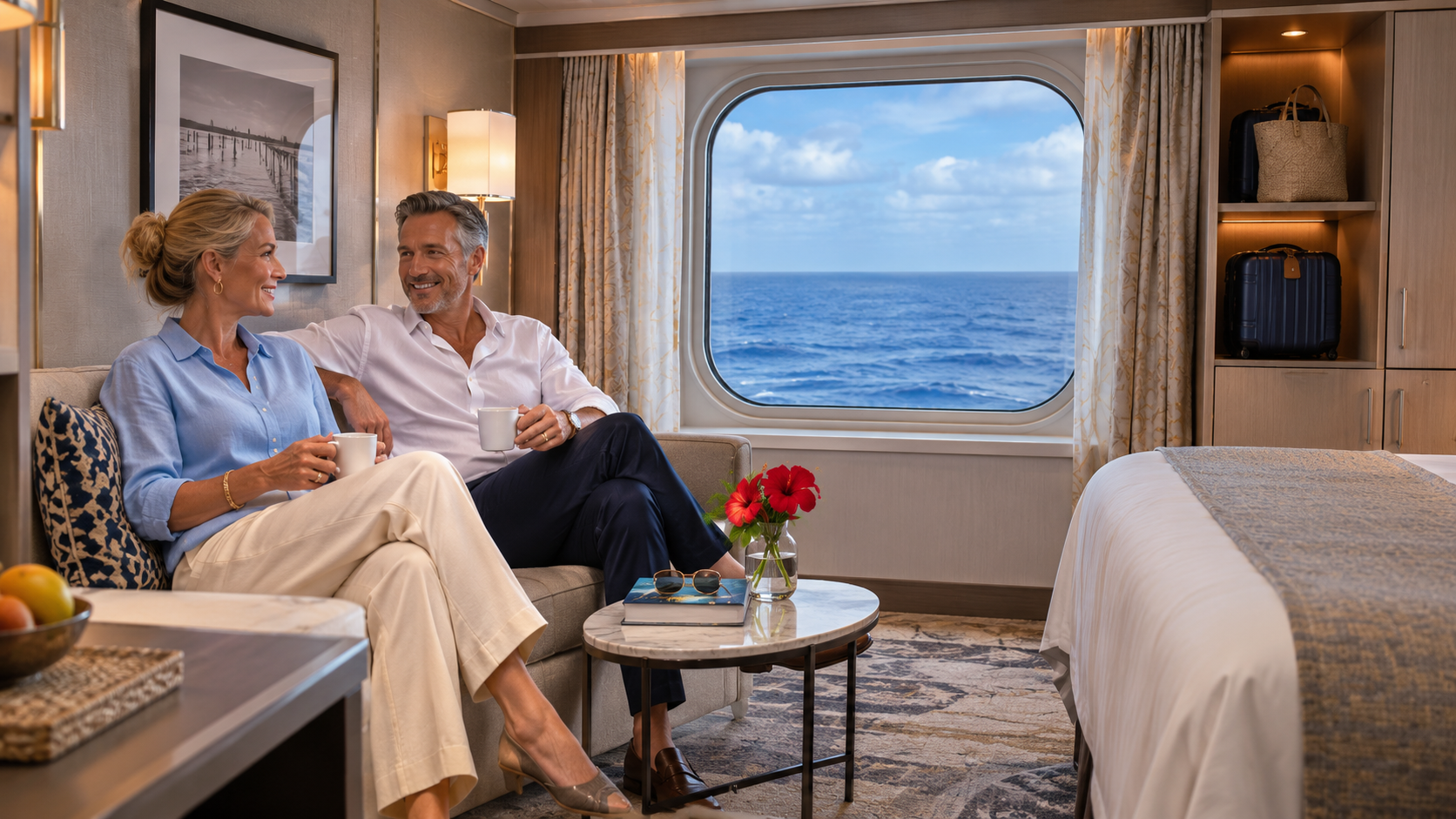
An ocean-view cabin provides a window without a private balcony.
On some ships, these rooms are available on lower passenger decks where the ship’s movement may feel less pronounced.
For a motion-sensitive traveler who finds horizon views helpful, this can offer an appealing balance.
However, check whether the window provides a clear view of the open ocean.
Some cabins have obstructed or unusual views, and window placement differs by ship.
A window doesn’t guarantee that you’ll feel better, but it can provide a useful visual reference that an interior cabin lacks.
Balcony Cabins: Comfort and Outdoor Access, With Important Limits
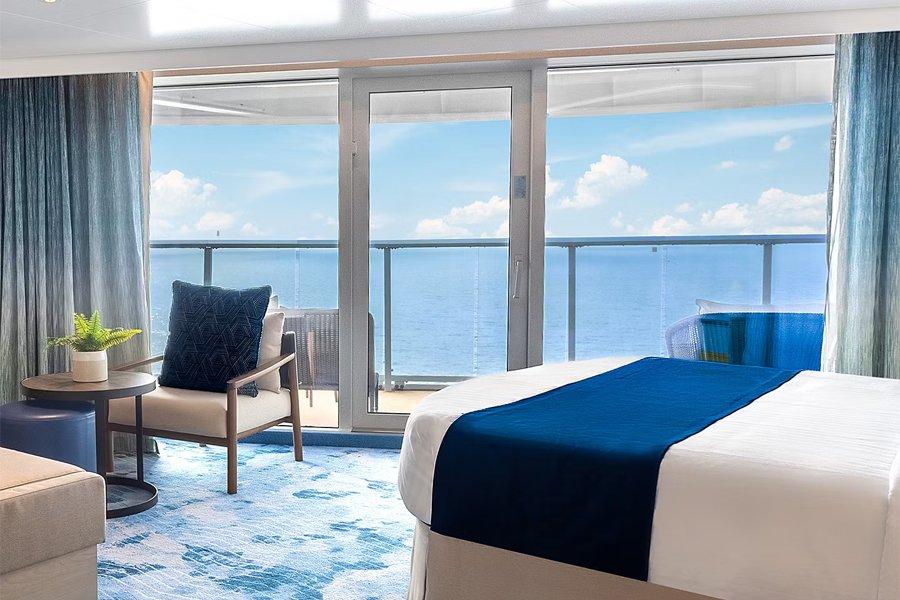
Balcony cabins let passengers see the ocean from their room and, when conditions permit, step onto a private outdoor space.
That access can be enjoyable on a Caribbean cruise, particularly if you prefer spending time outdoors without visiting a public deck.
The trade-off is that balcony cabins are often located on higher decks than some interior or ocean-view options.
If you’re especially sensitive to rolling movement, a high-deck balcony near the bow may be less attractive than a lower-deck midship cabin.
Also remember that balconies aren’t suitable places to remain during hazardous weather.
Follow the ship’s instructions about balcony access, doors, and outdoor restrictions.
Never enter a balcony or exposed deck that the crew has instructed passengers to avoid.
How Hurricane Season Should Influence Your Cabin Choice
A Caribbean cruise during hurricane season doesn’t automatically experience rough seas.
Some sailings encounter favorable weather throughout their itinerary.
Others may experience uncomfortable conditions caused by tropical systems, distant swells, or ordinary regional weather patterns.
The cabin-location principles remain the same in every season.
What changes during hurricane season is the importance of preparing for possible weather-related uncertainty.
Understand the Itinerary’s Exposure to Open Water
An itinerary with substantial time in open water may feel different from one with shorter passages between nearby destinations.
However, distance from land alone doesn’t reliably predict how rough the voyage will be.
A sheltered-looking route may still encounter uncomfortable swells, and a long open-water passage may be smooth.

Luxury Cruise Experiences at Smarter Prices
See premium sailings and upgraded cabins priced for travelers who know how to book well
Before booking, consider the sailing’s general geography, number of sea days, and how much flexibility you have if the itinerary changes.
Avoid treating historical weather patterns as a forecast for your particular cruise.
A Hurricane Can Affect Conditions Far From Its Center
The National Hurricane Center cautions that the forecast cone represents uncertainty around the predicted path of the storm’s center.
Hazardous weather can occur outside the cone, including conditions that affect marine travel. (National Hurricane Center — Forecast Cone Definition)
This explains why cruise operators may adjust routes even when the projected center of a hurricane isn’t close to the ship’s scheduled position.
A changed itinerary can lead to additional sea time or a different route, but you cannot know in advance whether those changes will make your individual cabin noticeably more or less comfortable.
Book a cabin that suits your motion preferences in general rather than attempting to anticipate one particular storm scenario.
Don’t Assume a Bigger or Newer Ship Eliminates Motion
Large modern cruise ships commonly feature systems designed to improve stability and passenger comfort.
Yet ship size and age alone aren’t reliable measures of how a vessel will behave in every sea condition.
Stabilizers are primarily intended to reduce rolling movement, not eliminate pitching or every other type of motion.
Their performance also depends on operating conditions and the vessel’s design.
A large, modern ship can still experience uncomfortable movement, and a smaller ship doesn’t automatically guarantee a worse trip.
When choosing between vessels, consider their itineraries, cabin layouts, accessibility, and amenities rather than relying on broad claims about size.
How to Read a Cruise Ship Deck Plan Before Booking
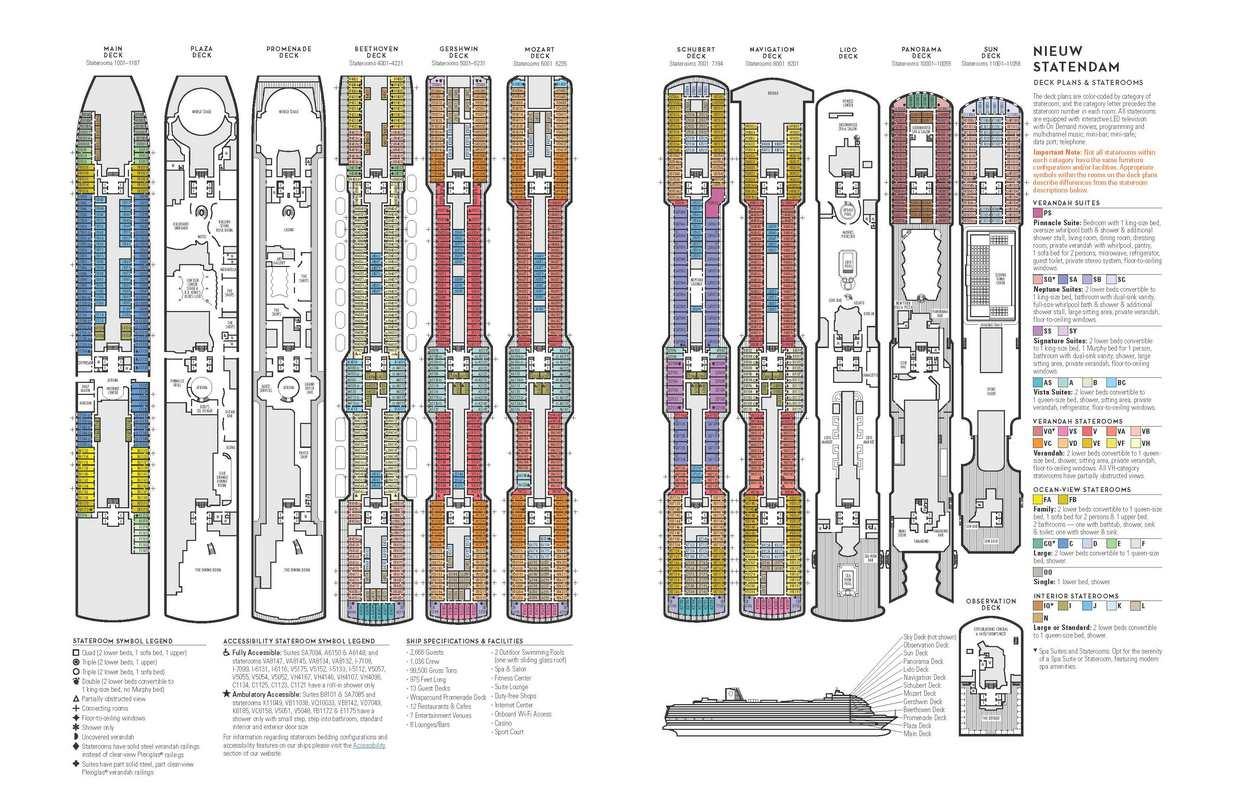
A deck plan is one of the most useful tools for choosing a cabin.
It shows where staterooms sit relative to the front, middle, and back of the ship, along with elevators, stairways, restaurants, entertainment spaces, and other facilities.
The difficulty is that a favorable location on one dimension may create a compromise elsewhere.
For example, a lower-deck midship cabin might be close to the central elevators, but another room on that deck could sit beneath a busy public area.
Check the Cabins Directly Above and Below
Noise can be as important as movement when you’re trying to sleep comfortably.
Inspect the decks above and below each candidate cabin rather than relying only on the plan for its own deck.
A room surrounded by other passenger cabins may offer a more predictable sleeping environment than one beneath a restaurant, pool deck, dance floor, or service area.
But this is a practical rule of thumb, not a noise guarantee.
Some cabins beneath public areas are well insulated, while others may experience sounds that aren’t obvious from the deck plan.
When possible, look for information about the exact ship and cabin number.
Avoid Universal Deck-Number Recommendations
Advice such as “always book Deck 4” or “avoid anything above Deck 10” is too simplistic.
Cruise ships differ substantially in height, passenger-deck arrangements, and the location of public venues.
Deck 6 may be relatively low on one vessel and positioned differently on another.
Instead of choosing a number in isolation, find a cabin on a relatively low passenger deck, near the central section of that specific ship, with acceptable surroundings.
Consider Elevator Access and Walking Distances
A midship cabin can be practical because central elevators often provide access to several parts of the ship.
However, the ideal distance from the elevator varies.
Some travelers value a short walk, particularly if they use mobility aids or have difficulty with long corridors.

Sail Away to Paradise Without Overpaying
Find cruise deals that make it easy to escape, relax, and enjoy the ocean without stretching your budget
Others prefer to be farther from elevator lobbies to reduce passing foot traffic.
Choose a location that balances your comfort with the activities and facilities you’ll use most frequently.
Should You Book a Guarantee Cabin During Hurricane Season?
A guarantee cabin can be an attractive way to book a cruise at a different price from selecting a particular room.
However, it involves giving up some control over the final cabin assignment.
Royal Caribbean’s published guarantee-stateroom policy explains that guests book a category and the cruise line assigns the specific cabin, potentially as late as check-in at the port. (Royal Caribbean — Guarantee Stateroom Policy)
This distinction matters if your ability to enjoy a cruise depends heavily on location.
When Choosing Your Exact Cabin May Be Worth More
If you know you experience significant motion sickness, the opportunity to reserve a specific lower-deck midship cabin may be valuable.
You’ll be able to review its location, nearby amenities, and position relative to other passenger decks before committing.
By contrast, a guarantee fare may place you in a location that meets the booked category but doesn’t match your movement preferences.
The cruise line may assign a cabin you would never have selected yourself.
When a Guarantee Cabin Can Still Make Sense
If you’re flexible about location, don’t experience significant motion discomfort, and care more about price or cabin category, a guarantee booking may be reasonable.
The important point is understanding the trade-off.
A guarantee room isn’t inherently inferior, but it doesn’t provide the same control as reserving a specific cabin.
If a particular location or accessible configuration is essential, verify the appropriate booking arrangement directly with the cruise line.
What to Do if Your Cabin Still Feels Uncomfortable at Sea
Even with careful cabin selection, you may encounter a day when the vessel’s movement is more noticeable than you’d like.
You don’t need to treat that as proof that you booked incorrectly.
Sea conditions change, and comfort can vary throughout a voyage.
Having a few practical strategies ready is more useful than expecting one cabin to solve every possible situation.
Spend Time Where Motion Feels More Manageable
If your cabin feels uncomfortable, consider moving to a lower-deck public lounge near the middle of the ship, provided the area is open and accessible.
A location with a visible horizon may also help some passengers.
Avoid unnecessary walking if the ship is moving heavily, and follow any instructions to remain in designated areas.
If you have difficulty maintaining your balance, ask for assistance.
Avoid Reading or Focusing on Screens When Nauseated
Reading, scrolling through a phone, or concentrating on nearby objects can make motion sickness worse for some travelers.
The CDC identifies obtaining a visual horizon reference and avoiding reading or visual scanning as behavioral measures that may help reduce symptoms. (CDC Yellow Book — Motion Sickness)
If you’re feeling unwell, put the screen aside and find a comfortable position.
Focus on recovery rather than repeatedly checking wave forecasts on your phone.
Discuss Motion Sickness Medication Before Departure
Some motion sickness medications work better when used before symptoms become established.
However, they can have side effects, including drowsiness, and some have important contraindications.
The CDC recommends considering individual medical circumstances when selecting treatments. (CDC Yellow Book — Motion Sickness)
If you take other medications, have a medical condition, or have previously experienced adverse reactions, discuss your options with a healthcare professional.
For severe vomiting, dehydration, unusual dizziness, or other concerning symptoms, seek medical evaluation aboard the ship.
What Happens to Your Cabin Choice if a Hurricane Changes the Itinerary?
A cruise line may respond to tropical weather by adjusting its route, substituting a port, or adding time at sea.
Your cabin doesn’t change the operator’s responsibility to assess weather and maritime conditions.
But it can influence how you experience the revised journey.
An Additional Sea Day
If a port visit is canceled and replaced by a day at sea, you’ll have more time aboard the ship than originally planned.
A comfortable cabin and a suitable selection of onboard spaces can make that unexpected day easier to enjoy.
However, the weather that caused the change doesn’t necessarily mean the replacement sea day will involve rough conditions.
Follow the ship’s announcements and make plans based on the actual circumstances.
A Replacement Port or New Route
A different destination may change the route and the amount of time spent cruising between ports.
It could also affect your shore excursions or accessibility arrangements.
Your existing cabin remains an important part of the vacation, but there is no sound basis for assuming it will automatically feel better or worse on the revised route.
If seas become uncomfortable, use the general motion-management strategies that suit you.
Why Insurance and Cabin Comfort Are Separate Decisions
Travel insurance may be relevant to cancellations, delays, or other covered disruptions, but it won’t reduce the physical motion you feel aboard a ship.
Likewise, choosing a midship cabin doesn’t make an insurance policy more valuable or create extra benefits.
Insurance coverage depends on the wording of the particular policy, including its covered events, exclusions, limits, and eligibility requirements.
A missed port or weather-related route adjustment doesn’t automatically entitle you to compensation.
Keep cabin comfort decisions focused on your onboard experience, and evaluate financial protection separately.
Which Cabin Should You Choose if You’re Worried About Rough Seas?
The right decision depends on how you balance movement, budget, views, accessibility, and possible noise.
| Your main concern | A practical starting point | What to check |
|---|---|---|
| Motion sickness | Lower-deck midship cabin | Actual location, deck height, horizon access |
| Budget and motion | Midship interior cabin on a lower deck | Nearby public venues and cabin layout |
| Motion and ocean views | Lower or middle-deck midship ocean-view cabin | Window visibility and view obstruction |
| Private outdoor space | Midship balcony at a moderate height | Deck location, noise, and balcony restrictions |
| Light sleeping | Cabin with other staterooms above and below | Elevators, service areas, entertainment spaces |
| Mobility requirements | Accessible cabin in a convenient location | Doorways, bathroom layout, elevator access |
| Maximum location control | Choose a specific cabin number | Availability and fare differences |
For someone whose primary worry is feeling the ship move, a relatively low midship cabin remains the strongest general starting point.
But if you know that looking toward the horizon helps you, a suitably located ocean-view cabin may be preferable to an interior room.
If accessibility is essential, that requirement may reasonably take priority over an otherwise attractive motion-comfort location.
The key is choosing for your actual needs rather than one supposed universal best cabin.
Book a Cabin That Gives You More Confidence About the Journey
You cannot control the weather during a hurricane-season cruise, but you can make a more thoughtful choice about where you’ll spend your time onboard.
Midship cabins on lower passenger decks are often good options for travelers concerned about noticeable ship movement.
A suitable ocean view may provide additional comfort for some passengers, while carefully reading the deck plan can help you avoid unnecessary noise or inconvenient locations.
Those advantages don’t guarantee that you’ll never feel seasick.
They give you a practical starting point for selecting a stateroom based on the way ships move and the way you prefer to travel.
Before booking, compare the available cabin numbers, review the surrounding decks, and decide which trade-offs matter most.
Then let the cruise line handle weather-related route decisions while you focus on preparing for an enjoyable vacation.
You don’t need to predict every swell to book thoughtfully. You need a cabin that suits your priorities and a realistic understanding of what it can—and cannot—do.
FAQ – Which Cruise Cabins Are Most Comfortable During Hurricane Season?
What is the best cruise cabin location for avoiding seasickness?
A cabin near the middle of the ship on a relatively low passenger deck is generally a good starting point for motion-sensitive travelers.
This position can reduce some of the movement associated with pitching and rolling.
However, the ship’s design, sea conditions, and your individual sensitivity all influence comfort. No stateroom can guarantee that you won’t experience seasickness.Are midship cabins better during hurricane season?
Midship cabins are often preferred because their central position can reduce certain kinds of noticeable movement.
This advantage applies to ordinary rough seas as well as unsettled conditions that may occur during hurricane season.
However, a midship location doesn’t provide special protection from a hurricane or guarantee smooth sailing.
The captain’s routing decisions and actual weather conditions remain much more important for vessel safety.Are lower decks more stable on a cruise ship?
Lower passenger decks can reduce some of the side-to-side movement associated with rolling.
This is one reason they’re commonly recommended to travelers who dislike noticeable ship motion.
However, a lower deck may introduce other considerations, including proximity to service spaces or operational equipment.
Review the actual deck plan rather than automatically choosing the lowest available cabin.Is the front or back of a cruise ship worse for motion sickness?
Forward cabins can experience pronounced up-and-down movement when the ship pitches through waves.
Aft cabins may also experience greater pitching movement than central cabins, although the exact sensation depends on the conditions and vessel.
Neither end is universally worse in every situation.
If you’re particularly sensitive to motion, a comparable midship cabin is usually the more practical starting point.Do higher cruise ship decks move more?
Higher locations can experience more noticeable side-to-side displacement when a ship rolls.
However, not every movement experienced aboard a ship depends solely on deck height.
Some high-deck cabins may feel comfortable in ordinary conditions, while lower cabins can still experience substantial motion in rough seas.
Choose based on your motion sensitivity, the ship’s layout, and the other cabin features you value.Are balcony cabins worse for seasickness?
Balcony cabins aren’t automatically worse for seasickness, but many are located higher on the ship than some interior or ocean-view staterooms.
Their movement depends on their actual position along the vessel and their height above the waterline.
A balcony also provides an ocean view, which may help certain passengers orient themselves when the ship moves.
Compare the exact location rather than judging the entire cabin category.Is an inside cabin better for motion sickness?
An inside cabin may be a useful choice when it is centrally located on a lower passenger deck.
However, it doesn’t offer a view of the horizon, which can help some travelers manage motion sickness.
An interior cabin is therefore not automatically superior to an ocean-view cabin.
Personal preferences, actual location, and access to a useful visual reference all matter.Does looking at the horizon help with seasickness?
Looking toward a stable horizon can reduce motion sickness for some travelers.
It provides visual information that may help the brain interpret the movement detected by the inner ear.
This approach isn’t guaranteed to eliminate symptoms, and the horizon may not always be visible.
If you find it helpful, an appropriate ocean-view cabin or accessible public lounge with windows may be worth considering.Should I book an ocean-view cabin for rough seas?
An ocean-view cabin may offer an appealing compromise between motion comfort and access to the horizon.
On some ships, ocean-view cabins are available on relatively low passenger decks near the middle.
However, window sizes, locations, and obstructions differ between ships.
Inspect the actual room and deck plan before assuming that every ocean-view category offers the same benefits.Does a larger cruise ship move less in rough seas?
Ship size can influence how a vessel responds to waves, but it doesn’t establish a universal ranking of passenger comfort.
Hull design, stabilizers, speed, wave direction, and other factors all affect movement.
A large ship may still experience pronounced rolling or pitching in challenging conditions.
Cabin position remains worth considering regardless of the vessel’s size.Do cruise ship stabilizers prevent seasickness?
Stabilizers are designed primarily to reduce certain rolling movements under suitable operating conditions.
They don’t eliminate pitching, heaving, or every other type of ship movement.
Passengers may therefore experience seasickness even aboard a large vessel with modern stabilizers.
If you’re prone to symptoms, consider both cabin location and appropriate prevention strategies.Is Deck 4 better than Deck 10 for rough seas?
Deck 4 may be relatively low on a particular vessel, while Deck 10 may be considerably higher.
However, different ships have different deck arrangements, and the numbers alone don’t establish which cabin is more comfortable.
The position along the ship and the surrounding facilities also deserve attention.
Compare the actual deck plans rather than following a fixed deck-number rule.Should I avoid cabins at the very front of the ship?
If you’re especially sensitive to up-and-down movement, an extreme forward cabin may be less attractive than a central one.
Forward areas can experience noticeable pitching when the vessel encounters certain wave conditions.
However, many passengers enjoy forward cabins without significant discomfort during ordinary sailings.
The choice depends on your sensitivity, itinerary, and preferences.Are aft-facing balconies a poor choice during hurricane season?
Aft-facing balconies can offer distinctive views but may experience more pitching movement than centrally located rooms.
Depending on the ship, some aft cabins may also have vibration or noise considerations.
Hurricane season alone doesn’t make these cabins unsuitable, and favorable weather may produce a comfortable voyage.
If motion is a major concern, compare an aft balcony against an available midship option before booking.Can choosing a cabin prevent rough-sea discomfort?
Selecting a favorable cabin may reduce certain sensations of movement but cannot prevent all discomfort.
Conditions aboard a moving ship can vary substantially throughout a voyage.
Some passengers benefit from additional measures such as a visible horizon or medically appropriate motion sickness prevention.
Think of cabin selection as one comfort strategy rather than a complete solution.Should motion-sensitive travelers book a guarantee cabin?
A guarantee booking usually means the cruise line chooses the specific stateroom within the applicable booking terms.
That can leave you with less control over whether your room is centrally located or on a preferred deck.
If cabin position is especially important because of motion sensitivity, selecting an exact cabin may be worth the additional cost.
Check the operator’s assignment rules before deciding.How can I tell if a midship cabin will be noisy?
Examine the deck plans immediately above and below the cabin to identify nearby public venues, service areas, or operational spaces.
Also consider how close the room is to elevators, stairways, and busy passenger corridors.
Reviews of the exact ship and cabin may provide additional context, although individual experiences can vary.
A central location doesn’t automatically guarantee quiet surroundings.What should I do if my cruise ship encounters rough seas at night?
Follow any instructions from the ship’s crew and avoid unnecessary movement if the vessel is rolling or pitching heavily.
If you’re feeling nauseated, resting in a comfortable position and avoiding prolonged screen use may help.
Ask for medical advice if symptoms are severe, unusual, or accompanied by dehydration.
Don’t assume that moving onto an exposed deck or balcony is appropriate during hazardous conditions.Will a hurricane-related reroute make my cabin more comfortable?
A reroute may change the conditions your ship encounters, but it isn’t possible to predict how comfortable one particular cabin will feel throughout the revised journey.
Cruise operators consider weather and operational factors when deciding whether to change destinations or sailing routes.
A midship lower-deck cabin may continue to provide motion-related advantages, but it doesn’t guarantee smoother seas.
Follow the updated itinerary and onboard instructions.How do I choose the best cabin if I’m worried about hurricane-season cruising?
Start with a relatively low midship location if minimizing noticeable movement is your leading priority.
Then compare ocean views, potential noise, accessibility, walking distances, and your budget.
Reserve a specific cabin when its location is important, rather than relying on an assignment you cannot control.
Finally, prepare for changing weather and itinerary adjustments without expecting the cabin itself to eliminate storm-related uncertainty.
Plan Your Next Cruise!
Discover Princess Cruise Line: Elegant Ships, Immersive Voyages, and World‑Class Experiences
One Delay Can Cost Your Entire Cruise A quick coverage check now protects you from the problems no one sees coming….

Unlock The Viking Ocean Experience: Elegant Ships, Cultural Immersion, And Unrushed Travel
One Delay Can Cost Your Entire Cruise A quick coverage check now protects you from the problems no one sees coming….

Sail Boldly: Experience Virgin Voyages’ Adults‑Only Cruises With Style, Freedom, And Fun
One Delay Can Cost Your Entire Cruise A quick coverage check now protects you from the problems no one sees coming….

Sail Into Freestyle Freedom: Norwegian Cruise Line for Adventure Thrills, Gourmet Dining, and Destination‑Rich Voyages
One Delay Can Cost Your Entire Cruise A quick coverage check now protects you from the problems no one sees coming….