One Delay Can Cost Your Entire Cruise
A quick coverage check now protects you from the problems no one sees coming.
Short Excerpt
- Learn which medications, documents, first-aid supplies, and charging essentials belong in your cruise emergency kit.
- Prepare for hurricane-season itinerary changes, delayed luggage, missed connections, and unexpected extra travel days.
- Avoid packing prohibited electrical accessories or relying on weather apps that cannot update without internet access.
- Use an interactive packing checklist to organize essentials for embarkation, your cabin, and port days.
Quick Take
- Your most important emergency supplies should remain accessible: travel documents, medications, essential medical equipment, your phone, and emergency contact information.
- Pack enough prescription medication for the voyage plus a reasonable reserve for unexpected delays, based on your healthcare professional’s advice and applicable rules.
- A compact personal first-aid kit can help with minor problems, but it cannot replace the ship’s medical center or emergency instructions.
- If you’re flying, power banks and spare lithium batteries must travel in carry-on baggage, subject to FAA and airline limits.
- Cruise ships may prohibit extension cords, surge protectors, and other electrical accessories, even when marketed as suitable for cruising.
- Download essential travel information before departure, but remember that hurricane forecasts cannot update offline.
What Should You Pack in a Cruise Emergency Kit?
Imagine your cruise ship’s arrival is delayed because severe weather has temporarily closed the return port.
Your cabin is still comfortable, meals are available, and the crew is providing updates.
But your flight home may need to change, your regular medication supply is running low, and some important travel information is saved in an email you can’t access.
None of these problems requires an enormous survival kit.
They require a few carefully chosen essentials, stored where you can reach them.
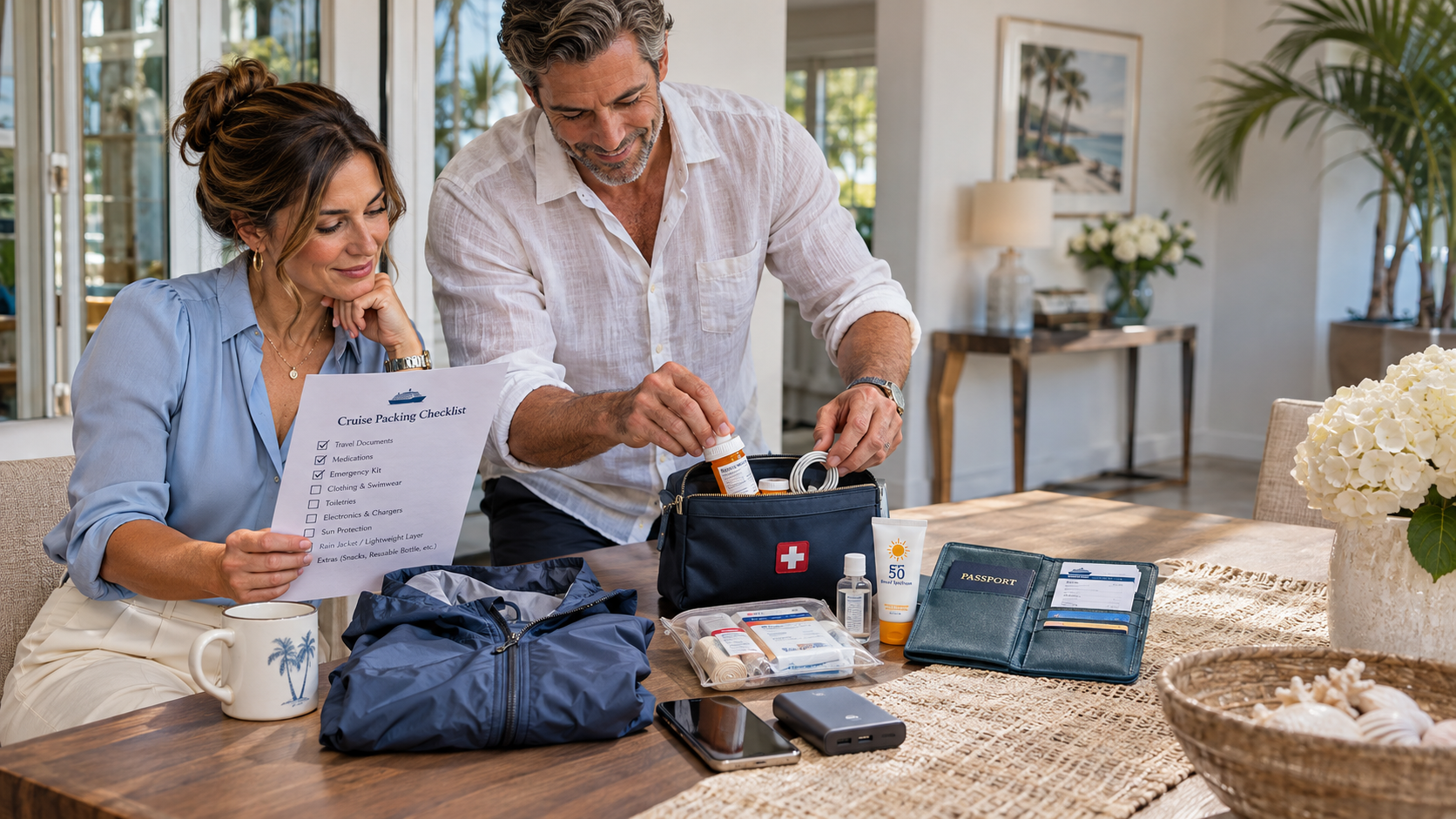
That’s what a useful cruise emergency kit is designed to provide: a compact collection of medications, documents, personal supplies, and communication tools that helps you deal with disruptions without packing an entire extra suitcase.
Modern cruise ships have emergency procedures, trained crews, and onboard medical services.
However, their medical facilities and supplies have limits, particularly when specialized care or replacement prescriptions are needed.
The CDC recommends that passengers with ongoing medical needs understand the capabilities of their particular ship before traveling. (CDC Yellow Book — Cruise Ship Travel)
Your personal kit complements those resources. It does not replace the ship’s safety equipment, medical services, or crew instructions.
During hurricane season, this distinction becomes particularly important.
A storm may never approach your ship directly but could still change a port visit, delay disembarkation, or disrupt flights and other travel arrangements.
The most effective approach is to prepare for those practical consequences rather than trying to equip yourself for every imaginable emergency.
Cruise Emergency Kit Builder: Your Interactive Packing Checklist
Use the checklist below to organize your emergency essentials by when and where you’ll need them.
The three categories serve different purposes.
Embarkation essentials should stay with you, cabin backups support unexpected delays, and port-day supplies help you manage ordinary needs away from the ship.
You can check items as you pack, copy the complete list, and reset it for your next cruise.
Cruise Emergency Kit Builder
Check items as you pack. Switch between carry-on, cabin, and port-day essentials. Copy your complete checklist when finished.
Embarkation carry-on
Planning aid only. Check cruise-line, airline, and destination restrictions. Follow medical advice and crew safety instructions.
The Seven Essentials Every Cruise Emergency Kit Should Cover
The ideal cruise emergency kit isn’t a collection of survival gadgets.
It’s a small group of supplies that helps you manage common problems while remaining practical to carry.
For most passengers, seven categories cover the essentials.
| Category | What to include | Why it matters |
|---|---|---|
| Health and medication | Prescriptions, appropriate first-aid supplies, medication details | Helps maintain treatment and manage minor problems |
| Travel documents | Identification, booking information, emergency contacts | Supports check-in, disruptions, and changes to travel plans |
| Power and communication | Phone, permitted power bank, charging cable | Keeps important information accessible |
| Light and visibility | Compact flashlight or headlamp | Useful during unexpected lighting problems |
| Hygiene and spare clothing | Basic toiletries, spare undergarments, extra outfit | Helps during luggage or travel delays |
| Weather protection | Compact rain jacket, protective pouch, suitable shoes | Useful for wet excursions and changing conditions |
| Contingency information | Insurance details, airline contacts, cruise instructions | Helps you act when arrangements change |
These categories are deliberately modest.
A small kit won’t eliminate a travel delay, provide hospital-level medical care, or keep your phone connected when no network is available.
It can, however, help you manage your immediate needs and access the information required to resolve a problem.
Medications and First-Aid Supplies: The Most Important Part of Your Kit
For many travelers, medications are the least replaceable belongings in a suitcase.
A forgotten toothbrush can usually be replaced.
Top Cruise Deals From Trusted Cruise Lines
Compare exclusive online offers and find the fare that fits your trip and your budget
An essential prescription may be difficult or impossible to obtain during a voyage, particularly if the medication has special storage requirements or is restricted in the countries you’re visiting.
The CDC recommends a personalized travel health kit based on your medical history, destination, and activities rather than one identical set of supplies for every traveler. (CDC Yellow Book — Travel Health Kits)
Bring Enough Prescription Medication for Unexpected Delays
Pack the supply needed for your entire trip, including flights, hotel stays, and any additional travel before or after the cruise.
Then discuss an appropriate extra supply with your prescriber or pharmacist.
Two extra days may not be enough if severe weather significantly delays your return.
Carnival, for example, recommends bringing an additional ten days’ worth of medication in case of emergencies or travel delays. (Carnival — Shipboard Medical Services FAQs)
That is Carnival’s recommendation, not a universal cruise-line requirement.
Some prescriptions cannot be refilled early, and some medications face restrictions when entering other countries.
The appropriate amount depends on your circumstances.
Keep medications in their original labeled containers when practical, especially for international travel, and carry a copy of your prescriptions or an accessible medication record.
Build a Small First-Aid Kit for Minor Problems
A personal first-aid pouch can include adhesive bandages, blister dressings, antiseptic wipes, and a small amount of gauze.
You might also include familiar nonprescription medicines, such as an appropriate pain reliever or allergy medication, after checking that they’re suitable for you.
The idea is to handle minor inconveniences, not to perform medical treatment beyond your knowledge or equipment.
For example, a blister from walking through a Caribbean port may be manageable with a dressing and a change of footwear.
A worsening wound, significant allergic reaction, chest pain, unusual dizziness, or severe dehydration requires professional assessment.
The ship’s medical center should remain your source of assistance when symptoms exceed ordinary self-care.
Don’t Forget Individual Medical Requirements
Passengers with diabetes, severe allergies, respiratory conditions, mobility needs, or other ongoing health concerns may require supplies beyond a general checklist.
These could include emergency medication, monitoring equipment, spare device components, or documentation about necessary treatment.
Before sailing, contact your cruise line about any equipment that requires refrigeration, electricity, specialized storage, or advance authorization.
Shipboard medical facilities vary, and supplies may be limited.
The CDC specifically advises passengers with significant medical needs to establish what care is available aboard their particular vessel. (CDC Yellow Book — Cruise Ship Travel)
Documents and Emergency Contacts You Should Be Able to Access Offline
Imagine your return flight needs to be rescheduled after a weather-related delay.
You have your phone, but shipboard internet is intermittent and your airline confirmation is buried in an email account that won’t load.
A small offline document folder can prevent that from becoming a much bigger inconvenience.
Keep the Right Travel Documents Accessible
Your required identification depends on citizenship, itinerary, cruise line, and destination requirements.
U.S. citizens on some qualifying closed-loop cruises may be eligible to use approved alternative documentation.
However, the U.S. Department of State strongly recommends carrying a valid passport book even when it isn’t required for boarding, because an emergency flight home from a foreign country may require one. (U.S. Department of State — Cruise Ships)
Online‑Only Cruise Offers You Won’t Find Elsewhere
Unlock special pricing and start planning the sailing that matches your perfect itinerary

The original document is more important than a photocopy.
A copy may help provide identifying information if the original is lost, but it doesn’t automatically replace a passport for international air travel.
Check your documentation requirements before leaving home, including those for children traveling with you.
What to Save in Your Offline Travel Folder
Keep essential information available without requiring a fresh internet connection:
- Cruise reservation and relevant confirmation details
- Airline and hotel booking references
- Travel insurance policy and assistance contact numbers
- Emergency contacts and important medical information
- Cruise-line communication and customer-service details
- Copies of relevant documents, stored securely
You can keep selected paper copies in a compact protective folder and encrypted digital copies on your phone.
Avoid leaving sensitive documents in an unlocked device or distributing unnecessary copies of your passport.
For international travel, the State Department also provides country-specific information and assistance resources through its official website. (U.S. Department of State — International Travel)
Power Banks, Flashlights, and Charging Supplies: What Is Actually Allowed?
A charged phone is useful for accessing travel confirmations, contacting providers, and reviewing official updates.
A compact flashlight may also help if cabin lighting is temporarily unavailable.
But electrical accessories are one area where passengers should be particularly careful.
The original article recommends bringing a surge protector.
That advice can cause problems because cruise lines frequently restrict or prohibit these devices.
Don’t Pack an Ordinary Surge Protector Without Checking the Rules
Royal Caribbean’s prohibited-items policy restricts extension cords, power strips, multi-plug outlets, and various electrical accessories.
The cruise line may review questionable equipment and determine whether it can be brought aboard. (Royal Caribbean — Prohibited Items)
Other cruise lines may have different restrictions.
A product advertised as cruise-approved isn’t necessarily permitted by your operator.
Before purchasing a charging hub, adapter, or other electrical accessory, check the current policy for your exact cruise line.
If you need an electrical arrangement for medical equipment, contact the cruise line rather than relying on a conventional extension cord.
Keep Power Banks in Carry-On Baggage When Flying
If your cruise vacation includes a flight, FAA rules become important.
Power banks and spare lithium batteries must be carried in the aircraft cabin rather than placed in checked baggage.
Lithium-ion batteries rated up to 100 watt-hours are generally permitted, subject to applicable quantity and airline restrictions.
Certain larger batteries require airline approval, and batteries above the allowable limits are prohibited. (FAA — PackSafe Lithium Batteries)

Luxury Cruise Experiences at Smarter Prices
See premium sailings and upgraded cabins priced for travelers who know how to book well
A power bank’s capacity is often advertised in milliamp-hours, but air-travel restrictions are assessed using watt-hours.
Don’t assume that a larger battery is better simply because it can charge your phone more times.
For most cruise passengers, a modest, properly rated power bank is easier to transport and use than a large portable power station.
Choose Simple Lighting Instead of Specialized Survival Gear
A small battery-operated flashlight or headlamp can be useful when you need additional lighting.
Choose something compact, familiar, and permitted by your travel providers.
A standalone emergency whistle, thermal survival blanket, or similar accessory may be appropriate for a specialized trip, but these are not universally necessary cruise supplies.
Cruise ships already have safety equipment and established emergency procedures.
Your personal emergency kit should not be presented as a substitute for those systems.
Hurricane-Season Additions That Are Worth Packing
Hurricane-season preparation deserves a place in this article, but it shouldn’t turn your suitcase into a storm-response supply cabinet.
Cruise lines make operational decisions about weather routing, shipboard restrictions, and emergency procedures.
Your role is to prepare for likely personal needs and follow official instructions.
A Compact Weather-Protection Kit
For many Caribbean itineraries, a lightweight rain jacket, suitable footwear, and a protective pouch for important belongings are useful additions.
A small waterproof bag may also be helpful during shore excursions where rain or spray is possible.
Choose clothing appropriate to your actual destination and planned activities.
A lightweight jacket suitable for a warm tropical shower may not provide enough protection for a prolonged outdoor excursion in Alaska or Northern Europe.
Snacks and Hydration Supplies Have Their Place
Shelf-stable snacks can be useful during long travel days or certain excursions, provided they comply with cruise-line and destination restrictions.
However, there is little benefit in packing large quantities of food for hypothetical shipboard emergencies.
Cruise ships normally provide meals and drinking water through their onboard services.
If you have dietary restrictions or rely on particular food products for medical reasons, contact the cruise line in advance and check its rules on bringing food aboard.
For port days, a refillable water bottle can be practical when appropriate drinking water is available.
A Weather App Is Not an Offline Hurricane Warning System
Before departure, bookmark the official National Hurricane Center website and familiarize yourself with your cruise line’s communication system.
Weather apps may display previously downloaded information without an active connection, but they generally cannot provide fresh forecasts or warnings while disconnected.

Sail Away to Paradise Without Overpaying
Find cruise deals that make it easy to escape, relax, and enjoy the ocean without stretching your budget
The National Hurricane Center notes that cached browser content can show outdated weather information when pages are not refreshed. (National Hurricane Center — Browser Help)
Do not rely on a saved map from yesterday to make decisions about current storm conditions.
When onboard internet is unavailable, follow the captain’s announcements and the ship’s official instructions.
Why Satellite Messaging Devices Aren’t Standard Cruise Emergency-Kit Essentials
Satellite communication products are sometimes marketed as equipment for staying connected far from cellular coverage.
But this doesn’t mean a satellite communicator is automatically useful or permitted on every cruise.
Devices such as the Garmin inReach family are specialized products with subscription requirements and operating limitations.
Cruise-line policies may restrict certain satellite communication equipment, and the available services can depend on the device, region, and environment.
Even when a device is permitted, it doesn’t replace the ship’s emergency communication systems or establish a separate rescue procedure for passengers.
For an ordinary mainstream cruise, keeping your phone charged, knowing how the ship communicates updates, and saving emergency contact information are more practical starting points.
If you need specialized communication for a particular journey, verify both the cruise line’s equipment policy and the service provider’s actual coverage and limitations before traveling.
Where Should You Store Your Emergency Kit?
An emergency kit works best when important items can be found quickly.
That doesn’t mean carrying every backup supply around the ship all day.
Separate the essentials you may need immediately from the belongings that can remain in your cabin.
Your Embarkation Carry-On
Use your carry-on for the items that should remain accessible while your checked suitcase is being delivered.
This includes medications, essential medical equipment, identification, booking information, your phone, and any other supplies you cannot comfortably replace.
A small toiletry kit and change of clothes can also be helpful.
If you’re flying, make sure your packing arrangement meets the relevant airline rules.
Your Cabin Backup Pouch
After boarding, organize less urgent supplies in one or two clearly identified pouches.
A medical pouch might contain basic first-aid supplies and other appropriate personal health items.
A separate travel pouch could hold spare charging cables, emergency contacts, backup toiletries, and other practical essentials.
Avoid storing every item in the cabin safe. Some belongings, particularly regularly needed medication, should remain easy to reach.
Follow the ship’s instructions for securing belongings when conditions become rough.
Your Port-Day Bag
On shore excursions, carry only what you need for the activity.
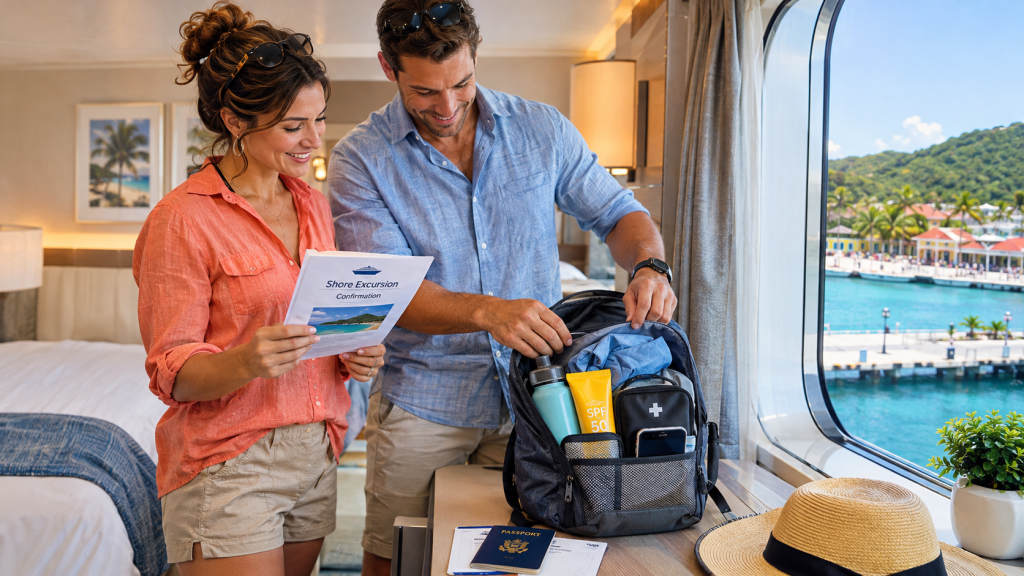
This might include required identification, a cruise card, payment method, essential medications, sun protection, water, and the instructions for returning to the ship.
The appropriate contents will differ between a guided bus tour, a beach day, and an active outdoor excursion.
Don’t automatically take your original passport ashore without checking the cruise line’s instructions and any applicable local requirements.
Most importantly, keep track of the ship’s actual all-aboard time rather than assuming it matches the departure time listed on a general itinerary.
How to Prepare if Your Cruise Is Delayed by a Hurricane
A hurricane can interfere with your journey without coming close to the ship itself.
A departure port may close temporarily, flights can be canceled, or the cruise line may adjust the itinerary to avoid hazardous conditions.
Those changes can leave passengers away from home longer than expected.
Your emergency kit should support the practical decisions that follow.
If Embarkation Is Delayed
Check the cruise line’s official communication for updated boarding instructions.
Don’t travel to a closed terminal simply because the original itinerary lists a particular boarding time.
If you’re staying at a hotel before departure, review any changes to transportation arrangements and maintain access to medications, documents, and other essentials.
Weather alerts provide useful context, but the cruise line must confirm how the situation affects your sailing.
If Your Return Is Delayed
An unexpected extra day may affect prescriptions, flights, medical appointments, childcare arrangements, or work obligations.
Having an appropriate medication reserve and contact information for your airline, insurer, and other providers can make those arrangements easier to manage.
Keep receipts and written notices if you incur additional expenses.
Travel insurance may cover certain qualifying delays or interruptions, but coverage depends on the policy’s terms, exclusions, benefit limits, and purchase timing.
The existence of a hurricane doesn’t automatically make every added expense reimbursable.
If a Medical Emergency Occurs
Contact the ship’s medical center or follow onboard emergency procedures rather than trying to manage a serious condition using your personal kit.
Cruise medical centers can provide important care, but facilities vary, and some emergencies may require treatment ashore.
The CDC specifically advises travelers with underlying medical conditions or special needs to learn about the available onboard medical services before sailing. (CDC Yellow Book — Cruise Ship Travel)
A list of medications, allergies, and important contacts can help medical professionals understand your situation.
Do not assume that evacuation can always be arranged immediately, particularly during difficult weather.
Travel Insurance Information Belongs in Your Kit, but Coverage Isn’t Guaranteed
Your insurance policy and emergency assistance contact details are useful documents to keep accessible.
However, putting an insurance company’s name in your emergency folder doesn’t establish what benefits you have.
Travel insurance products differ considerably in how they handle cancellations, missed connections, medical treatment, evacuation, and hurricane-related disruptions.
For example, a policy may cover some qualifying trip interruptions but exclude particular weather events, known storms, or circumstances that don’t meet the policy’s definition of a covered loss.
What to Confirm Before Departure
Review the policy’s emergency assistance telephone number, covered destinations, medical benefit limits, exclusions, and claims instructions.
Find out whether you must obtain authorization before arranging medical evacuation or other services.
If you have pre-existing medical conditions, confirm whether any exclusion applies and whether you meet the requirements for a waiver.
Keep the information available offline and, where practical, carry a concise printed copy of the assistance details.
You may compare plans through services such as VisitorsCoverage or Insubuy, but the actual protection depends on the selected policy—not the marketplace’s name.
Likewise, flight-compensation companies aren’t substitutes for travel medical or trip-interruption insurance.
Five Cruise Emergency-Kit Mistakes That Are Easy to Avoid

One common mistake is carrying too much equipment.
Passengers sometimes imagine scenarios that require camping supplies, large batteries, specialized radios, or extensive medical gear.
These products can add weight, create security problems, and distract from necessities such as medication and travel documents.
Another mistake is packing every important item in checked luggage, leaving nothing accessible during embarkation.
A third is assuming the ship can replace any forgotten prescription.
The fourth is treating a cached weather map as a live forecast when the phone has no connection.
Finally, some travelers buy accessories without checking cruise-line or airline restrictions.
None of these mistakes requires a complicated solution. Review your actual needs, confirm the relevant policies, and prioritize items that support a clear purpose.
Your Final Cruise Emergency-Kit Check Before Departure
Before leaving home, confirm that your identification and travel documents meet the requirements for your itinerary.
Review your medications, essential medical equipment, and any extra supplies needed for a possible travel delay.
Charge your phone and permitted power bank. Save important booking and emergency information in a form you can access offline.
Pack a small first-aid pouch, basic toiletries, an appropriate clothing backup, and any weather protection you reasonably expect to need.
Check your cruise line’s prohibited-items policy before adding electrical accessories or unusual equipment.
Then review your kit one last time, separating what must remain with you from what can safely stay in your checked luggage or cabin.
The point isn’t to carry everything. It’s to have the right items available when they would genuinely help.
Feel More Prepared for Your Cruise Without Packing for Every Emergency
Cruise travel offers opportunities to visit extraordinary destinations without repeatedly changing hotels or transportation.
Most voyages won’t involve a serious emergency, and many ordinary disruptions can be handled using the ship’s facilities and crew support.
Still, personal preparation matters.
An essential medication, a charged phone, the right travel documents, or a small first-aid pouch can make an unexpected situation more manageable.
During hurricane season, an additional reserve of critical supplies and a practical plan for travel delays can be especially useful.
You don’t need an elaborate survival kit to enjoy greater confidence aboard a cruise ship.
Choose a compact collection of belongings that matches your needs, verify the rules that apply to your journey, and keep important items accessible.
Once those preparations are complete, you can concentrate on the cruise itself rather than wondering what you might have forgotten.
FAQ – What Should You Pack in a Cruise Emergency Kit?
What should be included in a cruise emergency kit?
A practical cruise emergency kit should contain essential medications, required travel documents, emergency contact details, a charged phone, and basic first-aid supplies.
Depending on your circumstances, you may also need personal medical equipment, a permitted power bank, spare clothing, and weather protection.
Keep the kit compact enough to carry and organize without difficulty.
Its purpose is to support your immediate needs, not replace the ship’s emergency equipment or medical services.Do cruise ships provide emergency supplies for passengers?
Cruise ships carry safety equipment and maintain emergency procedures for passengers and crew.
Large ships also have medical facilities capable of assessing and treating a range of illnesses and injuries, although their capabilities vary.
Personal belongings such as prescription medications, specialized medical equipment, and spare clothing may not be readily available from the ship.
Bringing your own essential supplies helps address those individual needs.Should I keep my emergency kit in my cruise carry-on?
Your most important belongings should remain in your carry-on during embarkation.
This includes identification, medications, essential medical equipment, travel documents, and valuables.
Less urgent backup supplies can be placed in checked luggage if they’re permitted and don’t require immediate access.
Once aboard, organize your belongings so frequently needed items remain easy to find.How many extra days of medication should I bring on a cruise?
The appropriate amount depends on your prescription, itinerary, medical needs, and the possibility of travel delays.
Carnival recommends bringing an additional ten days’ supply, but this is not a universal requirement across all cruise operators.
Your prescriber or pharmacist can help determine a suitable reserve, particularly when medication quantities or refills are restricted.
Keep essential medicines accessible and follow applicable destination and transportation rules.Can cruise medical centers replace forgotten prescriptions?
Cruise medical centers may carry certain medications, but their supplies and prescribing capabilities are limited.
They cannot guarantee that your regular medicine or an equivalent treatment will be available.
Some medications are also subject to restrictions that make replacement difficult during international travel.
Bring your prescribed supply and discuss contingency arrangements with your healthcare professional before departure.What first-aid supplies should I bring on a cruise?
A compact first-aid kit might include adhesive bandages, blister dressings, antiseptic wipes, gauze, and familiar nonprescription medications appropriate for you.
Your activities and personal medical needs may justify additional supplies.
Avoid carrying complicated treatment equipment you aren’t trained to use.
Contact the ship’s medical center when symptoms or injuries require professional attention.Can I bring a power bank on a cruise ship?
Many cruise lines permit ordinary portable charging batteries, but their specific electrical-equipment rules should be checked before departure.
If you’re flying, power banks must travel in carry-on baggage rather than checked luggage, subject to FAA and airline restrictions.
Battery capacity, condition, and airline limits all matter.
A power bank is useful for keeping your phone charged, but it doesn’t guarantee communication when no network is available.Are surge protectors and extension cords allowed on cruises?
Many cruise lines prohibit surge protectors, power strips, extension cords, or other multi-outlet electrical accessories.
Royal Caribbean restricts several of these categories under its prohibited-items policy.
The absence of surge protection doesn’t automatically make a device acceptable.
Check your cruise line’s current rules and arrange approved electrical assistance in advance if required for medical equipment.Should I pack a flashlight for a cruise?
A small battery-powered flashlight can be a useful optional addition to your emergency supplies.
It may help you locate belongings or move around your cabin if normal lighting is temporarily unavailable.
However, it doesn’t replace the ship’s emergency lighting or established safety procedures.
Choose a simple permitted device rather than carrying heavy specialized equipment.Do I need an emergency whistle or survival blanket?
A whistle or compact thermal blanket may have a place in a specialized travel kit, but neither is a universal cruise necessity.
Cruise ships already provide safety equipment and use organized communication and emergency procedures.
These accessories won’t independently improve the ship’s response to a hurricane or guarantee rescue.
Prioritize medications, identification, communication, and appropriate personal supplies before adding optional survival gear.Should I bring a satellite communicator on a cruise?
A satellite communicator is not a standard requirement for an ordinary passenger cruise.
Cruise-line equipment policies, service subscriptions, technical limitations, and geographic coverage may affect whether such a device is practical or permitted.
It also does not replace onboard emergency communications or establish independent rescue arrangements.
Check the specific cruise line and device provider before bringing specialized satellite equipment.Can hurricane tracking apps work offline during a cruise?
Some weather apps can display previously saved maps or cached information without an active connection.
However, they generally cannot receive new storm advisories, radar imagery, or live alerts while disconnected.
Previously saved forecasts may become outdated as conditions change.
Follow the ship’s official announcements and check updated NHC information when connectivity becomes available.What should I pack for hurricane-season cruise delays?
Prioritize enough essential medication for the trip plus a suitable reserve, accessible travel documents, emergency contact information, and basic hygiene supplies.
A permitted charger, spare clothing, and copies of important bookings can also be useful.
Large amounts of food or specialized survival equipment generally aren’t necessary for ordinary cruise travel.
The appropriate additional supplies depend on your individual medical needs and planned transportation.What happens if a hurricane delays my cruise’s return?
The cruise line will communicate confirmed changes to the voyage’s arrival arrangements and provide instructions relevant to the ship.
A delayed return may affect flights, hotels, transportation, work commitments, and medication supplies.
Keep booking details and contact information accessible so you can address those arrangements once the revised schedule is known.
Travel insurance benefits depend on the applicable policy and aren’t automatic.Should I bring printed documents on a cruise?
Printed copies of important phone numbers, booking references, and relevant travel instructions can be helpful when internet access is unavailable.
Secure digital copies may also provide useful backup access.
Original identification and travel documents remain necessary when required, and photocopies don’t automatically replace them.
Store sensitive information securely rather than carrying unnecessary duplicate documents everywhere.Do I need a passport in my cruise emergency kit?
You need the travel documents required for your specific citizenship, itinerary, and cruise line.
Certain qualifying closed-loop cruises may allow some U.S. citizens to travel with approved alternatives, but the exceptions aren’t universal.
The U.S. Department of State recommends carrying a valid passport book for international cruises in case an emergency requires a flight home from a foreign country.
Verify requirements before departure rather than relying on a photocopy as a substitute.Can I bring sealed snacks and electrolyte packets on a cruise?
Food and beverage restrictions differ between cruise lines and destinations.
Some operators may permit certain commercially packaged snacks, while restricting homemade foods or particular beverage products.
If you depend on specialized nutritional products or medical hydration supplies, confirm the rules and any required arrangements in advance.
Don’t assume every packaged product will automatically pass security screening.Where should I store emergency supplies inside my cruise cabin?
Keep frequently needed belongings in an easy-to-reach place where they won’t obstruct walkways or interfere with cabin equipment.
A small labeled pouch can help organize first-aid items, spare charging cables, and important travel information.
Medications requiring special storage should be handled according to their instructions and any arrangements confirmed with the cruise line.
Avoid placing all essential belongings somewhere that may be inconvenient to access quickly.Will travel insurance pay for cruise emergencies?
Travel insurance may provide reimbursement or assistance for certain covered medical events, delays, cancellations, or interruptions.
The actual benefits depend on the selected policy, covered circumstances, limits, exclusions, and any authorization requirements.
A hurricane-related itinerary change or missed port isn’t automatically covered.
Keep the policy’s assistance contact details accessible and review the conditions before traveling.What is the most important thing to remember about cruise emergency kits?
A cruise emergency kit should address your real personal needs rather than every unlikely scenario you can imagine.
Medications, important documents, communication tools, and basic supplies generally deserve priority over specialized gadgets.
Review cruise-line and airline restrictions to avoid carrying prohibited equipment.
Your kit supports preparedness, while the crew’s instructions and the ship’s established safety systems remain central during an actual emergency.
Plan Your Next Cruise!

Sail Into Modern Luxury: Celebrity Cruises for Design, Culinary Excellence, and Destination‑Rich Voyages
One Delay Can Cost Your Entire Cruise A quick coverage check now protects you from the problems no one sees coming….

Discover Regent Seven Seas Cruises: Opulent Suites, Gourmet Dining, and Exclusive Destinations
One Delay Can Cost Your Entire Cruise A quick coverage check now protects you from the problems no one sees coming….

Sail Into Sophistication: Holland America Cruises for Luxury, Culture, and Unforgettable Journeys
One Delay Can Cost Your Entire Cruise A quick coverage check now protects you from the problems no one sees coming….

Sail Into Timeless Luxury: Cunard Cruises for Transatlantic Elegance and Destination‑Rich Voyages
One Delay Can Cost Your Entire Cruise A quick coverage check now protects you from the problems no one sees coming….
Explore More

Experience Cruise Culinary Programs: Cooking Classes, Wine Pairings, and Chef Secrets

Experience the Perfect Blend of Disney Magic, Luxury Cruising, and Family Adventure at Sea

Unlock a Tailored Cruise Experience: From Cabin Choice to Shore Adventures