

One Delay Can Cost Your Entire Cruise
A quick coverage check now protects you from the problems no one sees coming
Short Excerpt
- Your cruise folio records onboard purchases and charges, but the total can grow quickly when you’re not checking it.
- Many cruise lines provide onboard account information through their apps, stateroom TVs, or Guest Services, so you can review spending during the sailing.
- Use the interactive folio spending tracker to compare your current charges with your budget and estimate whether you’re on track for the rest of your first cruise.
Quick Take
- Find your onboard account on embarkation day. Learn where to check your folio before purchases begin accumulating.
- Review your spending daily or every other day. A quick check can reveal unexpected charges while there’s still time to investigate them.
- Separate purchases from onboard credit. A promotional credit can lower what you owe without changing how much you’ve purchased.
- Watch your projected total. Spending $200 during the first two days of a seven-night sailing can have a different impact than spending the same amount near the end.
- Ask about unfamiliar charges promptly. Guest Services can help explain transactions, account adjustments, and billing discrepancies.
How to Keep Your First Cruise Spending Under Control Before the Bill Arrives
You’ve boarded your first cruise, unpacked your bags, and started exploring everything the ship has to offer.
Before long, you might purchase a specialty coffee, order a drink by the pool, or make a reservation at a restaurant you’ve been wanting to try.
Each purchase is surprisingly easy.
You hand over your cruise card, tap a wearable device, or authorize the charge through your onboard account.
There’s no need to carry your wallet from one venue to another, and the purchases become part of your running shipboard balance.
That convenience is one of the enjoyable parts of cruising, but it also makes spending less visible.
On land, you’re accustomed to seeing money leave your account whenever you make a purchase.
On a cruise, multiple charges can accumulate before you look at the complete statement.
By the time you check your balance, you may have forgotten some of the smaller purchases that contributed to it.
For first-time cruisers, the solution isn’t to stop enjoying paid experiences.
It’s to understand how the onboard account works and establish a simple way to monitor spending before it gets away from you.
Your cruise line’s folio is the record of transactions associated with your onboard account.
Depending on the operator, it may display purchases, service charges, credits, adjustments, and payments.
The account balance displayed on the screen may not be identical to the total value of purchases you’ve made, particularly when onboard credit or prepaid benefits are involved.
That’s why learning to read the statement matters just as much as checking the balance.
Find Out Whether Your Current Spending Is on Track
Imagine you’re taking a seven-night cruise and have set aside $500 for optional onboard purchases.
By the end of the second day, you’ve spent $180.
That might not seem alarming when viewed as a single amount.
However, if you continue at the same average daily pace for the entire sailing, those purchases could reach approximately $630 before any applicable credits.
Of course, cruise spending rarely follows an identical pattern every day.
You might spend considerably more on one sea day and almost nothing while exploring a port.
Still, an early projection gives you information you can use.
Perhaps you’d like to reduce specialty coffee purchases, postpone a spa treatment, or take advantage of more included entertainment.
The point isn’t to predict your final bill perfectly.
It’s to recognize when your spending is moving beyond the budget you established before sailing.
The interactive tracker below helps you make that comparison using the posted charges from your actual cruise folio.
Interactive First-Cruise Folio Spending Tracker
First-Cruise Folio Spending Tracker
Check your onboard account and enter the posted charges and applicable credits below. See whether your spending is tracking toward your planned budget.
Check your entries. Days elapsed must not exceed the plan length, and applied credit cannot exceed total eligible credit.
$30.00 over your budget.
Based on the average posted purchases per day.Illustrative planning tool only. It is not connected to your cruise line and does not retain a transaction history. Enter posted purchase totals before credits, not a net account balance. Only enter onboard credit eligible for the purchases being tracked. The forecast assumes your average daily spending continues and doesn’t predict future charges or billing adjustments. Pending card holds are not necessarily posted purchases.
Know the Difference Between Your Folio Balance and Your Actual Purchases
A first-time cruiser can easily misinterpret the amount shown on an onboard account because different statements present charges and credits in different ways.
For example, suppose you’ve made $180 in eligible onboard purchases and $60 of your available promotional credit has already been applied.
Your remaining net amount may appear as $120, even though your actual purchases total $180.
Top Cruise Deals From Trusted Cruise Lines
Compare exclusive online offers and find the fare that fits your trip and your budget

Those are two different numbers with two different purposes.
The purchases figure tells you how much you’ve consumed or bought.
The net amount helps you understand what may eventually need to be settled after applicable credits and other adjustments.
Some cruise lines also place temporary authorization holds on credit or debit cards.
These holds can reduce available funds in your bank account without representing additional purchases on your final folio.
If the amount charged to your payment card doesn’t seem to match your onboard account, check whether you’re looking at posted transactions, pending authorizations, or the final settled bill.
That distinction can prevent unnecessary concern and makes it easier to identify genuine errors.
Check Your Onboard Account Before the First Full Sea Day
One of the easiest improvements you can make to your first-cruise budget is locating the account-viewing function shortly after boarding.
You don’t need to spend your first afternoon studying every financial feature in the cruise line’s app.
Simply learn where to find the folio, how to view posted charges, and where available credit appears.
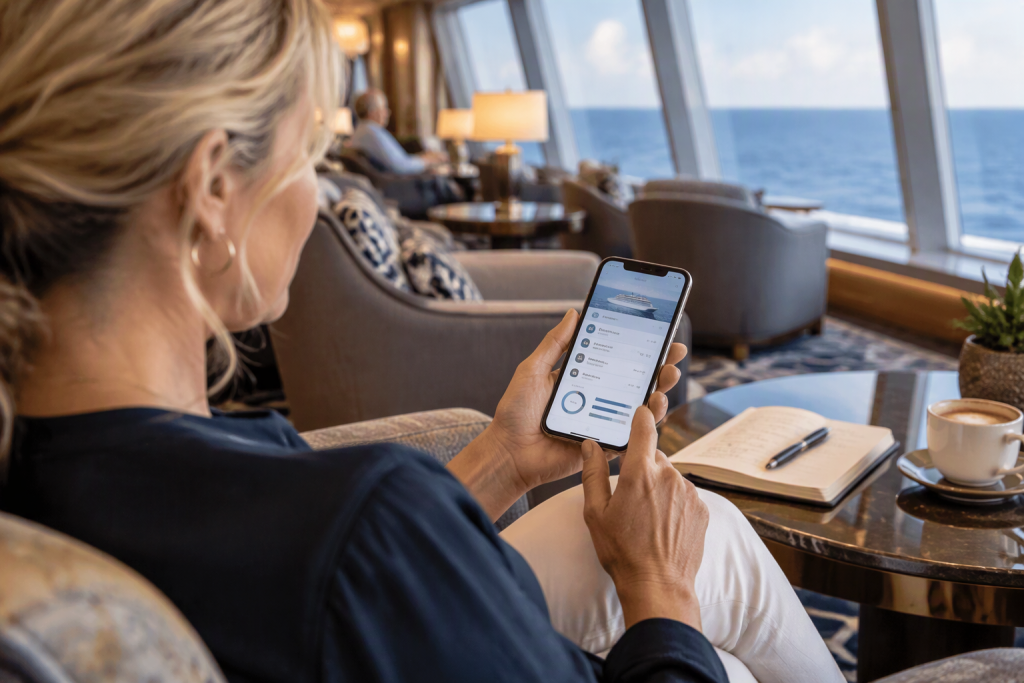
Royal Caribbean provides access to onboard account details through its app and stateroom television.
Carnival offers balance information through its HUB app, Guest Services, and onboard kiosks.
Norwegian’s current mobile app can also support onboard account-related information without requiring paid internet minutes for app use. Royal Caribbean Cruises+2
Some features may vary by ship, sailing, and app version, so confirm the options available onboard.
If your app doesn’t provide the detail you need, ask Guest Services how to obtain an itemized statement.
The goal is to know where the information lives before you actually need it.
Review Your Spending at a Time You’ll Remember
You don’t need to check your folio every time you order a drink or purchase a souvenir.
A regular daily check-in is usually a much more practical approach.
Choose a time that naturally fits your vacation, such as after breakfast or before dinner.
Review the total, look for anything unfamiliar, and compare your spending with the amount you planned to use.
If you’re comfortably within budget, there’s no need to rethink every purchase.
Online‑Only Cruise Offers You Won’t Find Elsewhere
Unlock special pricing and start planning the sailing that matches your perfect itinerary

When your account is growing faster than expected, you can adjust the categories that are contributing to the increase.
This might mean enjoying the included coffee options instead of visiting the specialty café several times each day.
You could also postpone a discretionary purchase until you’ve had time to consider whether it really adds value.
The purpose of tracking isn’t constant restraint. It’s maintaining enough visibility to make spending decisions intentionally.
Understand Which Onboard Credit You Can Actually Use
Onboard credit can be a valuable benefit, particularly when it’s provided as part of a booking promotion.
However, the details matter.
Some credit is refundable, while other credit may be nonrefundable and subject to restrictions on eligible purchases.
Certain promotions can exclude particular services or have specific expiration and usage conditions.
Before subtracting the full amount from your projected bill, confirm what the credit can cover.
For example, a credit restricted to certain onboard purchases may not offset every expense listed on your folio.
Similarly, some prepaid purchases may not appear in the same way as charges made after boarding.
The tracker above allows you to estimate the effect of credit, but your actual onboard statement and applicable terms remain the authority.
Keep Spending by Other Guests From Becoming a Surprise
Another issue first-time cruisers sometimes overlook is how charging privileges are assigned.
A family might have multiple guests using cruise cards connected to the same payment arrangement.
When everyone can make purchases, a single account can accumulate charges from several people.
Before sailing, find out whether your cruise line lets you manage charging privileges, separate accounts, or apply spending limits.
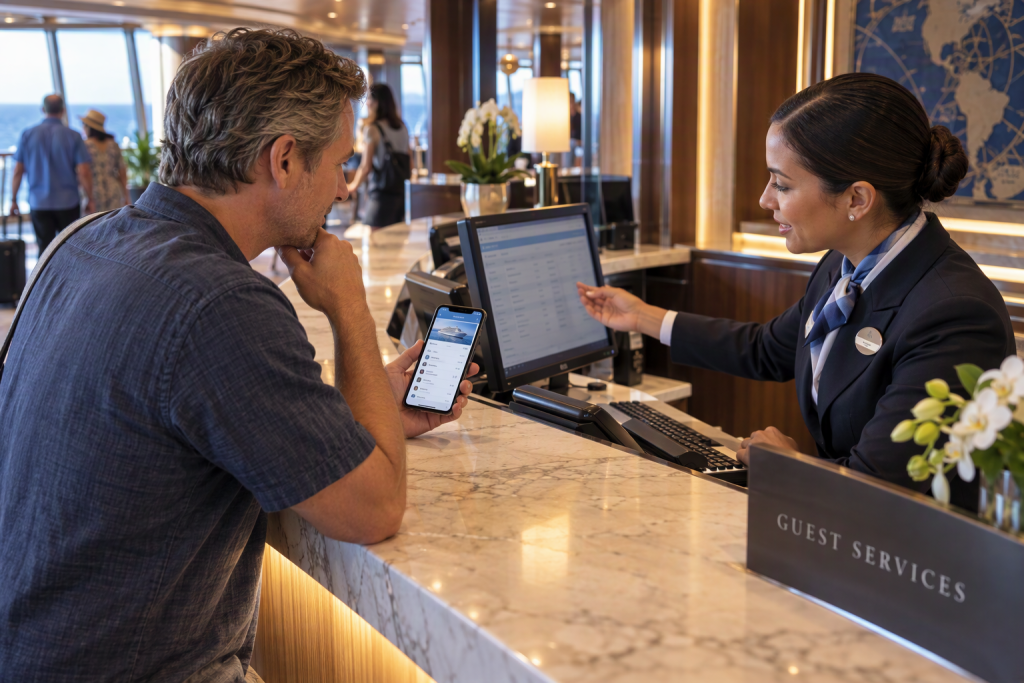
The available controls differ between operators, ships, and passenger categories.
If your children have onboard purchasing privileges, establish expectations before they start visiting shops, arcades, or paid attractions.
You don’t necessarily need to restrict every purchase.
You simply want to avoid discovering that several people were spending from one budget without realizing it.
Investigate Unexpected Charges While You’re Still Onboard
Sometimes the issue isn’t overspending.
You may notice an unfamiliar purchase, a charge for an activity that was canceled, or a transaction that doesn’t match your understanding of what was included.
Address those questions as soon as you identify them.
Guest Services can help review posted charges and explain which department or service generated them.
Depending on the transaction, the appropriate team may be able to investigate or correct an error.

Luxury Cruise Experiences at Smarter Prices
See premium sailings and upgraded cabins priced for travelers who know how to book well
Waiting until the final evening can make the experience more inconvenient, especially when many other passengers are also reviewing their bills.
A brief account check early in the sailing gives you more time to resolve questions without letting them interfere with your vacation.
Use the Tracker as a Guide, Not a Spending Target
A spending projection is useful because it highlights patterns, but it shouldn’t dictate every decision you make.
Your purchases may vary considerably between embarkation day, sea days, and days spent ashore.
An average calculated early in the cruise can exaggerate your likely final expenses if you’ve already made several one-time purchases.
The opposite can also happen.
A low initial balance doesn’t guarantee that upcoming excursions or paid activities won’t increase the total.
When you update the calculator, consider what’s still planned.
The best result isn’t necessarily finishing with the lowest possible bill.
It’s avoiding expenses you didn’t intend to incur while enjoying the experiences you deliberately chose.
Your folio should help you understand your vacation spending—not make you afraid of enjoying your first cruise.
How to Track Your Onboard Spending Without a Surprise Bill on Your First Cruise
If you are on your first cruise and worried about surprise charges, you are not alone.
Cruise ships make spending feel effortless, but that ease can lead to bill shock if you do not track your folio.
You tap your card, sign a slip, or scan your band, and everything flows into a running bill you do not see in full until later.
Instead of individual receipts you tuck into your wallet, charges collect in something the cruise line often calls your folio or account summary.
Your folio is simply the running ledger of every onboard purchase tied to your cabin or card.

Your account summary is the snapshot of that ledger you can see in the cruise line’s app, on your stateroom TV, at a kiosk, or at Guest Services.
When you do not understand how to read those tools or how often to check them, the money side of your vacation can feel like a guessing game.
The good news?
A few simple habits and the right app tools can keep your budget clear and your vacation stress-free.
A few simple habits, plus knowing which cruise lines let you see your folio right in their mobile apps, can turn your account summary into a friendly dashboard instead of a last-night shock.
Why Onboard Spending Feels Hard To Control For First-Time Cruisers
On land, you are used to paying as you go.
You swipe your card at a restaurant, see the total immediately, and tuck the receipt into your pocket or purse.
You pay for a ride share, a coffee, or a ticket and know right away what each choice cost.
On a ship, the pattern is different.
Your cruise card or wearable becomes your payment method almost everywhere, and charges quietly stack up on your folio instead of leaving a trail of paper in your wallet.
You may see your card tapped at the bar, the coffee shop, the arcade, or the spa, but you do not always see the updated total in that moment.
It is easy to think, “It is just one more drink,” or “It is just a small souvenir,” without realizing those small choices are adding up across several days.

Sail Away to Paradise Without Overpaying
Find cruise deals that make it easy to escape, relax, and enjoy the ocean without stretching your budget
When you combine that with extras like Wi-Fi, specialty dining, and shore excursions booked through the ship or through companies like Viator, GetYourGuide, Klook, Go City, or BikesBooking.com, the picture can get fuzzy fast.
Add in the fact that some offers are tied to onboard credit you received as a promotion, and you may not be sure what is really being covered by that credit and what is hitting your own card.
The result is a feeling that money is slipping through your fingers in a place where you cannot see it clearly.
That sense of fuzziness is what makes people worry that their final account summary will be a shock.
The fix is not to stop spending completely.
The fix is to bring structure to how you look at your folio so it becomes a tool instead of a mystery.
Why First-Time Cruisers Struggle With Onboard Spending
Cashless Systems Blur Individual Decisions
When every purchase is a tap instead of a physical payment, it is easy to lose track of totals.
The Folio Lives Behind The Scenes
Your spending flows into a digital ledger you only see when you actively pull up your account summary.
Add-Ons Layer Quietly On Top
Drinks, Wi-Fi, excursions, and spa services each seem small on their own but can stack up quickly across a week.
Simple Ways To Track Your Cruise Spending In Real Time
You do not have to watch your folio every hour to stay in control.
You just need a few repeatable habits that turn your account summary into a friendly dashboard instead of a verdict on the last night.
Learn Where To See Your Folio On Day One
As soon as you settle into your cabin on embarkation day, find out how your ship lets you view your account summary.
Most modern cruise lines make this very easy through their apps and cabin TVs.
On Royal Caribbean, you can see the details of your onboard account at any time on your stateroom TV and inside the Royal app while you are onboard. (Royal Caribbean)
On Carnival, the free Carnival HUB app shows real-time information on your current Sail & Sign account balance, so you can see charges almost as soon as they post without buying an internet package. (Carnival Cruise Lines)
On Norwegian Cruise Line, the Cruise Norwegian app lets you view your onboard credit and folio details, and those features work over the ship’s internal Wi-Fi intranet, not your paid internet minutes. (Norwegian Cruise Line)
On Princess, the Princess app includes a Folio section where you can see charges and check your balance daily, which many experienced Princess guests rely on instead of repeated visits to Guest Services. (Facebook)
Many other large lines now offer similar tools, and travel journalists regularly note that the easiest way to check your onboard bill is simply to open the cruise line’s app and look at your folio there. (The Points Guy)
If your line has an app, download it before you sail, then connect to the ship’s Wi-Fi network once onboard so it can switch into “onboard mode.”
For most lines, using the app to check your account, schedules, and reservations does not require a paid internet package, as long as your phone stays in airplane mode and uses only the ship’s internal Wi-Fi. (Carnival Cruise Lines)
If you prefer not to use an app, your stateroom TV often has a menu item for “Account,” “Folio,” or “Onboard Account.”
Guest Services can also print a paper copy of your account summary, and some lines offer self-service kiosks where you can tap your card and see or print your statement. (Carnival Cruise Line Help)
Taking five minutes to explore these options on day one removes a lot of guesswork and sets you up for low-friction tracking all week.
Set A Simple Check-In Routine
Once you know where your folio lives, build a light routine around it.
You do not need to stare at it constantly.
Checking it once a day, or every other day, is usually enough.
Some people like to make it part of their evening wind-down.
Others prefer to glance at their account summary after lunch or before dinner to see how the day is shaping up.
Whatever rhythm you choose, treat it as a quick pulse check, not a full audit.
You are simply confirming that your spending is in line with the budget you set back home.
If you notice that your bar tab is higher than you expected, your arcade charges are creeping up, or you are buying more specialty coffees than you planned, you can gently adjust your choices for the rest of the trip.
Use Categories, Not Just A Big Number
Some folios break charges into categories like “Bar,” “Shops,” “Dining,” “Excursions,” “Spa,” “Photos,” and “Other Services.”
If yours does, pay attention to where your money is actually going.
You might discover that your drink spending is right on target, but your impulse purchases in the shops are where the creep is happening.
Or you may see that a couple of ship excursions are taking more of your total than you realized, while a Viator or GetYourGuide tour could have provided a similar experience for less in certain ports.
Knowing the shape of your spending lets you adjust the right thing, instead of cutting back in areas that are already under control.
Give Each Adult A Quick Snapshot
If you are traveling with a partner or friends and all adults have charging privileges, make time for a quick check-in once or twice during the cruise.
You do not have to show each other every line item.
You just want to know whether everyone feels on track or whether someone is surprised by their own number.
That quick conversation can prevent awkward last-night moments when one person’s folio looks very different from what the group expected.
Easy Habits First-Time Cruisers Can Use to Track Spending
Find Your Account Summary Early
Knowing how to pull up your folio in the app, on the TV, or at a kiosk is half the battle.
Check A Little, Not A Lot
A quick daily glance keeps you informed without turning money into the focus of your entire trip.
Look At Patterns, Not Just Totals
Categories show you which habits are working and which ones are quietly stretching your budget.
How To Keep Your Folio Under Control Without Feeling Restricted
Tracking is only half the story.
You also want to prevent your folio from ballooning in the first place.
That does not mean saying no to everything.
It means setting up small guardrails so your spending stays in the zone you chose.
Decide Your Daily Comfort Number
Before you sail, it helps to have a rough daily number in mind for onboard spending.
You do not have to hit or avoid that number perfectly every day.
You just want a reference point.
For example, you might decide that $40 per day for drinks and extras feels comfortable, or that $75 per day is reasonable if it includes Wi-Fi and one or two paid activities.
Onboard credit can fold into this number.
If you know you have $200 in credit, you can treat that as covering a few days of spending in your mind, then track how much extra you are adding on top.
Knowing your comfort number helps you interpret your account summary when you look at it.
If you are consistently far below that amount, you know you have space for a few more fun choices.
If you are consistently above it, you can adjust before you drift too far.
Put Gentle Limits On Cards And Categories
The next step is to put gentle limits wherever money tends to leak the most.
If your kids or teens have cruise cards with charging privileges, consider turning off charging entirely or setting a fixed limit.
Some ships let you restrict specific cards to “no charges” while others can be set with daily caps.
Guest Services can explain what your line offers, and in some cases you can even manage limits at onboard kiosks. (Carnival Cruise Line Help)
For yourself, decide which categories are non-negotiable and which are flexible.
Maybe you absolutely want your specialty coffee every morning and a few cocktails during the week, but you are fine skipping full spa packages or expensive photo bundles.
Writing those priorities down once, even in the notes app on your phone or in a small notebook next to your Travelpro suitcase, can make your daily decisions easier.
Use Outside Tools To Support Your Plan
If you know you want strong travel protections and fewer financial surprises, you can also build tools into your plan.
Travel insurance from providers like VisitorsCoverage, World Nomads, Ekta, or Insubuy can help handle covered medical costs, trip interruptions, or delays, which keeps you from grabbing your credit card in panic if travel gets messy.
If airlines cause major disruptions, services like Compensair and AirHelp can sometimes help you pursue eligible compensation, putting money back into your overall travel pot.
None of these change the numbers on your folio directly, but they protect the bigger financial picture around your cruise so a problem does not erase all the careful tracking you did onboard.
Gentle Guardrails to Keep First-Time Cruise Budgets on Track
Pick A Daily Range You Actually Like
Your comfort number should feel realistic, not like a diet you are trying to endure.
Limit The Cards That Can Spend
Turning off or capping kids’ charging privileges keeps surprises off your folio.
Protect The Edges Of Your Budget
Insurance and compensation tools help when the unexpected threatens to blow up your plan.
Common Onboard Spending Tracking Mistakes Beginners Make
Most first-time cruisers are not careless.
They simply have never had to track spending in an environment where almost everything flows through one invisible ledger.
Waiting Until The Last Night To Look At The Folio
This is the biggest mistake.
If you avoid your account summary because you are afraid of what you might see, you give up your power to change course.
By the last night, most of your spending decisions are already behind you.
A long line at Guest Services filled with people questioning charges is the natural result. (The Points Guy)
If you check earlier in the week and see something strange or higher than expected, you can ask questions right away, while the transactions are easy for staff to trace and explain.
Ignoring Who Is Actually Charging To The Cabin
On many cruises, multiple people can charge to the same folio.
If you do not know which cards are active and who is allowed to use them, you can end up with mystery charges that turn out to be perfectly normal buys made by kids or relatives.
Setting ground rules for charging and limiting cards for younger travelers removes this confusion.
Misunderstanding Onboard Credit
Another mistake is assuming that onboard credit is limitless or that it automatically covers everything.
If you do not check how much credit you started with and how much remains, you may think charges are still hitting that pool when you have already spent through it.
Your account summary often shows onboard credit as a line or section.
Watching that number shrink during the week keeps your expectations aligned with reality.
Not Watching For Duplicate Or Unexpected Charges
Systems are usually accurate, but no system is perfect.
Occasionally, a drink might be entered twice, a canceled activity might still appear, or a charge might be mis-assigned to your cabin.
If you never glance at your folio, you may miss these small errors.
If you check your account summary every day or two, you can spot them and ask Guest Services to correct them while memories are fresh and transaction logs are easy to pull.
Letting Stress Spiral Instead Of Asking Questions
Sometimes new cruisers notice a higher number than they expected and then assume the worst.
They stew about it instead of asking for help, and anxiety grows larger than the actual problem.
Crew at Guest Services deal with folios all day.
They can explain categories, point out what onboard credit covered, and help you see the story behind the total.
Common Spending Mistakes First-Time Cruisers Should Avoid
Avoid The Last-Night Surprise
Looking at your folio early gives you time to adjust and to fix small errors before they become big frustrations.
Know Who Can Spend On Your Cabin
Simple rules about charging prevent “mystery” purchases that are really just unplanned ones.
Treat Guest Services As A Resource
If something does not look right, asking for clarification is smarter than worrying in silence.
Normal Fears About Watching Your Spending (And How To Ease Them)
Even with clear tools and good habits, you might still feel uneasy about your folio.
Money is emotional, and it can be tempting to avoid anything that reminds you of limits when you are supposed to be enjoying yourself.
Fear: “If I Look At My Account, It Will Ruin My Mood”
You might feel that looking at your account summary will turn vacation into a spreadsheet.
In reality, a quick scan can have the opposite effect.
It replaces vague anxiety with real information.
If the number is lower than you feared, you can relax more.
If it is higher than you expected, you at least know why and can decide what to change.
The story in your head is often worse than the actual total.
Fear: “I Am Bad With Money, So I Should Just Not Look”
A cruise is not the place to test that belief.
Instead, think of this trip as a chance to build new habits in a contained environment.
You have a clear start date, end date, and defined categories.
You are not tracking a whole year, just a week.
Checking your folio regularly and making small course corrections can be a confidence-building exercise, not a judgment.
Fear: “If Something Big Happens, I Am Completely On My Own”
This is where the broader structure of your trip matters.
Having travel insurance through VisitorsCoverage, World Nomads, Ekta, or Insubuy, booking hotels through platforms like Booking.com, Trip.com, Agoda, or Tripadvisor-listed options with clear policies, and knowing that services like Compensair and AirHelp exist for flight disruptions all protect your bigger financial picture.
They do not change your onboard folio, but they reassure you that one unexpected event will not automatically wreck your finances.
Fear: “I Will Look Cheap If I Watch My Spending Too Closely”
You may worry that being mindful about money makes you look out of place on a ship where others seem to be swiping freely.
Here is the truth.
Most people are paying attention, at least a little.
They may not talk about it, but they are looking at their folios too.
Taking care of your own budget is not rude or embarrassing.
It is responsible.
It lets you enjoy the cruise you paid for instead of worrying about the one you cannot afford.
Mindset Shifts That Make Cruise Spending Less Stressful
Information Is Less Scary Than Guessing
Knowing your numbers reduces that nagging background worry about a possible bill shock.
You Are Practicing A Skill, Not Taking A Test
Every check-in with your folio is a chance to build better habits that will serve you on future trips too.
Protecting Your Budget Protects Your Enjoyment
You are not on vacation to argue with yourself about money every night.
You are here to enjoy what you already decided you can afford.
FAQ – How Can First-Time Cruisers Track Onboard Spending and Avoid Surprise Charges?
How Do You Track Spending on Your First Cruise?
You can track spending on your first cruise by regularly reviewing the onboard account or folio associated with your purchases.
Depending on your cruise line, this information may be available through its mobile app, your stateroom television, a self-service kiosk, or Guest Services.
Compare the posted charges with the budget you established before sailing and investigate unfamiliar transactions promptly.
A short daily check helps you stay informed without making money management the focus of your vacation.What Is a Cruise Folio and Why Should First-Time Cruisers Check It?
A cruise folio is the record of purchases, charges, credits, and other transactions associated with your onboard account.
It can include beverage purchases, specialty dining, gratuities, excursions, and other expenses billed through the ship.
Reviewing it helps you understand what you’ve actually spent and which charges remain outstanding.
For first-time cruisers, checking the folio regularly is one of the easiest ways to avoid an unexpected final bill.Is Your Cruise Folio the Same as Your Onboard Account Balance?
Not exactly, because a folio can contain individual transactions while the displayed balance may reflect credits, payments, and adjustments.
You might have purchased more than the amount currently due if promotional onboard credit has already been applied.
Some accounts also display pending charges or separate transactions for different guests.
Understanding these distinctions helps first-time cruisers avoid mistaking the current balance for their total onboard spending.Can You Check Cruise Spending Through the Ship’s Mobile App?
Many major cruise lines provide account-viewing functions through their mobile apps, although the available features vary.
Royal Caribbean, Carnival, and Norwegian are among the operators that provide onboard account-related information through their digital services.
You may need to connect to the ship’s internal Wi-Fi network to access those features while sailing.
Check the instructions for your particular ship and app so you know how to retrieve your spending information.Does Carnival’s HUB App Show Your Sail & Sign Account Balance?
Yes, Carnival provides Sail & Sign balance information through its HUB app, as well as through Guest Services and onboard kiosks.
This allows passengers to review account activity during their sailing rather than waiting for the final statement.
The precise presentation and available details can depend on the app version and onboard system.
First-time Carnival cruisers should locate the account section shortly after boarding so they can review their charges throughout the trip.Can Royal Caribbean Passengers Check Their Onboard Account in the App?
Yes, Royal Caribbean provides access to onboard account information through the Royal app and stateroom television.
These options can help passengers review purchases and understand the charges connected to their SeaPass account.
It’s useful to check the account throughout the sailing and investigate unfamiliar items before disembarkation.
Your final statement and actual payment-card transactions may also reflect the timing of settlements and authorization holds.Can Norwegian Cruise Line Passengers Review Onboard Credit and Spending?
Norwegian provides account and credit information through its onboard digital services and stateroom television.
Its newer Norwegian Cruise Line app replaces the older Cruise Norwegian application, so first-time passengers should use the currently supported version.
The app can operate through the ship’s internal Wi-Fi without consuming paid internet minutes for supported functions.
Review the available account features onboard and ask Guest Services if you need additional transaction details.Can You Check Your Cruise Bill Without Buying a Wi-Fi Package?
Many cruise lines allow passengers to use selected onboard app features through the ship’s internal network without purchasing full internet access.
Account viewing may be among those functions, depending on the operator and ship.
You can also ask about stateroom television access, kiosks, or Guest Services when those options are provided.
First-time cruisers should confirm the available methods before assuming that monitoring their spending requires a paid internet package.How Often Should You Check Your Folio During Your First Cruise?
Checking once a day or every other day is a practical approach for many first-time cruisers.
That frequency helps you recognize unusual purchases and spending patterns without requiring constant attention.
You may prefer more frequent checks when several guests share an account or after a day involving multiple paid activities.
The important habit is reviewing charges early enough that you can investigate discrepancies before the final evening.How Can You Set a Realistic Daily Onboard Spending Budget?
Start with the total amount you’re comfortable spending on optional onboard purchases, then consider the length of your sailing.
Divide the allowance into a rough daily reference while leaving flexibility for more expensive activities on particular days.
A port day may involve fewer shipboard purchases than a sea day, so the daily average shouldn’t be treated as a strict requirement.
Compare your actual spending with the plan periodically and adjust the remaining allowance when necessary.What Is Onboard Credit and How Does It Affect Your Cruise Folio?
Onboard credit is an amount provided or purchased for eligible expenses during a cruise, subject to the operator’s terms.
It may appear as a credit or adjustment within your folio, reducing the amount you need to pay for covered purchases.
Some credit is refundable while other credit can have restrictions or expiration conditions.
First-time cruisers should confirm what their credit covers and monitor how much remains available.Can Onboard Credit Hide How Much You’ve Actually Spent?
Yes, onboard credit can make your net account balance appear lower than the value of your purchases.
For example, if you’ve purchased $200 in eligible services and $100 in credit has been applied, the amount remaining may be approximately $100 before other adjustments.
Your actual purchases still total $200.
Tracking the purchase total separately from the available credit gives first-time cruisers a clearer picture of their spending habits.Can Several People Charge Purchases to the Same Cruise Account?
Yes, depending on the cruise line’s account arrangements, multiple guests may have charging privileges linked to the same payment method or onboard account.
This can make it difficult to recognize who made individual purchases if you aren’t reviewing the transaction details.
Before sailing, establish expectations with everyone using the shared payment arrangement.
Families should also ask whether spending restrictions or separate accounts are available for younger passengers.Can You Limit Your Children’s Onboard Spending During a Cruise?
Some cruise lines provide controls that allow parents or responsible adults to restrict purchasing privileges or manage spending for children.
The availability of individual limits, disabled charging, or account separation differs between operators.
First-time cruisers should ask Guest Services or review the cruise line’s account policies before relying on a specific restriction.
Combining available account controls with clear family expectations can help prevent unexpected arcade, shopping, and specialty purchases.What Should You Do if You Find an Incorrect Charge on Your Cruise Folio?
Report the unfamiliar or potentially incorrect charge to Guest Services as soon as you notice it.
Have the transaction date, amount, and description available so the staff can investigate the purchase.
In some situations, the charge may relate to an automatic gratuity, a delayed posting, or a purchase made by another authorized guest.
Reviewing the issue while you’re still onboard often makes it easier to clarify what happened and request an appropriate correction.Why Does Your Bank Show More Money Pending Than Your Cruise Folio?
Some cruise lines place temporary payment-card authorization holds to ensure funds are available for onboard purchases.
These holds can affect your available card balance without representing additional finalized charges.
Your bank may also display pending transactions separately from the eventual settled payment.
If the amounts appear inconsistent, compare the posted folio charges with the pending authorizations and ask the cruise line or card issuer for clarification.Should You Check Your Cruise Folio Before Disembarkation?
Yes, reviewing your folio before disembarkation helps you identify unfamiliar charges and confirm whether expected credits or adjustments have been applied.
Waiting until after the voyage may make some billing questions less convenient to resolve.
Try to examine the account before the final evening, especially if you’ve made several paid purchases or used promotional credit.
Keep a copy of the final statement for comparison with the eventual charges to your payment method.How Can You Track Spending by Category on Your First Cruise?
Review your folio for transaction descriptions and group purchases into categories such as beverages, specialty dining, excursions, shopping, and spa services.
Some cruise systems may provide these categories directly, while others require you to interpret individual transaction descriptions.
Compare the amounts with the budget you assigned to each category before sailing.
This can help you reduce spending in the areas exceeding your expectations without cutting back on experiences that remain within budget.What Are the Biggest Onboard Spending Mistakes First-Time Cruisers Make?
Common mistakes include waiting until the final night to check the folio, overlooking automatic service charges, and misunderstanding how onboard credit affects the balance.
Some passengers also forget that other travelers may have purchasing privileges linked to their account.
Small repeated purchases can accumulate before the total becomes noticeable.
Establishing a check-in routine and reviewing unfamiliar charges promptly helps prevent these problems.What Is the Simplest Way to Avoid a Surprise Cruise Bill?
Find out how to access your onboard account as soon as you board and establish a realistic optional spending allowance.
Check your folio every day or two, compare the posted purchases with your budget, and monitor remaining onboard credit separately.
Ask Guest Services about charges you don’t recognize rather than waiting until the end of the cruise.
These straightforward habits allow you to enjoy your first sailing while maintaining a clear understanding of the expenses accumulating onboard.
Plan Your Next Cruise!

Experience the Perfect Blend of Disney Magic, Luxury Cruising, and Family Adventure at Sea
One Delay Can Cost Your Entire Cruise A quick coverage check now protects you from the problems no one sees coming….

Unlock The Viking Ocean Experience: Elegant Ships, Cultural Immersion, And Unrushed Travel
One Delay Can Cost Your Entire Cruise A quick coverage check now protects you from the problems no one sees coming….

Discover Princess Cruise Line: Elegant Ships, Immersive Voyages, and World‑Class Experiences
One Delay Can Cost Your Entire Cruise A quick coverage check now protects you from the problems no one sees coming….

Sail Into Italian Elegance: Costa Cruises for Culture, Cuisine, and Unforgettable Voyages
One Delay Can Cost Your Entire Cruise A quick coverage check now protects you from the problems no one sees coming….
Explore More

Cruising While Pregnant: The Rules, Risks, and Relaxation You Need to Know

Recharge at Sea: Luxury Cruise Spa Packages for Deep Relaxation and Lasting Wellness

Catch Every Game at Sea: Where to Watch Live Sports on Your Cruise
