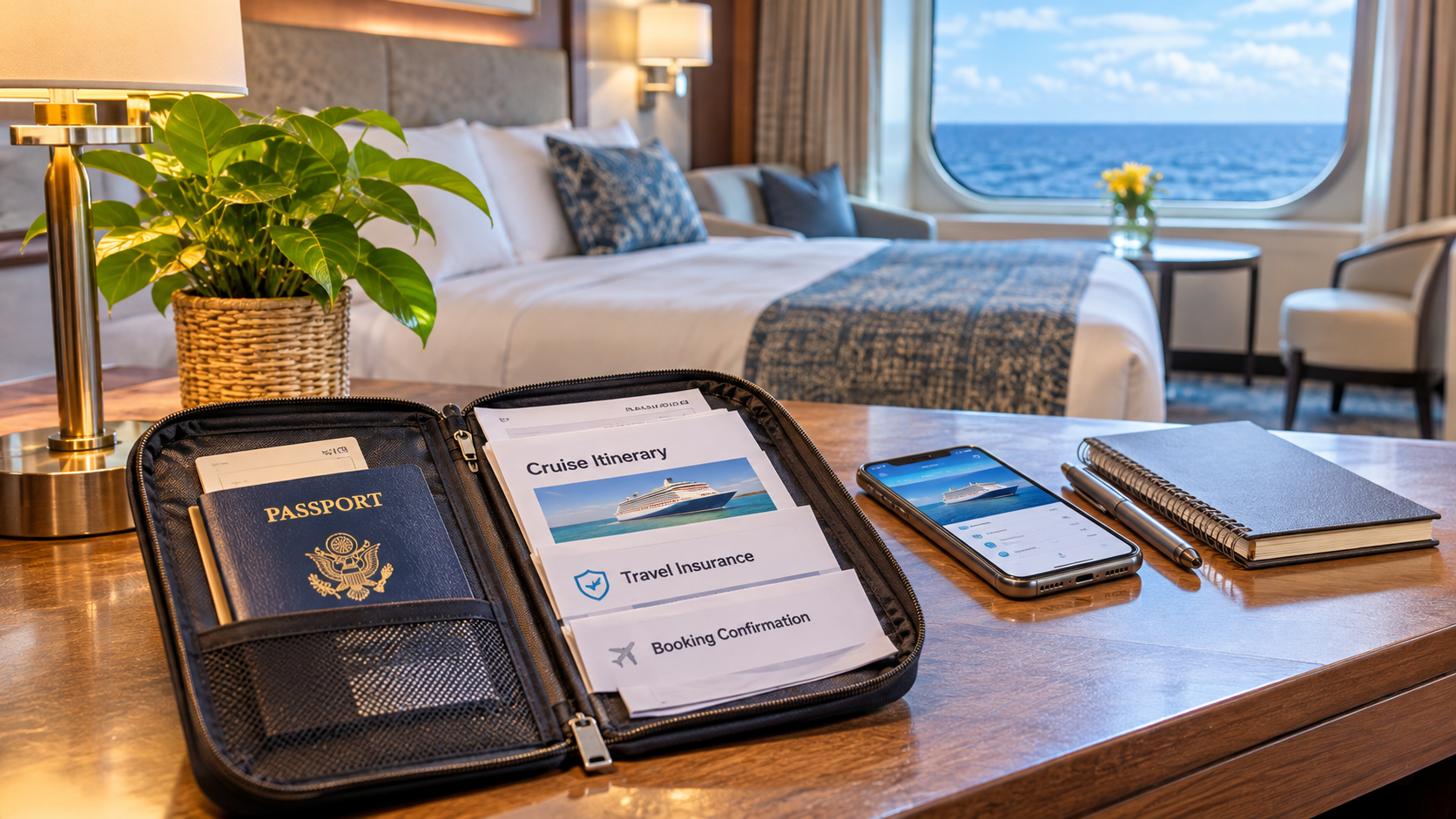

One Delay Can Cost Your Entire Cruise
A quick coverage check now protects you from the problems no one sees coming.
Short Excerpt
- Learn which original travel documents you need for boarding and which backup copies can help during disruptions.
- Understand why a passport book can be especially valuable if a hurricane forces an unexpected return flight.
- Organize insurance records, booking confirmations, medical information, and emergency contacts without carrying unnecessary paperwork.
- Use an interactive document-readiness checklist to prepare for embarkation, limited connectivity, and itinerary changes.
Quick Take
- Verify your required identification before departure. Passport rules depend on your citizenship, itinerary, destinations, and cruise line.
- A valid passport book is strongly recommended for international cruises, even when an eligible closed-loop sailing permits alternative documents.
- Keep required original identification and boarding documents in your carry-on, not in separately handled checked luggage.
- Save essential travel information in both a secure offline digital format and a small collection of printed backups.
- Insurance documents are useful for assistance and claims, but a hurricane-related itinerary change doesn’t automatically qualify for reimbursement.
- When your cruise changes ports or return dates, preserve official notices and receipts before dealing with affected reservations.
Which Cruise Documents Can Make Hurricane-Season Travel Less Stressful?
Your Caribbean cruise is going beautifully until the captain announces a change: a developing tropical storm has affected the planned route, and your ship will visit a different port.
The change may be relatively simple.
Perhaps you’ll enjoy an additional day at sea or explore another island.
But what happens if the ship returns late and you need to rebook a flight?
What if you require medical treatment ashore?
Or what if your passport, insurance information, and airline confirmation are all stored in an email account you can’t open?
These situations explain why organizing your documents matters during hurricane season.
The goal isn’t to carry a thick binder of paperwork everywhere you go.
It’s to know which originals are legally necessary, which copies are useful, and which records could help you resolve a travel disruption.
Most importantly, having documentation doesn’t automatically guarantee entry into another country, reimbursement from an insurer, or a faster immigration process.
It gives you information you can use when those arrangements need to be addressed.
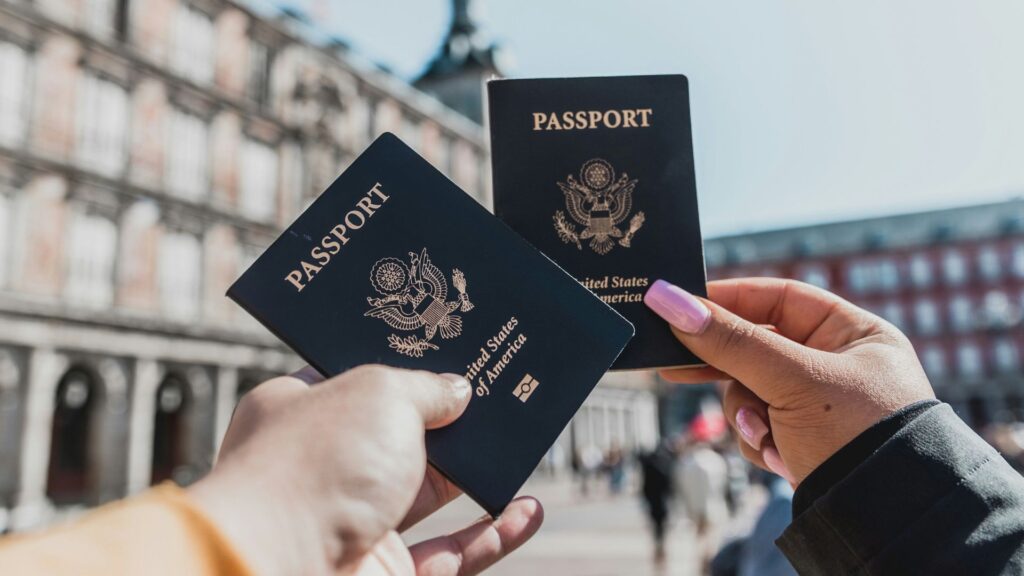
The U.S. Department of State strongly recommends that cruise passengers carry a passport book even when one isn’t required for the original sailing.
An emergency could require you to disembark abroad or return home by air, where different documentation rules apply. (U.S. Department of State — Cruise Ship Travel)
That’s an important distinction for anyone sailing during the Atlantic hurricane season, which officially extends from June 1 through November 30.
A cruise itinerary can change. Your preparation should account for that possibility without assuming something will go wrong.
The most practical approach is to organize your documents into three groups: what you must carry, what you should back up, and what you may need if travel arrangements change.
Cruise Document Readiness Checklist
Use this interactive checklist to review your boarding documents, offline backups, and disruption records.
Unlike a general cruise emergency kit, this tool focuses specifically on documentation: what has been verified, where you can access it, and which records matter if a hurricane affects your travel plans.
It doesn’t determine whether your documents meet immigration requirements or whether an insurance claim is covered.
Those decisions depend on the relevant authorities and your actual policy.
Cruise Document Readiness Checklist
Prepare your boarding documents, offline backups, and records for unexpected travel changes. Check items as you complete them.
Boarding documents
Planning aid only. Confirm actual requirements with your cruise line and relevant governments. Copies cannot replace legally required originals. Avoid entering sensitive identifying information.
Passport Books, Passport Cards, and Other Cruise Identification
The first question to resolve isn’t whether a hurricane could affect your cruise.
It’s whether every person traveling has the correct original documents for the itinerary they’ve booked.
Documentation requirements can differ based on citizenship, the countries visited, the starting and ending ports, and the rules of the cruise operator.
That makes general advice such as “all Caribbean cruises require passports” or “a birth certificate is always enough” unreliable.
Why a Passport Book Is Worth Considering Even When It Isn’t Required
Some U.S. citizens on qualifying closed-loop cruises may use approved alternative identification rather than a passport book.
A closed-loop cruise generally begins and ends at the same U.S. port, although additional eligibility conditions and destination requirements apply.
U.S. Customs and Border Protection explains that documentation varies by citizenship and itinerary, and foreign governments or cruise lines may impose requirements beyond U.S. reentry rules. (U.S. Customs and Border Protection — Cruise Documentation)
Top Cruise Deals From Trusted Cruise Lines
Compare exclusive online offers and find the fare that fits your trip and your budget

For hurricane-season travelers, the main limitation of alternative documentation is what happens if the journey changes substantially.
Suppose the ship cannot return as scheduled and you must fly home from another country.
A U.S. passport book is normally required for international air travel, even when you were eligible to begin the cruise with another form of documentation.
The State Department therefore strongly recommends traveling with a passport book on international cruises, including eligible closed-loop sailings. (U.S. Department of State — Cruise Ships)
This recommendation doesn’t mean every hurricane reroute creates an immigration problem.
It means a passport book provides more flexibility if an unexpected situation requires international air travel.
Why a Passport Card Is Not the Same as a Passport Book
A U.S. passport card is accepted for certain land and sea border crossings.
However, it is not valid for international travel by air. (U.S. Department of State — Passport Card vs. Passport Book)
If an emergency requires you to fly from a foreign port to the United States, a passport card won’t ordinarily meet the airline and immigration requirements for that journey.
That’s an important distinction when choosing documentation for a Caribbean or Bahamas cruise.
A passport card may be legally sufficient for some planned itineraries, but it doesn’t provide the same emergency travel flexibility as a passport book.
Check Passport Validity Before You Sail
Having a passport isn’t enough if it expires too soon for a destination’s requirements.
Some countries require a passport to remain valid for a specified period beyond the planned visit.
Others have different rules depending on nationality or type of entry.
Check the destinations on your itinerary, including any countries where you may embark or disembark.
Don’t assume that every Caribbean country requires six months of remaining validity, and don’t assume that none do.
The State Department recommends reviewing destination-specific entry requirements and passport validity rules before international travel. (U.S. Department of State — International Travel Checklist)
Online‑Only Cruise Offers You Won’t Find Elsewhere
Unlock special pricing and start planning the sailing that matches your perfect itinerary

Which Documents Should Stay in Your Embarkation Carry-On?
The originals you need for boarding should be separated from the backup records you may only need later.
One of the simplest ways to avoid documentation problems is to keep essential papers with you during embarkation.
Cruise operators may collect checked luggage before passengers enter the terminal, and those bags may not reach cabins immediately.
If your passport or other required identification is inside a checked suitcase, retrieving it can be difficult.
Royal Caribbean specifically advises passengers to carry their passports, boarding passes, valuables, and medications with them instead of placing them in checked luggage. (Royal Caribbean — Top Things to Know After Booking)
Your Essential Embarkation Document Set
| Document | Purpose | What to verify |
|---|---|---|
| Passport or approved identification | Boarding, immigration, and travel eligibility | Original document, validity, and itinerary requirements |
| Cruise boarding pass | Check-in and embarkation | Whether the cruise line accepts digital presentation or requires another format |
| Visa or travel authorization | Entry or transit where applicable | Requirements based on citizenship and destinations |
| Required child-travel documents | Proof of identity, relationship, or consent | Cruise-line and destination requirements |
| Reservation confirmation | Booking reference and traveler details | Correct names, ship, sailing date, and reservation number |
| Essential medical documentation | Supports individual health needs | Whether specific equipment, medication, or arrangements require documentation |
Don’t assume every operator calls its boarding pass a SetSail Pass.
That’s Royal Caribbean terminology. Other cruise lines have different check-in processes and document names.
Also, don’t assume that a screenshot will always replace the official boarding document.
Follow the cruise line’s current instructions for presenting a barcode, mobile pass, printed pass, or other accepted documentation.
Do You Need Visas or Special Entry Documents for Hurricane Reroutes?
This is one area where the original article could have given readers an unnecessarily alarming impression.
A hurricane doesn’t automatically mean passengers must obtain emergency visas for any replacement port.
Cruise operators handle vessel-level port arrangements, and passenger entry requirements depend on nationality, the destination, the circumstances, and whether travelers will formally enter the country.
Still, the ability to enter or leave a country shouldn’t be taken for granted.
What to Check Before Departure
Verify the required travel authorizations for the itinerary you’ve actually booked.
For some passengers, that may involve visas, electronic travel authorizations, permanent-resident documentation, or other permits.
Requirements for U.S. citizens can differ from those for travelers holding other passports.
The State Department advises checking the entry and exit requirements for every destination and confirming the necessary visas or travel authorizations before departure. (U.S. Department of State — Travel Industry Guidance)
An ESTA is not a general-purpose Caribbean visa.
It is associated with eligible travel to the United States under the Visa Waiver Program, and it shouldn’t be presented as something passengers can obtain in advance for an unknown replacement country.
If Your Cruise Adds an Unexpected Port
Wait for the cruise line to confirm the revised destination and any passenger instructions.
If you’re being asked to disembark in a foreign country, particularly to continue traveling independently, ask about the entry requirements affecting your nationality and circumstances.
Don’t assume that a new scheduled port automatically creates a problem, but don’t assume the ship can waive individual immigration requirements either.

Luxury Cruise Experiences at Smarter Prices
See premium sailings and upgraded cabins priced for travelers who know how to book well
If you must fly home independently, those documentation requirements can differ from remaining aboard the cruise ship.
Having a valid passport book and accessible booking records may help you deal with that situation.
Traveling With Children: Documents That Are Easy to Overlook
Families may need additional documentation beyond the ordinary adult identification requirements.
These rules deserve attention before departure, particularly when a child is traveling with one parent, a grandparent, another relative, or a family friend.
Birth Certificates and Proof of Relationship
Children may need passports, birth certificates, or other accepted citizenship and identity documents depending on the itinerary and operator.
The cruise line may also require specific records to establish the relationship between accompanying adults and children.
A photograph of a birth certificate isn’t necessarily accepted when an original or certified copy is required.
Check your cruise line’s current instructions rather than relying on another family’s experience.
Parental Consent and Custody Documents
Certain destinations require parental consent documentation when a child travels without one or both parents.
In some circumstances, documents establishing sole custody or legal guardianship may also be relevant.
The State Department advises that parents traveling internationally with children should review destination requirements, including any signed or notarized consent-letter rules. (U.S. Department of State — Travel With Minors)
You shouldn’t assume every cruise requires the same notarized letter.
Instead, confirm the requirements for the cruise line, countries visited, and the child’s particular travel arrangements.
What Travel Insurance Documents Should You Keep Accessible?
Insurance paperwork has a different purpose from passports and boarding documents.
It doesn’t establish your legal right to enter a country, and it doesn’t prevent a hurricane-related delay.
What it can do is help you find assistance details, understand your benefits, and identify the correct procedures if a covered event occurs.
Keep the Actual Policy, Not Just a Confirmation Email
A short insurance confirmation might show that you purchased a plan, but it may not explain what the plan covers.
Save the policy or certificate of insurance, the relevant coverage terms, and any applicable benefit schedule.
You should also have the provider’s emergency assistance number and claims contact details.

Sail Away to Paradise Without Overpaying
Find cruise deals that make it easy to escape, relax, and enjoy the ocean without stretching your budget
Make sure the records clearly identify the insurer and the specific policy you selected.
This matters if you purchased through a marketplace such as VisitorsCoverage or Insubuy, where the marketplace’s identity may differ from the insurer responsible for the selected coverage.
Which Insurance Records Matter During a Disruption?
| Record | Why it may be useful |
|---|---|
| Insurance policy and certificate | Identifies the purchased coverage and applicable conditions |
| Emergency assistance details | Explains how to seek help or obtain required authorization |
| Original cruise and travel receipts | Establishes booked arrangements and amounts paid |
| Cruise-line change notice | Documents a confirmed cancellation, delay, or itinerary alteration |
| Additional expense receipts | Supports requests involving qualifying costs actually incurred |
| Airline or hotel notices | Establishes changes made by those providers |
| Claims correspondence | Helps track instructions, requests, and decisions |
Not every insurance claim requires every document shown here.
The purpose is to retain relevant evidence rather than collect unnecessary paperwork.
Do Hurricane-Related Itinerary Changes Automatically Qualify?
No.
Some travel insurance policies cover specified interruptions, cancellations, or delays.
Others have exclusions, minimum qualifying conditions, limitations on missed ports, or requirements that an insured event cause a particular type of loss.
The National Association of Insurance Commissioners advises travelers to examine policy terms carefully and cautions that buying coverage after a storm has become a known event may leave claims arising from that storm excluded. (NAIC — Should I Get Travel Insurance?)
You also shouldn’t assume that every provider named in a travel article offers the same hurricane benefits.
A flight-compensation service, for example, is not interchangeable with an insurer providing travel medical or trip-interruption coverage.
Is There a 72-Hour Rule for Insurance Claims?
There is no universal 72-hour reporting deadline that applies to all travel insurance policies.
Some policies require prompt notice, preauthorization for particular services, or submission of supporting documentation within specified periods.
Others establish different deadlines.
Read your actual policy and contact the appropriate claims or assistance department when required.
Don’t invent a claim deadline based on general travel advice, and don’t assume that reporting a possible storm before any loss occurs guarantees coverage.
Medical and Emergency Information That Can Help During a Cruise Disruption
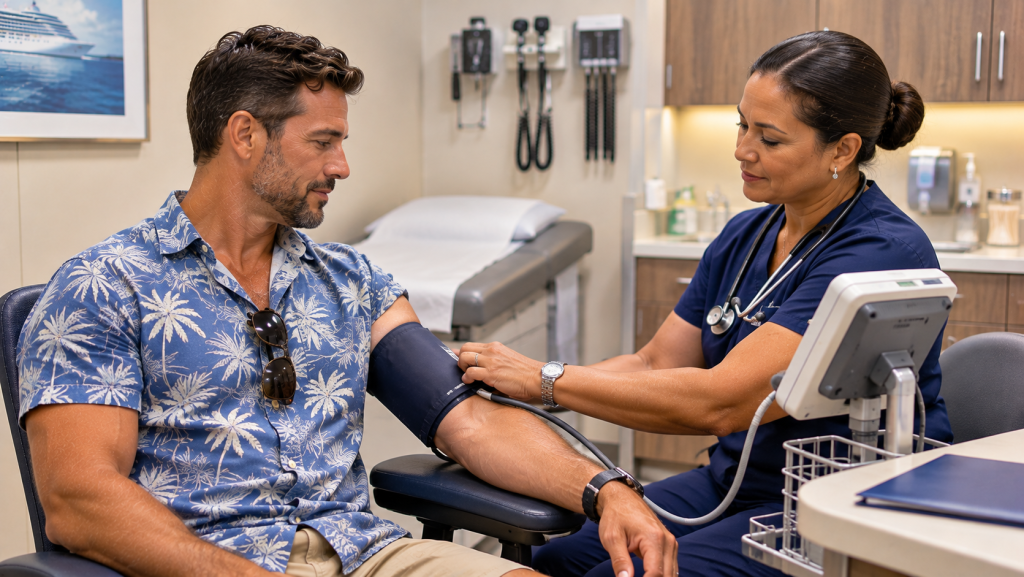
Medical records aren’t normally the central focus of a cruise-document folder.
However, a concise health information sheet may be valuable if you become ill or require medical attention while traveling.
This is especially relevant if you take multiple prescriptions, have important allergies, use medical equipment, or need regular treatment.
Prepare a Short, Accurate Medical Summary
Depending on your circumstances, consider keeping a current list of medications, dosages, relevant allergies, important conditions, and contact details for your regular healthcare professionals.
Keep these details private and accessible to appropriate individuals when needed.
You don’t need to carry your entire medical history on every excursion.
A concise summary is often easier to use than a folder full of unrelated test results.
Check Whether Medical Equipment Requires Documentation
If you’re traveling with oxygen equipment, specialized medication, mobility devices, or medical equipment requiring electrical power or refrigeration, contact the cruise line in advance.
Some equipment may require advance approval, supporting documentation, or specific arrangements.
Policies vary by cruise line and ship.
The CDC recommends that passengers with significant medical needs determine what services and arrangements are available on the vessel before departure. (CDC Yellow Book — Cruise Ship Travel)
How to Organize Your Cruise Documents Without Carrying a Large Binder
The best document system is easy to understand when you’re tired, traveling, or trying to resolve a schedule change.
For most passengers, a compact travel wallet and a secure digital folder are sufficient.
You don’t need a complicated filing system to be organized.
Use Three Simple Document Categories
The first category contains original identification and documents required for travel.
The second contains backup records, including insurance details, reservations, and emergency contacts.
The third is for disruption documentation: official itinerary notices, receipts, and communications you collect only if something changes.
Separating these purposes helps you avoid carrying unnecessary copies of sensitive documents.
Keep Originals Secure and Accessible
During embarkation and other situations where identification is required, keep original documents with you.
Once aboard, follow the cruise line’s guidance about passports and personal identification.
You may use the cabin safe for documents that aren’t currently needed, although you should understand the ship’s instructions for shore visits and disembarkation.
Don’t assume every port requires passengers to carry their original passport ashore.
Also, avoid carrying originals unnecessarily when a cruise card and other identification will meet the local and operator requirements.
Store Backups Separately
A printed copy can be useful if your phone battery dies or you cannot access a cloud account.
A secure digital copy can help if paper documents are misplaced or damaged.
Where reasonable, separate backup copies from the originals so a single missing bag doesn’t contain everything.
But more copies aren’t always better.
Unnecessary passport photographs or unprotected medical documents can create privacy risks if a device or bag is lost.
The State Department recommends keeping copies of important travel documents to help with replacement when originals are lost or stolen. (U.S. Department of State — International Travel Checklist)
How to Save Cruise Documents for Offline Access
Cloud storage services can be convenient for travel planning.
However, a cloud file isn’t necessarily available when your device is disconnected.
Before departure, identify the records you may need without a working internet connection and save them securely on your device.
What Belongs in the Offline Folder?
A useful collection could include your cruise booking reference, insurance policy, hotel information, flight confirmation, emergency assistance contacts, and copies of essential travel documents.
Use clear filenames so you can identify the correct records quickly.
For example, a file named “Cruise Insurance Policy” is easier to recognize than a collection of downloaded files with generic numerical names.
If you’re storing sensitive records digitally, use your device’s security features and avoid sharing access more widely than necessary.
Test Your Files Before Sailing
Don’t assume that downloading a file guarantees it can be opened offline.
Open your essential records while your phone is disconnected from the internet to confirm that they’re genuinely stored locally.
Do this before departure, while you still have time to fix problems.
Printed backups can cover a small number of particularly important items, including emergency telephone numbers and booking references.
Can You Use a Screenshot of Your Boarding Pass?
A screenshot may be helpful where the cruise line accepts that format.
However, boarding passes can involve barcodes, app-specific verification, or other rules that differ by operator.
A screenshot isn’t a substitute for original identification.
Follow the exact boarding instructions provided by your cruise line rather than assuming any saved image will be accepted.
What Documents Matter if Your Cruise Is Rerouted by a Hurricane?
A changed itinerary can involve several different situations.
Your ship might visit another port, skip a destination, spend an additional day at sea, return to its original port late, or make another operational adjustment.
Each situation has different documentary consequences.
The first step is to understand the actual change.
Save the Official Cruise-Line Notice
When your cruise operator confirms an adjustment, retain the message if possible.
This could be an email, an app notification, a revised itinerary, or another written communication.
Make sure you can identify what changed and when the updated arrangements were communicated.
If you receive only a verbal announcement and require documentation for an independent booking or insurance claim, ask guest services whether a written confirmation is available.
Avoid relying on passenger rumors or speculative forecast maps as evidence of a confirmed itinerary change.
Check Independent Excursions and Prepaid Arrangements
A missed port may affect independent tours, transfers, tickets, or other prepaid activities.
Review the provider’s cancellation terms and contact it using the revised itinerary details.
Keep the confirmation of the original booking, relevant communications, and any refund determination.
Don’t assume every operator provides an automatic refund when a cruise ship skips a destination.
The applicable terms vary.
If Your Return Is Delayed
A late return may create additional consequences for flights, hotel stays, ground transportation, or other plans.
Save the cruise line’s revised arrival information.
Then contact the relevant providers and preserve their responses.
If you incur additional expenses, keep receipts and a record of the reason those expenses arose.
These documents may help you seek reimbursement where appropriate, but their existence doesn’t guarantee that a claim or refund request will succeed.
What if You Lose Your Passport During a Cruise?
Losing a passport abroad can be more difficult than misplacing an ordinary travel document.
A photocopy or digital image of your passport may help establish identifying information, but it is not a replacement passport.
If you’re abroad and your passport is lost or stolen, the U.S. Department of State advises contacting the nearest U.S. embassy or consulate for assistance with replacement. (U.S. Department of State — Lost or Stolen Passport Abroad)
Tell the Cruise Line if the Loss Affects Your Travel
If the missing document could interfere with returning to the ship, disembarking, or continuing your journey, notify the cruise line promptly.
Ask which official procedures apply to your situation.
Don’t assume guest services can produce a replacement passport or override border-control requirements.
Use Copies to Support Replacement, Not to Replace the Original
A securely stored copy of your passport’s identifying information may assist when reporting the loss or arranging replacement.
However, it doesn’t authorize ordinary international air travel.
Once a valid U.S. passport has been formally reported lost or stolen, it cannot be used for international travel even if you later find it. (U.S. Department of State — Report a Lost or Stolen Passport)
The appropriate next steps depend on your location, nationality, travel circumstances, and instructions from the relevant authorities.
A Simple Document Routine Before, During, and After Your Cruise
You don’t need to review every piece of paperwork each day.
Instead, use a short routine at the stages when documents are most likely to matter.
Before departure, verify identification, visas, travel authorizations, booking information, and any necessary medical arrangements.
During embarkation, keep original documents and your boarding information accessible.
Once onboard, store originals securely, confirm your shore-visit instructions, and retain the information needed for your return journey.
If a hurricane or other disruption changes your plans, save official notices before contacting affected providers.
After returning home, organize any remaining receipts, claims correspondence, and refund information.
Once the practical matters are resolved, review whether you still need the temporary copies you’ve made.
This helps keep your personal information from remaining unnecessarily scattered across devices and folders.
Cruise With Your Documents Organized and One Less Thing to Worry About
Hurricane season can bring uncertain weather, but it doesn’t mean every Caribbean cruise will encounter a serious disruption.
Most passengers won’t need emergency replacement documents, unexpected international flights, or complicated insurance claims.
Still, the consequences of being unprepared can be significant when those situations do arise.
A valid passport book, accessible boarding information, secure document backups, and clearly organized insurance records can make an unexpected change easier to manage.
The important distinction is between carrying paperwork and having a useful documentation system.
You don’t need dozens of forms or copies of every confirmation you’ve ever received.
You need the right originals, reliable backup access, and a straightforward way to preserve evidence if travel plans change.
With those arrangements completed before departure, you’ll be better prepared to enjoy the voyage without spending your vacation searching through emails, folders, and missing confirmations.
FAQ – Which Cruise Documents Should You Carry During Hurricane Season?
What documents should I carry on a cruise during hurricane season?
Carry the original identification and travel documents required for your citizenship, itinerary, and cruise line.
You should also have your boarding pass, relevant travel authorizations, emergency contacts, and accessible booking information.
Insurance records and selected backups can help if severe weather changes your travel arrangements.
The exact documents required for boarding should be verified before departure.Do I need a passport for a Caribbean cruise during hurricane season?
Not every Caribbean cruise requires a U.S. citizen to carry a passport book under the original itinerary’s rules.
Some qualifying closed-loop cruises allow approved alternative documentation, although the cruise line or destinations may impose additional requirements.
The State Department strongly recommends a valid passport book because an emergency could require international air travel.
Hurricane season is one reason to consider that flexibility rather than rely only on the minimum boarding requirements.Is a passport card enough for a hurricane-season cruise?
A U.S. passport card can be accepted for certain land and sea border crossings.
It isn’t valid for international air travel, which becomes important if an emergency requires you to fly home from a foreign country.
Whether the card is acceptable for your planned sailing depends on the relevant rules and itinerary.
A passport book offers broader travel flexibility.What happens if my cruise is rerouted to another country?
The cruise line will communicate any confirmed itinerary changes and relevant passenger instructions.
Entry requirements at the replacement destination depend on nationality, local rules, and the circumstances of disembarkation.
A new port doesn’t automatically mean you must personally arrange a new visa, but permission to enter shouldn’t be assumed either.
Ask the operator for guidance if the change affects your ability to disembark or travel independently.Should I bring a printed copy of my cruise boarding pass?
A printed boarding pass can be a useful backup when the cruise line accepts or recommends that format.
Many operators also use mobile passes or app-based check-in systems.
A screenshot isn’t universally accepted, and a boarding pass doesn’t replace required identification.
Follow the specific instructions for your cruise rather than assuming every line uses the same process.Should I carry my passport in my checked cruise luggage?
Required identification should remain with you during embarkation, rather than being placed in luggage handled separately by porters.
Your checked suitcase may not be readily accessible during terminal check-in.
Once onboard, follow the cruise line’s instructions about storing identification and taking documents ashore.
Keep any originals you need for travel accessible at the appropriate time.Is a photocopy of my passport legally valid for cruise boarding?
A photocopy generally does not replace an original passport when a passport is legally required.
Some itineraries permit alternative original or certified documents, but the acceptance rules are specific.
Passport copies can help provide information if the original is lost or stolen.
Verify what your cruise line requires before relying on a photograph or printed copy.What insurance documents should I bring on a cruise?
Keep the policy or certificate of insurance, applicable coverage terms, emergency assistance details, and relevant booking records accessible.
These documents can help you understand benefits and follow claims procedures if a covered event occurs.
A purchase confirmation alone may not explain the policy’s exclusions or limitations.
Save essential information offline and protect sensitive details appropriately.Will insurance pay for a cruise itinerary change caused by a hurricane?
A weather-related change doesn’t automatically create an entitlement to insurance reimbursement.
Coverage depends on the selected policy, the type of disruption, applicable exclusions, and whether a covered loss occurred.
Some policies may provide benefits for qualifying delays or interruptions without covering a simple missed port.
Review the written terms and keep official evidence of any confirmed changes.Do I have to notify my travel insurer within 72 hours of a storm?
There is no universal 72-hour deadline applying to every travel insurance policy.
Some plans require prompt reporting, specific claims documentation, or advance authorization for certain services.
The correct timeline depends on the actual contract and circumstances.
Read your policy and follow its notification requirements rather than relying on a general deadline.What documentation helps with a cruise delay insurance claim?
Useful evidence may include the original booking confirmation, official delay notice, receipts for eligible additional expenses, and communications with affected providers.
Your insurer may require different supporting records depending on the claimed benefit.
A weather app screenshot alone may not prove the type of loss required by the policy.
Preserve relevant documents and follow the insurer’s instructions.Should I print my entire travel insurance policy?
You generally don’t need to carry a large paper policy everywhere you go.
It is useful to keep a secure offline copy of the full terms and a compact printed summary of important assistance contact details.
Make sure you can find the insurer’s identity and the correct policy documentation when necessary.
If your policy requires particular certificates or documents, follow those requirements.What medical information should I carry on a cruise?
A current medication list, relevant allergies, emergency contacts, and important medical information can be useful if you need treatment.
Travelers using specialized equipment or requiring particular accommodations may need additional documentation.
Keep personal medical records secure and share them only when appropriate.
Your healthcare professional and cruise line can help clarify what information is relevant to your circumstances.Do children need extra travel documents on cruises?
Children need the documents required for their citizenship, itinerary, and cruise operator.
Certain situations may also require birth certificates, parental consent letters, custody documentation, or proof of guardianship.
Requirements differ depending on the destination and whether the child travels with one or both parents.
Verify the exact rules well before departure.How should I save cruise documents for offline access?
Store essential PDFs or records directly on your device using an appropriate secure storage method.
Check that they actually open when the device is disconnected, rather than assuming a cloud link will remain available.
Use clear filenames for reservations, insurance details, and other information.
Keep selected printed backups where they can be accessed if your device becomes unavailable.Is it safe to email copies of my passport to myself?
Email can be convenient, but an ordinary inbox may not be the most secure place for sensitive identity documents.
Access could be affected by account security problems, device loss, or unavailable connectivity.
Consider secure storage with appropriate device protection and keep copies only when they serve a genuine purpose.
Avoid sending unnecessary passport information to multiple people or accounts.Should I carry my original passport during every shore excursion?
Not necessarily, because the correct procedure depends on the destination and cruise-line instructions.
Some ports may require specific identification ashore, while others allow passengers to leave original passports securely aboard.
Your cruise card and other documents may also be relevant.
Follow the instructions for each port instead of applying one rule to every destination.What should I do if I lose my passport while on a cruise?
Notify the cruise line if the loss affects your travel arrangements and contact the appropriate embassy or consulate if you’re abroad.
A digital or paper copy may help with identification during the replacement process, but it isn’t a replacement travel document.
Official procedures depend on nationality, location, and the circumstances of the loss.
Don’t assume you can fly internationally using only a passport photograph.Can I use my credit card’s travel insurance instead of buying a policy?
Some credit cards provide travel protection benefits, but those benefits vary and may depend on how the trip was purchased.
Coverage limits, covered events, exclusions, and claims requirements can differ substantially from standalone travel insurance.
Not every card provides medical or evacuation benefits.
Review the card’s actual benefits guide before deciding whether additional coverage is appropriate.What is the easiest way to organize cruise documents before departure?
Create three clearly separated categories: original boarding documents, secure backup records, and information needed if travel plans change.
Keep essential originals in your carry-on and verify that important digital files are available offline.
Save insurance assistance information and the contact details of major travel providers.
This simple arrangement gives you useful access to records without requiring a large collection of unnecessary paperwork.
Plan Your Next Cruise!

Experience the Ultimate Vacation with Carnival Cruise Line’s Fun Ships, World‑Class Entertainment, and Relaxation
One Delay Can Cost Your Entire Cruise A quick coverage check now protects you from the problems no one sees coming….

Sail Boldly: Experience Virgin Voyages’ Adults‑Only Cruises With Style, Freedom, And Fun
One Delay Can Cost Your Entire Cruise A quick coverage check now protects you from the problems no one sees coming….

Sail the World in Style: MSC Cruises’ Innovative Ships, Luxury Amenities, and Global Adventures
One Delay Can Cost Your Entire Cruise A quick coverage check now protects you from the problems no one sees coming….

Sail Smart: Discover The Real Cost of Luxury Cruises and Maximize Your Travel Value
One Delay Can Cost Your Entire Cruise A quick coverage check now protects you from the problems no one sees coming….
Explore More

Unlock a Tailored Cruise Experience: From Cabin Choice to Shore Adventures

Inside Cruise Ship Backup Power: Blackouts, Safety Systems, and What Passengers Should Expect

Sail Into Sophistication: Holland America Cruises for Luxury, Culture, and Unforgettable Journeys