
One Delay Can Cost Your Entire Cruise
A quick coverage check now protects you from the problems no one sees coming
Short Excerpt
- Worried about seasickness on your first cruise? Learn what to prepare before boarding so motion sickness doesn’t dominate your vacation plans.
- Understand why medication timing matters and why free seasickness pills aren’t guaranteed onboard.
- Use an interactive first-cruise checklist to organize your preparations before departure and during embarkation.
- Discover practical ways to manage nausea, avoid common mistakes, and know when to seek medical assistance.
Quick Take
- Prepare before your first cruise. Ask your doctor or pharmacist about motion sickness prevention if you’ve experienced nausea in cars, planes, or smaller boats.
- Understand medication timing. Many motion sickness treatments work better before exposure to movement. Follow your specific medication instructions rather than guessing when to take it.
- Don’t assume Guest Services provides free pills. Availability, charges, and distribution procedures vary by cruise line. Bring an appropriate personal supply.
- Use your surroundings. Midship areas on lower decks generally experience less pronounced movement, while looking toward the horizon may reduce discomfort.
- Avoid common triggers. Excessive alcohol, inadequate sleep, and prolonged reading or screen use can make motion sickness harder to manage.
- Know when to ask for help. Persistent vomiting, dehydration, severe dizziness, or worsening symptoms require appropriate medical evaluation.
Worried About Getting Seasick on Your First Cruise? Prepare Before You Board
You’ve booked your first cruise, started looking forward to exploring the ship, and imagined everything you’ll enjoy once you’re sailing.
But if you’ve experienced motion sickness before, one worry may be difficult to ignore: what happens if you spend your vacation feeling nauseated instead of enjoying it?
Perhaps you remember an unpleasant ferry crossing or a car ride that left your stomach unsettled.
You might be wondering whether a large cruise ship will feel different or whether you’ll spend your first evening wishing you were back on land.
Being sensitive to movement doesn’t automatically mean you’ll have a difficult first cruise.
Your experience depends on individual sensitivity, sea conditions, and how your body responds to the ship’s motion.
The useful preparation begins before embarkation.
If you’re considering motion sickness medication, talk with your doctor or pharmacist about which options are appropriate and when they should be used.
Many preventive medications work better before exposure to movement than after nausea develops.
However, different treatments have different timing requirements, side effects, and medical precautions. (CDC Yellow Book — Motion Sickness)
It’s also worth checking what your cruise line actually provides onboard.
Some operators make seasickness remedies available through Guest Services or the medical center, but complimentary medication isn’t a universal cruise benefit.
Carnival, for example, states that guests can purchase meclizine through Guest Services, the medical center, or room service. (Carnival — Motion Sickness / Sea Sickness)
Bringing an appropriate supply of your own medication is more dependable than assuming tablets will be available without charge.
Before you board, a simple preparation checklist can help you organize those decisions and identify where to get assistance if you need it.
Interactive First-Cruise Seasickness Preparation Checklist
The checklist below focuses on the preparations most likely to be overlooked: selecting an appropriate remedy before departure, reviewing medication precautions, checking onboard availability, and knowing where to seek help.
It doesn’t recommend medication or dosage.
Its purpose is to help you complete your preparations without repeatedly worrying about what you might have forgotten.
My First-Cruise Seasickness Plan
Check off each step as you prepare for your voyage.
You can copy your checklist to keep a record of the tasks you’ve completed.
My First-Cruise Seasickness Plan
Check off each step as you prepare for your voyage. Copy your checklist to keep a record of your progress.
Preparation aid only. This checklist does not replace individualized medical advice.
What This Checklist Helps You Decide Before Boarding
You don’t need to predict exactly how your body will respond to the ship.
The checklist simply helps you complete decisions that are easier to make before departure than while feeling unwell at sea.
Once you know which remedies are appropriate for you, where onboard assistance is available, and what symptoms deserve medical attention, you can focus on enjoying your first cruise.
The next step is understanding why seasickness can feel so intimidating beforehand—and how the practical measures discussed throughout this guide can help you respond without unnecessary panic.
Why Seasickness Feels So Intimidating Before Your First Cruise—and How to Manage That Worry
Worried about seasickness on your first cruise?
You are not alone.
If you are planning your first cruise and quietly worrying about seasickness, you are not being dramatic.
You are being honest.
Maybe you had a rough ferry ride once and swore you would never repeat it.
Maybe you get queasy in the back seat of a car or on twisty roads and assume a ship will be worse.
Top Cruise Deals From Trusted Cruise Lines
Compare exclusive online offers and find the fare that fits your trip and your budget

Maybe you are excited about the trip but secretly picturing yourself stuck in a cabin, miserable, while everyone else is having fun.
All of that anxiety is understandable.
The important shift is realizing that seasickness is not a mysterious curse.
It is a specific kind of motion sickness, and you can prepare for it with specific steps.
Motion sickness happens when your inner ear, your eyes, and your brain disagree about what is going on.
On a ship, your inner ear feels motion, while your eyes might be looking at something that appears still, like a hallway or your phone screen.
Your brain gets mixed messages, and some people’s bodies respond with nausea, dizziness, and a general “off” feeling.
Modern cruise ships are large, stabilized, and designed to reduce motion, but you may still feel the sea at times.
What matters is that you understand how to prevent symptoms before they start, how to use the ship’s resources—especially free seasickness pills from Guest Services—and how to respond if you feel wobbly without letting fear take over the entire trip.
Why Seasickness Feels Bigger Than It Often Is
Before you ever step on board, seasickness exists mostly in your imagination.
Your brain remembers car rides, small boats, amusement parks, or one bad crossing and projects that feeling onto an entire cruise.
You might picture yourself losing entire days to nausea.
You may imagine that once you get sick, there is nothing you can do.

You might also worry that asking for help will make you look weak or unprepared.
In reality, seasickness on large cruise ships is usually milder and more manageable than people fear, especially when they prepare.
The gap between your imagined worst-case and the more realistic, preventable version is where most anxiety lives.
Closing that gap with clear information makes a huge difference.
Motion Sickness In Plain Language
Motion sickness is what happens when your inner ear and your eyes send conflicting signals to your brain about movement.
If your inner ear says “we are moving” but your eyes say “everything looks steady,” your brain gets confused and sometimes responds with nausea, dizziness, or headaches.
On a cruise ship, you may be more vulnerable to this when you are inside, looking at walls, reading, or staring at your phone, because your eyes cannot see the horizon.
When you step outside and watch the water line or distant land, your eyes finally agree with your inner ear.
For many people, that alone makes them feel more stable and less queasy.
Why Your Worry Is Completely Normal
You are leaving solid ground and trusting a large ship and its crew.
You are spending real money and do not want it ruined by motion.
You may be responsible for kids, partners, or friends and want to stay functional for them.
These are not silly concerns.
They are exactly why it is worth building a simple seasickness plan before you sail.
Helpful Truths About First-Time Seasickness Worries
Your Worry Has A Job
Your brain is trying to keep you safe, not ruin your vacation.
Information Shrinks Fear
Once you know how prevention works, seasickness stops feeling like a mysterious force and starts feeling like something you can manage.
You Are Not The Only One Nervous
Plenty of first-time cruisers feel exactly like you and still end up enjoying their trips.
Proactive Remedies: Getting Seasickness Pills From Guest Services
The single most useful step most first-time cruisers never hear about is also the simplest.
As soon as you get on board, and after you have dropped bags in your cabin or found your way around, make a direct trip to Guest Services.
Do this before sail away.
Do it before dinner.
Online‑Only Cruise Offers You Won’t Find Elsewhere
Unlock special pricing and start planning the sailing that matches your perfect itinerary

Do it before you start to feel even the slightest bit off.
When you reach the desk, wait your turn and then say something like: “This is my first cruise, and I am worried about motion sickness. Do you have seasickness pills, and when should I take them.”
On many mainstream cruise lines, the answer will be yes.
Guest Services or the medical team will provide basic motion sickness tablets at no cost.
These are often generic versions of familiar over-the-counter motion sickness medicines.
The exact ingredient may vary by line and region, which is why it is essential to read the information they provide and ask questions.
What Typically Happens At Guest Services
When you ask for seasickness pills, the crew member will often:
Explain what kind of tablets they are offering and how they should be taken.
Confirm how often you can take them and what the daily maximum is.
Tell you that you should avoid alcohol while the medication is in your system.

Remind you that these pills work best when taken before symptoms start.
They may hand you a small blister pack or a few doses in a labeled envelope.
In some cases, they might direct you to the medical center if they feel your health history or other medications need a doctor’s review before you take anything.
Do not be alarmed by that.
It is a sign they are taking you seriously.
Why Timing Matters So Much
The big mistake many first-time cruisers make is waiting.
They think, “I’ll see if I get sick and then take something.”
By the time you are actively nauseated, you are asking the medication to catch up with a moving train.
It can still help, but you might have a much rougher few hours while it kicks in.
Motion sickness pills are most effective as prevention, not as a last-minute rescue.
Taking them early, according to the schedule provided by the ship or your own doctor, can keep your inner ear and brain from spiraling into full symptoms.
You are essentially giving your body a head start.
Alcohol And Seasickness Pills
One critical reason to visit Guest Services early is the alcohol question.
Many seasickness medications do not combine well with drinking.
They can increase drowsiness, affect balance, and make dehydration worse when mixed with alcohol.
Crew and medical staff will almost always advise you to avoid alcohol while you are taking these pills.
If you have purchased a drink package or are planning to enjoy cocktails, you need to know this before you drink, not after.
That does not mean your trip is ruined if you are on medication.
It does mean you may choose to prioritize feeling steady for the first night or two and save heavier drinking for later in the cruise if your doctor agrees and you no longer need the pills.
How Guest Services Fits With Your Own Doctor’s Advice
Before you travel, it is wise to talk to your own doctor or pharmacist about motion sickness.
Tell them you are planning a cruise.
Explain your history with motion sickness in cars, planes, or smaller boats.

Luxury Cruise Experiences at Smarter Prices
See premium sailings and upgraded cabins priced for travelers who know how to book well
Ask which types of medications and doses are appropriate for you, especially if you are on other prescriptions.
You may board already carrying a recommended medicine.
Guest Services and the medical team become a backup and a support system.
They can supplement your supply, explain how their onboard medicine interacts with what you already take, and help you adjust your plan based on real conditions at sea.
Travel insurance from companies such as VisitorsCoverage, World Nomads, Ekta, or Insubuy makes it easier to seek professional help if you need the ship’s medical center, because you know you have a framework to help with covered expenses instead of hesitating purely over cost.
How Often You Can Go Back
If the voyage is longer or the route is rougher than you expected, you may run low on the initial pills you received.
In that case, you can return to Guest Services or visit the medical center to ask about more.
They may:
Provide additional tablets.
Suggest switching to a different approach, like a patch or a different dose, if the doctor approves.
Check whether there might be something else contributing to your symptoms, such as dehydration or another illness.
Again, their goal is not to judge you.
Their goal is to keep you as comfortable and safe as possible.
Seasickness Pills: Key Takeaways
Ask Early, Not Late
Visit Guest Services soon after boarding and get clear instructions before you ever feel sick.
Treat Pills as Prevention
Take medication as directed before symptoms start, not as a desperate move after you are already miserable.
Respect The “No Alcohol” Guidance
If the crew or doctor says not to drink on these pills, take that advice seriously for your own safety and comfort.
Onboard Habits That Support Your Stomach
Medication is powerful, but your everyday choices on board are just as important.
You can think of them as the background settings that either support your body or make things harder.
Ships move less in the middle and on lower decks, so if you are very motion sensitive, midship cabins on lower decks are often more comfortable.
Outdoor spaces where you can see the horizon give your brain consistent visual information that matches what your inner ear feels.
Heavy, fried meals, large portions, and a lot of sugar or alcohol can make your stomach more easily upset.
Planning lighter meals and steady hydration gives your body a better foundation.
Practical Daily Habits That Help
Spend time outside looking at the horizon whenever you start to feel even slightly “off.”
Seeing the true motion helps your brain reset.
Choose lighter meals on days when the sea feels more active—grilled proteins, plain starches, simple vegetables, and fruit instead of heavy, creamy, or deep-fried dishes.
Sip water regularly instead of gulping large amounts all at once; steady hydration supports your balance and energy.

Sail Away to Paradise Without Overpaying
Find cruise deals that make it easy to escape, relax, and enjoy the ocean without stretching your budget
Avoid overdoing caffeine, which can make you feel jittery and dehydrated.
Give yourself a little time between taking a seasickness pill and lying completely flat; a brief walk on deck with fresh air can help the medicine settle.
If your doctor approves, gentle supports like ginger candies, ginger tea, or acupressure bands can add another layer of comfort.
Even your clothing can help.
Tighter waistbands or clothing that feels constricting can make nausea feel worse, while soft, breathable fabrics make it easier to relax and move.
Where To Spend Time When You Feel Uneasy
If you feel a wave of nausea, your first instinct might be to hide in your cabin.
Sometimes rest is exactly what you need.
But if your cabin is an interior room with no windows, staring at unmoving walls can intensify the mismatch between what your inner ear feels and what your eyes see.
Instead, consider going to an open deck or a lounge with big windows.
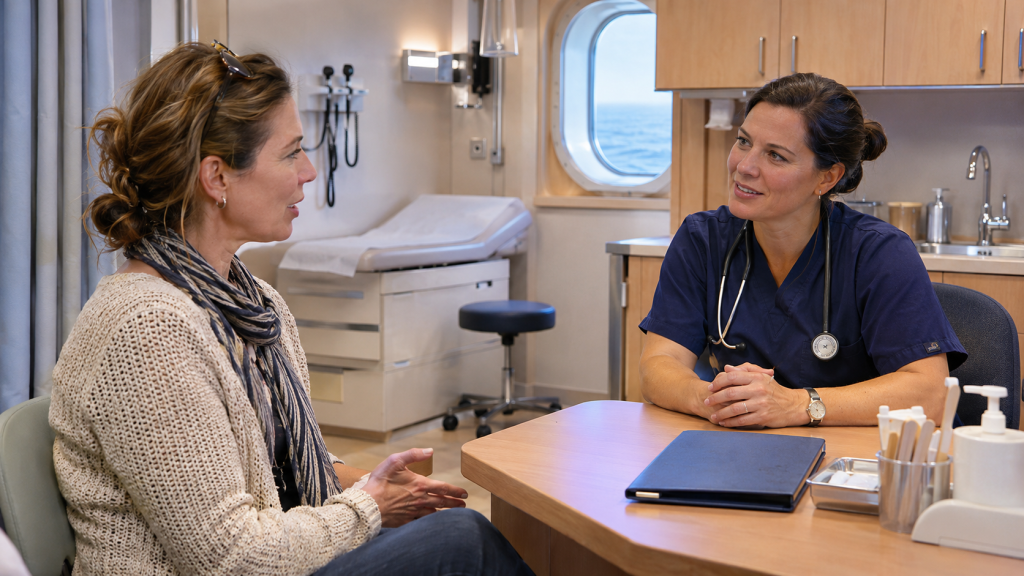
Find a seat where you can see the water.
Breathe slowly.
Look straight ahead at the horizon, not down at your phone.
Give your body time to sync up.
Onboard Habits: Key Support Ideas
Light And Simple Beats Heavy And Rich
Your stomach will thank you for easier foods on days when the ship is moving more.
Water, Not Just Cocktails
Steady hydration makes everything else you are doing more effective.
The Horizon Is A Powerful Tool
Spending time where you can see the water often helps your brain and body agree on what is happening.
Avoid Seasickness Mistakes That Trip Up First-Time Cruisers
Most first-time seasickness mistakes are not about “doing something wrong.”
They are about waiting too long, ignoring early signs, or believing myths.
The first big mistake is assuming you will “wait and see” instead of planning.
By the time you realize you are sensitive to the ship’s movement, you have already slipped into a pattern of nausea that is harder to stop.
The second is treating seasickness pills like a magic reset button you can press at any time, rather than a preventive tool with specific timing and rules.
The third is mixing motion sickness pills with alcohol because “everyone is here to party,” and underestimating how strongly that combination can affect your body.
There are also mindset mistakes.
Thinking you must push through and never ask for help.
Hiding how you feel from your traveling companions until you are completely overwhelmed.
Avoiding the medical center out of embarrassment or fear of cost when you really do need professional support.
Examples Of Mistakes You Can Easily Avoid
Waiting until the ship hits rougher water on the first night, then taking a pill for the very first time while you are already nauseated.
Skipping a visit to Guest Services because you worry about being “dramatic,” even though they see motion-sensitive guests every single sailing.
Eating the heaviest, richest buffet meal on embarkation night, then immediately heading to a show in the very front or very back of the ship, where motion feels stronger.
Buying a big drink package and deciding you will just “deal with the pills later,” even when the crew tells you not to mix the two.
Brushing off the idea of travel insurance, then hesitating to visit the medical center because you are worried about cost instead of focusing on getting better.
How To Correct These Patterns
You can treat seasickness prevention like sunscreen instead of like burn cream.
You use it early and regularly, not only after you are already in trouble.
You can see the medical center and Guest Services as partners, not last-resort options.
They exist partly for people in your exact situation.
You can combine health support with financial backup by buying travel insurance from providers such as VisitorsCoverage, World Nomads, Ekta, or Insubuy and being aware of airline assistance tools like Compensair and AirHelp if your journey to the ship is disrupted.
Knowing that help is available on both the medical and financial sides makes it much easier to act early instead of waiting until things feel urgent.
Mistakes And Fixes: Core Lessons
Waiting Makes Everything Harder
The longer you delay prevention, the more effort it takes to dig yourself out of symptoms.
Pills Are Tools, Not Magic
They work best with proper timing, no alcohol, and supportive habits like fresh air and light food.
Asking For Help Is Wise, Not Weak
Guest Services and the medical team are there precisely so you do not have to handle this alone.
Overcome Seasickness Fears: Confidence Tips for First-Time Cruisers
Even with a solid plan, you may still feel nervous.
You might worry that you are “someone who always gets motion sick” and that nothing will help.
You might picture yourself ruining the trip for your family by needing to rest more.
You might fear that if the sea gets rough, you will not cope.
These fears are often louder than the reality.
On large cruise ships, many people who are sensitive in cars or on small boats discover that with preventive medication, good habits, and a little support, they handle the motion far better than expected.
They may have a rough first night and then feel noticeably better once they find what works for them.
Common Fears, Answered
“I am scared I will be sick from the moment we leave port until the day we get back.”
In practice, most passengers experience seasickness—if they feel it at all—in shorter windows, often tied to particular conditions or routes.
Proactive meds and habits dramatically shrink those windows.
“I am worried I will ruin the trip for everyone else.”
Your loved ones would rather see you take care of yourself early, with pills, rest, and support, than watch you try to push through and end up miserable.
Also, many ships have quiet spaces, room service, and flexible activities, so you can adjust on a day or two without losing the whole cruise.
“I am anxious about needing the medical center.”
Knowing the medical team is there, having travel insurance in place, and understanding that they see seasickness regularly turns the medical center from a scary unknown into a clear, available resource.
Emotional Anchors You Can Carry
You Have A Plan, Not Just A Fear
Guest Services, pills, habits, and medical backup form a real system, not just wishful thinking.
Rough Moments Do Not Define The Whole Trip
Even if you have one difficult evening, it does not mean the entire cruise will feel that way.
You Are Allowed To Protect Your Own Comfort
Looking after your health is part of being a good traveling companion, not the opposite.
FAQ – How Can First-Time Cruisers Prevent Seasickness and Feel Better at Sea?
FAQ – Will I Get Seasick on My First Cruise if I Get Motion Sick in Cars?
Getting motion sick in cars may indicate that you’re more sensitive to movement, but it doesn’t guarantee you’ll become seasick on your first cruise.
Large ships move differently from cars and smaller boats, and conditions vary throughout a voyage.
If you’ve experienced motion sickness before, discuss prevention options with your doctor or pharmacist before departure.
Having a plan can help you respond if symptoms develop.FAQ – How Can You Prepare for Seasickness Before Your First Cruise?
Start by considering whether you’ve experienced motion sickness during previous journeys.
Ask a healthcare professional about appropriate prevention options, particularly if you take other medications or have underlying medical conditions.
If treatment is recommended, pack an adequate supply and review the instructions before sailing.
You should also check where your cruise line makes motion sickness remedies and medical assistance available onboard.FAQ – Can You Get Free Seasickness Pills From Guest Services on a Cruise Ship?
Some cruise lines may provide motion sickness tablets through Guest Services, but complimentary medication isn’t guaranteed.
Other operators sell remedies or direct passengers to a medical center or another onboard department.
Ask your cruise line about its arrangements before departure if you expect to need medication.
Bringing an appropriate personal supply is more dependable than assuming free tablets will be available.FAQ – Should You Take Seasickness Medication Before Your Cruise Ship Leaves Port?
Many motion sickness medications are more effective when taken before exposure to movement rather than after nausea develops.
However, the correct timing depends on the active ingredient, formulation, and individual medical circumstances.
Ask your doctor or pharmacist which treatment is appropriate and follow its instructions.
Don’t take extra doses or combine medications because you’re worried about the ship moving.FAQ – What Seasickness Medications Are Commonly Used on Cruises?
Common motion sickness treatments include meclizine and dimenhydrinate, while prescription scopolamine patches may be suitable for certain travelers.
These options differ in how they’re used, how long they act, and the side effects they can cause.
Drowsiness is a concern with many treatments, and some medications have additional restrictions for particular medical conditions.
A healthcare professional can help you select an appropriate option before your first cruise.FAQ – Can You Drink Alcohol While Taking Seasickness Pills on a Cruise?
Alcohol may increase the drowsiness, dizziness, and impaired coordination caused by many motion sickness medications.
It can also make motion sickness symptoms worse independently of medication use.
Check the warnings for your particular treatment and ask a healthcare professional about potential interactions.
Don’t assume a medication is safe to combine with alcohol simply because it’s available without a prescription.FAQ – Where Should You Sit on a Cruise Ship if You Start Feeling Seasick?
A location near the middle of the ship on a lower deck generally experiences less pronounced movement than areas near the bow, stern, or upper decks.
If you’re feeling nauseated, a comfortable seat with a clear horizon view may also help reduce the conflicting sensory signals associated with motion sickness.
Avoid reading or staring at your phone if those activities aggravate symptoms.
If you’re too dizzy to walk safely, remain seated or rest and ask for assistance.FAQ – Is a Lower-Deck Midship Cabin Better for Preventing Seasickness?
A lower-deck cabin near the middle of the ship is often a reasonable choice for travelers particularly sensitive to movement.
These locations generally experience less pronounced pitching and rolling than certain cabins farther forward, aft, or higher above the waterline.
However, no cabin location guarantees that you’ll avoid seasickness in every condition.
If you’ve already booked elsewhere, you can still use lower-motion public areas when needed.FAQ – Why Does Looking at the Horizon Help With Seasickness?
Motion sickness can occur when visual information conflicts with the movement detected by your inner ear.
Looking toward a distant horizon provides a reference that can help your visual system interpret the ship’s movement.
This may reduce discomfort, although it doesn’t guarantee immediate relief.
If moving to a horizon-facing location is unsafe because of dizziness or rough conditions, rest where you are and request assistance.FAQ – Can Reading or Using Your Phone Make Seasickness Worse?
Reading or looking at a nearby screen may worsen seasickness because your eyes remain focused on an apparently stationary object while your balance system detects movement.
This can increase the sensory conflict associated with motion sickness.
If you begin feeling uncomfortable, put your phone or book aside and consider looking toward the horizon.
Reducing visually demanding activities is one of the behavioral strategies used to manage motion sickness.FAQ – What Should You Do if You Feel Seasick on Your First Cruise Night?
If nausea begins during your first evening, stop activities that appear to aggravate symptoms and find a safe place to rest.
Looking toward the horizon, limiting unnecessary head movements, and taking small sips of water may help with mild discomfort.
Follow your approved medication instructions rather than taking extra doses to accelerate relief.
Contact the ship’s medical center if symptoms persist, worsen, or prevent you from keeping fluids down.FAQ – Is It Better to Rest in Your Cabin or Go Outside When You Feel Seasick?
Both approaches can be helpful, depending on the severity of your symptoms and conditions onboard.
An outdoor seating area with a horizon view may reduce sensory conflict, while lying down and keeping your head relatively still may be preferable when movement feels uncomfortable.
You don’t need to force yourself outside if you’re dizzy or the weather is unsafe.
Choose the safer option and ask crew for help when necessary.FAQ – How Long Does Seasickness Usually Last During a Cruise?
There is no fixed duration because motion sickness symptoms depend on individual sensitivity, sea conditions, and continued exposure to movement.
Some passengers experience occasional discomfort, while others notice symptoms during particular portions of the voyage.
The body may gradually adapt to repeated movement, but that process doesn’t happen at the same speed for everyone.
Seek medical advice if symptoms persist or become unusually severe.FAQ – Do Cruise Ship Stabilizers Prevent Seasickness?
Modern stabilizers help reduce certain rolling movements, but they don’t eliminate every type of movement a ship experiences.
Passengers may still notice pitching, rolling, or other motion when sea conditions change.
Your sensitivity and location onboard also influence how comfortable you feel.
Stabilizers can improve the experience, but they shouldn’t replace appropriate preparation if you’re prone to motion sickness.FAQ – Do Ginger Candies and Acupressure Wristbands Work for Seasickness?
Ginger candies, ginger tea, and acupressure wristbands are popular comfort measures among cruise passengers.
However, evidence supporting ginger for motion sickness is inconsistent, and studies haven’t shown that acupressure bands consistently outperform placebo treatments.
Some travelers may find these options comforting, but they aren’t guaranteed to prevent nausea.
If you’re highly susceptible to motion sickness, discuss established prevention approaches with a healthcare professional.FAQ – What Should You Eat and Drink if You Feel Seasick on a Cruise?
When you’re feeling nauseated, smaller portions and familiar foods may be easier to manage than a large meal.
Taking small sips of water can help maintain hydration when your appetite is reduced.
Avoid excessive alcohol, particularly if you’re taking medication that can cause drowsiness or dizziness.
No particular diet reliably prevents seasickness, so focus on what you tolerate and seek medical attention if you’re unable to keep fluids down.FAQ – Can Children Experience Seasickness on Their First Cruise?
Children can experience motion sickness, although they may describe their discomfort differently from adults.
A child might become unusually quiet, lose interest in food, or complain about an unsettled stomach before clearly reporting nausea.
Parents should consult a pediatrician about age-appropriate prevention options and medication precautions before sailing.
Never assume an adult motion sickness medication becomes appropriate for a child simply by reducing the dose.FAQ – When Should You Visit the Cruise Ship Medical Center for Seasickness?
Contact the medical center if you experience repeated vomiting, significant dizziness, difficulty keeping fluids down, or symptoms that don’t improve with appropriate self-care.
Fainting, confusion, severe headache, or unusual neurological symptoms require urgent medical assessment because not every episode of nausea is ordinary motion sickness.
The medical team can evaluate your symptoms and determine whether additional treatment is necessary.
Don’t delay necessary care solely because you’re worried about potential charges.FAQ – Does Travel Insurance Cover Seasickness Treatment on a Cruise Ship?
Some travel insurance policies may cover eligible medical consultations or treatment for seasickness, subject to their terms.
Coverage can be affected by exclusions, benefit limits, pre-existing condition provisions, and other requirements.
Shipboard medical centers may charge passengers directly, with reimbursement considered afterward when applicable.
Review your policy before sailing rather than assuming insurance automatically pays every medical bill.FAQ – Can You Enjoy Your First Cruise Even if You’re Prone to Seasickness?
Being prone to motion sickness doesn’t automatically mean your first cruise will be uncomfortable or disappointing.
Appropriate preparation, suitable medication when recommended, and practical onboard habits can help you manage the experience.
Some passengers find that they tolerate larger cruise ships better than smaller vessels, although individual responses vary.
Knowing how to respond to symptoms allows you to focus more on enjoying your vacation and less on anticipating discomfort.
Plan Your Next Cruise!

Escape To Paradise: Inside The Exclusive World of Cruise Line Private Islands
One Delay Can Cost Your Entire Cruise A quick coverage check now protects you from the problems no one sees coming….

Experience the Perfect Blend of Disney Magic, Luxury Cruising, and Family Adventure at Sea
One Delay Can Cost Your Entire Cruise A quick coverage check now protects you from the problems no one sees coming….

Sail Into Sophistication: Holland America Cruises for Luxury, Culture, and Unforgettable Journeys
One Delay Can Cost Your Entire Cruise A quick coverage check now protects you from the problems no one sees coming….

Sail Into Timeless Luxury: Cunard Cruises for Transatlantic Elegance and Destination‑Rich Voyages
One Delay Can Cost Your Entire Cruise A quick coverage check now protects you from the problems no one sees coming….
Explore More
Unlock Your Dream Cruise: Match Itineraries to Your Travel Style, Budget, and Goals

Step Inside a Cruise Ship: Feel the Wonder of Dining, Entertainment, and Endless Space

Discover Regent Seven Seas Cruises: Opulent Suites, Gourmet Dining, and Exclusive Destinations