One Delay Can Cost Your Entire Cruise
A quick coverage check now protects you from the problems no one sees coming
Short Excerpt
- Learn which items cruise lines commonly prohibit, including certain appliances, electrical accessories, weapons, and outside beverages.
- Understand why alcohol allowances vary between Royal Caribbean, Carnival, Norwegian, Disney, MSC, and other cruise lines.
- Discover the difference between items that may be held until disembarkation and belongings that may be confiscated or discarded.
- Check your cruise line’s current rules before packing so you can avoid unnecessary problems at the terminal.
Quick Take
- Prohibited-item policies aren’t identical across cruise lines. Always check the rules for your specific sailing.
- Clothes irons, garment steamers, candles, and certain heating appliances are prohibited by many cruise operators.
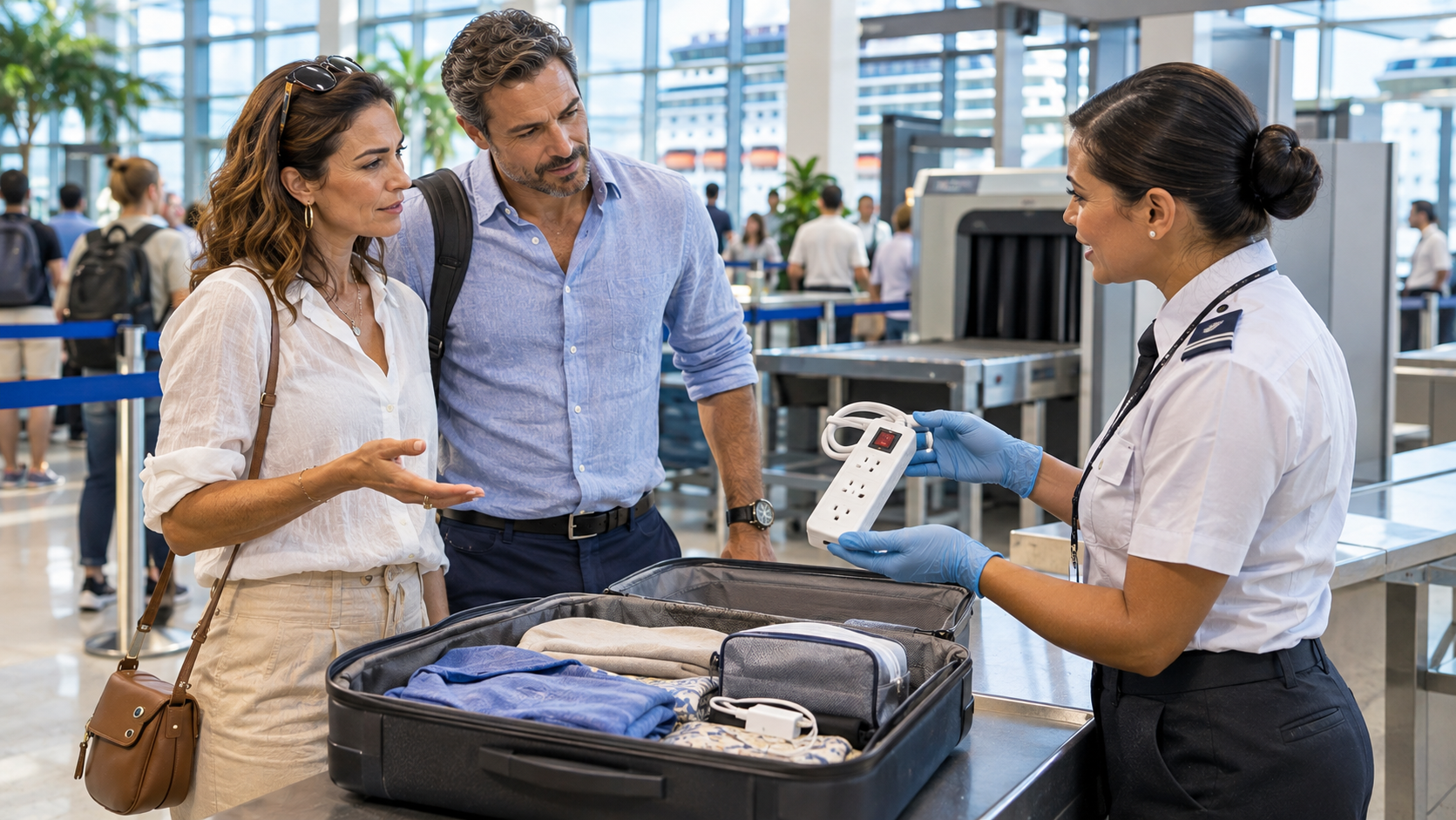
- Don’t assume a non-surge-protected power strip is acceptable. Some cruise lines prohibit power strips and extension cords regardless of surge protection.
- Alcohol allowances vary by cruise line, beverage type, passenger age, embarkation port, and sometimes itinerary.
- Nonalcoholic drinks aren’t universally prohibited. Carnival allows qualifying canned or carton beverages within its published limits, while other lines may be more restrictive.
- If security finds an unpermitted item, the outcome can include removal, temporary storage, disposal, or other action under the applicable policy.
What Items Should You Leave at Home Before Your First Cruise?
The most important cruise packing mistakes often involve belongings that seem completely ordinary at home.
A clothes steamer, extension cord, bottle of wine, or case of bottled water might seem like a reasonable vacation essential.
However, cruise ships follow safety, security, and beverage policies that can differ significantly from those of hotels, airlines, and other travel accommodations.
For first-time cruisers, the confusing part is that an item accepted aboard one cruise line may be restricted by another.
Carnival, for example, permits certain non-surge-protected electrical accessories under its safety conditions, while Royal Caribbean restricts power strips, extension cords, and multi-plug outlets. (Carnival — Electrical Outlets and USB Ports), (Royal Caribbean — Prohibited Items)
Alcohol rules create similar differences.
One cruise line may permit a limited quantity of wine in carry-on luggage, another may allow beer under specific conditions, and another may prohibit passengers from bringing alcoholic beverages aboard altogether.
These aren’t merely recommendations about what might be convenient to pack.
They can determine whether your belongings pass security screening and what happens if an item isn’t permitted.
The best preparation begins with understanding how to verify your cruise line’s restrictions before you leave home.
Why Cruise Security Rules Aren’t the Same Across Every Ship
Cruise ships operate under a combination of maritime safety requirements, applicable laws, and individual cruise-line policies.
Those policies can cover fire hazards, weapons, electrical appliances, alcohol, food, beverages, and other belongings that may pose safety or operational concerns.
Although many prohibited-item categories overlap, the specific exceptions can differ.
That’s why a general list of cruise restrictions is useful for identifying potential problems but shouldn’t replace your cruise line’s official guidance.
Check the Exact Cruise Line and Sailing
Before packing a questionable item, review the prohibited-items section of your cruise line’s official website.
For beverages, also look for its alcohol and nonalcoholic beverage policy.
These rules may appear separately from the main prohibited-items list.
Pay attention to details such as:
- Whether an item is permitted at all
- Whether it must be carried on rather than checked
- Quantity, container-size, or packaging restrictions
- Passenger-age requirements
- Special exceptions for medical or infant needs
- Whether rules differ by departure port or itinerary
A policy that says passengers may bring a bottle of wine, for example, doesn’t automatically mean beer, spirits, or additional bottles are also permitted.
Likewise, a permitted electrical accessory may still be subject to specific conditions.
If the published guidance doesn’t clearly address your item, ask the cruise line directly before departure rather than relying on product advertising or another traveler’s experience.
What Happens When Cruise Security Finds a Prohibited Item?
Cruise security screening can involve examination of both carry-on and checked luggage.
When staff identify a potentially prohibited item, they may inspect it, ask for clarification, or apply the cruise line’s procedures for restricted belongings.
The outcome depends on the item and the operator.
Some belongings may be retained for safekeeping until the end of the cruise.
Others may be confiscated, discarded, or refused entry.
For example, Royal Caribbean’s alcohol policy provides for storage of certain excess wine and alcohol purchases until the end of the sailing, while MSC’s conditions of carriage reserve the right to confiscate alcohol brought aboard contrary to its rules. (Royal Caribbean — Alcohol Policy), (MSC Cruises — Conditions of Carriage)
It’s important not to assume that every confiscated item will be returned.
You also shouldn’t assume that luggage inspection always happens in front of you.
Procedures for checked bags can differ from those used during carry-on screening.
Can a Prohibited Item Prevent You From Boarding?
Certain violations can have consequences beyond having an item removed.
Royal Caribbean’s published alcohol policy states that guests who violate alcohol rules, including attempts to conceal alcohol during security checks, may be denied boarding or disembarked at their own expense. (Royal Caribbean — Alcohol Policy)
MSC also warns that bringing prohibited controlled substances aboard may lead to denial of boarding or other enforcement action. (MSC Cruises — Prohibited Items)
The consequences depend on the circumstances and applicable policy, so an ordinary packing mistake shouldn’t automatically be equated with a serious security violation.
Still, attempting to conceal prohibited belongings is a much different decision from accidentally packing an item whose rules you misunderstood.
The safest approach is to resolve uncertainty before reaching the terminal.
Alcohol Allowances Can Change Even When a Cruise Line’s General Policy Looks Familiar
Alcohol restrictions deserve special attention because they’re not simply a question of whether a bottle is allowed.
The rules can depend on the beverage, passenger age, number of containers, where the alcohol is packed, and whether you intend to consume it in your cabin or a public venue.
A particularly important distinction is that a cruise line may permit wine but prohibit guests from bringing beer or spirits.
Another may allow wine and beer in specified quantities, while charging a fee if permitted wine is served in a restaurant.
Royal Caribbean: A Limited Wine or Champagne Allowance
Royal Caribbean permits each guest of legal drinking age to bring one sealed 750 ml bottle of wine or champagne on embarkation day.
Boxed wine and other container types aren’t permitted under that allowance.
Alcohol purchased in ports, aboard the ship, or brought in excess of the allowance is generally stored until the end of the sailing. (Royal Caribbean — Onboard Alcohol Policy)
The important distinction is that permission to bring wine doesn’t extend automatically to beer, spirits, or unlimited quantities of beverages.
Carnival: Wine and Qualifying Nonalcoholic Drinks
For its U.S.-departure policy, Carnival allows passengers ages 21 and older to bring one sealed, unopened 750 ml bottle of wine or champagne per person at embarkation, in carry-on luggage.
Carnival also allows up to 12 sealed cans or cartons of nonalcoholic beverages, each holding no more than 12 ounces, per person under its specified conditions.
Bottled soda and water aren’t included in that general allowance. (Carnival — Liquor and Beverage Policy)
This is why it’s inaccurate to say Carnival prohibits all outside nonalcoholic beverages.
The packaging and quantities matter just as much as the type of drink.
Norwegian Cruise Line: Wine, Champagne, and Corkage Exceptions
Norwegian permits wine and champagne to be brought aboard under its published conditions, while restricting other alcoholic beverages.
Its policy lists a corkage charge of $15 for a 750 ml bottle and $30 for a 1,500 ml bottle, including consumption in the stateroom.
However, Norwegian states that passengers with qualifying beverage packages, including those received through Free at Sea, aren’t charged that corkage fee. (Norwegian Cruise Line — Alcohol Policy)
This exception matters when deciding whether bringing personal wine makes financial sense.
Disney Cruise Line: Verify the Current Allowance, Not an Older Article
Disney is an important example of why alcohol-policy information needs regular verification.
Its current published policy permits eligible guests to bring one unopened bottle of wine or sparkling wine, no larger than 750 ml, or six beers of no more than 12 ounces each at the beginning of the voyage.
The drinks must be carried through security rather than placed in checked luggage.
Disney also lists a $20 corkage fee per bottle when personal wine or sparkling wine is consumed in a dining room. (Disney Cruise Line — Prohibited and Restricted Items)
Older guidance describing a two-bottle wine allowance or a different corkage charge should not be relied upon without checking the current policy.
MSC Cruises: A More Restrictive Approach
MSC Cruises generally prohibits guests from bringing outside alcohol and beverages aboard under its published rules.
Its conditions of carriage also prohibit bringing food and beverages onboard for consumption during the voyage, subject to applicable arrangements and exceptions. (MSC Cruises — Conditions of Carriage)
Passengers with medical or infant-feeding needs should contact MSC before departure to establish the correct procedure rather than assuming ordinary beverage restrictions determine every special circumstance.
Understand Corkage Fees Before Bringing Your Own Wine
A corkage fee is a charge that some cruise lines apply when passengers consume personal wine in specified venues.
However, the rules aren’t identical.
Carnival’s published policy lists a $15 charge when personal wine is served in the main dining room, specialty restaurant, or bar.
Norwegian applies its listed charge to personal wine consumption more broadly but provides a qualifying beverage-package exception.
Celebrity Cruises lists a $35 charge for wine consumed in restaurants, bars, or dining venues, with exemptions for guests holding its Classic or Premium Beverage Package. (Carnival — Liquor and Beverage Policy), (Norwegian Cruise Line — Alcohol Policy), (Celebrity Cruises — Onboard FAQs)
For first-time cruisers, the lesson is to check three separate questions: whether you’re permitted to bring the bottle, whether you’re allowed to consume it in your chosen venue, and whether an additional charge applies.
A permitted bottle isn’t necessarily a cost-saving option once applicable fees are considered.
Medical and Infant-Feeding Exceptions Need Separate Attention
General beverage restrictions can create understandable concerns for travelers who rely on distilled water for medical devices or need water for infant formula.
Norwegian’s published policy specifically provides an exception for factory-sealed purified or distilled water used with medical devices or to reconstitute infant formula.
Carnival has separate arrangements for distilled water needed for CPAP machines, including onboard purchase and a procedure for carrying personal supplies. (Norwegian Cruise Line — Beverage Policy), (Carnival — Liquor and Beverage Policy)
These are examples, not universal rules.
If a medical device, prescription treatment, infant-feeding routine, or dietary requirement depends on a particular supply, contact the cruise line before departure.
Confirm any approval, labeling, documentation, and packing instructions.
Don’t depend on receiving an exception at the security checkpoint without advance arrangements.
Check Your Cruise’s Rules Again Before Closing Your Suitcase
Cruise prohibited-items policies can change, and older packing advice may remain online long after a rule has been revised.
Before departure, review your cruise line’s official guidance for prohibited items, electrical accessories, alcohol allowances, other beverages, and any exceptions that apply to your circumstances.
If you’ve found a contradictory rule on another website, use the cruise line’s current policy and obtain clarification directly when necessary.
For belongings that might be held or confiscated, deciding not to bring the item may be easier than dealing with it at embarkation.
Once you’ve established what’s permitted, the guide below explains the most common problem categories, practical substitutes, and mistakes that first-time cruisers can avoid.
Why Prohibited Cruise Items Can Disrupt Your First Boarding Day
Packing mistakes rarely ruin socks—they ruin boarding day.
The real stress comes when cruise security flags your bag and your vacation starts tense.
Every cruise line runs its own rules like a floating city, so what feels safe at home can vanish at the terminal.
Cruise rules can feel inconsistent because each line runs its own ship like a small city.
That is why the same item can be fine on one sailing and removed on another.
This guide shows you exactly what not to pack, what cruise security actually looks for, and how alcohol rules differ by cruise line.
You’ll also get easy swaps that keep comfort high without risking confiscation.
By the end, you’ll know exactly what to leave behind and what to carry with confidence.
Quick Cruise Packing Red Flags That Trigger Confiscation
Most confiscations fall into a few predictable categories.
Heat and open flames are common triggers because cabins must stay fire safe.
Weapons, self defense items, and sharp objects get removed because ships enforce consistent safety rules.
Outside alcohol and disguised containers get attention because beverage policies are strict and heavily enforced.
Certain power strips and extension cords raise alarms because of ship electrical systems.
Glass and bulky beverages can slow screening even when you meant well.
Treat this snapshot like your first filter before you zip your bag.
Heat And Flame
Clothes irons, travel steamers, candles, incense, hot plates, and coffee makers are common no items. (Royal Caribbean)
Safety And Weapons
Firearms, ammunition, blades, pepper spray, and many self defense tools are usually prohibited. (Royal Caribbean)
Alcohol And Disguised Containers
Hard liquor and beer are often prohibited to bring onboard, and some lines inspect containers like mouthwash bottles for concealed alcohol. (MSC Cruises)
Power And Cords
Surge protected strips are frequently restricted, and simple cruise approved options are safer.
Fast Takeaways
Start With Categories
Thinking in categories helps you avoid missing a surprise item.
Pack For Screening
A clean bag boards faster and feels calmer immediately.
Choose Simple Swaps
One safe alternative beats one risky gadget every time.
Cruise Terminal Security Works Like A Safety Gate
Cruise terminals feel calmer than airports, but the scanning is real.
Bags go through screening, and flagged items get pulled for inspection.
Checked luggage can be opened even when you are not standing there.
That is why prohibited items sometimes vanish and you only learn about it later.

Sail Away to Paradise Without Overpaying
Find cruise deals that make it easy to escape, relax, and enjoy the ocean without stretching your budget
Cruise lines prioritize onboard fire safety and crowd safety more than liquid limits.
That is why appliances and certain cords get more attention than toothpaste.
A smooth boarding day is mostly about preventing avoidable flags.
What Happens When A Bag Flags
Staff typically open the bag, show the item, and reference the policy.
Some items may be held and returned at the end of the sailing, depending on the category and the line.
Other items are confiscated and not returned, especially when they violate alcohol rules or safety rules.
Planning for that reality keeps you calm when you hear the word inspection.
A Calm Backup Plan
Staying near the port the night before gives you more flexibility if you realize you packed something risky.
A storage service like Radical Storage can be a practical way to stash prohibited items before you reach the terminal.
That keeps you from surrendering an item you still want to keep.
Security Takeaways
Expect Scanning
Assume every bag will be screened, because it will be.
Avoid Debates
Policies are enforced for the whole ship, not negotiated per guest.
Give Yourself Time
Arriving early turns a hiccup into a minor pause, not a crisis.
Heat And Flame Items That Get Removed Quickly
Anything that heats, steams, or creates an open flame is a high risk category onboard.
Cruise cabins are compact, and a single fire can impact thousands of guests.
That is why items that seem harmless at home become automatic no items on many lines.
Royal Caribbean lists items with open flames and steamers among prohibited categories, which reflects how seriously lines treat heat risk. (Royal Caribbean)
Even when a traveler believes they will use an item carefully, the line cannot verify that.
The safer move is swapping in non heat solutions and using ship services when needed.
That approach keeps you from losing time and starting your trip frustrated.
Common Heat Triggers
Clothes irons, travel steamers, hot plates, and similar heating appliances are common confiscation targets. (Royal Caribbean)
Candles and incense are also frequent no items because they create open flame risk. (Royal Caribbean)
Some ships restrict coffee makers and kettles for the same reason.
The Easy Swaps
Wrinkle release spray replaces a steamer for most outfits.
Hanging clothes in the bathroom during a warm shower can smooth light wrinkles without devices.
Laundry and pressing services exist because ships cannot allow everyone to bring heating tools.
Heat Takeaways
Skip Cabin Appliances
Fire risk items are the most predictable way to get flagged.
Use Ship Services
Laundry and pressing solve the problem without policy risk.
Pack Calm Fabrics
Wrinkle resistant clothing reduces your need for gadgets.
Sharp Objects And Self Defense Items That Create Trouble
Cruise lines enforce safety rules consistently across ships and ports.
That consistency means many self defense tools are treated like weapons onboard.
Royal Caribbean includes weapons, knives, sharp objects, and martial arts or self defense items in its prohibited categories, which mirrors broader industry practice. (Royal Caribbean)
Even if an item is legal where you live, the ship can still remove it.
That is not personal, and it is not a judgment about your intentions.
It is a safety policy designed for a crowded environment.
The calm solution is packing for comfort and planning for safety with behavior, not tools.
What To Leave Home
Pepper spray and similar products often trigger confiscation.
Multi tools with blades can also be removed depending on the line and the specifics.
Large scissors and sharp utility blades are common problems at screening.
A Better Safety Plan
Walking with your group reduces risk more than a questionable item in a bag.
Using reputable transportation and tours in ports can lower stress when you are far from the pier.
Keeping your phone charged and your plans simple helps you feel steady in unfamiliar places.
Safety Takeaways
Pack Vacation Tools
Grooming basics are fine, but tactical style items are not worth the risk.
Choose Behavior Safety
Smart habits prevent more problems than gadgets do.
Reduce Screening Friction
A bag without sharp surprises moves faster through security.
Alcohol And Beverages That Get Confiscated Most Often
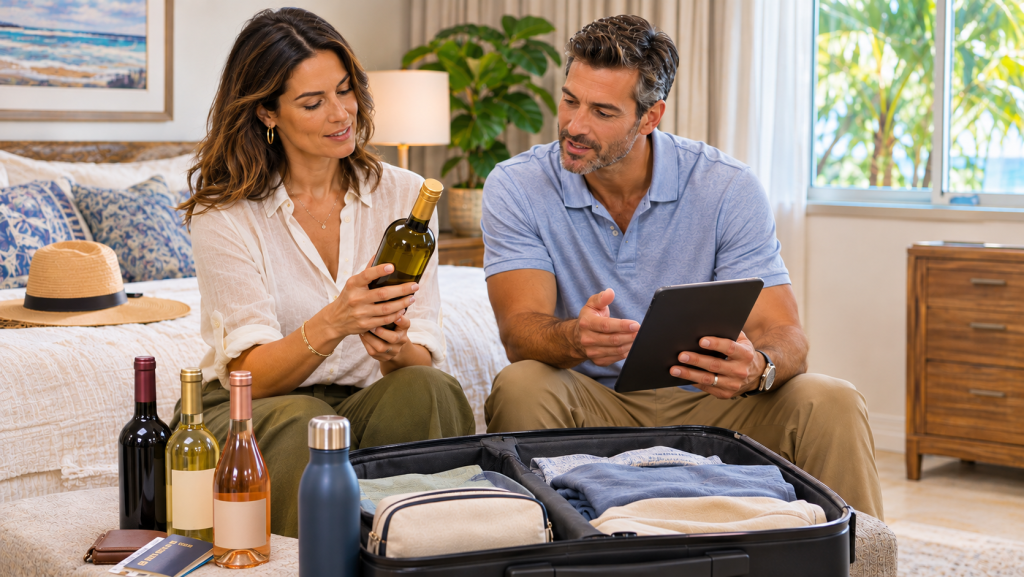
This is the number one area where first time cruisers get caught off guard.
Cruise lines do not treat outside alcohol like a normal hotel does.
Each line sets its own allowances for wine, champagne, beer, and spirits.
Many lines also store alcohol bought in port until the end of the voyage.
Royal Caribbean allows one sealed 750 ml bottle of wine or champagne per guest of drinking age on embarkation day, and it stores extra bottles and port purchases until the last day. (Royal Caribbean)
MSC prohibits guests from bringing alcoholic beverages onboard unless permitted by security, and it notes that security may inspect containers like water bottles and mouthwash and dispose of concealed alcohol. (MSC Cruises)
The calmer move is picking one simple plan that fits your cruise line instead of trying to optimize every bottle.
Corkage Fee Explained
A corkage fee is a service fee charged when you bring your own wine and drink it in certain venues.
Royal Caribbean charges a corkage fee when guests consume personal wine or champagne in public areas. (Royal Caribbean)
Carnival charges a corkage fee if wine or champagne is consumed in dining venues or bars, and it frames stateroom consumption as the easiest path. (Carnival Help)
Norwegian charges corkage even if the bottle is consumed in the stateroom, which is an important difference for planning. (Norwegian Cruise Line)
Disney charges a corking fee if you consume your brought on bottle in one of the dining rooms. (Disney Cruise Line)
Those differences can change whether bringing wine feels worth it for you.
Human Readable Cruise Line Alcohol Policies
Use this table as your baseline, then confirm your specific sailing because policies can change.
| Cruise Line | What You Can Bring On At Embarkation | Where To Pack It | Corkage Or Venue Fees | Port Purchase Handling |
|---|---|---|---|---|
| Royal Caribbean | 1 sealed 750 ml wine or champagne per guest of drinking age, boxed wine prohibited | Carry on is the safest choice | 15 dollars per bottle if consumed in public areas | Extra bottles and port purchases are stored and returned on the last day |
| Celebrity | 1 bottle of personal wine, 750 ml, per guest of drinking age | Carry on recommended by the line | Fees depend on venue rules, confirm on your sailing page | Extra alcohol may be held until the end depending on itinerary |
| Carnival | 1 sealed 750 ml wine or champagne per guest age 21 or older on embarkation day only | Carry on required | 15 dollars per 750 ml bottle in dining venues or bars | Outside the exception, alcohol is prohibited and can be confiscated and discarded |
| Norwegian | Wine and champagne allowed, boxed wine not allowed | Carry on strongly advised | 15 dollars for 750 ml, 30 dollars for 1500 ml, applies even in stateroom | Alcohol rules apply across venues, confirm itinerary details |
| Disney | Up to 2 bottles of wine or champagne, 750 ml or smaller, or 6 beers, 12 oz or smaller, per adult on embarkation or after port | Carry on required | 29 dollars per bottle if consumed in dining rooms | Excess and spirits are stored until the end |
| Princess | 1 bottle of wine or champagne, 750 ml or less, per guest per voyage | Present at security during embarkation | 20 dollars corkage if consumed in public areas, and fees can apply to additional bottles | Port purchases may be collected for later delivery |
| Holland America | Allows certain beverages and permits sealed distilled or purified water for medical devices in checked luggage when packed with the device | Depends on item type | Corkage and beverage handling varies by policy and voyage | Port purchases are commonly held until near disembarkation |
| Virgin Voyages | 2 bottles of wine per cabin, 750 ml each, carry on only, no liquor or beer | Carry on required | 25 dollars corkage at eateries | Any alcohol in checked luggage is collected and returned after the voyage |
| MSC | Alcoholic beverages prohibited unless permitted by security, boxed wine and other containers prohibited | Security enforced | Focus is restriction and disposal of concealed alcohol | Alcohol purchased onboard or in ports is secured and returned near the end |
How To Choose the Calm Option
Decide whether bringing a bottle actually improves your vacation.
Choose the allowance your line clearly permits, and stop there.
Pack it in carry on when the line says carry on, because checked luggage is where bottles often get removed. (Celebrity Cruises)
Do the corkage math before you sail so you do not accidentally pay more than simply buying onboard.
Avoid any trick container ideas, because some lines explicitly inspect containers for concealed alcohol. (MSC Cruises)
Alcohol Takeaways
Follow Your Line
Alcohol rules differ sharply across cruise lines, so copy the correct rule for your sailing.
Pack It Correctly
Carry on packing is often the difference between smooth boarding and a confiscation. (Carnival)
Skip The Gamble
Disguised containers are a predictable way to lose alcohol and start stressed. (MSC Cruises)
Non Alcohol Drinks And Snacks That Still Cause Issues
Many travelers pack bottled water and soda like they are going to a hotel.
Some lines restrict outside beverages broadly, and that can lead to removal even when there is no alcohol involved.
Carnival states that outside the wine exception, other alcoholic and non alcoholic beverages are strictly prohibited and can be confiscated and discarded, which is a big surprise for first timers. (Carnival)
Medical and infant related exceptions exist on some lines, and Holland America explicitly allows sealed distilled or purified water for certain medical device use when packed with the device. (Holland America Line)
That is why labeling and packing with the device matters when you need an exception.
The simplest plan is carrying only what is allowed, then relying on the ship for the rest.
A cruise is built to keep you fed and hydrated without you hauling cases of drinks.
Snack Strategy That Feels Calm
Bring a small amount of shelf stable snacks for travel day if it helps you feel steady.
Avoid packing your cabin like a pantry, because it adds clutter and can trigger screening.
If you have dietary needs, communicate with the cruise line ahead of time and keep documentation accessible.
Drinks Takeaways
Avoid Bulk Drinks
Beverage cases create screening friction and are often restricted. (Carnival)
Plan Medical Exceptions
Pack allowed medical water with the device when the policy requires it. (Holland America Line)
Trust Ship Supply
Ships are designed to feed you constantly, so overpacking drinks rarely pays off.
Overpacking Mistakes That Make Cabin Life Hard
Some things are not prohibited, but they still do not belong in your suitcase.
Extra bulk makes embarkation day harder and cabin life messier.
Cabins have limited storage, and clutter can raise anxiety fast.
Shoes are the most common weight trap for first timers.
Outfit overload is another common regret because you will not wear everything you packed.
A cleaner bag gives you more room for souvenirs and less daily frustration.
Using organized luggage can help, and Travelpro style compartments are useful when you want structure without overpacking.
The Calm Packing Rule
Pack for the cruise you will actually live, not the imaginary cruise where you change outfits five times a day.
Choose repeatable basics and one or two special looks.
Keep your cabin simple so your mind stays simple.
Overpacking Takeaways
Pack Fewer Shoes
Two or three pairs solve most cruise needs, and more adds stress.
Repeat Outfits
Outfit repeating is normal on cruises, and nobody is judging you.
Choose Organization
Structured luggage reduces mental load because everything has a place.
First Time Mistakes That Trigger Screening Delays
Most cruise packing mistakes come from hotel assumptions.
Heat tools feel normal at home, so people toss them in without thinking.
Alcohol rules feel like resort rules, so travelers assume one bottle will be fine.
Power strips feel helpful, so people bring the wrong type without realizing it can be restricted.
The fix is not obsessing over rules.
The fix is following a few high impact policies that remove the biggest risks.
That is how experienced cruisers board calmly every time.
Mistake Takeaways
Stop Hotel Packing
Cruise rules are different because you live inside the same building you travel in.
Copy The Policy
Writing down your line alcohol allowance prevents the most common embarkation mistake. (Royal Caribbean)
Reduce Risk Items
Removing one prohibited item can save you more time than any other packing trick.
Fears That Feel Big And Fixes That Feel Calm
Packing anxiety is normal when you are new.
The fear usually sounds like what if they take my stuff or what if I miss something essential.
The calm answer is building one clean checklist and trusting it.
Another fear is what if a flight delay ruins the whole trip.
That fear is practical, and it is why some travelers use travel insurance for trip interruption and medical support, not because it is required, but because it reduces stress.
World Nomads, VisitorsCoverage, EKTA, and Insubuy are common choices travelers compare when they want that kind of breathing room.
If a flight turns into a compensation mess, tools like Compensair and AirHelp can reduce the paperwork burden while you focus on the trip.
Fear Takeaways
Trust One List
One strong checklist beats constant second guessing.
Protect Your Travel Chain
Coverage can reduce stress for flights, transfers, and the cruise together.
Keep Plans Simple
Simple plans create calm because fewer things can break.
Pack Light And Board With Confidence
A smooth embarkation is not luck.
It is the result of avoiding the few categories that cruise lines reliably remove.
Leave heat items and open flames at home, because they create predictable fire risk flags. (Royal Caribbean)
Keep sharp and self defense items out of your bag so security never has a reason to pause you. (Royal Caribbean)
Treat alcohol rules as cruise line specific, and follow your line carry on guidance exactly. (Royal Caribbean)
Once you do that, your first cruise starts the way it should start.
Easy.
Calm.
Fully in your control.
FAQ – What Should First-Time Cruisers Know About Prohibited Items and Alcohol Rules?
What items are commonly prohibited on cruise ships?
Many cruise lines prohibit weapons, dangerous materials, open-flame items, and certain electrical or heating appliances.
Clothes irons, garment steamers, candles, and hot plates are common examples, although specific rules vary by operator.
Alcohol, outside beverages, and some foods may also be restricted under separate policies.
Always review your cruise line’s current prohibited-items list before packing.Can cruise security confiscate items from checked luggage?
Yes, cruise security may inspect checked luggage and remove belongings that violate the ship’s policies.
Depending on the cruise line and item, staff may retain the property for safekeeping, dispose of it, or follow another established procedure.
Some belongings may be returned after the cruise, but return isn’t guaranteed for every prohibited category.
Keep important possessions accessible and avoid checking items whose eligibility is uncertain.What happens if you accidentally bring a prohibited item on a cruise?
Security staff may identify the item during screening and apply the cruise line’s procedures for restricted belongings.
The result might involve an inspection, removal, temporary storage, or disposal, depending on the circumstances.
Accidentally packing an ordinary restricted accessory isn’t necessarily treated the same as deliberately concealing dangerous or prohibited items.
Contact the cruise line beforehand whenever you’re unsure whether something is permitted.Can you bring a clothes iron or garment steamer on a cruise?
Many mainstream cruise lines prohibit personal clothes irons and garment steamers because of fire-safety concerns.
Royal Caribbean and MSC, for example, include these appliances in their prohibited-items guidance.
Instead, choose fabrics that travel well and check whether your ship offers laundry or pressing services.
Don’t assume that a compact travel steamer is exempt simply because it’s small.Are curling irons, hair straighteners, and hair dryers allowed?
Some cruise lines permit ordinary personal hair-styling appliances even though clothes irons and garment steamers are prohibited.
Royal Caribbean specifically allows curling and flat irons for personal grooming under its published policy.
Other cruise lines may have their own requirements, including restrictions relating to damaged or unsafe electrical equipment.
Check your operator’s guidance before packing any heat-producing appliance.Can you bring a power strip or extension cord on a cruise?
Power-strip and extension-cord rules vary by cruise line, and avoiding surge protection doesn’t automatically make a device acceptable.
Royal Caribbean prohibits power strips, extension cords, and multi-plug outlets under its current policy, while Carnival permits certain devices that meet its safety conditions.
Some electrical accessories may be subject to additional security review.
Check the exact requirements before packing or buying a charging device.Can you bring candles, incense, or a portable kettle?
Candles and incense are prohibited by many cruise lines because they involve open flames or other fire hazards.
Portable kettles and similar heating appliances are also commonly restricted, although individual cruise lines establish their own policies.
Royal Caribbean and MSC both identify multiple heating or flame-producing items as prohibited.
Review the ship’s amenities before bringing equipment that may already be provided or available through an approved service.Are pocketknives, scissors, or multitools allowed on cruises?
Cruise lines often restrict knives, weapons, and certain sharp objects, but the exact treatment of grooming tools and small scissors can differ.
An item that’s legal to carry in your home jurisdiction isn’t automatically permitted aboard a passenger ship.
Security personnel may inspect questionable belongings and make decisions under the operator’s published rules.
If you need a particular tool for an approved purpose, contact the cruise line in advance rather than assuming it will pass screening.Can you bring pepper spray or other self-defense items on a cruise?
Many cruise lines prohibit pepper spray, weapons, and other defensive devices under their safety policies.
These restrictions can apply even when an item is legal to possess where you live.
Carrying a prohibited device may result in confiscation or more serious consequences depending on the item and circumstances.
Review your cruise line’s security rules and use appropriate personal-safety practices while traveling.Can you bring your own wine or champagne on a cruise?
Some cruise lines allow eligible passengers to bring a limited quantity of wine or champagne at embarkation.
Royal Caribbean and Carnival permit one qualifying 750 ml bottle per eligible guest under their published policies, while other cruise lines have different allowances.
Some operators require bottles to be placed in carry-on luggage, and restaurant consumption may involve a corkage fee.
Check your specific sailing’s age, container, quantity, and packing requirements before bringing alcohol.Can you bring beer or hard liquor on a cruise?
Beer and spirits are restricted by many cruise operators, even when passengers are allowed to bring wine.
Disney currently permits eligible passengers to bring six qualifying beers instead of its permitted wine bottle at the beginning of the voyage.
Carnival and Royal Caribbean don’t extend their standard personal wine allowances to unrestricted beer or spirits.
Always verify the exact beverage categories your cruise line permits rather than assuming all alcohol is treated equally.How much alcohol can you bring on a Carnival cruise?
Under Carnival’s published U.S.-departure policy, each passenger age 21 or older may carry on one unopened 750 ml bottle of wine or champagne at the beginning of the cruise.
The allowance doesn’t extend to beer, liquor, or additional wine bottles.
Carnival also has separate rules for nonalcoholic beverages and purchases made during the voyage.
Check the policy for your departure region because the rules may differ on other itineraries.How much alcohol can you bring on Disney Cruise Line?
Disney’s current published policy generally permits each eligible guest to bring one unopened bottle of wine or sparkling wine of no more than 750 ml, or six beers of no more than 12 ounces each, at the beginning of the voyage.
The beverages must be carried through security rather than packed in checked luggage.
Age requirements and certain details can differ for specific departures, including eligible Singapore sailings.
Verify the current guidance before traveling because older articles may describe previous allowances.Does Norwegian Cruise Line charge corkage for wine consumed in your cabin?
Norwegian’s published wine policy applies corkage charges to personal wine consumed in staterooms as well as restaurants and other public areas.
It lists charges of $15 for a 750 ml bottle and $30 for a 1,500 ml bottle.
However, passengers with qualifying beverage packages, including applicable Free at Sea packages, aren’t charged the corkage fee.
Review your reservation and current package terms before assuming the charge applies.What is a cruise corkage fee?
A corkage fee is a charge cruise lines may assess when passengers consume or have personal wine served in specified areas.
Some operators charge it for wine served in restaurants or bars, while others have broader requirements.
The amount and any exemptions vary between cruise lines and may change.
Check the current rules before deciding whether bringing your own wine is worthwhile.Can you bring bottled water, soda, or juice aboard a cruise?
Nonalcoholic beverage allowances vary considerably between cruise lines.
Carnival permits qualifying beverages in sealed cans or cartons within its published quantity limits, but restricts ordinary bottled beverages under its U.S.-departure policy.
Norwegian generally restricts outside beverages while providing specific exceptions for certain medical and infant-feeding needs.
Check packaging, quantity, and carry-on requirements rather than assuming that all nonalcoholic drinks are permitted.Can you bring distilled water for a CPAP machine?
Some cruise lines allow distilled or purified water for medical devices under specific conditions.
Carnival provides arrangements for CPAP water, including purchase options and instructions for bringing personal supplies, while Norwegian recognizes certain factory-sealed medical-water exceptions.
The correct procedure may depend on your cruise line and the equipment you use.
Contact the operator before sailing to confirm any packing, documentation, or advance-request requirements.Can you bring snacks or homemade food onto a cruise ship?
Policies on outside food differ by cruise line and may distinguish between commercially packaged snacks, homemade food, and other perishable items.
MSC generally prohibits passengers from bringing outside food and beverages aboard, subject to its applicable procedures and exceptions.
Other operators may permit certain factory-sealed snacks while restricting homemade or unsealed products.
If you need special food for medical, allergy, or infant-feeding reasons, contact your cruise line before departure.Can you bring alcohol purchased in a cruise port back onto the ship?
Many cruise lines allow passengers to purchase alcohol ashore but require them to surrender it to security when reboarding.
The bottles may then be stored until the final evening or disembarkation rather than being available for consumption during the cruise.
Procedures and restrictions differ, and local customs or import rules may also apply to purchases you take home.
Check your cruise line’s policy and retain any purchase receipts or collection documentation.How can you avoid prohibited-item problems on your first cruise?
Start with your cruise line’s official prohibited-items list and review its separate alcohol and beverage policies.
Check any unusual electronics, heating appliances, food, medical supplies, or restricted belongings before placing them in your suitcase.
Follow requirements for carry-on versus checked luggage and keep any necessary approval or documentation accessible.
A final policy check before departure is more reliable than assuming something is permitted because it worked on another cruise.
Plan Your Next Cruise!

Experience the Perfect Blend of Disney Magic, Luxury Cruising, and Family Adventure at Sea
One Delay Can Cost Your Entire Cruise A quick coverage check now protects you from the problems no one sees coming….

Sail Smart: Discover The Real Cost of Luxury Cruises and Maximize Your Travel Value
One Delay Can Cost Your Entire Cruise A quick coverage check now protects you from the problems no one sees coming….
Escape To Paradise: Inside The Exclusive World of Cruise Line Private Islands
One Delay Can Cost Your Entire Cruise A quick coverage check now protects you from the problems no one sees coming….
Discover Princess Cruise Line: Elegant Ships, Immersive Voyages, and World‑Class Experiences
One Delay Can Cost Your Entire Cruise A quick coverage check now protects you from the problems no one sees coming….
Explore More
Why Cruise Ships Enter Dry Dock: Essential Repairs, Refits, and Passenger Benefits

Stay Safe and Confident: Everything You Need to Know About Cruise Ship Tenders
Wildlife Cruises That Deliver Galápagos, Antarctica, Alaska, Amazon, and Arctic Encounters