One Delay Can Cost Your Entire Cruise
A quick coverage check now protects you from the problems no one sees coming
Short Excerpt
- Food allergies, celiac disease, and strict dietary restrictions require advance planning when you’re taking your first cruise.
- Notify the cruise line before sailing, confirm your requirements with the dining team, and never assume buffet labels or menu descriptions guarantee a safe meal.
- Use the interactive dietary communication card to explain your restrictions, request ingredient verification, and make conversations with onboard dining staff easier.
Quick Take
- Notify the cruise line before departure. Special meal requests may have advance-notice deadlines, particularly when specific ingredients or products must be ordered.
- Speak with the dining supervisor. Confirm your dietary requirements after boarding rather than assuming reservation notes are sufficient.
- Take cross-contact seriously. A dish without an allergen in its recipe may still be unsuitable if it shares utensils, preparation surfaces, or cooking oil with that allergen.
- Use an allergy communication card. Written instructions can reduce misunderstandings, especially when different servers or kitchens are involved.
- Follow your prescribed emergency plan. Keep necessary medication accessible and confirm what medical assistance is available during your cruise and in port.
How to Plan a First Cruise When You Have Food Allergies or Dietary Restrictions
You’ve found a cruise itinerary you’re excited about, selected your cabin, and started imagining the destinations you’ll visit.
Then you begin looking at the dining options and realize that enjoying your vacation will involve more than choosing restaurants that look appealing.
You also need to know whether the kitchen can accommodate your dietary requirements.
At home, you may already have a familiar routine.
You know which ingredients to avoid, which restaurants understand your restrictions, and what questions you need answered before ordering.
A cruise introduces a different environment.
The main dining room may change its menu each evening, buffets serve large numbers of passengers, and specialty restaurants can have different preparation procedures.
Even a dish that looks straightforward might contain an ingredient you need to avoid, while shared utensils or cooking surfaces may introduce another concern.
For a first-time cruiser, the best approach is to make dietary planning part of the reservation process rather than waiting until you’re seated for your first meal.
Cruise lines can have procedures for accommodating food allergies and special diets, but those procedures differ.
Advance requests, dedicated dining contacts, ingredient availability, and the extent of available accommodations may all depend on the operator and sailing.
Most importantly, no cruise line can guarantee that every food preparation environment will be free of allergens or cross-contact.
For example, Carnival explicitly advises that its buffets and other dining locations cannot guarantee allergen-free meals and directs guests with food allergies toward appropriate dining-room coordination.
That doesn’t mean you should automatically rule out a cruise.
It means your planning needs to focus on confirmed accommodations, clear communication, and understanding when a particular food or dining arrangement isn’t appropriate for your needs.
Start With a Clear Description of Your Dietary Requirements
A statement such as “I can’t eat nuts” might be understandable in ordinary conversation, but it doesn’t always provide the information a kitchen needs.
Does your restriction involve peanuts, tree nuts, or both?
Are you avoiding an ingredient because of a diagnosed allergy, celiac disease, another medical requirement, or a personal dietary preference?
These differences can affect how the dining team evaluates ingredients and preparation methods.
When informing the cruise line, use precise language that reflects your actual needs.
For example, someone with a diagnosed peanut allergy may need the dining team to verify ingredients and evaluate potential cross-contact with peanuts.
A guest with celiac disease may need specific precautions involving gluten-containing ingredients and shared preparation equipment.
Top Cruise Deals From Trusted Cruise Lines
Compare exclusive online offers and find the fare that fits your trip and your budget
A vegan guest may have different requirements involving ingredient sourcing and substitutions.
The point isn’t to give staff an unnecessarily long explanation.
It’s to provide enough detail for them to understand what they need to check.
Writing those details down also reduces the chance of missing important information when you speak with different employees during the sailing.
Create a Dietary Communication Card Before Your First Cruise
An allergy or dietary communication card gives you a consistent way to explain your requirements to restaurant servers, dining supervisors, and other staff responsible for preparing food.
It’s especially useful when you’re tired, a restaurant is busy, or you need to communicate the same instructions multiple times.
The interactive card creator below lets you describe your dietary restrictions, specify whether cross-contact precautions are necessary, and generate a short message to show staff.
You can copy the message or print the card before departure.
It’s intended to support communication—not to certify that a meal is safe.
Interactive Cruise Allergy & Dietary Communication Card
My Cruise Dietary Communication Card
Describe your dietary requirements so you can communicate them consistently with dining staff. This tool cannot verify that food is safe.
DIETARY COMMUNICATION CARD
Foods or restrictions:
Additional instructions:
Please confirm ingredients and preparation with the chef or dining supervisor. If these requirements cannot be verified, please tell me before serving.
This communication aid does not certify that food is allergen-free or suitable for your medical needs. Restaurant staff must confirm ingredients and preparation. Follow your clinician’s emergency plan and carry prescribed treatment. Suspected anaphylaxis requires prompt use of prescribed epinephrine and emergency care. Avoid including names, cabin numbers, or other identifying information. The tool does not store your entries.
Notify Your Cruise Line Before Dietary Accommodation Deadlines
You should notify your cruise line about your dietary requirements as soon as your reservation is confirmed.
That advice is particularly important when the kitchen may need to obtain special ingredients or arrange meals that aren’t routinely available.
Advance notice requirements aren’t universal.
Royal Caribbean’s dietary guidance describes advance notice requirements for particular requests, including longer lead times on certain itineraries.
Norwegian also asks guests with special medical diets and food allergies to contact its Access Desk before sailing, with its accessibility guidance specifying at least 45 days for special dietary requests.
Rather than assuming a general deadline applies to every ship, check the procedure associated with your own sailing.
When submitting your request, describe the specific restriction and ask whether the operator can accommodate it.
An acknowledgment that your request was recorded isn’t necessarily confirmation that every dish or preparation method can meet your needs.
If your restriction is medically significant, clarify what the kitchen can and cannot provide before the cancellation or payment deadlines become relevant.
Speak With the Dining Supervisor When You Board
Submitting information before sailing is the first step, but it shouldn’t be your final conversation about food.
Once onboard, ask how your ship handles special dietary requests and whether you should speak directly with the dining-room supervisor, maître d’, or chef.
Verify that the team has your information and understands what you’re asking it to check.
Online‑Only Cruise Offers You Won’t Find Elsewhere
Unlock special pricing and start planning the sailing that matches your perfect itinerary
For example, Carnival directs guests with food allergies to inform both the maître d’ and dining team, and explains that meal planning and advance ordering may be available in the main dining room. Carnival Cruise Line
This is particularly useful for someone traveling with several restrictions or needing careful ingredient verification.
Ask whether meals can be selected in advance, which venues can accommodate your requirements, and what to do if you’re assigned a different server.
A consistent dining arrangement may make communication easier, but it doesn’t eliminate the need to verify individual meals.
Why Buffet Allergen Labels Are Not Enough
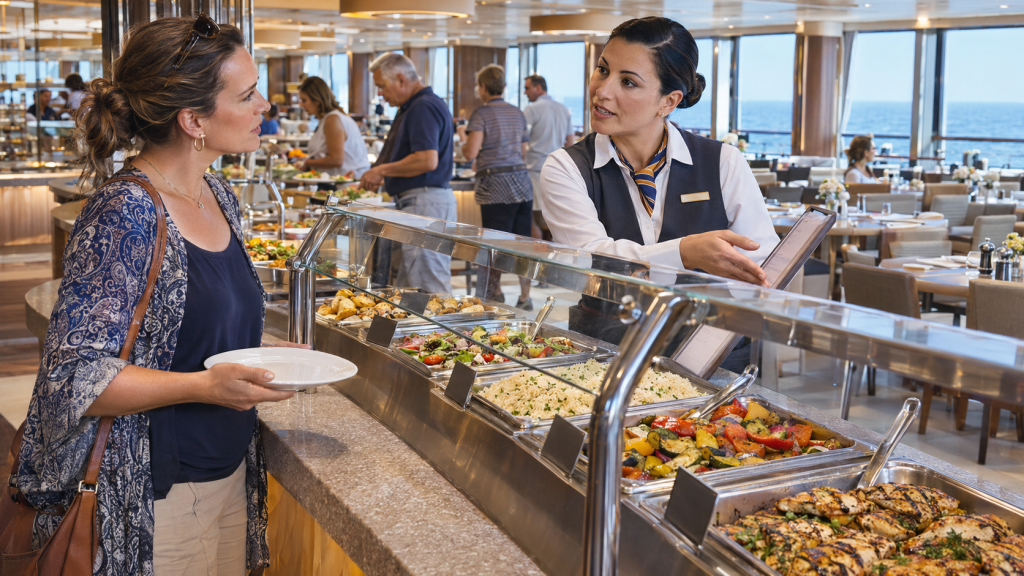
Buffets can provide extensive variety, but the number of dishes and shared serving areas can complicate allergy management.
Even when labels identify common ingredients, they may not describe every preparation detail or possible source of cross-contact.
Serving utensils can move between dishes, shared cooking equipment may be used, and ingredients can change.
A plate that appears to contain only foods you normally eat isn’t necessarily suitable when you don’t know how it was prepared.
For severe allergies or celiac disease, don’t treat an unlabeled dish, a simple recipe, or a verbal guess from an employee as proof of safety.
Ask the dining supervisor or chef to verify the ingredients and preparation procedures.
Carnival explicitly states that it cannot guarantee its buffet or other non-main-dining locations are free of allergens, illustrating why assumptions about buffet labeling can be dangerous. Carnival
If adequate verification isn’t possible, choose another meal arrangement rather than relying on appearance alone.
Make Cross-Contact Part of Every Relevant Conversation
An ingredient list answers only one part of an allergy question.
Cross-contact can occur when a food that doesn’t intentionally contain your allergen comes into contact with that allergen through a shared utensil, preparation surface, cooking oil, or another source.
This matters when considering seemingly simple dishes such as grilled proteins, fried foods, vegetables, or desserts.
For example, a food prepared in shared oil may be unsuitable even if the recipe itself doesn’t contain the allergen.
Food Allergy Research & Education recommends communicating directly with restaurant staff, using chef cards, and asking about how foods are prepared as well as what they contain. FoodAllergy.org
Your communication card should therefore explain the particular restrictions you’ve been advised to follow rather than simply listing foods you avoid.
A kitchen’s ability to manage those precautions must be established through direct communication, not assumed.
Plan Meals Ashore With the Same Care
Your dietary requirements don’t disappear when the ship reaches port.
A food tour, restaurant visit, cooking class, or private dining experience may involve different ingredients, preparation methods, and local language considerations.
Before booking a food-focused excursion, ask the operator whether it can accommodate your restrictions.

Luxury Cruise Experiences at Smarter Prices
See premium sailings and upgraded cabins priced for travelers who know how to book well
This is especially important for group experiences where dishes may be prepared in advance or shared among participants.
Platforms such as Eatwith, Viator, GetYourGuide, and Klook can help you discover experiences, but the individual host or operator must confirm the practical arrangements.
A listing that mentions vegetarian, gluten-free, or allergy-friendly options isn’t automatically evidence that it can accommodate a particular medical requirement.
For serious allergies, communicate directly with the provider and review the contingency plan if a suitable meal cannot be prepared.
You may also want to bring appropriate food you know you can eat, subject to your cruise line’s rules and any restrictions on bringing food ashore.
Know What to Do if an Allergic Reaction Occurs
Medical information: The following is general safety guidance, not individualized medical advice.
Before sailing, review allergy management, prescribed medication, and emergency procedures with your treating clinician.
A cruise ship medical center can provide assistance, but medical resources at sea are not identical to those available in a major hospital on land.
If you have a known severe food allergy, discuss your travel plans with your clinician before departure.
Follow the emergency action plan provided for your condition and carry your prescribed medication in a readily accessible place.
Food Allergy Research & Education advises people at risk of severe allergic reactions to carry two epinephrine delivery systems.
Don’t rely on medication stored in checked luggage or left in your cabin when you’re dining elsewhere on the ship or visiting a port.
If you suspect anaphylaxis, use prescribed epinephrine promptly according to your emergency plan and seek immediate medical assistance.
Antihistamines are not a substitute for epinephrine when treating anaphylaxis.
You should also learn how to contact the ship’s medical team and what arrangements exist for emergencies in port.
Travel insurance may help with certain covered medical expenses or evacuations, but coverage varies and should be reviewed before departure.
Make Your First Cruise Dining Plan Realistic
It’s reasonable to want a vacation where meals feel enjoyable rather than like a recurring research project.
However, dietary planning works best when it is built around clear information instead of promises that every kitchen will be able to accommodate every need.
Start early, document your requirements, confirm them with the operator, and communicate directly with the dining team once onboard.
Use your card whenever it helps avoid misunderstandings, and don’t hesitate to ask for a supervisor when an answer is incomplete.
For less restrictive diets, that preparation may make dining much easier.
For severe allergies or medically necessary diets, it also helps you identify limitations before they become emergencies.
Your first cruise dining experience should be built around accommodations that have been verified—not assumptions about what a menu or label appears to promise.
How to Handle Food Allergies, Special Meals, and Buffet Dining on Your First Cruise
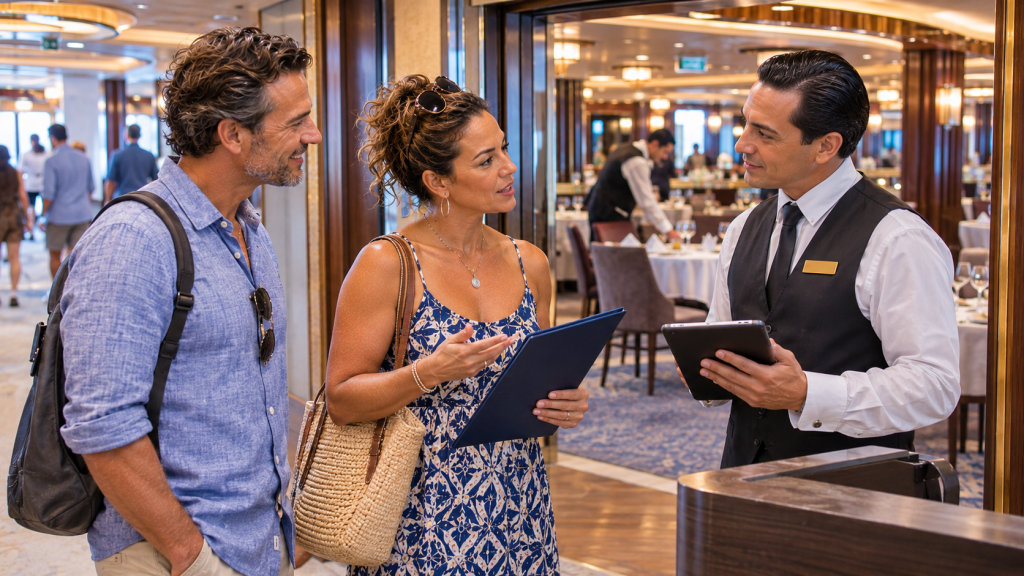
If you live with food allergies or strict dietary rules, cruise dining can feel more stressful than exciting at first.
You are stepping onto a ship where menus change daily and kitchens are busy, and you may wonder, “Will they really understand my needs?”
You might be picturing crowded buffets, unlabeled sauces, and servers who do not fully understand what “gluten-free” or “nut allergy” really means.
You may also worry that one misunderstanding could turn a dream vacation into a medical emergency.
The good news is that cruise lines handle allergies and special diets every single sailing.

Sail Away to Paradise Without Overpaying
Find cruise deals that make it easy to escape, relax, and enjoy the ocean without stretching your budget
They have systems, people, and routines built specifically to accommodate guests who cannot just “eat whatever is there.”
Your job is not to be perfect or to police every plate on your own.
Your job is to use those systems well, starting when you book, and to give yourself a simple, clear plan for buffets, main dining rooms, and ports so you can enjoy your cruise without feeling like you have to stand guard at every bite.
The truth is, cruise lines have systems to protect guests with allergies and restrictions every voyage—and once you know how to use them, you can enjoy your meals without constant worry.
Why Cruise Dining Feels Risky—and How to Lower That Stress
When you have allergies or dietary rules, you have probably built a careful routine at home.
You know which brands are safe, how to read labels, which restaurants get it, and which ones you skip.
On a ship, that familiar structure disappears.
Menus are new.
Labels look different.
Kitchen teams are busy, and you may not know how seriously staff will take your needs.
It is no wonder your stress level spikes when you picture the first dinner.
Add in the fact that you are at sea—with limited access to your usual hospitals or grocery stores—and your brain understandably treats food decisions as higher stakes.
The key to lowering that pressure is understanding how cruise lines organize information about allergies and diets, and how early communication gives the crew a head start on protecting you.
What “Special Request” Really Means
When the cruise line asks about a special request, they are talking about things like food allergies, medical diets, religious restrictions, or mobility needs that require planning.
You will usually see this phrase during booking or check-in, on a form field labeled “Special Requests” or “Dietary Needs.”
Filling this out is not being demanding.
It is the first step in building a record of your needs that gets passed to the onboard team.
What “Allergen Labeling” Really Is
You will also see menus and buffets that use allergen labeling.
This simply means they mark dishes with small icons or text showing common allergens such as gluten, dairy, eggs, nuts, soy, or shellfish.
On printed menus and buffet placards, those icons are shorthand to help you quickly see which items may be safer for you and which need more questions.
Emotional Anchors For This Section
Your Worry Has A Logic
You are not being picky; you are trying to stay healthy in a new environment.
Systems Exist Specifically For You
Cruise lines expect guests with allergies and restrictions every voyage and build procedures around that reality.
Clarity Beats Guessing
Once you understand how special requests and allergen labeling work, you move from “Is it safe at all” to “How do I make this safe for me.”
Plan Ahead Before Boarding: Your Allergy Safety Checklist

The single most important step for cruising with allergies or dietary restrictions happens before you ever see the ship.
You need to tell the cruise line about your needs at booking, not at your first dinner.
When you book online, look carefully for sections labeled “Special Requests,” “Dietary Requirements,” or “Accessibility and Medical Needs.”
Use that space to list your allergies in clear, specific language.
For example, “severe peanut allergy – risk of anaphylaxis” is much more helpful than “nuts.”
If you are gluten-free because of celiac disease, say so.
If you keep kosher, avoid pork, or need low-sodium or diabetic-friendly meals, write that down as well.
If you book through a travel advisor, make sure they pass this information to the cruise line and confirm it is in your reservation notes.
Do not assume they will remember.
Follow up and ask them what the line said in response.
After you complete your online check-in, many cruise lines offer another chance to confirm dietary needs.
Use it.
If the line has a dedicated special needs department or email address, consider sending a short, polite message outlining your situation and your sailing date.
You are not asking for a custom chef; you are giving the kitchen team time to plan substitutions, stock alternative products, and coordinate with your head waiter.
Travel insurance from providers like VisitorsCoverage, World Nomads, Ekta, or Insubuy can also be part of your pre-trip setup.
If you live with a severe allergy, knowing you have coverage for medical care and trip interruptions adds another layer of security behind all the food planning.
Pre-Cruise Setup: Key Actions
Use The Special Request Field Thoroughly
Treat that box as your first safety tool, not an optional comment area.
Confirm Your Needs Are In The Reservation
If you book through an agent, verify they have passed your information to the cruise line and received an acknowledgment.
Pair Planning With Protection
If your allergies are serious, travel insurance provides financial backup if you ever need onboard medical care or treatment in port.
Connect With the Dining Team Early for Safer Meals
Once you board, the next step is to connect your pre-trip paperwork to real people.
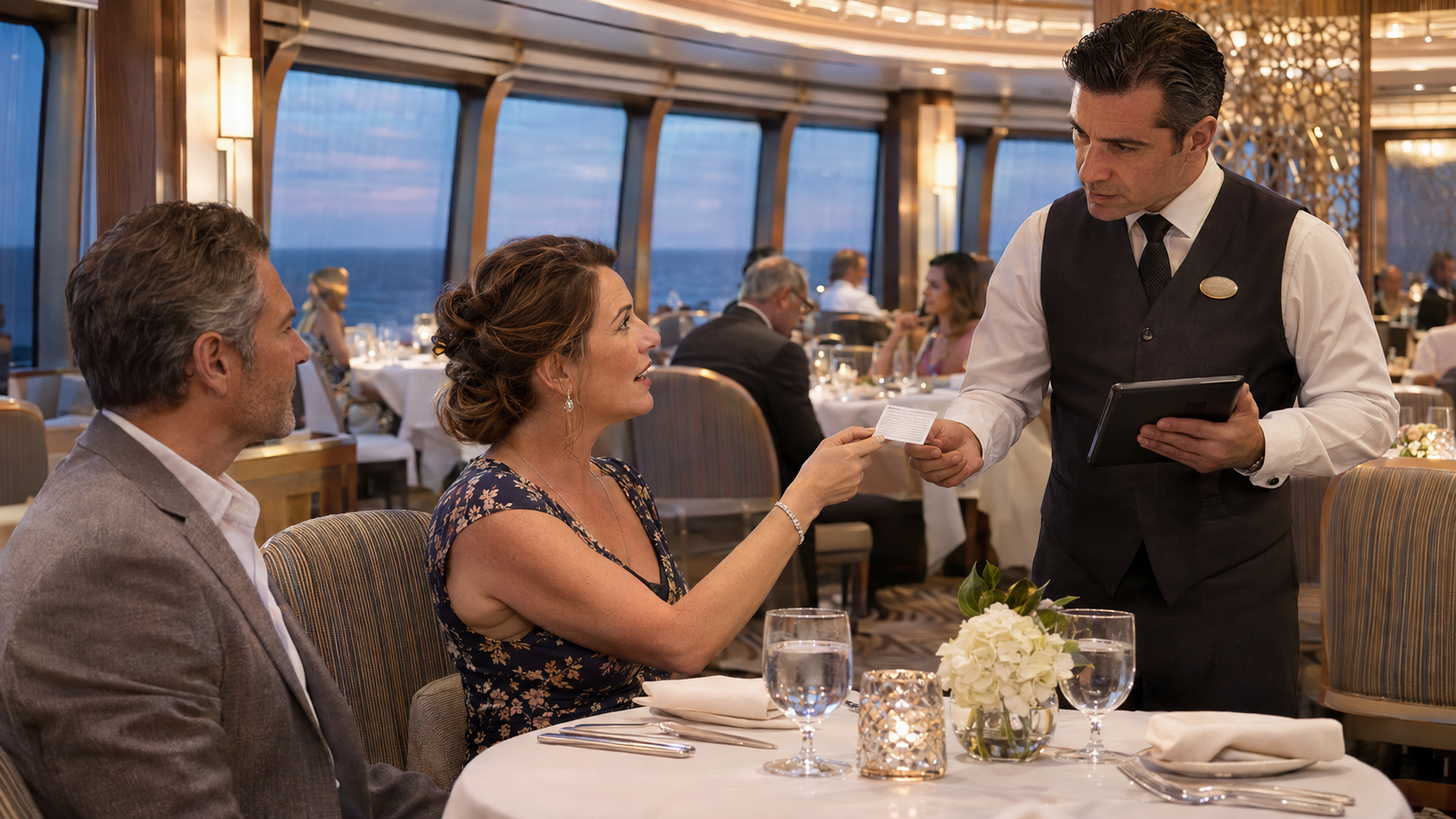
On embarkation day or at your first dinner, ask to speak with the headwaiter, maître d’, or dining room supervisor.
Introduce yourself and calmly explain your allergies or restrictions.
Mention that you noted them as a special request before sailing.
This gives them a chance to pull up your reservation notes and confirm they see what you submitted.
They may ask follow-up questions about severity, cross-contact, and what you are comfortable with.
Be honest and specific.
If even trace amounts of an allergen can cause serious reactions, say so clearly.
If you are flexible on some items but not others, clarify that too.
In many cases, the dining team will offer to pre-order your meals a night in advance.
They may bring the next day’s menu to your table so you can choose dishes and let them adjust recipes or prepare separate plates in a more controlled way.
This can be especially helpful for gluten-free guests, people with multiple allergies, vegans, or travelers with medical diets.
Some cruise lines even have separate allergen-friendly menus the headwaiter can provide once they understand your needs.
If you are booked in traditional main dining with the same servers each night, this relationship becomes one of your best safety nets.
They learn your needs, your comfort zone, and your preferences, and they often advocate for you in the kitchen without you having to re-explain every time.
If you prefer flexible or “anytime” dining, simply build a habit of asking for a supervisor on the first night and reminding your server each evening.
Be polite but firm.
Your health is not a minor preference.
It is okay to ask questions like, “Can you check with the chef whether this sauce contains nuts or gluten,” or “Is this prepared near shellfish.”
Working With The Dining Team: Takeaways
Introduce Yourself Early
Speaking to the headwaiter or maître d’ on night one sets the tone for the rest of the cruise.
Use Pre-Ordering To Your Advantage
Choosing meals a day ahead gives the kitchen more time to prepare safe options without last-minute pressure.
Treat Your Servers As Allies
The staff want you to enjoy your meals and stay safe; clear, respectful communication helps them help you.
Master the Cruise Buffet Without Anxiety: Smart Strategies
Buffets can be the most intimidating part of cruise dining when you have allergies or dietary rules.
There are many stations, lots of guests, and constant movement.
The good news is that most modern cruise buffets use allergen labeling and layout strategies that can help you make safer choices.
You will typically see small placards in front of each dish that list its name and sometimes symbols for common allergens: a wheat icon for gluten, a milk symbol for dairy, a peanut symbol for nuts, and so on.
Some buffets also mark items as vegan, vegetarian, or sugar-free.
These labels are your first filter, not your final answer.
They tell you where to start and where to ask follow-up questions.
If you have a severe allergy or celiac disease, cross-contact is often the bigger risk than the recipe itself.
Serving spoons move between dishes, guests drip sauces from one pan into another, and crumbs fall everywhere.
One practical strategy is to visit the buffet during less crowded times, such as early or late in the meal period, when staff have just refreshed trays.
Look for stations where crew serve you instead of letting everyone serve themselves.
Carving stations, omelet bars, and made-to-order counters often give you a chance to ask the cook directly about ingredients and preparation.
If your needs are strict, you can also ask a supervisor if the kitchen can prepare a separate plate for you away from the main line.
Many ships will do this when they understand the severity of your allergy.
When in doubt, simpler is usually safer.
Plain grilled proteins, steamed vegetables, baked potatoes, fresh fruit, and pre-packaged items with printed labels are easier to assess than complex casseroles, mixed salads, or unlabeled sauces.
If a dish is not clearly labeled and no one can confidently answer your questions, skip it.
Your peace of mind and health are worth more than any one tray of food.
Buffet Navigation: Key Principles
Treat Allergen Labels As A Starting Point
Use icons and text to narrow down options, then ask staff if anything is unclear.
Watch For Cross-Contact, Not Just Ingredients
Crowded buffets increase the chance that safe foods get touched by unsafe ones, so time your visits and choose your stations wisely.
Simple Foods Often Carry Less Risk
Build your plate around items where you can see every component, especially if your allergy is severe.
Use Allergy Alert Cards and Smart Prep for Peace of Mind
One of the most effective tools you can bring is an allergy alert card you can hand to servers and supervisors.
This is a small card that clearly states your allergies and what you need staff to know.
Having it written down reduces the chances of miscommunication, especially when staff are busy or there are language differences.
You can print these at home, ask your doctor’s office to help you create one, or design your own.
You can also translate the card into other languages if your cruise visits ports where English is not the primary language, which is especially helpful for meals off the ship.
For travelers who book food tours or home-style meals with companies like Eatwith in port, handing hosts an allergy card at the beginning of an experience helps them adjust dishes and keep you safe in more intimate settings.
If you have a history of severe reactions, carry your prescribed medications—such as epinephrine auto-injectors and antihistamines—with you at all times, including on the ship.
Do not pack them in checked luggage.
Keep them in your carry-on when boarding and in a small bag whenever you go to public areas or off the ship.
It is also wise to let the medical center know about your allergy on day one so they have your information on file before any issues arise.
Allergy Alert Card Template
You can adapt a simple template like this to create your own card:
Front:
My name is: ______________________
Cabin number: ____________________
I have the following food allergies / dietary restrictions:
– __________________________________
– __________________________________
– __________________________________
Back:
Even small amounts of these foods can make me very sick.
Please:
– Check ingredients and sauces carefully.
– Avoid cross-contact with shared utensils, oil, or cooking surfaces.
– Tell the chef or supervisor about this card.Thank you for helping me stay safe.
You can laminate this card, keep a photo of it on your phone, and print copies for family members or travel companions to carry as well.
Tools And Prep: Core Ideas
Put Your Allergies In Writing
An alert card backs up your voice and keeps your message consistent even in busy environments.
Keep Emergency Medications With You
If you have prescribed treatments, they belong in your pocket or bag, not in a drawer across the ship.
Loop In The Medical Center Early
Letting the medical team know about your history on day one gives them context if anything ever happens.
Avoid These Mistakes When Cruising With Allergies
Most mistakes come from trying to be easygoing or from assuming things will be handled without clear communication.
The first big mistake is failing to notify the cruise line at booking.
Guests show up on embarkation day, mention severe allergies for the first time, and then feel frustrated when the ship needs time to adjust.
Another mistake is treating servers as if they should “just know” which dishes are safe.
Even excellent dining teams cannot guess the details of your needs.
They rely on you to start the conversation.
Some guests also over-rely on buffets, thinking they offer more choice and therefore more safety.
In reality, main dining rooms often give you more control, because food is plated to order and you have consistent staff following your situation.
Skipping conversations with the headwaiter or ignoring pre-ordering options can make your life harder than it needs to be.
A fourth mistake is letting embarrassment stop you from speaking up.
You might feel like you are slowing the line or being “that person” who asks too many questions.
In truth, a minute or two of clear conversation could be the difference between an easy trip and a serious reaction.
Staff would rather answer your questions than see you sick later.
Mistakes And Better Choices
Silence At Booking Makes Everything Harder
Notifying the line when you reserve gives chefs time to prepare for your needs.
Expectation Without Explanation Leads To Confusion
Servers need your details, not just the word “allergy,” to support you well.
Choosing Control Over Convenience Is Often Safer
Main dining with pre-orders may be less spontaneous than the buffet, but it is usually friendlier for strict diets.
Ease Your Biggest Cruise Food Fears With Simple Truths
Even with a great plan, you may still feel uneasy.
You might worry that one distracted server or one mislabeled tray could undo all your care.
You may fear being that person who needs medical attention because of a meal.
Those thoughts do not mean you should not cruise.
They mean your past experiences and your body have taught you to take food seriously.
Fear: “What If They Do Not Take Me Seriously”
Sometimes people with allergies have been brushed off at restaurants on land, and they expect the same treatment at sea.
On reputable cruise lines, allergy and dietary training is part of staff onboarding.
When you speak up early and consistently, you are not surprising them; you are activating systems they already have.
Fear: “What If Something Still Goes Wrong”
No system is perfect, and your fear of a reaction is not irrational.
The important part is knowing that there is a medical center on board, a ship doctor who can respond, and travel insurance options like VisitorsCoverage, World Nomads, Ekta, and Insubuy that help with covered medical costs if you need treatment.
You are not left to manage a reaction alone in the middle of nowhere.
Fear: “What If I Cannot Enjoy Food Like Everyone Else”
Cruise menus are far more flexible than many people expect.
Chefs often enjoy the challenge of creating satisfying options within restrictions.
If you communicate clearly and work with the dining team, you may be pleasantly surprised at how many safe, enjoyable meals you can have.
Emotional Reframes For This Journey
You Are Not Asking For Favors
You are asking the ship to use systems it already has for guests like you.
Protection Layers Are Real
Communication, kitchen procedures, medical backup, and insurance all stack together to lower risk.
Enjoyment Is Still On The Table
Clear boundaries around food are what make relaxed enjoyment possible, not what take it away.
FAQ – How Can First-Time Cruisers Manage Food Allergies and Dietary Restrictions More Safely?
Can You Take Your First Cruise if You Have Food Allergies?
You may be able to cruise with food allergies, but the suitability of a particular sailing depends on your medical needs and the accommodations the operator can provide.
Many cruise lines offer procedures for requesting dietary assistance and discussing meals with dining staff.
However, no kitchen can guarantee the complete absence of allergens or cross-contact.
If your reactions can be severe, consult your treating clinician and confirm the cruise line’s limitations before committing to the trip.When Should You Tell the Cruise Line About Your Food Allergies?
Notify the cruise line as early as possible, ideally when making your reservation.
Some dietary requests require advance notice because specific ingredients, products, or preparation arrangements may need to be organized.
Deadlines vary between operators and can depend on the itinerary or type of request.
Confirm that your information has been received and ask whether the cruise line can meet your particular requirements.How Do You Request Special Meals Before Your First Cruise?
Begin by reviewing your cruise line’s dietary request, accessibility, or special-needs procedures.
Describe your actual restrictions clearly, including the foods or ingredients you need to avoid and any medically required preparation precautions.
Follow the operator’s submission process and retain any acknowledgment.
Before sailing, confirm whether the request can be accommodated rather than assuming that entering information in a reservation field guarantees suitable meals.Should You Speak to the Headwaiter About Food Allergies on Embarkation Day?
Yes, contacting the appropriate dining supervisor after boarding is an important step in managing food allergies.
You can confirm whether the dining team received your advance request and discuss the available meal arrangements.
Ask how ingredients and preparation methods will be verified and whether advance meal ordering is possible.
Continue communicating relevant requirements when dining in different venues or with unfamiliar servers.Can Cruise Ships Accommodate Severe Nut Allergies?
Some cruise lines may be able to make accommodations for passengers with nut allergies, but the extent of those accommodations varies.
Shared kitchens, preparation equipment, and dining areas can introduce cross-contact risks that may not be completely eliminated.
For severe allergies, explain the exact allergens and required precautions when contacting the operator.
Work with your treating clinician and the cruise line to determine whether the available arrangements are appropriate for your situation.Is Gluten-Free Food Available on Your First Cruise?
Many major cruise lines provide gluten-free meal options or can consider requests for gluten-free products with advance notice.
However, gluten-free menu availability doesn’t automatically establish that preparation practices meet the needs of someone with celiac disease.
Shared utensils, cooking equipment, and food preparation areas may introduce cross-contact.
If you have celiac disease, explain that diagnosis and confirm the relevant procedures with the dining team.Are Cruise Buffets Safe for Passengers with Food Allergies?
Cruise buffets can present additional challenges because they may involve shared utensils, frequently changing dishes, and large numbers of passengers serving themselves.
Allergen labels can provide useful information but shouldn’t be treated as guarantees of safety.
Guests with significant allergies should ask qualified dining staff about ingredients and preparation procedures before selecting food.
If those details can’t be verified, choose a different dining arrangement.Can You Trust Allergen Labels on Cruise Ship Menus?
Allergen labels can help identify ingredients that may be present in a dish, but their completeness and format differ between ships and dining venues.
They may not fully address shared cooking surfaces, utensils, or other possible sources of cross-contact.
Use the labels as an initial reference rather than a final determination.
When the consequences of exposure are medically significant, ask the dining supervisor or chef to confirm the relevant details.What Is Food Allergen Cross-Contact and Why Does It Matter on a Cruise?
Cross-contact occurs when an allergen unintentionally transfers into food that might not otherwise contain it.
This can happen through shared cooking oil, utensils, equipment, or preparation surfaces.
Cruise dining environments can involve large-scale food preparation, making these details important to discuss.
Passengers with allergies should communicate their specific precautions and avoid eating foods whose preparation cannot be adequately verified.Is the Main Dining Room Better Than the Buffet for Special Diets?
The main dining room may provide more structured communication with servers, supervisors, and the kitchen.
Some cruise lines also offer meal planning or pre-ordering arrangements through their main dining rooms.
However, these services aren’t identical across operators and don’t guarantee allergen-free preparation.
Confirm which venue can best accommodate your needs rather than assuming one dining arrangement is universally safe.Can You Pre-Order Allergy-Friendly Meals on a Cruise?
Some cruise lines allow passengers with dietary requirements to select meals in advance, particularly through the main dining room.
This can give the kitchen additional time to consider ingredients and possible modifications.
Availability depends on the operator, venue, and type of restriction.
Ask your dining supervisor whether pre-ordering is offered and how your requirements will be communicated to the team preparing each meal.What Should Be Written on a Cruise Allergy Alert Card?
A useful allergy alert card should identify the specific foods or ingredients you need to avoid and explain any relevant cross-contact precautions.
It can also ask the dining team to verify ingredients and preparation procedures with the chef or supervisor.
Keep the wording straightforward so staff can understand your request without interpreting vague descriptions.
The card supports communication but cannot certify that a meal is suitable for you.Should You Bring Allergy Medication on Your First Cruise?
If you have been prescribed medication for allergic reactions, bring it according to your treating clinician’s instructions and applicable travel requirements.
Keep essential treatment readily accessible rather than relying on checked luggage or medication stored elsewhere on the ship.
Passengers at risk of anaphylaxis should review their emergency action plan and prescribed epinephrine arrangements before traveling.
Confirm how to reach onboard medical assistance and any relevant medication storage requirements.What Happens if You Have a Severe Allergic Reaction at Sea?
A severe allergic reaction requires immediate attention and should be managed according to your prescribed emergency action plan.
For suspected anaphylaxis, promptly use prescribed epinephrine and seek emergency medical assistance.
Cruise ships have medical facilities, but their capabilities and access to specialist hospital care vary.
Before sailing, discuss emergency preparedness with your clinician and learn how to contact the ship’s medical team.Can Cruise Lines Provide Vegan or Vegetarian Meals?
Many cruise lines provide vegetarian dishes, and some offer vegan menus or suitable modifications on request.
However, the available choices and ingredient-handling procedures depend on the operator and dining venue.
If your restriction involves additional requirements, such as avoiding dairy, eggs, or particular preparation methods, explain those details clearly.
Check the current menus and ask the dining team to verify ingredients rather than relying solely on a dish’s title.Are Kosher or Halal Meals Available on Cruise Ships?
Some cruise lines can accommodate certain religious dietary requirements, but availability and preparation arrangements vary considerably.
Kosher meals may require advance ordering, particularly when specially sourced products are necessary.
Halal accommodations should be confirmed directly with the operator, including any preparation and certification requirements relevant to you.
Never assume that a general dietary request guarantees meals meeting all religious standards.Can Cruise Ships Accommodate Low-Sodium or Diabetic-Friendly Diets?
Some cruise lines offer meal adjustments or options designed around particular medical dietary requirements, including reduced sodium or sugar.
However, availability and the nutritional information provided may differ between operators and venues.
If your diet is medically prescribed, discuss the specific requirements with your clinician and cruise line before sailing.
A menu described as low-sugar or healthy isn’t automatically suitable for every medical condition.How Should You Manage Food Allergies During Shore Excursions?
Contact the excursion provider before booking any activity that includes food, tastings, or restaurant visits.
Explain your specific restrictions and ask whether the operator can verify ingredients and preparation procedures.
A food tour’s advertised dietary options shouldn’t be treated as confirmation that it can accommodate a severe allergy.
Carry your prescribed emergency treatment and follow local food and medication transport requirements when going ashore.Does Travel Insurance Cover Food Allergy Emergencies on a Cruise?
Some travel insurance policies provide benefits for eligible emergency medical treatment, evacuation, or trip interruptions, but coverage depends on the policy.
Existing medical conditions, exclusions, benefit limits, and claims procedures may affect whether a particular allergy-related incident is covered.
Review those provisions before purchasing a plan.
Insurance may offer financial protection, but it doesn’t eliminate medical risk or replace the need for an emergency response plan.What Is the Best Way to Prepare for Dining With Allergies on Your First Cruise?
Start by discussing your travel plans and emergency preparedness with your treating clinician when medically appropriate.
Notify the cruise line early, confirm the available accommodations, and bring a clear written explanation of your dietary requirements.
Once onboard, speak directly with the dining supervisor and ask how ingredients, preparation, and cross-contact risks are handled.
Continue verifying meals throughout the sailing and avoid foods or venues that cannot provide the information necessary for your particular needs.
Plan Your Next Cruise!

Sail in Style: Oceania Cruises’ Culinary Excellence, Cultural Immersion, and Refined Luxury
One Delay Can Cost Your Entire Cruise A quick coverage check now protects you from the problems no one sees coming….
Sail Boldly: Experience Virgin Voyages’ Adults‑Only Cruises With Style, Freedom, And Fun
One Delay Can Cost Your Entire Cruise A quick coverage check now protects you from the problems no one sees coming….
Sail Into Sophistication: Holland America Cruises for Luxury, Culture, and Unforgettable Journeys
One Delay Can Cost Your Entire Cruise A quick coverage check now protects you from the problems no one sees coming….
From Icon to Oasis: Explore Royal Caribbean’s Groundbreaking Ships and Unforgettable Voyages
One Delay Can Cost Your Entire Cruise A quick coverage check now protects you from the problems no one sees coming….
Explore More

Cruise Cabin Noise Levels — What to Expect and How to Sleep Better
Sail Into Sophistication: Holland America Cruises for Luxury, Culture, and Unforgettable Journeys

Escape the Noise: Find Your Perfect Quiet Cabin on Any Cruise Ship