
One Delay Can Cost Your Entire Cruise
A quick coverage check now protects you from the problems no one sees coming
Short Excerpt
- Cruise terminal security usually involves document verification, baggage screening, and checks of passengers before boarding.
- Your first cruise may include an X-ray inspection of carry-on luggage, metal detector screening, and additional checks when security needs to examine an item.
- Use the interactive embarkation security checklist to organize your documents, review prohibited items, and prepare for the checkpoint.
Quick Take
- Keep travel documents accessible. You’ll need the documents required for your itinerary and cruise line, which may include a passport or other accepted citizenship documentation.
- Expect baggage screening. Checked luggage and carry-on bags can be inspected separately, including through X-ray equipment.
- Review prohibited items before packing. Cruise lines have different policies for electrical accessories, drinks, sharp items, and other belongings.
- Follow checkpoint instructions. Requirements for shoes, electronics, liquids, and personal items can differ between terminals.
- Allow time for extra inspections. A bag pulled aside for review isn’t necessarily evidence of wrongdoing, but an unresolved prohibited item can affect boarding.
- Expect checks when returning from port. Reboarding normally involves identification and security procedures, even after you’ve already passed embarkation security.
What Happens During Cruise Security Checks on Your First Sailing?
You’ve arrived at the cruise terminal, luggage in hand, and can already see your ship waiting at the pier.
After weeks of planning, you’re almost ready to walk aboard and begin your first cruise.
But there’s still one unfamiliar part of embarkation ahead: security.
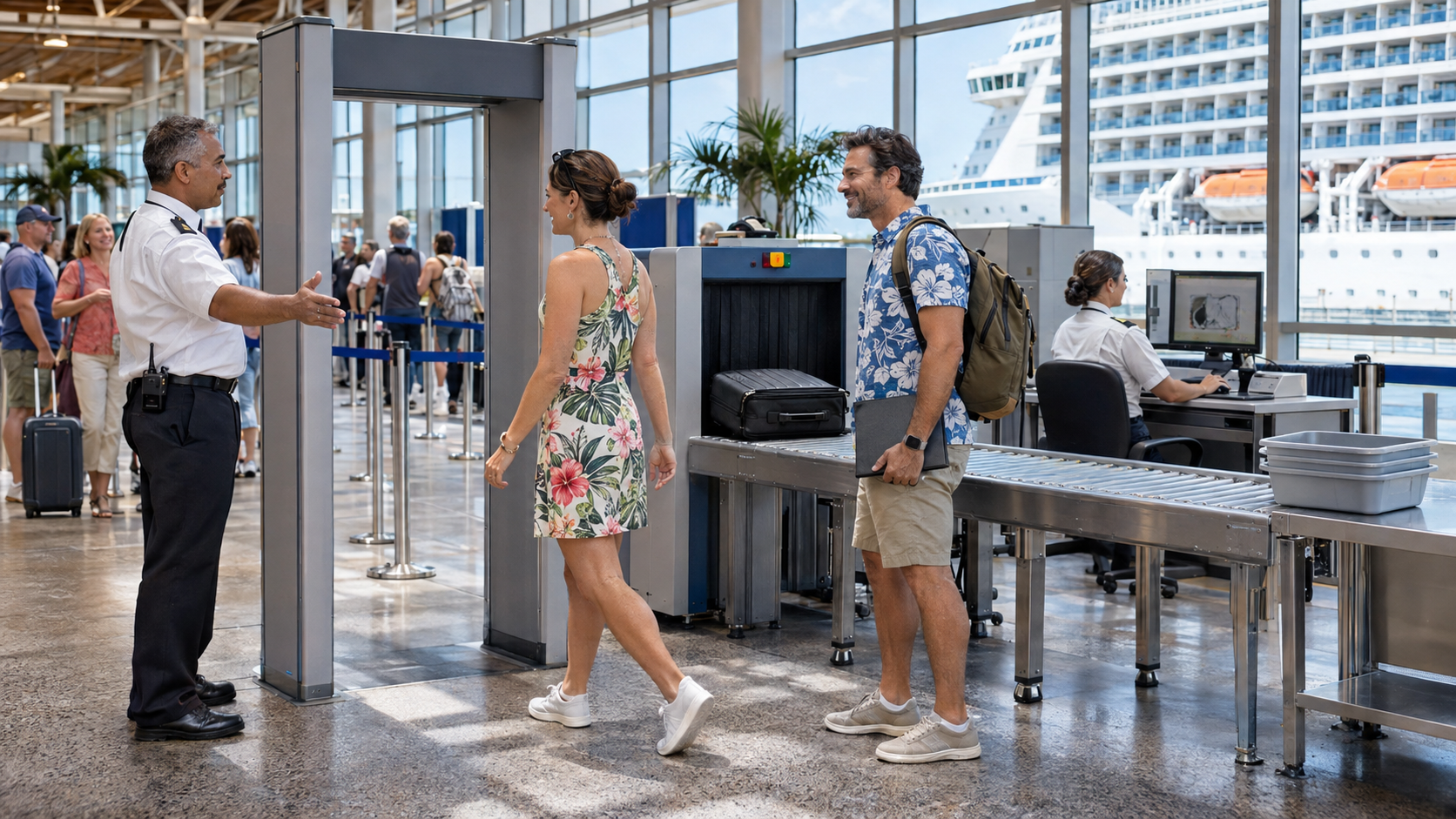
You may see passengers lining up beside baggage scanners, security officers checking documents, and carry-on bags moving along conveyor belts.
If you’ve flown before, some of the equipment will look familiar.
Yet cruise terminal screening isn’t necessarily identical to airport security.
For example, you shouldn’t assume that you must remove your shoes, place every electronic device into a separate bin, or follow the same restrictions on liquids that apply to airline carry-on baggage.
Those requirements depend on the terminal’s procedures, the cruise line, and the instructions given by security personnel.
Cruise security is designed to screen passengers and their belongings before they enter the ship.
Screening can also take place when passengers return from ports.
Royal Caribbean’s published security policy, for instance, requires passengers to follow security instructions and undergo screening before boarding and when required during a voyage. (Royal Caribbean Guest Health, Safety, and Conduct Policy)
For a first-time cruiser, the process becomes easier to navigate once you understand what normally happens and how to prepare.
You don’t need to know every detail of the security equipment or anticipate every question an officer might ask.
Instead, focus on having the correct documents, packing within your cruise line’s rules, and following the directions provided at your terminal.
What Cruise Security Checks Before You Board
At a typical cruise terminal, security may inspect your carry-on belongings, screen your person, and examine checked luggage separately.
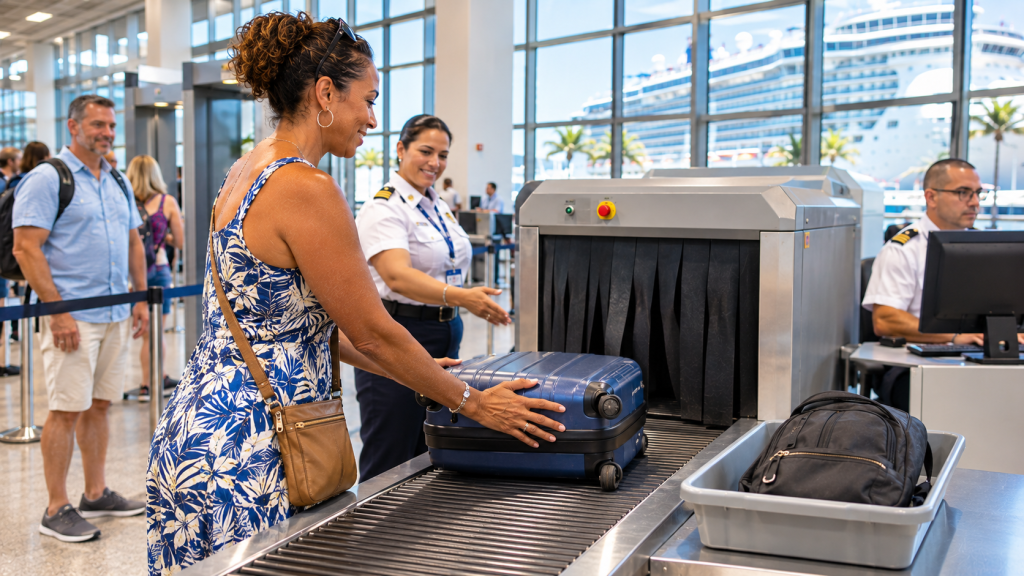
Your bags may pass through an X-ray scanner that generates images security staff use to evaluate their contents.
Personal screening may involve a walk-through metal detector or other equipment, with additional checks when necessary.
The screening process is not limited to finding dangerous objects.
It also helps enforce restrictions on belongings that could create safety problems onboard.
For instance, Royal Caribbean lists clothing irons and garment steamers among prohibited items.
Its current policies also restrict numerous electrical accessories, including some extension cords and multi-plug devices. (Royal Caribbean Prohibited Items Policy)
Carnival likewise maintains its own prohibited-items policy and explains that checked luggage is screened, with restrictions on items that could compromise passenger or vessel safety. (Carnival Prohibited Items)
Top Cruise Deals From Trusted Cruise Lines
Compare exclusive online offers and find the fare that fits your trip and your budget

However, an item permitted on one cruise line is not necessarily permitted on another.
That’s particularly important for travelers bringing electrical accessories, medical equipment, drinks, or products bought in port.
Checking the policy before packing is much easier than learning about a restriction when your belongings are being examined.
Prepare Your Carry-On Before You Reach the Security Line
One of the most helpful things you can do is organize the essentials you’ll need between arriving at the terminal and entering your stateroom.
Keep your identification and required travel documents somewhere you can retrieve them without unpacking the entire bag.
You should also carry necessary medication, valuables, and other important items rather than relying on checked luggage that may be delivered to your cabin later.
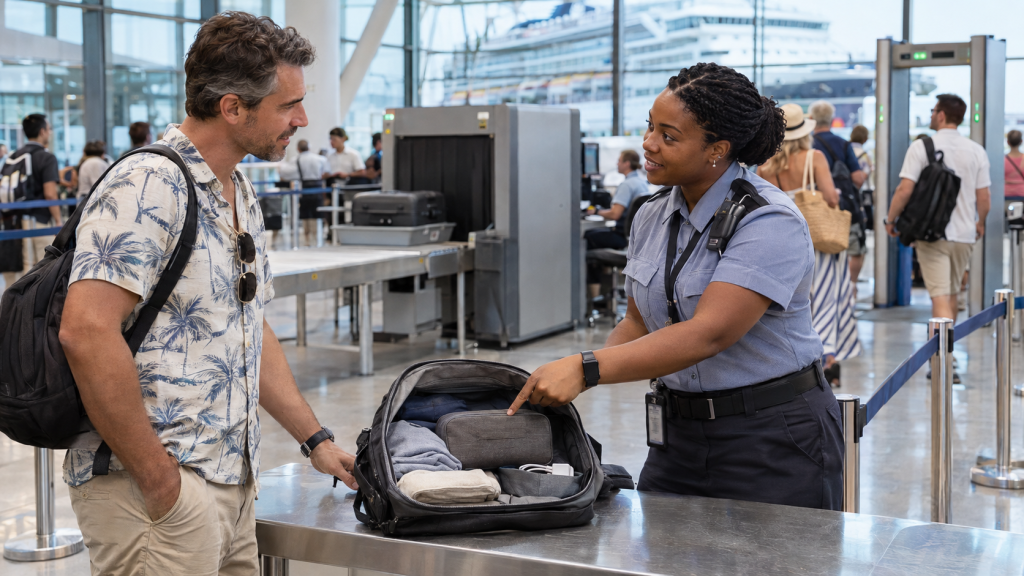
Royal Caribbean advises guests to carry their boarding documentation and medication personally, and notes that carry-on luggage must fit through the terminal’s X-ray screening equipment, which can vary in size between ports. (Royal Caribbean Luggage Policy)
If you’ve checked large suitcases with porters, your carry-on becomes your temporary luggage for the beginning of the sailing.
It should contain what you reasonably need until you can access your room and receive the rest of your belongings.
There’s no advantage to bringing every possible item through the security line if you don’t need it with you.
Interactive First-Cruise Security Preparation Checklist
Use this checklist before leaving for the terminal. It focuses on the preparations that help reduce avoidable questions, unpacking, and security delays.
My First-Cruise Security Checklist
Prepare your documents and luggage before your first cruise security screening.
Preparation aid only. This checklist does not approve items for boarding. Consult your cruise line’s official policies and follow directions from terminal security staff. Your progress is not stored between visits.
From Terminal Arrival to Boarding: The Security Sequence
On embarkation day, you’ll usually encounter several different steps before boarding, although their exact order varies by terminal.
You may first check larger luggage with a porter and then proceed toward the terminal entrance with your documents and carry-on belongings.
Staff may verify your arrival appointment, boarding information, or travel documents before directing you to the next area.
Your carry-on luggage can then be screened, and you may pass through a metal detector or another security screening procedure.
After completing the required checks, you’ll continue through any remaining check-in steps and eventually proceed to the ship.
However, it’s important not to describe a universal sequence in which security always happens before check-in, or vice versa.
For example, Carnival’s published embarkation instructions explain that passengers must complete online check-in, select an arrival appointment, bring required documentation, and arrive within their assigned arrival period. (Carnival Embarkation and Departure)
The order of queues, document checks, identity verification, and security can still vary with terminal operations.
Your best approach is to follow the instructions for your actual sailing rather than relying on a diagram showing a single rigid process.
What an X-Ray Scanner Actually Shows Security Staff
A cruise terminal X-ray scanner generates images that help security staff examine the contents of luggage without opening every bag.
That doesn’t mean every object is presented as a simple black outline.
Depending on the system, X-ray screening equipment can display different colors, shapes, and material-related information to assist operators in identifying items requiring further inspection.
Online‑Only Cruise Offers You Won’t Find Elsewhere
Unlock special pricing and start planning the sailing that matches your perfect itinerary

Security staff may examine items whose appearance is unclear or that seem to conflict with the cruise line’s rules.
A flagged item doesn’t automatically mean you’ve done something wrong.
It may simply require additional examination.
If an officer asks to inspect a bag, follow their directions and answer questions about the item being reviewed.
The outcome depends on what is found and the applicable security policy.
Can You Keep Your Shoes and Jacket On During Cruise Security?
Cruise terminal screening often differs from the familiar airport process.
However, there isn’t one nationwide cruise-terminal rule that guarantees passengers can always keep shoes, jackets, or accessories on.
Procedures may depend on the screening equipment, security assessment, terminal, and individual circumstances.
The simplest preparation is to keep loose metal objects organized and be ready to follow instructions.
If security asks you to place a belt, jacket, phone, or another item in a tray, do so as directed.
If you use medical equipment or have an accessibility need that may affect screening, contact the cruise line beforehand and explain the situation to security staff when appropriate.
What Happens if Security Finds a Prohibited Item?
A prohibited or questionable item can trigger additional inspection, and the possible outcome varies.
Security may decide that the item is allowed, arrange for it to be held, or refuse to permit it onboard.
Royal Caribbean describes a process in which checked luggage containing an item believed to be prohibited may be held for inspection.
When an item is retained under its applicable procedure, guests may receive a receipt explaining how to retrieve it after the voyage. (Royal Caribbean Security-Held Luggage)
However, not every prohibited item is returned.
Some may be discarded, surrendered to authorities, or result in more serious action.
Carnival specifically warns that prohibited items can be confiscated and disposed of without compensation, while serious security violations can have additional consequences. (Carnival Prohibited Items)
For that reason, don’t assume an accidental packing mistake will always end with the item being held until disembarkation.
Check the rules before traveling and ask the cruise line when you’re uncertain.
Why Electrical Accessories Deserve a Separate Packing Check
Electrical accessories can be easy to overlook because many travelers routinely pack them for hotel stays.
Cruise lines take additional precautions because shipboard electrical systems and fire safety requirements differ from those of ordinary accommodations.
Clothing irons, garment steamers, extension cords, multi-plug devices, and power strips may be restricted or prohibited depending on the operator and equipment.

Luxury Cruise Experiences at Smarter Prices
See premium sailings and upgraded cabins priced for travelers who know how to book well
There can also be limited exceptions for particular medical devices.
For example, Norwegian publishes specific information about CPAP equipment, distilled water, and extension-cord requirements, including a restriction against surge protectors and the possibility of security inspection. (Norwegian Cruise Line CPAP Guidance)
That’s why a generic packing list saying that all power strips are safe as long as they lack surge protection would be misleading.
Check the exact item category and the policy of the cruise line you’re sailing.
Understand Beverage Rules Before Packing Your Carry-On
Cruise security also checks compliance with onboard beverage policies.
These rules vary between operators and may distinguish alcoholic beverages, nonalcoholic drinks, medical supplies, and purchases made in port.
Royal Caribbean, for example, currently permits each guest of legal drinking age to bring one sealed 750 mL bottle of wine or champagne on embarkation day, subject to its published restrictions.
It also permits certain nonalcoholic beverages within specified limits. (Royal Caribbean Food and Beverage Policy)
Norwegian’s published policy is different, generally restricting guests from bringing nonalcoholic beverages such as soda, water, and juice, with certain exceptions for medical devices and infant formula. (Norwegian Cruise Line Terms)
These differences matter more than whether you’re carrying a bottle in a backpack or suitcase.
Follow the applicable rules for your operator, departure date, and itinerary.
Expect Another Security Check When Returning From Port
After spending the day ashore, you may encounter another screening process before returning to your ship.
You’ll generally need to show the required cruise identification and pass through the ship’s reboarding security procedures.
Purchases made in port may be subject to inspection or restrictions, including certain beverages and items that cannot be used onboard.
Don’t assume something purchased legally in a destination is automatically permitted on the ship.
It’s also important to return before the all-aboard deadline, which may be earlier than the advertised departure time.
Leave room for transportation delays, port access procedures, and any queue that forms near the gangway.
Make Cruise Security a Routine Part of Your Embarkation Plan
The goal isn’t to memorize every scanner feature or predict whether your bag will be selected for additional examination.
It’s to prepare the things within your control.
Confirm your arrival appointment, organize your documents, review the prohibited-items policy, and keep important belongings accessible.
Once at the terminal, follow the instructions from the security and boarding teams.
If something needs additional inspection, cooperate with the process and ask for clarification when necessary.
And when you return from a port day, expect another identity and security check before reboarding.
Your first cruise security experience doesn’t have to be intimidating.
Knowing what to expect gives you one less unfamiliar part of embarkation to figure out while you’re standing in line.
How Cruise Terminal Screening, X-Ray Scans, and Bag Inspections Work
Worried about cruise security checks on your first sailing?
You are not alone.
If you are taking your first cruise and wondering what security checks will be like, you are not alone.
You might be picturing airport-style chaos, shoes off in long lines, and confusing rules that change from port to port.
You may be unsure what happens to your luggage, what you are allowed to bring aboard, and what those big machines at the terminal actually do.

Sail Away to Paradise Without Overpaying
Find cruise deals that make it easy to escape, relax, and enjoy the ocean without stretching your budget
You might also worry that one small mistake will delay your vacation or embarrass you in front of a line of strangers.
The reality is simpler and more structured than most first-time cruisers expect.
Cruise lines use a screening process that feels familiar if you have flown before, but with a slightly different rhythm and more of a vacation atmosphere.
Security teams and port staff are not there to catch you out.
They are there to keep everyone safe, move people steadily, and get you onto the ship with as little confusion as possible.
Once you understand each step, including what an X-ray scan actually does and how your carry-on is checked, the whole experience feels more predictable and much less intimidating.
What “Screening Process” And “X-Ray Scan” Really Mean
Before you set foot in the terminal, it helps to translate two pieces of security jargon into plain language.
The screening process is the series of checks every guest and bag passes through before boarding the ship and when returning from ports.
It usually includes showing your ID and boarding documents, going through a metal detector, and having your bags examined by security using machines and sometimes manual inspections.
It is essentially a structured routine that helps crew and port security make sure no prohibited items or serious risks get on board.
An X-ray scan is the part where your bags travel along a belt and into a machine while you walk through a metal detector.
Inside that machine is an X-ray system that produces images of what is in your luggage.
Security staff look at those images on a screen to see shapes and densities.
They are not reading your documents or judging your clothing.
They are checking for things like weapons, explosives, or other banned items that could threaten safety.
They may also spot liquids or objects that violate cruise line policies, such as irons, certain power strips, or alcohol stored where it does not belong.
Understanding those definitions helps your brain see the process as a predictable routine instead of a mysterious gateway.
How Security Checks Fit Into Your Vacation
Security checks are not there to make your day harder.
They are there to make sure the ship stays a secure, controlled environment once you are on board.
When you see scanners, walk-through detectors, and uniformed security staff, you are looking at the protective shell around your floating resort.
By moving smoothly through that shell, you help keep it strong for everyone.
What The Machines Can And Cannot Do
X-ray scanners show shapes and densities, not colors or details like a photograph.
Security agents see outlines and masses, not brand names or private information.
The machines are tools for spotting potential risks, not for critiquing your packing choices.
Why Everyone Goes Through The Same Process
Security checks apply to all guests, from first-timers to frequent cruisers, and to crew as well.
This consistency keeps the environment predictable and fair, so no one feels singled out.
Step-By-Step: What Happens During Cruise Security Checks
The good news is that cruise security checks follow a familiar pattern each time you board at the terminal and each time you return from a port.
Once you know the sequence, you can move through it like someone who has done this many times.
Step 1: Approaching The Terminal
When you arrive at the terminal, you will usually see signage for luggage drop-off, security entrance, and check-in.
If you have large checked bags, you hand them to porters outside the building, just like you would hand luggage to an airline agent.
Those bags are tagged with your stateroom information and screened separately behind the scenes before being delivered to your cabin later.
Your smaller items stay with you as carry-on luggage and go through the main security line.
This is a good time to have your travel documents in order.
Keep your passport, boarding pass, and any required health paperwork in a secure but easily accessible spot, such as a Travelpro carry-on pocket or a small document organizer.
Travel bags designed for airports often work beautifully here, because they keep everything organized for quick presentation.
Step 2: Document Check And Entry To Security
At the entrance to the security area, a staff member will review your passport and boarding pass.
They may ask a few simple questions, like how many in your party or whether you have completed online check-in.
Once they confirm your information, they direct you toward the screening machines.
This is the beginning of the screening process in the formal sense.
From this point, everyone passes through similar steps.
Step 3: Preparing For The Belt And X-Ray Scan
Before you reach the belt where bags go into the X-ray scan, you will usually see trays or bins and a table where you can organize your items.
Unlike many airports, you often do not have to remove shoes or jackets, depending on the port and line.
You do, however, need to place your carry-on, purses, backpacks, and sometimes larger electronics or bottles into the bins.
If you have anything metal on your person that could set off a detector—keys, coins, belts with large buckles—place those in a tray as well.
Liquids rules vary by port and cruise line, but as a general guideline you should keep obvious beverages, open containers, and large liquid bottles out of your carry-on during the screening moment.
If you are unsure, ask the staff before you reach the belt.
They would rather answer a quick question than stop the line later.
Step 4: Walking Through The Metal Detector
Once your bags are on the belt and moving into the X-ray scan, a security staff member will invite you to walk through a metal detector.
This is similar to the airport checkpoint.
You step in, walk at a normal pace, and step out.
If the machine beeps, the security officer may ask you to step aside briefly so they can use a handheld wand or ask about any metal on your body.
They may ask you to remove an item and walk through again.
This is routine and does not mean you have done anything wrong.
It is simply how they confirm that no prohibited metal objects are being carried through.
Step 5: Bag Review And Possible Secondary Checks
While you walk through the detector, your bag is gliding through the X-ray scan machine.
A security agent watches the screen to see what is inside.
If everything looks ordinary, your bags come out the other side, and you pick them up and move on.
If something looks suspicious, unclear, or against the rules, they may pull your bag aside for a secondary check.
In that case, they will ask you to open the bag on a table and show them what is inside.
They are looking for specific shapes or objects the X-ray flagged, such as irons, coffee makers, power strips with surge protectors, or bottles of alcohol that are not allowed in carry-on.
They may confiscate prohibited items for the duration of the cruise or explain how those items will be handled.
The key thing to remember is that this is about the item, not about you as a person.
You are not being accused of anything.
Security is simply enforcing the ship’s rules.
Step 6: Final Steps And Moving Into The Check-In Area
Once you and your bags clear security, you step into the main terminal space.
Here you handle check-in desks or kiosks, photos, and final paperwork.
You may show your documents again, have a security photo taken, and receive your cruise card or wearable if you do not already have it.
From there, you move into the waiting area until your boarding group is called.
When you reboard after a port day, a shorter version of this process repeats.
You show your cruise card, place bags on the belt for an X-ray scan, and walk through a metal detector before stepping back onto the ship.
Security Steps: Big Picture Reminders
Everyone Follows The Same Flow
From document check to belt to detector, the pattern is predictable across most ports and ships.
Machines Look At Objects, Not At You
X-ray scans and detectors are focused on shapes and materials, not on judgment of your packing.
Questions Are Normal, Not Accusations
If staff pull a bag aside or ask you to walk through again, it is a routine part of keeping the ship secure.
Avoid Security Check Mistakes That Trip Up First-Time Cruisers
Most first-time mistakes at cruise security are simple oversights, not deliberate rule-breaking.
They come from either overpacking, not reading guidelines, or treating cruise security as less serious than airport security.
Bringing Prohibited Items “Just In Case”
Many guests pack items that work fine at hotels but are not allowed on ships.
Irons, full-size steamers, power strips with surge protection, candles, and certain heating appliances are common examples.
These can create fire risks or interfere with electrical systems, so they are not permitted.
If they show up clearly in the X-ray scan, security will pull the bag and remove them.
Packing Alcohol Against The Rules
Cruise lines have specific policies about how much wine or other alcohol you can bring.
Many allow a small amount of wine in carry-on at embarkation but restrict other types or quantities.
If you pack bottles in checked luggage or try to carry them through outside of the rules, they are likely to be flagged and held.
This can be awkward at the checkpoint and may delay you briefly.
Forgetting Documents Or Burying Them In Your Bag
Storing your passport or boarding pass deep in a suitcase instead of keeping them accessible slows you down and increases stress in the line.
Using a dedicated pocket in a Travelpro carry-on or a slim document pouch keeps everything easy to reach without juggling loose papers.
Wearing Lots Of Metal Through The Detector
Belts with large buckles, metal-heavy jewelry, and pockets full of coins or keys will almost guarantee extra passes through the detector.
You can avoid this by placing obvious metal items in the tray before you step through.
Losing Focus At Port Re-Entry
After a great excursion booked through GetYourGuide, Viator, Klook, or a local operator you found on Tripadvisor, it is easy to stroll back to the ship half-distracted.
People sometimes forget they still have pocketknives, sharp souvenirs, or open drinks with them.
Those will be flagged in the screening process, which can mean delays or disposals.
Mistakes And Smoother Alternatives
Check The Line’s Prohibited Items List Before Packing
That five-minute check can prevent awkward conversations at the checkpoint.
Treat Cruise Security As Real Security
Use the same common sense you would at an airport, even though the atmosphere feels more relaxed.
Keep Documents And Essentials Organized
A small, well-designed carry-on and clear pockets reduce fumbling, which lowers your stress.
Overcome Cruise Security Fears: Confidence Tips For First-Time Cruisers
Even with a clear understanding of the steps, you may still feel uneasy.
You might worry about being pulled aside and judged.
You might fear making a mistake that delays your boarding or draws attention.
You might feel anxious about metal detectors or X-ray machines in general.
Fear: “What If I Get Pulled Out Of Line And Embarrassed”
Bag checks and second passes through the detector happen to all kinds of travelers, not just to people who have done something wrong.
Security is looking at items, not at your worth as a passenger.
If your bag is selected, you simply open it, let them check the area they are curious about, answer a question or two, and move on.
Most of the people around you are focused on their own bags, not on yours.
Fear: “What If I Accidentally Pack Something I Shouldn’t”
Sometimes you will.
Maybe you forget a small knife in your daypack, leave a bottle from a port tasting in your bag, or pack a household item without realizing it is prohibited.
Security will either remove it, hold it for you, or explain how it will be handled.
You might feel a flash of embarrassment, but then it is done.
Your cruise continues.
Reviewing cruise policies ahead of time and keeping daypacks simple on port days greatly reduces how often this happens.
Fear: “What About My Data And Personal Information”
Security checks at the terminal are focused on physical safety, not on reading your phone or laptop.
If you are using ship or port Wi-Fi to access accounts, a VPN such as NordVPN can give you extra protection, and tools like Incogni can help reduce your long-term data exposure.
For travel connectivity in port, eSIMs from companies like Airalo, Drimsim, Yesim, or Sally Sim give you data without relying on open public networks.
These steps are separate from the screening process, but together they help you feel more protected overall.
Fear: “What If Travel Disruptions Collide With Security Delays”
Sometimes, the bigger anxiety is about everything piling up at once.
Delayed flights, tight connections, and then a security line that feels slow.
You can soften this by planning to arrive early on embarkation day, ideally with an overnight stay arranged through Booking.com, Trip.com, Agoda, or another hotel platform you trust.
Travel insurance from providers like VisitorsCoverage, World Nomads, Ekta, or Insubuy can help with covered costs if delays or cancellations force you to adjust.
If airlines cause serious disruption, services such as Compensair and AirHelp can help you pursue eligible compensation.
Knowing you have logistical and financial backup lets you stand in the security line with much less fear that one small hiccup will wreck the entire trip.
Emotional Reframes For Security Anxiety
Security Is There To Protect You, Not To Trap You
The checks are about creating a safe environment onboard, not about catching you out.
Small Missteps Are Fixable, Not Fatal
Most mistakes result in items being removed, not in your trip being taken away.
Being Early And Prepared Reduces Pressure
Arriving with time to spare, documents ready, and bags packed with the rules in mind turns security from a threat into a simple formality.
FAQ – What Should First-Time Cruisers Know About Security Screening Before Boarding?
FAQ – What Happens During Cruise Security Checks Before Your First Sailing?
Cruise terminal security generally involves screening passengers and luggage before they board the ship.
Depending on the terminal, you may have your travel documents checked, place carry-on bags through an X-ray scanner, and pass through a metal detector or another screening system.
Security may conduct additional inspections if an item requires review.
The exact order and procedures vary, so follow the directions given at your departure terminal.FAQ – Is Cruise Ship Security the Same as Airport Security?
Cruise security uses some familiar equipment, including baggage X-ray machines and metal detectors, but its procedures aren’t necessarily identical to airport screening.
Requirements for shoes, jackets, electronics, and beverages may differ.
Cruise lines also maintain their own lists of items passengers cannot bring aboard.
Rather than relying on airline rules, check your cruise operator’s instructions and follow the terminal security team’s directions.FAQ – Do You Have to Remove Your Shoes During Cruise Security?
Not necessarily, because shoe-removal requirements aren’t identical across cruise terminals.
Some passengers may be permitted to walk through screening with their shoes on, while others could be asked to remove footwear during additional checks.
The procedure can depend on the equipment and security instructions at that location.
Wear comfortable shoes and be prepared to follow the screening officer’s directions.FAQ – Do Cruise Terminals Use X-Ray Machines for Carry-On Luggage?
Cruise terminals commonly use X-ray screening equipment to inspect carry-on bags and other belongings.
These systems allow security staff to examine luggage contents and identify items that may require further inspection.
The equipment and screening procedures can vary between ports.
If your bag is selected for additional review, an officer may ask you to open it or explain a particular object.FAQ – Do Cruise Ships Screen Checked Luggage Separately?
Checked luggage is generally screened separately from the bags passengers carry through the terminal.
Cruise lines may inspect luggage and temporarily hold bags containing questionable or prohibited items.
Delivery to your stateroom can therefore take time, particularly if additional inspection is necessary.
Keep essential travel documents, medications, and valuables with you rather than placing them in checked suitcases.FAQ – What Documents Do You Need to Get Through Cruise Terminal Security?
You generally need the boarding documents and identification required for your cruise itinerary.
Depending on the sailing, acceptable documentation may include a passport, other citizenship documents, visas, or additional identification.
Requirements vary according to your nationality, itinerary, and cruise line.
Check your booking instructions before departure and keep the documents readily accessible during terminal processing.FAQ – What Happens if a Cruise Security Scanner Flags Your Bag?
A bag may be selected for secondary inspection when security needs to identify an object or determine whether it complies with the rules.
Staff may ask you to open the luggage or provide information about particular belongings.
A flagged bag doesn’t automatically mean you’ve committed a violation.
However, prohibited or dangerous items can be removed, retained, discarded, or handled according to the cruise line’s security procedures.FAQ – Can Cruise Security Confiscate Items From Your Luggage?
Yes, cruise lines may confiscate or refuse items that violate their safety and security policies.
What happens afterward depends on the item, operator, applicable laws, and circumstances of the inspection.
Some property may be retained for collection after the voyage, while other belongings may be disposed of or surrendered to authorities.
Review the official prohibited-items policy rather than assuming everything confiscated will be returned.FAQ – Are Irons and Garment Steamers Allowed Through Cruise Security?
Clothing irons and garment steamers are prohibited on many cruise lines because they can create fire hazards.
Individual operators publish their own rules, and passengers shouldn’t assume a small or travel-sized appliance is acceptable.
Some personal grooming appliances may be treated differently from clothing irons.
Check the precise item restrictions before packing so your luggage doesn’t require avoidable inspection.FAQ – Can You Bring a Power Strip or Extension Cord on Your First Cruise?
Whether an electrical accessory is allowed depends on the cruise line and the specific device.
Surge protectors, extension cords, and multi-plug accessories are often restricted, although some operators have limited exceptions for approved equipment or medical needs.
An item labeled cruise-friendly by a retailer isn’t necessarily approved by your cruise line.
Verify the current operator policy before bringing electrical accessories onboard.FAQ – Can You Bring Water, Soda, or Wine Through Cruise Security?
Beverage allowances differ substantially between cruise lines and may also depend on whether you’re boarding initially or returning from port.
Some operators permit limited quantities of certain drinks, while others prohibit guests from bringing particular beverages aboard.
Alcohol policies may specify quantity, container size, and the manner in which drinks must be carried.
Always review the beverage rules for your sailing rather than applying another cruise line’s allowances.FAQ – Do You Have to Remove Electronics from Your Bag at Cruise Security?
Electronic-device screening procedures vary by terminal and the equipment being used.
Some checkpoints may allow devices to remain in a bag, while others may instruct passengers to place certain items into a separate tray.
Security personnel can request additional examination when necessary.
Keep your electronics organized and follow the instructions provided instead of assuming airport procedures apply.FAQ – Are Medications Allowed Through Cruise Terminal Security?
Passengers can generally bring personal medications, subject to applicable laws, cruise-line policies, and itinerary-specific restrictions.
It’s advisable to carry essential medication with you, preferably in properly labeled containers when appropriate.
Medical devices or specialized supplies may require advance coordination with the cruise line.
Check the requirements for your situation rather than assuming every medicine or medical product is treated identically.FAQ – Can You Take All Your Luggage Through Cruise Security Yourself?
Some cruise lines allow passengers to carry luggage onboard, provided it meets the applicable requirements.
However, carry-on bags must fit through the terminal screening equipment, and access to your cabin may be delayed after boarding.
Large suitcases are often more convenient to check with authorized porters.
Review your cruise line’s baggage instructions and consider what you’ll need before your stateroom becomes available.FAQ – Do Children Have to Go Through Cruise Security Checks?
Children are generally subject to the terminal’s passenger screening and identification procedures, with arrangements that may vary according to age and individual needs.
Parents or guardians should have the necessary documents ready and follow instructions from security personnel.
Explain the process in simple terms before reaching the checkpoint so children know what to expect.
Ask staff for assistance if a child requires additional support.FAQ – Can Cruise Security Checks Delay Your Boarding?
Yes, queues, document issues, additional inspections, and other terminal procedures can affect how quickly passengers board.
However, the duration varies considerably with the port, arrival appointment, passenger volume, and local operations.
Follow your assigned arrival time rather than assuming arriving extremely early will speed up the process.
Keep required documents accessible and avoid packing prohibited items to reduce preventable delays.FAQ – Do You Go Through Security Again After a Shore Excursion?
Passengers generally undergo identification and security procedures when returning to a cruise ship after visiting a port.
Your bags or purchased items may be inspected, and certain belongings may not be permitted onboard.
The exact process depends on the ship, port, and security arrangements.
Return before the published all-aboard deadline and allow sufficient time for any checks near the gangway.FAQ – What Should You Do if You Accidentally Bring a Prohibited Item?
Inform or cooperate with security personnel and follow the cruise line’s instructions regarding the item.
Depending on the circumstances, the item may be refused, retained, confiscated, or disposed of.
Some violations can result in more serious consequences, including denied boarding, so don’t assume every mistake is minor.
The most reliable prevention is checking the prohibited-items list before leaving home.FAQ – Can You Request Assistance During Cruise Security Screening?
Passengers with disabilities, medical devices, or other accessibility needs may be able to request assistance through the cruise line or terminal.
The process can require advance notice, depending on the accommodation.
Contact your operator before departure to understand what arrangements are available.
When you arrive, explain any relevant screening needs to authorized personnel and follow their guidance.FAQ – What’s the Easiest Way to Prepare for Cruise Security on Your First Sailing?
Check your boarding instructions, confirm the required identification, and review the operator’s prohibited-items and beverage policies.
Keep medications, documents, and valuables in an accessible carry-on bag, and follow the luggage-handling instructions for your departure terminal.
Arrive within your assigned time and be prepared for baggage screening or additional inspection if necessary.
These preparations help you approach embarkation with a clearer understanding of what will happen.
Plan Your Next Cruise!

Experience the Perfect Blend of Disney Magic, Luxury Cruising, and Family Adventure at Sea
One Delay Can Cost Your Entire Cruise A quick coverage check now protects you from the problems no one sees coming….

Sail Into Timeless Luxury: Cunard Cruises for Transatlantic Elegance and Destination‑Rich Voyages
One Delay Can Cost Your Entire Cruise A quick coverage check now protects you from the problems no one sees coming….

Escape To Paradise: Inside The Exclusive World of Cruise Line Private Islands
One Delay Can Cost Your Entire Cruise A quick coverage check now protects you from the problems no one sees coming….

Sail Into Sophistication: Holland America Cruises for Luxury, Culture, and Unforgettable Journeys
One Delay Can Cost Your Entire Cruise A quick coverage check now protects you from the problems no one sees coming….
Explore More

The Keel Explained: The Backbone That Keeps Cruise Ships Upright at Sea

Unlock Your Dream Cruise: Match Itineraries to Your Travel Style, Budget, and Goals

Cruise Smoking Rules: Avoid Costly Fines and Find Your Designated Spots Onboard