
One Delay Can Cost Your Entire Cruise
A quick coverage check now protects you from the problems no one sees coming
Short Excerpt
- Understand what to expect on embarkation and disembarkation day, from terminal check-in to leaving the ship.
- Learn why your assigned arrival window and final boarding deadline matter more than early-boarding shortcuts.
- Compare self-assist and standard disembarkation so you can choose an option that fits your luggage and onward travel.
- Prepare for possible delays, crowded public spaces, luggage collection, and airport transfers without unnecessary rushing.
Quick Take
- Follow your assigned terminal arrival time. Don’t assume reaching the port hours early will secure an earlier boarding group.
- Know your final boarding deadline. This isn’t necessarily the same as the ship’s scheduled departure time.
- Pack for both ends of the cruise. Keep essential medication, identification, valuables, and travel necessities accessible when boarding and leaving the ship.
- Use the ship’s actual schedule. Cabin access, restaurants, lounges, and public areas may have different availability on embarkation and disembarkation days.
- Choose disembarkation based on your circumstances. Self-assist requires you to handle your own luggage, while standard departure follows the ship’s assigned baggage and exit procedures.
- Allow time for the journey home. Ship clearance, luggage retrieval, border processing, port traffic, and airport security can affect when you reach your flight.
How to Prepare for Both Your First Cruise Boarding Day and Your Final Morning
The excitement of your first cruise usually centers on what happens between departure and the last port of call.
Yet the experience begins before you board the ship and continues after you leave it.
Embarkation and disembarkation involve different responsibilities.
On the first day, you’ll need to complete terminal processing, hand over any checked luggage, and follow your assigned arrival instructions.
On the final morning, you’ll be working around the ship’s clearance procedures, luggage arrangements, and the transportation you’ve planned for the journey home.
Understanding that difference can help you avoid two common planning mistakes.
The first is assuming that arriving at the terminal ahead of your assigned check-in window will necessarily get you onboard sooner.
Carnival publishes arrival appointments, Holland America assigns terminal check-in times, and Royal Caribbean instructs passengers to arrive during their selected window.
The second is assuming that the time your ship returns to port tells you exactly when you’ll be standing outside the terminal with your luggage.
Disembarkation usually involves several steps after the ship docks, including clearance by the appropriate authorities, passenger departures, and baggage collection.
Your individual exit time can depend on the procedures and options available for your sailing.
This is why your arrival plan and return-flight arrangements deserve separate attention.
On embarkation day, plan around the assigned terminal arrival window and final boarding deadline.
For disembarkation, allow enough time after the ship’s scheduled arrival to complete the departure process and reach your next destination.
A practical starting point is to save the cruise line’s arrival instructions before you travel, then check its disembarkation guidance during the final days onboard.
You don’t need to predict every queue or transportation delay.
You need to know which deadlines apply and what flexibility you have if the day doesn’t run exactly as expected.
What First-Time Cruisers Should Expect When Boarding and Leaving the Ship
Embarkation and disembarkation are the two days that feel the biggest on any cruise.
They are the days when you are moving bags, listening for announcements, watching the clock, and trying not to miss anything important.
Handled badly, they can leave you exhausted before you ever enjoy the ship and drained just when you are supposed to be heading home.
Handled well, they become organized bookends to your vacation instead of the most stressful parts.
Most first-time cruisers never get that second version.
Top Cruise Deals From Trusted Cruise Lines
Compare exclusive online offers and find the fare that fits your trip and your budget
They show up at random times, drag too many bags, follow the largest crowd, and accept whatever waiting area they are assigned without realizing they have options.
Your job is not to out-hustle the system.
It is to understand how the system really works—and how it actually works in practice—and then make a few smart decisions that lower the pressure.
You can start shaping that lower-stress experience long before you see the ship.
Booking flights with tools like Kiwi.com, Omio, CheapOair, or Aviasales helps you choose earlier arrivals and sensible connections for embarkation and realistic departure times for disembarkation.
Staying near the port at a hotel you booked through Booking.com, Trip.com, Agoda, or Tripadvisor means you are close to the ship on the way in and have the option of one more night in the port city on the way out if things run late.
Layering in trip protection from VisitorsCoverage, World Nomads, Ekta, or Insubuy gives you a safety net if flights or weather disrupt either end of your cruise, so a bad travel day does not automatically become a financial crisis.
Why Embarkation Day Feels Overwhelming for First-Time Cruisers
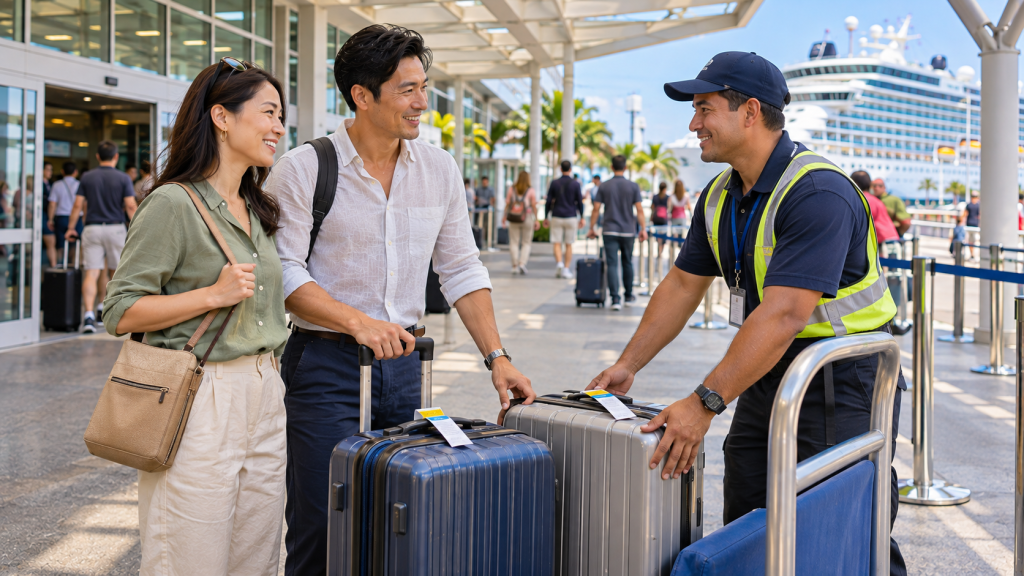
Embarkation day feels like a lot because it is.
You are in a new city, walking into a big terminal, following signs you have never seen before, and trusting port staff and security to funnel you where you need to go.
You are handing checked bags to porters and hoping they show up at your cabin door.
You are pulling up the cruise line’s app, trying to find your boarding pass, and keeping track of IDs, health forms, and reservation numbers all at once.
You also might be dealing with normal travel fatigue from an early flight or a long drive.
The way to take the edge off is to remove as many variables from that morning as you can.
Flying in the day before and staying at a port-area hotel you booked through Booking.com, Trip.com, Agoda, or Tripadvisor turns embarkation from a race into a short local errand.
If you prefer to drive, arranging a rental or one-way drop-off through Auto Europe, Discover Cars, or Rentalcars.com lets you plan parking, timing, and directions in advance instead of guessing.
By the time you roll a sturdy Travelpro carry-on toward the terminal, you are not wondering if you will even make it.
You are walking into a process you have already given yourself room to handle.
Three Straightforward Reasons Embarkation Feels So Intense
Too Much Packed Into One Morning
If you are flying in, transferring, and boarding in one stretch, every small delay feels like a threat to the entire day.
Everything Is New At The Same Time
You are learning the terminal, the ship, the app, and the safety routine all within a few hours, and that drains your energy even when nothing truly goes wrong.
You Get Pulled Along By The Crowd
Without a simple plan of your own, you end up doing whatever the loudest or largest group is doing, even when it does not serve you.
How Boarding Times Really Work (And Why Arriving Early Often Helps)

On paper, most cruise lines work the same way.
They show you a scheduled check-in time on your boarding pass or in the app, and they tell you to arrive during that window.
Carnival and Holland America, for example, say they enforce these times.
In practice, many cruisers discover something different once they reach the terminal.
At a lot of ports, once the doors open and security is running, the process shifts to a very simple model: whoever clears security first, waits less and boards earlier.
You check in, you are directed to a seating area, and boarding groups are called in roughly the order that people made it through the process—not strictly by whatever was printed on the boarding pass.
That means if you show up toward the earlier end of the check-in period (and the terminal is open), you may be sitting closer to the doors and stepping onto the ship well ahead of people who technically had “earlier” printed times but arrived later.
There is one major exception worth noting.
Virgin Voyages is known for actually enforcing its arrival times.
Online‑Only Cruise Offers You Won’t Find Elsewhere
Unlock special pricing and start planning the sailing that matches your perfect itinerary

If you show up very early, you may be turned away and told to come back closer to your slot.
For Virgin, the safest move is to respect the printed time and treat it like a real appointment.
For many mainstream lines like Carnival and Holland America, your real-world advantage usually comes from arriving on the early side, within the first waves the terminal will accept.
A Practical Arrival Strategy
Find Out When The Terminal Actually Opens
Your check-in time might say 12:30 p.m., but the terminal may begin accepting guests earlier.
If the cruise line or your documentation indicates an opening time, aim for soon after that—unless you are sailing Virgin Voyages, in which case you should stick closely to your assigned time.
For Most Lines, Earlier In The Day Often Means On Sooner
With Carnival, Holland America, and many other mainstream lines, once security is moving, clearing it earlier often puts you into the first boarding groups, regardless of what is printed on your pass.
Virgin Voyages Is The Outlier
Virgin tends to be serious about its scheduled arrival times.
Treat those like real appointments and do not plan on being processed early.
What This Means For You
If you want to start enjoying your ship as early as possible on most lines, plan to get to the terminal as early as the port and cruise line reasonably allow, get through security, and let the first-come-first-served reality work in your favor.
The sooner you are on, the sooner you can find the quiet spots, have lunch on your terms, and start your vacation while other guests are still in line.
Quiet Embarkation Strategies Most Cruisers Never Think About
Once you step onto the ship, the patterns become obvious.
Most people follow the music, the announcements, and the smell of food toward the main pool and the biggest buffet.
That is exactly why those spaces feel packed, noisy, and hectic on day one.
You do not have to follow that path.
Walk through the atrium, enjoy the look and feel of the ship, and then keep walking.
Take the elevator up or down one or two decks from the main action and start looking for spaces that were never designed for crowds.
The library is often almost empty on embarkation afternoon, even though it has comfortable chairs and big windows.
The card room and game room usually have lots of tables, good light, and very few people because they are not part of the first food rush.
Forward observation lounges, cocktail lounges that will not fill up until evening, and tucked-away interior bars with plenty of seating are also excellent places to sit, breathe, and watch the harbor.
You can bring a soft drink, plug your phone into an outlet, and read the daily program while everyone else is circling for a place to sit in the buffet.
If staying connected lowers your stress, setting up a travel eSIM with Airalo, Drimsim, Yesim, or Sally Sim before you travel lets you pull up emails, transfer details, and tour confirmations without fighting random Wi-Fi.
Using a privacy tool like NordVPN on top of that gives you a safer way to log into your cruise account and browse Tripadvisor, Viator, GetYourGuide, or Klook on hotel and terminal networks.
Easy Ways To Choose Quiet Over Chaos
Walk Past The Buffet On Purpose
Skip the first wave of noise and head straight to the library, card room, or a low-key lounge where you can sit down right away.
Go One Deck Away From The Crowds
The deck above or below the pool and atrium often has long rows of empty chairs with the same views and a fraction of the people.
Set Up Your Tech Before You Need It
Handle your eSIM and VPN setup before you leave home so you are not wrestling with logins and patchy signals at the terminal.
Where To Eat And Sit Without Getting Caught In The Buffet Rush
Food drives a lot of embarkation stress.
Everyone is hungry, curious about the “all-inclusive” options, and eager to see what the buffet looks like.
That is how you end up carrying a tray, squeezing through narrow gaps, and searching for one open chair that never seems to appear.
You do not have to start your cruise that way.
On many ships, one of the main dining rooms or a smaller venue opens for a sit-down embarkation lunch.
It is not always promoted loudly, so a lot of passengers never think to look for it.
Check the app or your printed schedule as soon as you’re on board and see which quieter venues are open for lunch.
If a dining room is available, use it.

Luxury Cruise Experiences at Smarter Prices
See premium sailings and upgraded cabins priced for travelers who know how to book well
You sit, order from a menu, and let the crew handle the food and the plates while you look over tomorrow’s activities.
If you arrived the day before and already had a solid breakfast at your port-area hotel from Booking.com, Trip.com, or Agoda, you may not need a large lunch at all.
In that case, a light snack in a quiet coffee bar or lounge is usually enough.
You can use that time to double-check independent excursions you organized through GetYourGuide, Viator, Go City, BikesBooking.com, or Big Bus Tours so you are not stuck in long lines later at the ship’s excursion desk.
Simple Food Choices That Keep Things Manageable
Trade Trays For A Table
If a dining room is open, choose table service over the busiest buffet line and let crew members look after you.
Eat Lightly If You Already Ate On Shore
If you had a full breakfast, a smaller snack in a quiet venue is better than forcing an overeager buffet run.
Turn Mealtime Into Planning Time
Use that relaxed table to read your daily program and confirm tour details so you go into day two feeling organized.
Common Embarkation Day Mistakes You Can Easily Avoid
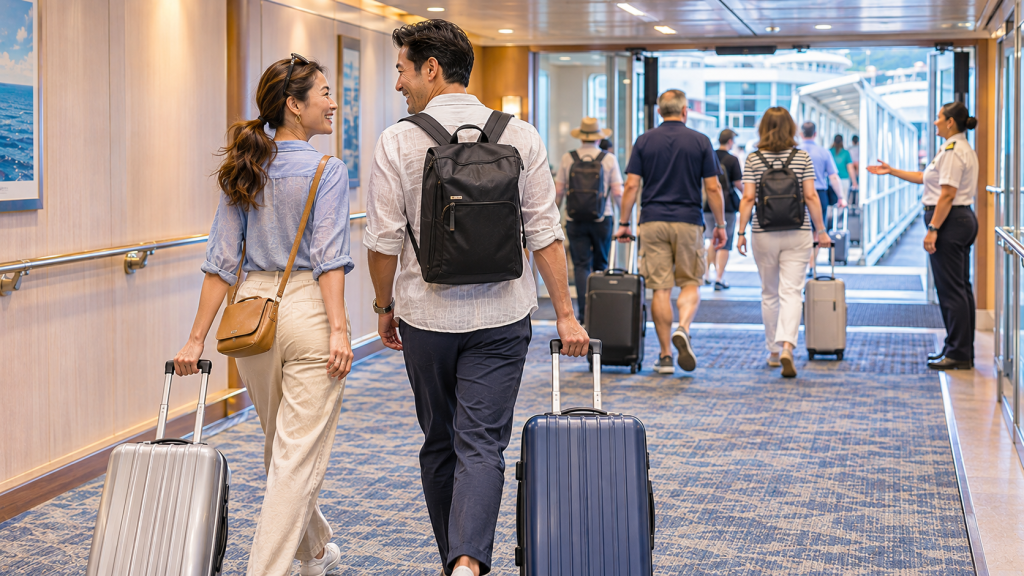
Most of the miserable embarkation stories you hear come from the same few mistakes.
Once you know what they are, you can walk right around them.
One major mistake is dragging too much luggage through every step.
Hauling multiple large suitcases plus backpacks through security, check-in, elevators, and narrow hallways makes the ship feel harder to manage than it really is.
Let the porters take your checked bags as soon as you reach the curb.
Keep your carry-ons small and intentional, with the few things you truly need before your luggage arrives at your cabin—medications, documents, valuables, a swimsuit, and a change of clothes.
A well-built carry-on like a Travelpro spinner, with smooth wheels and smart pockets, makes that part of the day feel much easier.
Another mistake is trying to fix every small detail immediately.
Guest Services and the shore excursion desk are usually at their busiest in the first couple of hours after boarding.
Standing in those lines while you are tired and hungry sets a bad tone for your entire trip.
Unless something is urgent, walk past those lines and come back later in the afternoon or early evening when they are shorter and staff have more time.
A third mistake is treating every pause like a sign that things are going wrong.
Short waits at security, brief delays before cabins are ready, or a slow-moving line at the gangway are normal parts of moving thousands of people onto a ship.
When your trip is supported by protection from VisitorsCoverage, World Nomads, Ekta, or Insubuy, and you know companies like Compensair and AirHelp can help with compensation questions if flights truly go off the rails, you can treat minor delays as expected bumps instead of disasters.
Mistakes That Make Embarkation Feel Harder Than It Has To
Carrying Everything Yourself All Day
Check big bags and carry only what you can easily handle so elevators and hallways do not become an obstacle course.
Joining Long Lines Immediately After Boarding
Save non-urgent Guest Services and excursion questions for later in the day when counters are quieter and staff are less rushed.
Treating Every Delay As A Warning Sign
Expect a few slow points so you are not shocked every time the line pauses.
Fears First-Time Cruisers Have About Embarkation Day
If this is your first cruise, it is normal to be uneasy about embarkation.
You may picture missing the ship, getting completely lost on board, or spending the whole afternoon packed into loud, crowded spaces.
Most of those fears shrink once you know how the day actually works.
A common fear is, “If I do not arrive super early, I will miss the ship.”
In reality, cruise lines publish clear final check-in times.

Sail Away to Paradise Without Overpaying
Find cruise deals that make it easy to escape, relax, and enjoy the ocean without stretching your budget
For most mainstream lines, arriving early—once the terminal is open—helps you get processed and boarded sooner, but you still only need to beat the final cut-off, not camp out at sunrise.
Virgin Voyages is the exception: their arrival times tend to be real appointments, not suggestions.
For Virgin, plan to honor your scheduled time closely.
For many other lines, arriving on the earlier side of what the port will accept works in your favor.
Another worry is, “I will not know where to go once I am on board.”
Embarkation afternoon is designed with that concern in mind.
Crew members stand at key intersections to direct you toward cabin decks, dining rooms, and muster drill areas.
Deck plans are posted near stairwells and elevators, and the app usually includes a ship map you can carry in your pocket.
You do not have to know every corner of the ship on day one.
You just need to know how to get from your cabin to a few important places and back.
Many people also fear that “Everything will be crowded all day.”
Crowds definitely happen, but they arrive in waves.
You will see bigger crowds right after boarding and again just before the safety drill.
Between those spikes, the ship is full of quiet corners—libraries, card rooms, interior lounges, and shaded spots on deck where hardly anyone sits.
If you choose those spaces on purpose, your version of embarkation will feel very different from the worst stories.
How To Reframe The Big Embarkation Fears
Use The Times And Limits The Cruise Line Gives You
Know the terminal opening time and final check-in time, then aim to be on the earlier side of that range for most lines and on time, not early, for Virgin Voyages.
Remember That Maps And Crew Are Built Into The Experience
Ask for help and use posted deck plans and the app whenever you feel turned around.
Seek Out The Rooms No One Advertises
Look for libraries, card rooms, and tucked-away lounges where the noise drops and seats are easy to find.
Why Disembarkation Day Can Feel Like A Nightmare
If embarkation feels big, disembarkation can feel heavier, especially the first time.
You are tired from your last night on board.
You are thinking about flights, transfers, and whatever is waiting for you at home.
Meanwhile, the ship needs to move thousands of people off in just a few hours, clear immigration and customs, and reset cabins for the next set of guests.
Most cruise lines handle this with disembarkation groups and strict timelines.
The night before you arrive in your final port, you will usually receive colored luggage tags and written instructions.
With standard disembarkation, you put those tags on the bags you want the crew to handle and leave them outside your cabin door by a set time.
During the night, crew members move those bags to the terminal and sort them by tag color so you can claim them later.
You keep a carry-on with overnight items, medications, documents, valuables, and anything fragile.
On the final morning, most cruise lines ask you to leave your cabin by a specific time so housekeeping can start turning rooms over.
They assign you a waiting area based on your disembarkation group and flight timing.
That might be a theater, lounge, dining room, or even the casino.
You wait there until your group is called, then join the line through the gangway, pick up your checked bags in the terminal, and pass through immigration and customs.
If you are not ready for this rhythm, it can feel like a long, frustrating shuffle through crowded rooms and echoing announcements.
If you understand it—and make a few choices that fit your schedule—it becomes far more manageable.
Practical Ways To Make Disembarkation Day Easier
Choose The Disembarkation Option That Fits Your Schedule
Most cruise lines offer “self-assist” or “express” disembarkation, where you keep all your luggage with you and walk off early with the first groups.
This can be helpful if you have an earlier flight you know you can realistically make.
Standard disembarkation uses the tag system and assigns you a time based on your onward plans.
If your flight is midafternoon or later, you can usually choose a later group so you are not rushing to leave the ship just to sit in the airport for hours.
Be Honest About Your Flight Times
When the cruise line collects departure details, give them the real times.
If you still need to book flights, use Kiwi.com, Omio, CheapOair, or Aviasales to choose departures that leave enough space for port traffic, customs, and airport security.
Pack A Focused Disembarkation Day Bag
The bag you carry off with you is your lifeline for the day.
Include medications, passports, printed or digital flight confirmations, a phone charger, valuables, basic toiletries, and a change of clothes if you might need it.
If your checked bags are delayed in the terminal or your flight plans change, you still have what truly matters.
Be Strategic About Where You Wait
You may not have to sit in the loudest room on the ship.
If your assigned room is packed and your cruise line allows you to wait in public spaces until your group is called, choose a quieter spot like the library, card room, or a lounge near the elevators you will use to exit.
You can still hear announcements or follow updates in the app while sitting somewhere that feels less chaotic.
Settle Your Onboard Account Before The Last Morning
Guest Services lines on disembarkation morning can be long and tense.
Check your account in the app or at a kiosk on the last sea day and visit Guest Services then if anything looks off.
Fixing issues early keeps you out of the final-morning line.
Pre-Plan Your Ride From The Port
Standing in a massive taxi line after a long morning makes the day feel endless.
Arrange an airport transfer in advance, or set up a rental car through Discover Cars, Auto Europe, or Rentalcars.com if you plan to drive.
If you are spending another night in the port city, your hotel booking through Booking.com, Trip.com, Agoda, or Tripadvisor may include shuttle details or simple directions for getting there.
Stay Connected For Real-Time Adjustments
Travel eSIMs from Airalo, Drimsim, Yesim, or Sally Sim make it easy to check airline apps, rideshare status, or train schedules as you walk off the ship.
If immigration moves slowly or port traffic is heavier than expected, you can adjust plans and communicate with airlines or tour providers without hunting for a better signal.
How To Lower Disembarkation Stress In Real Life
Match Your Disembarkation Group To Your Real Plans
Ask for a disembarkation time that fits your actual flight or onward travel instead of grabbing the earliest slot just because it sounds efficient.
Treat Waiting Areas As Temporary Lounges
Bring a book, podcast, or downloaded show so that sitting in a theater or lounge feels like downtime, not lost time.
Build Buffers Into Your Departure Plans
Choose flights and transfers with room for port traffic and airport lines so one slow step does not put your entire day at risk.
Quick Embarkation And Disembarkation Low-Stress Checklist For First-Time Cruisers
This checklist is meant as a simple visual guide you can keep on your phone.
Glance at it before you leave home, the night before embarkation, and again as disembarkation approaches.
- Fly in early or the day before whenever possible, and use flight tools you trust to choose realistic arrival times.
- Book a hotel near the port through familiar sites so you are close to the ship on both ends of the trip.
- Find out when the terminal actually opens and, for most lines, plan to arrive on the earlier side of that window so you can clear security and be among the first boarding groups.
- If you are sailing Virgin Voyages, treat your printed arrival time as a real appointment and do not plan to be processed early.
- Use a service like Radical Storage to hold bags if you have extra time between hotel checkout and when the terminal begins accepting guests.
- Keep carry-ons light and organized, with only what you need before your luggage reaches your cabin.
- Walk past the buffet, main pool, and loud atrium bar on embarkation day and head for the library, card room, game room, or a tucked-away lounge.
- Choose a sit-down lunch or smaller venue over the busiest buffet line when that option exists.
- Use interior cabin corridors to move around the ship instead of weaving through crowded open decks.
- Save non-urgent Guest Services and excursion questions for later in the day when lines shrink.
- The night before disembarkation, read the instructions carefully and choose self-assist or standard disembarkation based on your real flight time.
- Pack a focused disembarkation day bag with documents, medications, valuables, chargers, and basics you cannot afford to lose.
- Confirm your onboard account on the last sea day and fix any billing issues before the final morning.
- Pick or request a disembarkation group that matches your schedule instead of automatically choosing the earliest time.
- Treat your waiting area as a temporary lounge and, when allowed, opt for quieter spaces like the library or card room.
- Use your travel protection and compensation tools so rare major disruptions are handled properly and normal delays feel like routine parts of the day, not emergencies.
Turn Your First Cruise Days Into A Low-Stress Start And Finish
Embarkation and disembarkation will probably always be busy, but they do not have to feel out of control.
When you build in extra time with your flights and hotel, understand how boarding times actually work, and arrive early enough to take advantage of first-come-first-served boarding on most lines, your first day quickly starts to feel like vacation instead of a test.
When you understand how disembarkation groups, luggage tags, and assigned waiting areas work, you can make choices that fit your schedule instead of just taking whatever sounds fastest.
Using trusted booking tools for flights and hotels, backing your trip with protection from VisitorsCoverage, World Nomads, Ekta, or Insubuy, and knowing that services like Compensair or AirHelp can help when flights go sideways keeps you from feeling like you are facing every problem alone.
You are not aiming for a trip with zero friction.
You are building a start and finish that feel organized, predictable, and far less stressful than the stories you may have heard—so you can step onto the ship and walk off it feeling like you were in charge the whole time.
FAQ – What Should First-Time Cruisers Know About Embarkation and Disembarkation?
What Is the Difference Between Cruise Embarkation and Disembarkation?
Embarkation is the process of checking in and boarding your cruise ship at the beginning of the voyage.
Disembarkation is the process of leaving the ship, usually at the end of your cruise.
Both can involve luggage handling, identification checks, and instructions from the cruise line.
However, embarkation is organized around passenger arrival and boarding, while disembarkation depends on departure arrangements and any required ship or border clearance.Should You Arrive at the Cruise Terminal Before Your Assigned Check-In Time?
Generally, you should follow the arrival window assigned or selected through your cruise line.
Some terminals may accommodate passengers outside their windows, but that isn’t a dependable strategy for boarding earlier.
Carnival, Holland America, Royal Caribbean, and Virgin Voyages publish terminal arrival procedures that passengers are expected to follow.
Check your specific sailing instructions rather than relying on reports from a different ship or departure port.Does Arriving Early Guarantee an Earlier Cruise Boarding Group?
No, arriving before your assigned time doesn’t guarantee an earlier boarding position.
Cruise lines may organize passenger processing through arrival appointments, priority categories, terminal capacity, or other procedures.
Some operators explicitly state that guests arriving early may need to wait or return later.
Your best approach is to complete online check-in and follow the boarding instructions for your sailing.What Is the Difference Between a Cruise Arrival Time and Final Boarding Time?
Your terminal arrival time tells you when the cruise line expects you to report for check-in.
Final boarding time is the deadline by which you must meet the operator’s boarding requirements.
Missing the final deadline can prevent you from sailing even if the ship is still at the pier.
Check both times in your boarding documents and don’t use the ship’s departure time as your intended arrival time.Is It Better to Fly Into Your Cruise Departure City the Day Before?
Arriving the day before gives you more time to recover from flight delays, missed connections, or baggage problems.
It also lets you travel to the cruise terminal from a nearby hotel rather than depending on a same-day flight.
However, an overnight stay adds cost and doesn’t eliminate every possible travel disruption.
Consider the complexity of your journey and how difficult it would be to reach the ship if your original flight is delayed.What Should You Keep in Your Carry-On During Embarkation?
Keep required identification, boarding documents, essential medication, valuables, and other necessities in the luggage you carry yourself.
A change of clothes, swimwear, and small toiletries can also be useful if your cabin or checked suitcases aren’t available immediately.
Choose a bag that you can comfortably manage through the terminal and around the ship.
Always follow your cruise line’s luggage restrictions and screening requirements.Can You Avoid the Buffet Crowds When You First Board a Cruise Ship?
You may have alternatives to the main buffet, depending on which venues are open during embarkation.
Some ships operate additional restaurants or offer seating in other public areas, but availability isn’t consistent across cruise lines.
Check the daily program, app, or crew instructions before heading to a particular location.
If a quieter restaurant or lounge is available, you can choose that option without feeling obligated to follow the largest crowd.What Should You Do if Your Cruise Cabin Isn’t Ready When You Board?
Follow the ship’s instructions about when passengers may enter their staterooms.
Until your cabin is available, you may need to keep your carry-on with you while visiting permitted public areas.
Avoid entering restricted accommodation corridors or assuming you can leave luggage outside your door.
A manageable carry-on makes the wait easier, especially if you plan to eat or explore the ship.When Should You Start Preparing for Cruise Disembarkation?
Begin reviewing your departure arrangements before the final morning rather than waiting until the ship reaches port.
Your cruise line will generally provide instructions covering luggage handling, exit groups, and other disembarkation procedures.
Use that information to decide whether self-assist or standard departure is appropriate.
Confirm your onward transportation and keep important belongings accessible before your checked suitcases are collected.What Is Self-Assist Disembarkation on a Cruise?
Self-assist is a departure option in which passengers carry all their own luggage off the ship instead of placing large bags outside their cabins for crew handling.
It can be useful for travelers who want an early departure and can safely manage every suitcase themselves.
Availability and exit times depend on the cruise line, ship, and clearance procedures.
If you need mobility assistance or have more luggage than you can comfortably carry, a standard departure arrangement may be more appropriate.How Does Standard Cruise Disembarkation Work?
With standard disembarkation, passengers typically follow instructions for tagging larger suitcases and placing them outside their cabins before a specified deadline.
Crew members handle those bags, which passengers collect after leaving the ship according to the terminal’s arrangements.
Guests are usually assigned a departure group or time, and they leave when instructed.
The exact process varies by cruise line and may differ between ports.Does Your Cruise Ship’s Arrival Time Mean You Can Leave Immediately?
No, a ship’s scheduled arrival doesn’t mean passengers can automatically walk ashore at that moment.
The vessel may need to complete clearance procedures before guests are permitted to disembark.
Baggage handling, departure groups, and terminal processing can also affect your exit time.
Avoid scheduling onward transportation as though docking and disembarkation happen simultaneously.How Early Can You Book a Flight After Cruise Disembarkation?
There isn’t one reliable flight departure time that applies to every cruise port and itinerary.
The appropriate schedule depends on the ship’s planned arrival, clearance procedures, distance to the airport, transportation availability, and airline check-in requirements.
Cruise lines may publish recommended earliest flight times for particular ports or provide guidance through their transfer services.
Use those recommendations and allow additional flexibility where possible rather than booking solely around the ship’s arrival time.Where Should You Wait for Your Cruise Disembarkation Group?
Your cruise line may designate a waiting area or permit passengers to remain in certain public spaces until their group is called.
Those arrangements can change depending on the ship’s operational needs.
Don’t relocate to another lounge or deck without confirming that the area is available and that you’ll receive the necessary departure instructions.
Follow crew directions and leave when your group is authorized to disembark.What Should You Pack in Your Disembarkation Day Bag?
Keep identification, required travel documents, medication, valuables, phone chargers, and anything needed overnight in your personal luggage.
Remember that checked bags may be collected before bedtime during standard disembarkation.
You’ll still need access to suitable clothing and basic toiletries on the final morning.
Pack with your onward transportation in mind, especially if you’re flying or traveling a significant distance after leaving the port.Should You Review Your Cruise Account Before the Final Morning?
Reviewing onboard charges before disembarkation can give you more time to identify and question unexpected items.
Many cruise lines provide account information through an app, cabin television, or other onboard systems.
If a charge appears incorrect, contact the designated department while there is still time to investigate it.
Don’t assume that every transaction will be reflected immediately or that resolving an issue before disembarkation is always possible.Will a Travel eSIM Work During Cruise Disembarkation?
A travel eSIM may provide mobile data when your phone connects to a supported terrestrial network near the arrival port.
That depends on the destination, coverage, device configuration, and your particular service plan.
A land-based eSIM doesn’t automatically provide internet access while the ship is beyond ordinary mobile coverage.
Check your provider’s destination coverage and roaming settings before relying on it for transportation updates.How Can First-Time Cruisers Make Embarkation and Disembarkation Less Stressful?
Treat boarding and departure as separate travel days with different schedules and requirements.
Before embarkation, complete online check-in, verify your arrival appointment, and organize the documents and luggage you’ll need.
Before disembarkation, read the ship’s instructions, choose an appropriate luggage-handling option, and confirm your onward transportation.
A flexible plan built around official procedures is more dependable than attempting to get ahead of every crowd.
Plan Your Next Cruise!

Sail Into Italian Elegance: Costa Cruises for Culture, Cuisine, and Unforgettable Voyages
One Delay Can Cost Your Entire Cruise A quick coverage check now protects you from the problems no one sees coming….

From Icon to Oasis: Explore Royal Caribbean’s Groundbreaking Ships and Unforgettable Voyages
One Delay Can Cost Your Entire Cruise A quick coverage check now protects you from the problems no one sees coming….

Escape To Paradise: Inside The Exclusive World of Cruise Line Private Islands
One Delay Can Cost Your Entire Cruise A quick coverage check now protects you from the problems no one sees coming….

Experience the Perfect Blend of Disney Magic, Luxury Cruising, and Family Adventure at Sea
One Delay Can Cost Your Entire Cruise A quick coverage check now protects you from the problems no one sees coming….
Explore More

Cruise Cabin Noise Levels — What to Expect and How to Sleep Better

Sail Gluten-Free: How Cruise Lines Deliver Safe, Delicious Dining for Every Guest

From Priority Boarding to Private Lounges: Inside Cruise Concierge Perks