
One Delay Can Cost Your Entire Cruise
A quick coverage check now protects you from the problems no one sees coming
Short Excerpt
- Managing prescription medication on your first cruise requires planning for luggage delays, changing schedules, limited pharmacy access, and temperature-sensitive supplies.
- Keeping essential prescriptions accessible, carrying appropriate documentation, and confirming medication storage arrangements can prevent avoidable problems at sea.
- A practical medication checklist and a personalized dosing plan help you maintain your routine while enjoying the freedom of your cruise vacation.
Quick Take
- Keep essential medication in your carry-on, never in luggage handed to porters.
- Bring sufficient supplies for unexpected delays, with your pharmacist’s or prescriber’s guidance.
- Confirm medication timing across time zones before departure, especially for time-sensitive prescriptions.
- Arrange medical refrigeration in advance if your medication requires controlled storage temperatures.
- Carry prescription information and a backup plan in case medication is lost, damaged, or unavailable.
Protect Your Medication Routine Before Your Cruise Leaves the Port
One of the most important medication decisions you can make happens before you board the ship.
It involves more than remembering to pack your prescriptions.
You need to confirm that your medication can travel legally, remain within its required storage conditions, and stay accessible throughout your journey.
Start by reviewing your itinerary, including every country where your ship will stop.
Medications legally prescribed in the United States are not automatically permitted in every destination.
Certain controlled substances, stimulants, sedatives, pain medications, and other prescriptions can be subject to restrictions or documentation requirements abroad.
Check the official medication import rules for your destinations before sailing.
Some countries limit the quantity you may bring, while others require a doctor’s letter, advance authorization, or additional paperwork.
Remaining on the ship during a port visit does not eliminate the need to understand applicable rules for medications you bring into the country.
Next, review your prescriptions with your pharmacist or healthcare professional.
This is especially important if you take medication that must be administered at consistent intervals, requires refrigeration, or cannot be safely interrupted.
Ask whether your current supply will cover your full vacation, including transportation days and a reasonable allowance for travel disruptions.
If an early refill is necessary, contact your pharmacy or insurance provider well before departure to discuss available options.
Travelers using injectable medications, medical devices, or temperature-sensitive prescriptions should also contact the cruise line’s accessibility or special-needs department.
Confirm what storage, sharps disposal, and medical equipment accommodations are available on your particular ship.
A standard cabin beverage cooler should not automatically be considered suitable for medication refrigeration.
Its temperature may fluctuate or fall outside the range required by the manufacturer.
Proper storage arrangements are especially important for products whose effectiveness may be affected by excessive heat, freezing, or other temperature changes.
Your medication routine may also need adjustment when your itinerary crosses time zones.
Some prescriptions allow flexibility, while others require more precise intervals between doses.
Rather than deciding onboard whether to follow home time or ship time, ask your pharmacist or prescriber to help establish an appropriate schedule.
Write the plan down and verify that reminders will continue working correctly if your phone changes time automatically.
Travel documentation provides another layer of protection.
Keep an updated medication list that includes the generic and brand names, prescribed doses, administration instructions, and relevant medical contacts.
Top Cruise Deals From Trusted Cruise Lines
Compare exclusive online offers and find the fare that fits your trip and your budget

A copy stored securely on your phone can be useful, but a printed backup prevents an unavailable device or dead battery from becoming another complication.
Finally, consider what would happen if your medication were lost during an airport transfer, damaged in your cabin, or unavailable when you needed it.
Your backup plan should identify who to contact, which documentation to provide, and when a missed dose or interruption requires medical advice.
The goal is to leave home with a medication routine that remains dependable even when your travel schedule changes.
Once you understand those practical requirements, medication management becomes less about worrying over unfamiliar situations and more about following a familiar routine in a new environment.
Why Managing Prescription Medication on Your First Cruise Requires a Different Kind of Preparation
Managing medication on your first cruise can feel overwhelming when routines shift and backup plans seem far away.
Your routines are different.
Your pharmacy is not around the corner.
Your “I can fix this quickly” backup plan suddenly feels far away.
That distance can trigger health anxiety, even for people who feel steady at home.
Distance from your pharmacy and normal schedule can trigger health anxiety, even for confident travelers.
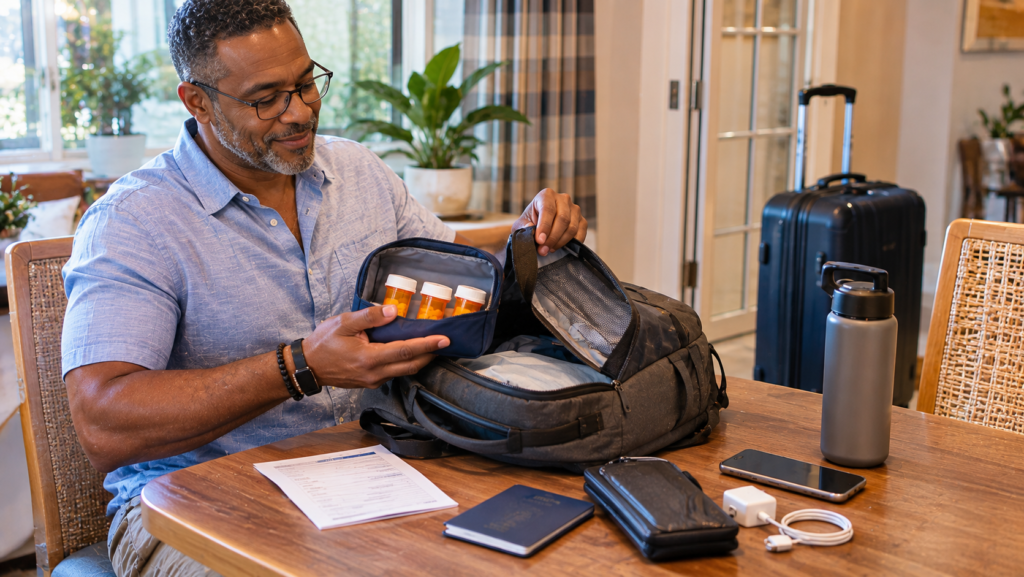
The good news: a simple, organized system makes cruising with medication safe and stress-free.
Most problems come from timing mistakes, missing documentation, and packing choices that limit access.
This guide gives you a clear plan so you feel prepared, protected, and ready to enjoy your vacation.
This article is for general informational purposes only, does not provide medical advice, and you should consult a licensed clinician before using or changing any medication plan for travel.
Understand the Medical Center’s Role Before You Sail
A ship’s medical center is the onboard clinic where medical professionals can evaluate and treat many urgent issues.
It exists to stabilize problems, not to function as your regular pharmacy.
It can help with injuries, dehydration, infections, severe nausea, allergic reactions, and certain medication side effects.
It is not designed to guarantee your exact medication, your exact dose, or your exact formulation.
Inventory onboard can be limited, and restocking is not instant.
That is why the safest cruise strategy is assuming you must bring what you need for the full trip plus a buffer.
When you plan that way, the medical center becomes a reassuring safety net instead of your primary plan.
A safety net feels good, especially when you are far from your normal routine.
Medical Center Reality

The medical center can help in urgent scenarios, yet it cannot replace preparation for everyday medication needs.
A buffer supply protects you from common travel delays and schedule disruptions.
Clear expectations reduce fear because you stop imagining unrealistic worst-case surprises.
Costs And Paperwork Clarity
Many cruise lines charge for medical visits and treatments onboard.
That cost reality makes prevention and preparation even more valuable.
Documentation helps the medical team move faster when you feel unwell.
Faster decisions reduce stress when you are away from home and out of routine.
A simple medication list can save precious time during an evaluation.
Time saved often feels like control, and control reduces anxiety.
A protective plan is not only convenient.
A protective plan is part of your vacation comfort.
Why This Matters For First Timers
First-time cruisers sometimes assume the ship operates like a hotel with a pharmacy nearby.
Cruises are their own ecosystem, and the nearest pharmacy may be a port day away.
Ports can bring language barriers, limited availability, or different brand names for similar medications.
Online‑Only Cruise Offers You Won’t Find Elsewhere
Unlock special pricing and start planning the sailing that matches your perfect itinerary

Even when a medication exists in port, the dosing format may not match what you take at home.
That mismatch can create confusion at the exact moment you want clarity.
Clarity is the point of this system.
Clarity is what helps you relax onboard.
Relaxing is easier when the plan is already built.
Know The Limits
Medical centers are helpful for urgent care, not predictable refills.
A personal buffer supply is one of the simplest anxiety reducers you can pack.
Clear expectations support steadier decisions when you need them most.
Pack Medication for Cruise Safety and Stress-Free Access
Medication packing fails when it is treated like an afterthought.
A cruise adds long days, movement, and unfamiliar timing.
Those factors make “I’ll just throw it in my bag” a risky strategy.
A cruise-friendly medication plan is built around access and redundancy.
Access means you can reach what you need without digging through everything.
Redundancy means you are protected if a bag is delayed, a bottle breaks, or pills spill.
When access and redundancy are handled, your brain usually relaxes on its own.
That mental shift is where the vacation feeling finally arrives.
Carry On Always
Put all essential medications in your carry-on, not in checked luggage.
Bring prescriptions in original labeled containers when possible.
Original labels help if security asks questions and help onboard staff understand what you take.
If you use a pill organizer, keep the original bottles as backup and as proof of what was prescribed.
Pack a separate one-day dose kit in a small pouch in case your main bag is temporarily inaccessible.
A one-day kit can live in a purse, backpack, or day pack you keep with you.
This is not paranoia.
This is practical protection for travel realities.
Add A Buffer Supply
Bring extra doses beyond the length of the cruise.
Travel delays happen, and ships can return late in rare weather scenarios.
A buffer also protects you if you drop pills or spill a bottle in the cabin.
Health anxiety often comes from imagining a shortage.
A buffer neutralizes that loop quickly.
Your clinician can advise what buffer is appropriate for your situation.
If insurance limits refills, ask about vacation overrides well in advance.
Earlier requests usually produce easier solutions.
Keep Everything Organized
Use one simple system instead of multiple scattered bags.
One zip pouch for daily meds works well, especially if it is easy to find quickly.

Luxury Cruise Experiences at Smarter Prices
See premium sailings and upgraded cabins priced for travelers who know how to book well
A second pouch for backups works well, especially if it stays in the cabin safe or another secure spot.
Label pouches by purpose rather than by emotion.
Purpose labels reduce mistakes when you are tired.
Tired brains make avoidable mistakes.
Avoidable mistakes are what you are preventing with this whole plan.
Prevention is one of the best comfort upgrades you can give yourself.
Carry On Wins
Essential meds belong with you, not inside the ship’s luggage process.
Original labels reduce confusion when questions come up.
A one-day kit prevents a minor inconvenience from turning into panic.
Follow This Cruise Medication Checklist for Peace of Mind

Checklists reduce anxiety because they turn vague worry into concrete action.
This checklist is designed for first-time cruisers who want clarity without complexity.
Use it once when you pack and again on embarkation morning.
That second review catches the common “left it on the counter” mistake.
The goal is not perfection.
The goal is protection.
Protection makes you feel freer onboard.
Freedom is what makes cruising enjoyable.
Medication Checklist
| Item | What To Do | Why It Helps |
|---|---|---|
| Prescription bottles | Pack in carry-on with labels | Prevents loss and reduces questions |
| Dose buffer | Bring extra doses | Protects against delays and spills |
| Pill organizer | Use if helpful and keep originals | Improves routine and keeps proof |
| Medication list | Print and store on phone | Speeds help if you feel unwell |
| Prescriber info | Include clinic name and phone | Helps if verification is needed |
| Pharmacy info | Include pharmacy contact | Useful for refill questions |
| Time schedule | Write dose times by clock | Prevents missed or doubled doses |
| Refrigerated meds | Plan a cooling method | Protects temperature sensitive meds |
| Inhalers and injectors | Keep accessible at all times | Ensures fast response when needed |
| Over the counter basics | Pack a small kit | Prevents searching when symptoms start |
| Sharps plan | Bring proper container if needed | Protects safety for you and staff |
| Port day doses | Pack small day bag doses | Prevents missed meds off the ship |
How To Use It
Start with the medications that would cause the most trouble if missed.
Those are your non-negotiables.
Pack those first, before clothes, before toiletries, before anything else.
Then pack the support items like lists, buffers, and small organizers.
Support items make the routine feel easy instead of fragile.
A fragile routine creates stress.
A stable routine creates confidence.
Confidence is the emotional goal of this post.
Checklist Takeaways
A checklist turns health anxiety into action you can complete.
Packing non-negotiables first prevents the most common travel mistake.
A written schedule reduces missed doses more than willpower ever will.
Manage Cruise Time Changes and Medication Timing with Confidence
Dose timing is where first-time cruisers get tripped up.
The ship runs on ship time, and that time may change as you move between regions.
Your body does not change time just because a clock changes.
The goal is keeping medication timing safe and consistent for your needs.

Sail Away to Paradise Without Overpaying
Find cruise deals that make it easy to escape, relax, and enjoy the ocean without stretching your budget
For some medications, staying close to your home schedule works best.
For other medications, gradually shifting to ship time is easier.
Your physician can advise what is safest for your specific medications.
A simple written plan prevents you from improvising when you are tired.
Know What Clock You Use
Decide whether you will follow ship time or home time for critical medications.
Critical medications are those where timing matters significantly.
Write your decision down so you do not change it midweek.
Changing strategies midweek is when mistakes happen.
If your sailing changes time zones, note the change date and new time.
A phone reminder can help, yet reminders should match your strategy.
A reminder with the wrong time creates confusion.
Confusion is what triggers anxiety spirals.
Use Anchors
Anchors are daily events you attach medication to.
Breakfast, dinner, and bedtime can be anchors for many routines.
Anchors work best for medications that are flexible within a window.
Windows should be confirmed with your physician for your situation.
When you pair meds with anchors, you stop relying on memory.
Memory fails when travel is busy.
Anchors succeed because they are predictable.
Predictable routines create the low-stress experience you want.
Protect The High Risk Moments
Embarkation day is a high risk day for missed doses because routines break.
Port days are high risk days because you leave the cabin and get distracted.
Late show nights are high risk nights because bedtime shifts.
Plan for these moments before they happen.
A small day bag dose kit solves most port day misses.
A simple bedtime reminder solves many late-night slips.
When you plan for high risk moments, you stop fearing them.
Fear fades when you feel prepared.
Timing Takeaways
Ship time changes can create confusion unless you choose a strategy early.
Anchors reduce missed doses because they remove mental load.
Port day dose kits protect your routine when schedules shift.
Protect Refrigerated Medications and Temperature-Sensitive Supplies Onboard
Temperature sensitive medications require extra attention on a cruise.
Some cabins have fridges, and some fridges are better suited for drinks than for medication.
The safest approach is confirming storage needs before you sail.
Cruise lines may offer medical refrigeration support through onboard services.
You should ask early because last-minute requests are harder to accommodate.
A cooler bag with cold packs can help during travel days.
Your physician and pharmacist can advise safe temperature handling for your medication.
A clear plan prevents you from feeling stuck midtrip.
Confirm Storage Early
Call the cruise line or check your booking portal to ask about medical refrigeration.
Ask whether the cabin fridge is appropriate for medication storage.
Ask whether temperature monitoring is available if your medication requires it.
If the ship offers medical storage, ask how you access it.
Access matters because you need the medication when you need it.
Do not assume a drinks fridge holds a stable medical temperature.
Assumptions create risk.
Clarity removes risk.
Plan Your Travel Day
Travel day is often the biggest temperature challenge.
Airports, transfers, and waiting periods can expose supplies to heat or cold.
Pack temperature sensitive items in your carry-on, not in checked luggage.
Bring a small insulated pouch if appropriate.
Bring extra supplies when needed, like spare pens or backup doses.
Backups prevent panic if something warms too long.
Panic increases mistakes.
Mistakes are what you are preventing.
Store Smart Onboard
Keep temperature sensitive medication away from direct sun in the cabin.
Avoid leaving it near windows or hot electronics.
If you use a cabin fridge, place items where temperature feels most stable.
Avoid frequent door opening when possible.
Stable temperature is the goal, not maximum cold.
Your pharmacist can clarify storage ranges that are safe.
When you handle storage correctly, the rest feels easier.
Easy is what you want on a cruise.
Cold Chain Takeaways
Temperature sensitive medications require early confirmation and a travel day plan.
Cabin fridges vary, so assumptions are not a safe strategy.
Insulated pouches and backups protect you from avoidable stress.
Recover Quickly If You Forget or Lose Medication During Your Cruise
Forgetting or losing medication is a fear that can sit in the background of a first cruise.
That fear is understandable because the ship is not your normal environment.
A plan reduces the fear and improves the outcome if it happens.
Start by using your medication list and prescription labels as your foundation.
Then contact onboard guest services and the medical center for guidance.
If you are in a port, a local pharmacy might be an option, yet availability can vary.
Availability varies more for controlled medications and specialized formulations.
A buffer supply is still your best prevention tool.
Use Your Documentation
Your medication list should include medication names, dosages, and prescribing clinician information.
A photo of prescription labels can be helpful as a backup reference.
If you use electronic patient portals, keep access available on your phone.
Using secure access matters on public networks.
NordVPN can be useful when you need a more private connection for personal information while traveling.
Documentation reduces the burden of explaining everything from memory.
Memory is not reliable when you are stressed.
Reliable documentation is calming.
Ask For Practical Help
Guest services can help you understand ship processes and direct you to the right onboard resource.
The medical center can evaluate urgent situations and advise next steps.
If your medication is essential and you are at risk without it, do not wait.
Early action creates better options.
Waiting shrinks options.
If you are in port, ask about timing and transportation so you do not risk missing the ship.
Planning your return buffer protects you from the pier runner nightmare.
A safe return is always more important than a rushed pharmacy run.
Replacement Takeaways
Documentation is your fastest path to help if something goes wrong.
Early action creates more options than waiting does.
Privacy and access tools can make health logistics easier on the road.
Avoid These Medication Mistakes That Can Disrupt Your Cruise
Most medication mistakes on cruises are small routine failures that compound.
A missed dose can lead to symptoms.
Symptoms lead to stress.
Stress makes the next decision worse.
Breaking that chain is the goal.
These are the most common beginner mistakes and the simple fixes that prevent them.
The fixes are realistic, not perfection-driven.
Packing In Checked Bags
Checked bags can be delayed, and delays are common on busy embarkation days.
A delayed bag can mean a missed medication window.
Missing a window can create symptoms that ruin day one.
Day one sets the emotional tone for the whole cruise.
Put medications in your carry-on and keep them accessible.
Accessible means you can reach them without unpacking your whole life.
When you do that, the cruise feels safer immediately.
Safety is what reduces health anxiety.
Relying On Memory
Cruise days blend together, especially on sea days.
Ports, shows, naps, and late dinners can disrupt your normal cadence.
A written schedule prevents accidental doubles and accidental misses.
Phone reminders help when they align to your chosen time strategy.
A small notebook plan helps if your phone battery dies.
Redundancy is comfort.
Comfort is what makes you feel like you can relax.
Bringing Too Little
Underpacking happens when people assume the ship can solve it.
Ships are great at many things, yet routine refills are not guaranteed.
A buffer supply is the simplest fix.
A buffer also protects you if the ship returns late due to weather routing.
Weather routing is rare, yet it can happen.
A buffer removes that worry.
Less worry means better sleep.
Better sleep means better cruising.
Mistake Takeaways
Carry-on packing prevents the most disruptive medication problem on day one.
Written schedules reduce mistakes more than mental effort ever will.
A buffer supply is the most practical anxiety reducer you can bring.
Reduce Health Anxiety with Responsible Cruise Medication Planning
Health anxiety often shows up as constant checking and constant imagining.
Cruising can amplify that because you are away from familiar support systems.
A responsible plan helps because it gives your brain a “done” feeling.
Done means you handled the critical items.
Done means you stop spinning.
You still pay attention, and you stop obsessing.
That balance is the goal.
A cruise should feel like relief, not like monitoring.
Create A Quick Daily Ritual
A daily ritual can be sixty seconds.
Check your day bag dose kit.
Confirm your next dose time.
Refill water.
Then move on.
Short rituals create confidence without feeding obsessive checking.
Long rituals can become compulsive and tiring.
Your ritual should feel like a reset, not a burden.
When it stays light, it supports calm.
Keep One Backup Plan
Choose one backup plan that covers the most likely disruptions.
A backup plan can be “I have extra days of medication and a printed list.”
A backup plan can be “I know where the medical center is and how to contact it.”
A backup plan can be “I keep essential meds in my day bag when I leave the ship.”
Pick one plan that feels protective and believable.
Believable plans reduce fear better than vague reassurance.
Vague reassurance does not work when anxiety is loud.
Concrete plans work because they are actionable.
Use Supportive Travel Tools
Travel-day disruption is a common trigger for health anxiety.
A pre-cruise hotel night can reduce the rush and protect your routine.
Booking.com, Trip.com, Agoda, and Tripadvisor can help you compare port hotels with calmer mornings.
Radical Storage can help if you arrive early and want to explore without dragging bags while keeping medications with you.
Travelpro luggage can make organization easier so you are not digging for bottles in a messy suitcase.
VisitorsCoverage, World Nomads, EKTA, and Insubuy can help you compare travel protection options for peace of mind.
Compensair or AirHelp can be relevant in some situations for eligible compensation claims if flight disruptions derail your timing.
When logistics feel handled, anxiety often drops naturally.
A handled feeling is the best vacation feeling.
Anxiety Takeaways
Short daily rituals reduce anxiety without feeding obsessive checking.
One concrete backup plan is more calming than ten vague ones.
Travel tools reduce logistics stress, which often reduces health anxiety too.
Cruise with Confidence: Keep Your Medication Routine Secure
Managing medication onboard is mostly about preparation, access, and simple routines.
A carry-on plan keeps essentials close and prevents day one disruption.
A checklist prevents forgetting key items and reduces uncertainty.
A clear timing strategy protects you when ship time changes or days get busy.
Temperature sensitive supplies become manageable when storage is confirmed early.
Mistakes become unlikely when you rely on written plans instead of memory.
When your routine is protected, your mind relaxes and the cruise feels like a break again.
You deserve that break, and you can board knowing you planned well.
FAQ – How Can You Manage Prescription Medication Safely on Your First Cruise Without Missing Doses or Running Out?
Can You Bring Prescription Medication on a Cruise Ship?
Yes, cruise passengers can generally bring prescribed medications onboard for personal medical use, subject to applicable cruise line policies and destination-country restrictions.
Keeping prescriptions in their original labeled containers is a practical precaution because it helps identify the medication, prescribing information, and intended recipient.
Some controlled medications or specialized treatments may require additional documentation or authorization when traveling internationally.
Check the rules for your itinerary before departure rather than assuming that a valid domestic prescription will be sufficient everywhere.Should You Pack Prescription Medication in Your Cruise Carry-On or Checked Luggage?
Essential prescription medications belong in the carry-on bag you keep with you during travel and embarkation.
Checked luggage and bags handed to cruise porters may not reach your cabin until several hours after boarding, creating problems if a scheduled dose is due.
Keeping medication accessible also protects against airline baggage delays and misplaced suitcases.
Make sure your carry-on contains the necessary supplies, relevant medical information, and any devices required to administer your prescriptions.How Much Extra Medication Should You Bring on Your First Cruise?
Bring enough medication for your scheduled trip and an additional supply appropriate to your personal circumstances, prescription requirements, and possible travel disruptions.
Cruise itineraries can change, flights may be delayed, and unexpected events can extend the time before you return home.
There is no universal number of extra days that is suitable or legally permitted for every medication.
Ask your pharmacist or prescriber about an appropriate buffer and arrange any necessary vacation refill authorization before departure.Do Cruise Ships Have Pharmacies That Can Refill Your Prescriptions?
Cruise ships have medical facilities, but they should not be treated as replacements for a regular retail pharmacy.
Onboard clinicians may have access to certain medications for medical treatment, although inventory can be limited and specific brands, dosages, or formulations may not be available.
Routine prescription refills are therefore not guaranteed.
Bring the supplies you need and contact the medical center promptly if you experience a shortage involving an essential medication.Can You Use a Pill Organizer Instead of Original Prescription Bottles on a Cruise?
A pill organizer can help maintain your daily routine, particularly when several medications must be taken at different times.
However, retaining the original labeled packaging is advisable because travel authorities, medical personnel, or customs officials may need to identify the medication.
Some destinations also impose specific requirements concerning prescription documentation and containers.
Before transferring medication into an organizer, confirm any relevant travel restrictions and whether the product requires protection from moisture, light, or other conditions.How Should You Handle Medication Times When Your Cruise Changes Time Zones?
Medication timing depends on the particular prescription, its dosing interval, and the clinical consequences of taking a dose early or late.
Some medications can be managed using a consistent daily routine, while others require more precise timing regardless of ship time or local time changes.
Consult your pharmacist or prescriber before departure and establish a schedule appropriate for each time-sensitive medication.
Record the plan and check your phone’s time-zone settings so automatic clock changes do not create missed or duplicate doses.What Happens If You Forget to Take a Medication Dose During Your Cruise?
The safest next step depends on the medication, how late the dose is, and whether another dose is approaching.
Some prescriptions have specific missed-dose instructions, while others require individualized medical guidance.
Do not automatically double the next dose to compensate for one you missed.
Follow the directions provided by your prescriber or pharmacist and contact the ship’s medical center when you are uncertain or the interruption could be medically significant.Can You Store Insulin or Other Refrigerated Medication in a Cruise Cabin Refrigerator?
Some cruise cabins have refrigerators or beverage coolers, but these appliances may not maintain temperatures appropriate for medication storage.
Insulin and other temperature-sensitive products have specific manufacturer instructions that can vary by formulation, whether the product has been opened, and how long it will be used.
Contact the cruise line before sailing to arrange appropriate refrigeration or other approved storage accommodations.
Confirm temperature requirements with your pharmacist and avoid relying on a cabin cooler unless it has been verified as suitable.How Do You Travel With Injectable Medication and Sharps on a Cruise?
Passengers who use injectable medications should keep the medication and necessary administration supplies accessible throughout their journey.
Ask the cruise line whether it provides approved sharps containers and whether special arrangements are required for refrigeration or medical equipment.
Airport security procedures and destination-country regulations may also affect how syringes, needles, and injectable prescriptions should be transported.
Bring appropriate documentation and follow the medication manufacturer’s storage and handling instructions.Can You Bring Controlled Prescription Medications on an International Cruise?
Controlled medications can involve additional legal restrictions when traveling internationally, even when they are properly prescribed in your home country.
Requirements may vary by destination and could include quantity limits, import permits, original packaging, or supporting documents from your prescriber.
Some medications may be prohibited in particular countries without special authorization.
Research the official rules for every relevant destination and obtain any required documentation before you travel.What Should You Do If You Lose Your Prescription Medication During a Cruise?
Contact the ship’s medical center promptly if the missing medication is essential or its interruption could cause health problems.
Bring your medication list, prescription information, and prescribing clinician’s contact details to help the medical team understand your needs.
Replacement options may depend on the ship’s available inventory, the next port’s pharmacy regulations, and the type of medication involved.
Avoid purchasing unfamiliar substitutes or changing doses without appropriate professional guidance.Can You Buy Replacement Prescription Medication at a Cruise Port?
A pharmacy at a port of call may be able to supply certain medications, but availability and dispensing requirements vary by country.
Your usual brand or formulation may not be sold locally, and a prescription issued at home might not be accepted by a foreign pharmacy.
Controlled medications can be especially difficult to replace without local authorization.
Consult the ship’s medical team or an appropriately qualified local clinician before obtaining a substitute, and allow sufficient time to return before the ship’s all-aboard deadline.How Much Does It Cost to Visit a Cruise Ship Medical Center for Medication Problems?
Cruise ship medical centers commonly charge for consultations, treatments, medications, and other services.
The amount varies according to the cruise line, ship, treatment provided, and medical circumstances.
Passengers may be required to pay onboard and seek reimbursement from an insurance provider afterward.
Review your travel medical coverage before sailing and keep itemized receipts and medical documentation if you need treatment.Does Travel Insurance Cover Prescription Medication Problems During a Cruise?
Some travel medical policies provide benefits for qualifying medical treatment during a cruise, but they do not necessarily cover routine prescription refills, forgotten medication, or every replacement expense.
Coverage may depend on whether the situation involves an unforeseen illness, an emergency, or another event specifically included in the policy.
Pre-existing condition provisions, exclusions, deductibles, and reimbursement limits can also affect eligibility.
Compare policy terms carefully if ongoing prescription treatment is an important consideration for your trip.What Should You Include on a Cruise Medication Checklist?
Your checklist should include all prescription medications, appropriate extra supplies, original labeled containers, and an updated medication list.
Add relevant prescriber and pharmacy contact information, dosing instructions, and any specialized storage or administration equipment.
Travelers using injectable treatments should account for needles, testing supplies when applicable, and an approved disposal method.
Review the checklist before leaving home and again before handing over any luggage at the cruise terminal.How Can You Keep Medication Accessible During Cruise Shore Excursions?
Carry any medication you may need during the excursion in a secure day bag, using appropriate storage conditions for the product.
Check your expected return time, planned activities, and whether a scheduled dose might fall while you are away from the ship.
Temperature-sensitive supplies may require an approved insulated transport method, while critical emergency medication should remain readily accessible.
Make sure your arrangements comply with local medication rules and avoid placing essential prescriptions in luggage you cannot reach quickly.What Are the Most Common Medication Mistakes First-Time Cruisers Should Avoid?
Frequent mistakes include packing essential prescriptions in checked luggage, bringing too little medication, and relying on memory when normal schedules change.
Travelers may also overlook time-zone adjustments, storage requirements, or international restrictions involving particular prescriptions.
Assuming the ship’s medical center can provide an immediate replacement is another potentially costly error.
Reviewing medication needs with a healthcare professional and preparing a written travel plan can help prevent these problems.How Can You Reduce Medication-Related Anxiety Before Your First Cruise?
Preparation can make medication routines feel more predictable when you are away from familiar healthcare resources.
Begin by confirming that your prescriptions, travel documentation, dosing schedule, and storage arrangements are appropriate for the trip.
Keep a concise checklist and a practical backup plan so you do not need to repeatedly reconsider the same arrangements.
Once those essentials are addressed, focus on following your established routine and enjoying the cruise rather than continually imagining unlikely problems.
Plan Your Next Cruise!

Sail Smart: Discover The Real Cost of Luxury Cruises and Maximize Your Travel Value
One Delay Can Cost Your Entire Cruise A quick coverage check now protects you from the problems no one sees coming….

Sail in Style: Oceania Cruises’ Culinary Excellence, Cultural Immersion, and Refined Luxury
One Delay Can Cost Your Entire Cruise A quick coverage check now protects you from the problems no one sees coming….

Sail Into Timeless Luxury: Cunard Cruises for Transatlantic Elegance and Destination‑Rich Voyages
One Delay Can Cost Your Entire Cruise A quick coverage check now protects you from the problems no one sees coming….

Sail Into Italian Elegance: Costa Cruises for Culture, Cuisine, and Unforgettable Voyages
One Delay Can Cost Your Entire Cruise A quick coverage check now protects you from the problems no one sees coming….