One Delay Can Cost Your Entire Cruise
A quick coverage check now protects you from the problems no one sees coming
Short Excerpt
- Large cruise ships can feel overwhelming at first, but learning a few landmarks, elevator locations, and deck-plan basics makes navigating them much easier.
- A simple embarkation-day orientation route can help you find your cabin, dining venues, entertainment, and favorite public areas without repeatedly getting lost.
- Discover practical navigation strategies, elevator tips, and the world’s largest cruise ships so you can choose and explore a mega-ship with greater confidence.
Quick Take
- Learn the ship’s directional terms: forward, aft, midship, port, and starboard.
- Find three important landmarks near your cabin, a central public area, and somewhere you enjoy relaxing.
- Practice two useful routes on embarkation day instead of attempting to explore the entire ship immediately.
- Check the deck number before walking long distances, since many major venues occupy different levels of the same ship.
- Allow extra time around busy elevators, particularly before dinner and after popular performances.
- Compare ships by size, layout, and passenger capacity, not simply by which vessel is advertised as the biggest.
Why Even the World’s Largest Cruise Ships Become Easier Once You Understand Their Layout
Standing inside a massive cruise ship for the first time can be an extraordinary experience.
You might enter through a towering atrium, discover several levels of restaurants and entertainment, and realize that the vessel is considerably larger than anything you’ve traveled on before.
That sense of scale is part of the appeal, but it can also make simple tasks feel unexpectedly complicated.
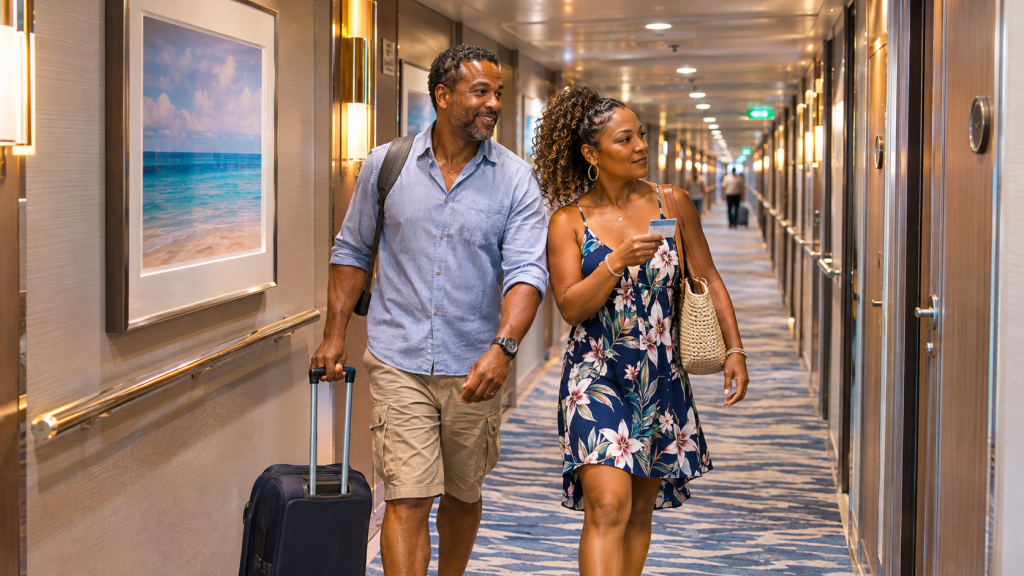
Finding your cabin might involve walking through a long corridor that looks almost identical to the one you just left.
Getting to dinner could require changing decks, crossing a central promenade, and locating the right elevator bank.
Even choosing the quickest route to the pool can become confusing when the ship has multiple outdoor areas spread across different sections.
Fortunately, you don’t need to memorize the entire vessel to navigate it comfortably.
The most effective strategy is to learn how the ship is organized, establish a few reliable routes, and gradually expand your familiarity as you explore.
Begin With the Three Locations You’ll Use Most Often
Rather than studying every deck, begin with the places that will matter most to your daily routine.
Your cabin is the first. Learn its deck number, its approximate position toward the front or back of the ship, and which elevator or staircase is most convenient.
Next, identify a central public area that you’ll pass through regularly.
Depending on the vessel, that might be the atrium, promenade, or another recognizable gathering space.
Finally, choose somewhere you’d enjoy returning to when you want a break, such as an oceanview lounge, a café, or a quieter section of the outdoor deck.
These three locations become reference points you can use throughout the voyage.
Instead of trying to remember an unfamiliar maze of corridors, you’ll gradually recognize how important areas connect.
When you need to visit a new restaurant or theater, you can orient yourself around something you already know.
Understand Why Deck Numbers Matter More Than Walking Faster
One of the easiest mistakes on a large cruise ship is heading in the correct general direction while remaining on the wrong deck.
You might know that the theater is located toward the front of the ship, but walking forward won’t help if the entrance is several levels below you.
Before leaving your cabin or another venue, check both the deck number and the forward, midship, or aft location of your destination.
Top Cruise Deals From Trusted Cruise Lines
Compare exclusive online offers and find the fare that fits your trip and your budget
In many situations, it makes sense to reach the correct deck using a convenient staircase or elevator and then walk toward the venue.
However, this isn’t a universal rule because some ships have unusual layouts, venues that span multiple decks, and corridors that don’t connect all the way through.
For that reason, follow the specific route shown on the ship’s map rather than assuming you can always travel directly across a deck.
With a little practice, you’ll begin recognizing which routes are straightforward and which require using particular staircases or elevator banks.
Use Familiar Landmarks Instead of Trying to Remember Every Corridor
The most intimidating part of a mega-ship is often the repetition.
Long cabin corridors can look similar, and a staircase on one deck may resemble another several levels away.
Without recognizable reference points, you can walk quite a distance before realizing you’re heading in the wrong direction.
Landmarks make navigation easier because they’re more memorable than lists of cabin numbers or deck names.
A distinctive staircase, colorful artwork, large theater entrance, or familiar café can help you recognize where you are.
As you explore, pay attention to which landmarks connect with the elevator banks and corridors you use most frequently.
You’ll eventually develop a simple mental picture of the ship: your cabin is near one elevator bank, your favorite restaurant is across from a major lounge, and the theater can be reached from a particular public deck.
That knowledge makes the vessel feel more familiar without requiring you to learn every detail.
Plan Around Busy Times Without Letting Crowds Dictate Your Vacation
Even an efficiently designed cruise ship can experience crowding when large numbers of passengers head toward the same place.
Elevators may become particularly busy before dinner, after a popular show, or when passengers are returning from shore excursions.
If you’re able and comfortable using stairs, they may provide a convenient alternative for traveling between nearby decks.
However, passengers with mobility limitations should plan around accessible routes and allow more time rather than feeling pressured to use stairs.
You can also reduce unnecessary waiting by giving yourself a few extra minutes before scheduled activities.
For example, leaving for a theater performance slightly earlier may help you reach the venue before a large crowd forms at the elevators.
The important distinction is that crowding doesn’t necessarily mean you’re lost or that the ship is poorly organized.
Sometimes you’re simply moving through a popular area at the busiest part of the day.
Let Your First Sea Day Complete the Orientation
Embarkation day provides an opportunity to learn the basics, but you don’t have to finish exploring before sail-away.
Once you’ve located your cabin area, completed the required safety procedures, and found somewhere to eat, spend a little time walking through one or two public decks.
Your first sea day is ideal for expanding that familiarity because you can explore without coordinating an excursion or preparing to leave the ship.
Take a look at restaurant locations, find the entrances to entertainment venues, and visit outdoor areas you might enjoy later in the voyage.
Online‑Only Cruise Offers You Won’t Find Elsewhere
Unlock special pricing and start planning the sailing that matches your perfect itinerary
If the ship is especially large, explore it one neighborhood or section at a time rather than attempting to walk through everything in a single outing.
You may also discover useful shortcuts that weren’t obvious from the deck plan alone.
The goal isn’t to know every corner of the ship. It’s to know enough familiar routes that getting somewhere new no longer feels intimidating.
Once those routes become familiar, the ship’s enormous size can become one of its greatest advantages, offering more dining, entertainment, and relaxation choices without making you feel obligated to explore them all at once.
What Are the Largest Cruise Ships in Service in 2026?
As of October 2026, Icon of the Seas, Star of the Seas, and Legend of the Seas share the top position by gross tonnage.
| Ship | Class | Gross tonnage | Double-occupancy capacity |
|---|---|---|---|
| Icon of the Seas | Icon | 248,663 GT | 5,610 |
| Star of the Seas | Icon | 248,663 GT | 5,610 |
| Legend of the Seas | Icon | 248,663 GT | 5,610 |
| Utopia of the Seas | Oasis | 236,473 GT | 5,668 |
| Wonder of the Seas | Oasis | 235,600 GT | 5,734 |
| Symphony of the Seas | Oasis | 228,081 GT | 5,518 |
| Harmony of the Seas | Oasis | 226,963 GT | 5,479 |
| Oasis of the Seas | Oasis | 226,838 GT | 5,602 |
Updated October 2026 · Gross tonnage measures enclosed volume, not weight. Figures reflect published ship data; capacity is based on double occupancy, not the maximum number of guests possible. Gross-tonnage figures may differ slightly between published sources.
For first-time cruisers, these figures establish the scale of the ships, but they don’t determine which vessel will be easiest to navigate.
The organization of public areas, elevator placement, and proximity of frequently used venues remain more useful considerations.
A smaller vessel can feel busy when passengers converge in a few central areas, while a much larger ship may distribute its guests across multiple neighborhoods.
When choosing between mega-ships, consider how the design supports your preferred activities instead of relying exclusively on size.
How to Navigate a Huge Cruise Ship Without Feeling Lost or Overwhelmed
A big cruise ship can feel thrilling in photos but overwhelming in person.
The scale hits you fast.
Multiple decks, endless corridors, and crowded elevators can turn simple tasks into stress.
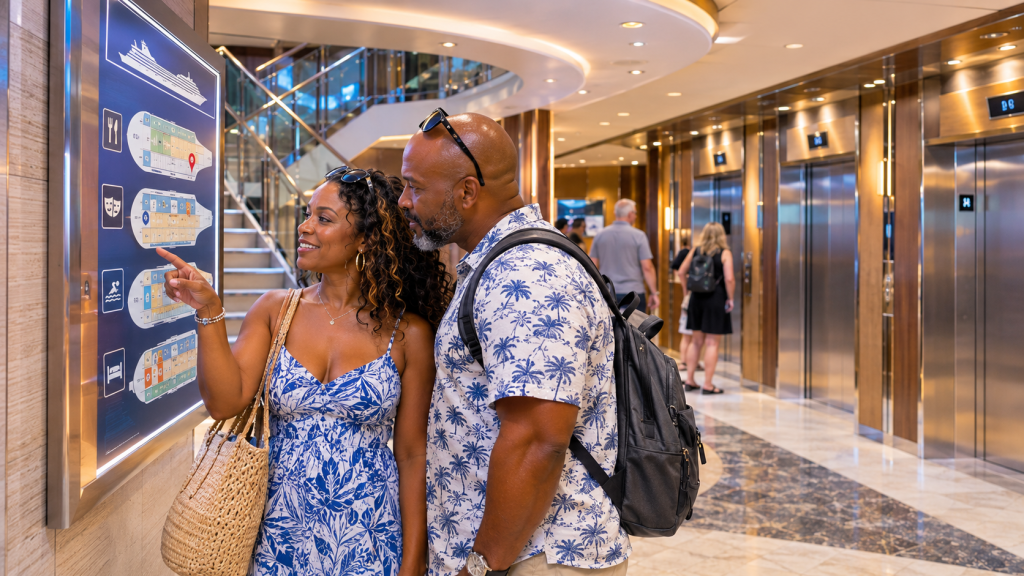
Add travel-day fatigue, and even simple tasks can feel oddly hard.
Finding dinner, making a show on time, or locating your cabin can suddenly feel like a scavenger hunt you did not ask for.
That feeling is normal for first-time cruisers, especially on today’s largest ships.
The good news?
You can avoid feeling lost with a simple system that makes navigation easy from day one.
It is simply what happens when you enter a floating city without a system.
This post gives you a simple, repeatable system.
You will learn how to read a deck plan, how to orient yourself using landmarks, and how to move through the ship with purpose.

Luxury Cruise Experiences at Smarter Prices
See premium sailings and upgraded cabins priced for travelers who know how to book well
You will also get a beginner-friendly strategy for elevators, stairs, and day-one routines that prevent confusion later.
Because you asked to plan around the biggest ships at sea, you will also see the largest cruise ships sailing right now, with the numbers that matter most for “big ship” experiences. (Royal Caribbean)
By the time you finish, you will be able to board a mega-ship and feel like you have been there before.
That is the outcome you actually want.
Not perfection, but readiness.
Readiness makes everything onboard feel more enjoyable.
This guide gives you deck plan tips, day-one routes, and elevator strategies so your first sailing feels effortless instead of confusing.
What “Big Ship” Really Means
Big is not one single measurement on a cruise ship.
Most people feel “big” in two ways.
One is physical scale, meaning long distances between places you care about.
The other is crowd scale, meaning how many people share the same elevators, venues, and peak-time lines.
Cruise industry comparisons often use gross tonnage as a standard size measure, which is why “largest” lists typically rank ships by gross tonnage first. (Wikipedia)
Passenger capacity matters too, because a ship with more guests can feel busier even when it is designed well. (Royal Caribbean)
That is why first-time cruisers should compare both ship size and guest count, not just the name or the photos. (Royal Caribbean)
Size Versus Crowds
A ship can be huge and still feel manageable when spaces are distributed well.
A ship can also be smaller and feel hectic if public areas compress traffic at peak times.
This is why two mega-ships can feel totally different.
Deck layout, venue placement, and elevator locations shape your daily experience.
Passenger capacity shapes how quickly lines build and how noisy public zones get.
Your goal as a first-time cruiser is choosing a ship whose layout supports your comfort style.
Comfort style is not “better or worse.”
It is simply your personal bandwidth.
Ship Class Defined
A ship class is a group of ships built from a similar design.
If you learn one ship in a class, the next one often feels familiar faster.
Royal Caribbean’s Oasis-class and Icon-class ships are examples of design families that share many navigation patterns across ships. (Royal Caribbean)
That matters because familiarity reduces overwhelm.

Sail Away to Paradise Without Overpaying
Find cruise deals that make it easy to escape, relax, and enjoy the ocean without stretching your budget
Familiarity is what experienced cruisers look like they have on day one.
You can create it faster by choosing ships that share a class layout you understand.
This is a practical shortcut that beginners rarely use.
Once you use it once, you will keep using it.
The Big Ship Advantage
Mega-ships often have more “neighborhood” style zones.
More zones can actually reduce the feeling of crowds, because people spread out.
Mega-ships also tend to have more dining, more entertainment, and more alternate pathways.
Alternate pathways are underrated.
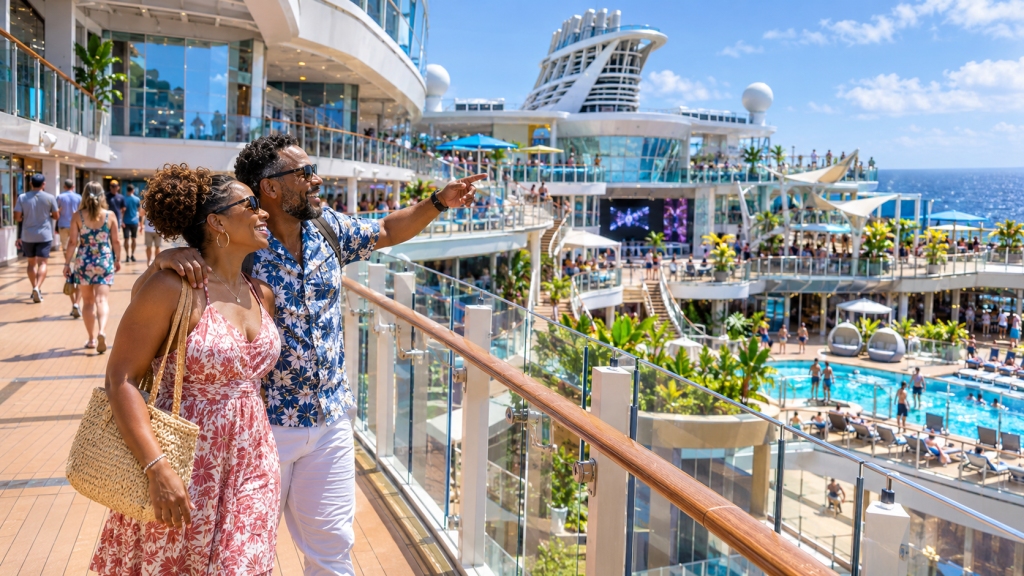
They reduce the stress of feeling stuck in one crowded corridor.
When you learn how to use those pathways, a big ship starts to feel easier than a small ship.
Ease comes from options.
Options come from knowing where to go.
Big Has Two Meanings
Physical size and guest count shape how a ship feels, so compare both. (Royal Caribbean)
Class Creates Familiarity
Ship class patterns can make a second mega-ship feel easier immediately. (Royal Caribbean)
Options Reduce Pressure
Big ships often feel easier once you learn alternate routes and zones.
The Largest Cruise Ships Sailing Right Now
If you want the biggest ships on the ocean, focus on ships ranked near the top by gross tonnage and also known for ultra-high maximum guest counts. (Royal Caribbean)
Royal Caribbean’s Icon-class currently leads the “biggest ship” conversation, and Royal Caribbean publishes a comparison table that lists gross tonnage and maximum guest capacity for Icon of the Seas, Utopia of the Seas, and Star of the Seas. (Royal Caribbean)
MSC and Carnival also operate some of the world’s largest ships, with MSC World Europa and Carnival Jubilee often appearing in “largest ship” discussions for their lines. (Travel Weekly)
Use this list as a planning starting point when you want the biggest possible onboard experience.
Treat it like a shortlist, then confirm sailings and itineraries that match your timing and budget.
Ship size is only the first decision.
Route, port mix, and sailing length matter too.
Still, if “largest at sea” is your filter, this section answers it clearly.
Largest Ships List
Largest cruise ships in service, with “big ship” planning numbers.
| Ship | Cruise Line | Class | Gross Tonnage | Max Guest Capacity | Why First-Timers Choose It |
|---|---|---|---|---|---|
| Icon of the Seas | Royal Caribbean | Icon | 250,800 | 7,600 | The newest mega-ship scale, with many zones that help distribute crowds. (Royal Caribbean) |
| Star of the Seas | Royal Caribbean | Icon | ~250,800 | ~7,600 | Icon-class sister ship with similar scale and “neighborhood” planning approach. (Royal Caribbean) |
| Utopia of the Seas | Royal Caribbean | Oasis | 236,473 | ~7,000 | Oasis-class scale with huge capacity and familiar “zone” layout once learned. (Royal Caribbean) |
| Wonder of the Seas | Royal Caribbean | Oasis | 235,600 | 6,988 | One of the biggest Oasis ships, often chosen for “city-at-sea” vibes. (Wikipedia) |
| MSC World Europa | MSC Cruises | World | 215,863 | 6,762 | Massive ship with a different layout style, still very large and feature-heavy. (Travel Weekly) |
| Carnival Jubilee | Carnival | Excel | 183,521 | (Varies by sailing) | Carnival’s largest ship, big-ship energy with a different “zones” feel than Oasis/Icon. (help.goccl.com) |
How To Use This List
Start by deciding what “largest” means for you.
If you want the most physical scale and the most guest capacity, Icon-class ships are the obvious first look. (Royal Caribbean)
If you want mega-ship size with a slightly different vibe and ship flow, look at Oasis-class options like Utopia and Wonder. (Royal Caribbean)
If you want a huge ship that feels less like the Royal Caribbean mega-ship formula, MSC World Europa gives you a different design style at a still-massive scale. (Travel Weekly)
If you want big-ship energy with Carnival’s brand style, Jubilee is the flagship size pick for that line. (help.goccl.com)
Then, once you choose the ship, compare itineraries.
Itineraries change how “lost” feels, because port days break up ship time.
A first-time cruiser often does best with a route that balances sea days with ports that feel straightforward.
That balance gives you time to learn the ship without feeling like every day is a rush.
Biggest Ships Are Not For Everyone
A mega-ship can be a perfect first cruise for the right traveler.
Families often love the variety and the constant activity options.
Social travelers often love the energy and the sheer number of venues.
Some first-timers, however, do better on a mid-size ship because the layout feels simpler.
That does not mean mid-size is “better.”
It simply means the learning curve is different.
This post assumes you are interested in big ships, so the next sections teach you how to win on them.
Once you learn the system, size becomes a feature instead of a stressor.
Big Ship Planning Starts Here
Using gross tonnage and max guests helps you identify true mega-ships quickly. (Royal Caribbean)
Icon And Oasis Lead
Icon-class and Oasis-class ships dominate the “largest at sea” experience right now. (Royal Caribbean)
Size Must Match Style
A mega-ship can feel amazing when your preferences align with its flow and energy.
Read The Deck Plan Like A Pro
Most first-time cruisers glance at the map, then still feel lost.
That happens because you are trying to use the deck plan the wrong way.
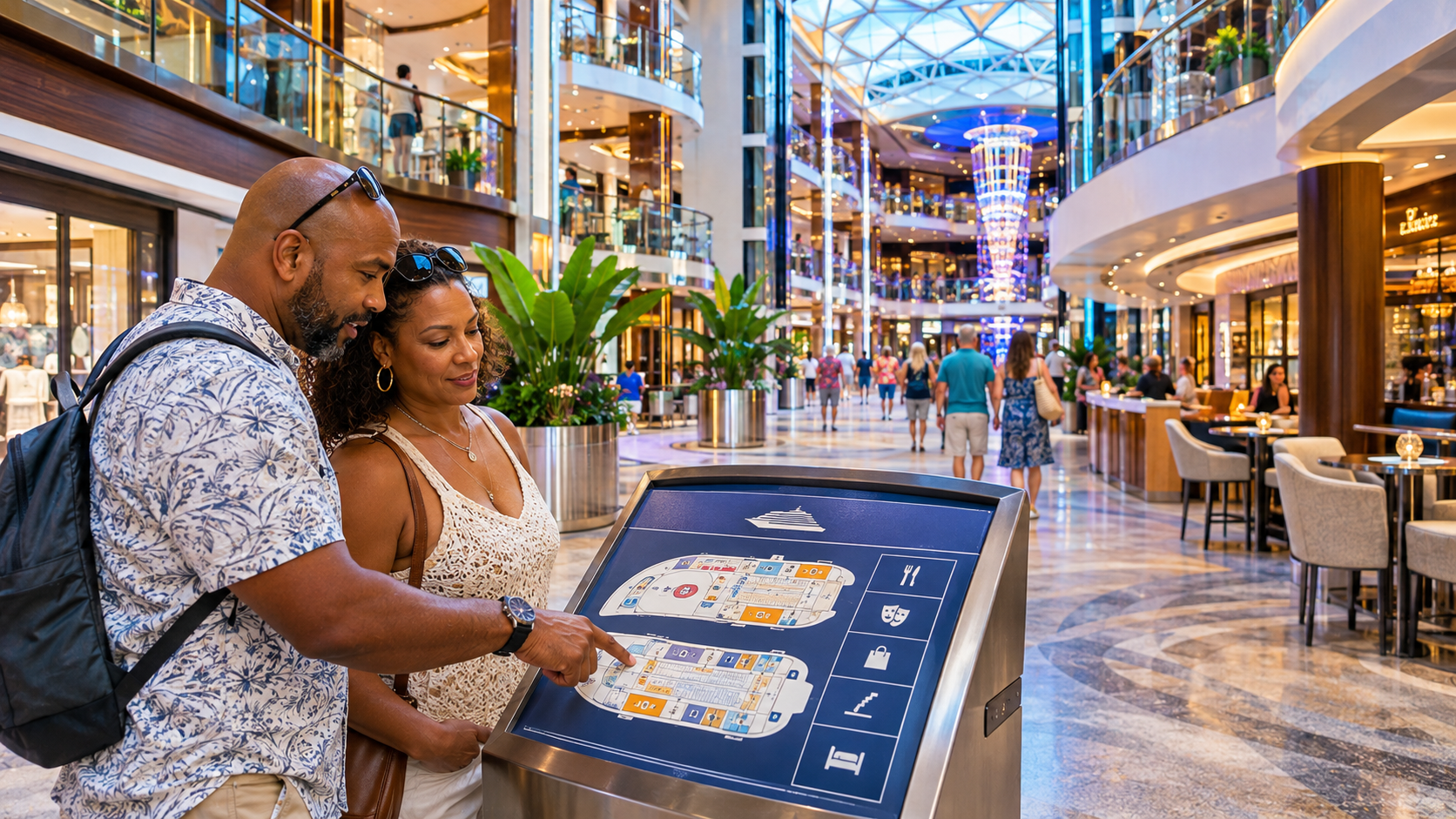
A deck plan is the ship’s map that shows deck-by-deck layouts, venues, stairs, elevators, and cabin zones.
It is not meant to be memorized.
It is meant to give you three anchor points you can reuse all week.
Once you have those anchor points, you stop wandering.
Wandering is what triggers overwhelm.
Anchors are what create confidence.
Three Anchors Method
Anchor one is your cabin zone.
Learn the deck number, the general direction, and the nearest staircase or elevator bank.
Anchor two is your “daily hub.”
Pick one public place you return to often, like the main promenade, a central café, or the atrium.
Anchor three is your “reset spot.”
Choose a quieter area you can always return to when the ship feels busy.
This system works because it reduces decisions.
Reducing decisions reduces mental fatigue.
Less fatigue means you navigate better.
Better navigation makes the ship feel smaller.
Understand Ship Directions
Cruise ships use a few directional terms that matter for navigation.
Forward means toward the front of the ship.
Aft means toward the back of the ship.
Port means left when you face forward.
Starboard means right when you face forward.
Midship is the center zone where many elevator banks and major venues live.
Once you know forward, aft, and midship, you stop feeling like hallways are endless.
Hallways become segments.
Segments are easier to manage.
Ship Map Guide
Use this mini-guide the first two days, and you will feel different by day three.
It is designed for beginners who want a simple way to interpret signs quickly.
It also helps you avoid the common “wrong deck” mistake that wastes time.
Save it as a screenshot on your phone before you board.
Then use it like a cheat sheet during the busiest moments.
A cheat sheet is not weakness.
It is smart travel.
Smart travel feels low-stress.
| What You See | What It Usually Means | The Quick Fix |
|---|---|---|
| Venue name with a deck number | You are on the wrong level or near a stair/elevator decision point | Check the deck number first, then move vertically before you walk far |
| Cabin numbers increasing | You are walking toward higher-numbered cabins in that corridor | Use the number direction to confirm forward or aft movement |
| Two elevators close together | You are in a “bank” that serves certain decks more efficiently | Take that bank repeatedly so it becomes familiar |
| Promenade or atrium signage | You are near a central landmark | Use it as your “return to center” reference point |
| “Forward” or “Aft” on a sign | The ship is telling you direction, not just a location | Choose direction first, then choose deck second |
Why Deck Confusion Happens
Most beginners walk first and check the deck number second.
That is backwards.
On big ships, the wrong deck can still look similar to the right deck.
You can walk five minutes and still be “almost there,” while actually being stuck one deck above the venue you need.
This is why deck number is your first filter.
Vertical movement is usually the real solution.
Horizontal walking is usually the trap.
Once you flip this habit, you stop wasting time.
Time saved becomes enjoyment gained.
Deck First Always
Checking deck number before walking far prevents most navigation frustration.
Anchors Beat Memorizing
Three anchor points are enough to make a mega-ship feel manageable.
Vertical Fixes Most Problems
Wrong-deck mistakes create “lost” feelings more than wrong corridors do.
Build A Day-One Route That Trains Your Brain
Feeling lost is often a day-one problem that echoes for days.
Day one sets the mental map you use for the rest of the sailing.
That is why day one needs a deliberate route.
The route is not long.
It is simple and repeatable.
It teaches your brain landmarks, elevator banks, and the fastest path back to center.
Once your brain has that path, anxiety drops.
Drops in anxiety make learning faster.
The Fifteen Minute Loop
Create a short loop right after you board, ideally before you chase activities.
Start at the main atrium or promenade.
Walk to the nearest elevator bank.
Take it to your cabin deck.
Locate your cabin corridor, then go back to the elevator bank you used.
Return to the atrium or promenade.
Now do the same loop once more, but using a different stairwell or elevator bank.
This gives you two “known routes” immediately.
Two routes are enough to stop the lost feeling.
Learn One Staircase
Big ships have many stairs, but you only need one to start.
Choose one staircase that is near your cabin and near a major public zone.
Use it repeatedly.
Repeated use turns it into a mental shortcut.
Shortcuts create confidence because you stop thinking about every step.
You simply move.
Movement that feels automatic is what experienced cruisers look like they have.
You can build it within hours.
The trick is repetition, not intelligence.
Make The App Work For You
Most cruise lines offer an onboard app that includes maps, schedules, and venue locations.
The best practice is downloading it before you leave home and learning the map view quickly.
A practical backup is saving screenshots of key decks in case connectivity is limited or the app feels slow.
If you like staying connected in ports or want dependable messaging, travel eSIM tools like Airalo, Yesim, Drimsim, or Sally Sim can help reduce the “no signal, no plan” stress.
If you use public networks to access accounts or travel details, NordVPN can add a layer of privacy that makes some travelers feel more secure.
These supports are optional.
The real goal is having your information available without panic-searching.
Panic-searching is how people get lost twice.
Train With A Loop
A simple day-one loop creates a usable mental map faster than wandering does.
Repetition Builds Shortcuts
One staircase used repeatedly becomes your “home route” on a mega-ship.
Backup Maps Help
Screenshots and simple tech planning reduce the urge to spiral when directions feel confusing.
Navigate Like A Local Using Ship Neighborhoods
Mega-ships are designed in zones.
Zones might be labeled as neighborhoods, districts, or simply themed areas.
The labels vary by cruise line, but the concept stays the same.
You are not meant to think of the ship as one giant space.
You are meant to think of it as a set of smaller places connected by corridors and elevators.
This is why big ships can feel surprisingly intuitive once you understand the zones.
Zones create mental “rooms” in your mind.
Rooms are easier than endless hallways.
Landmark First
Pick a few landmarks and treat them like city monuments.
A signature bar, a central café, a large theater entrance, a distinctive sculpture, or a major pool deck feature works well.
Every time you pass a landmark, say its name in your head.
This sounds simple, because it is simple.
Simple works.
Landmarks attach memory to a place.
Places with memory feel familiar.
Familiar places reduce overwhelm.
Choose A Home Base
A home base is the public area you use as your “reset to center” location.
On many ships, the atrium or promenade works because it connects multiple decks.
On others, a central café works because you will naturally return for coffee and snacks.
Using a home base prevents the “where am I” feeling after a show or dinner.
It gives you a default plan.
Defaults are powerful on a first cruise.
They stop you from overthinking.
Overthinking is where lost feelings grow.
Create Two Routes
Create two reliable routes between your cabin and your two most-used venues.
Route one can be elevators.
Route two can be stairs plus a shorter corridor.
Having two routes matters because ships get busy.
A blocked elevator bank can make you feel trapped when you only know one way.
Two routes remove that pressure.
Pressure removed equals confidence gained.
Confidence gained equals more fun.
Landmarks Make Maps Real
Named landmarks turn a deck plan from abstract into practical memory.
Home Bases Reduce Wandering
A consistent “reset to center” spot prevents confusion after busy moments.
Two Routes Protect You
Alternate routes keep a big ship from feeling like a maze when crowds build.
Elevators And Stairs Without Stress
Elevators are where a big ship can feel most frustrating.
Peak times create bottlenecks.
Bottlenecks create impatience.
Impatience makes you feel lost even when you are not.
The solution is not fighting crowds.
The solution is choosing strategies that work with ship flow.
Ship flow has rhythms.
Once you learn them, you stop getting stuck.
Use The “One Deck Rule”
When you need to move one or two decks, take stairs.
It is faster on most big ships at peak times.
It also teaches you geography.
Geography learned through movement sticks better than geography learned through staring at a map.
The “one deck rule” quickly reduces elevator dependence.
Reduced dependence reduces frustration.
Reduced frustration improves your whole mood.
Mood matters on a vacation.
Ride Off Peak
Big ships have predictable elevator surges.
Pre-dinner, post-show, and late morning pool rushes are common surge windows.
Shifting your timing by fifteen minutes often changes everything.
This is a quiet trick experienced cruisers use constantly.
Beginners rarely use it because they assume the schedule is fixed.
In reality, you can adjust your personal timing while still doing everything you want.
Small shifts create big wins.
Big wins create confidence.
Pick An Elevator Bank
Many mega-ships have multiple elevator banks.
Choose one bank near your cabin and treat it like “your bank.”
Repeated use makes it familiar.
Familiarity reduces decision fatigue.
Decision fatigue is what makes you feel lost when you are actually fine.
Once you have “your bank,” you stop scanning signs every time.
You simply go.
That “simply go” feeling is what you are building.
Stairs Teach Layout
Stairs are not just exercise, they are navigation training on a mega-ship.
Timing Beats Fighting
A fifteen-minute shift often avoids the most frustrating crowd waves.
Familiar Banks Help
One consistent elevator bank reduces mental load and keeps you oriented.
Avoid These Common Navigation Mistakes That Make Big Ships Feel Hard
Feeling lost usually comes from predictable mistakes.
That is good news, because predictable mistakes are easy to fix.
Most mistakes are not about intelligence.
They are about habits that work on land and fail on ships.
Once you learn ship habits, you stop wasting time and energy.
Energy saved becomes enjoyment.
Enjoyment is why you booked the cruise.
Here are the most common mistakes on big ships.
Mistake One Walking First
Walking first and checking the deck later is the classic beginner trap.
On a mega-ship, the wrong deck can look “almost right.”
Almost right wastes the most time.
Check the deck number first.
Move vertically second.
Walk horizontally last.
This order solves more problems than any other tip in this post.
Mistake Two Skipping Landmarks
Many first-time cruisers treat the ship like a hotel hallway.
Hotel hallways look similar and do not require memory.
Mega-ship corridors require memory because they branch and repeat.
Landmarks create memory quickly.
No landmarks means every corridor feels the same.
Every corridor feeling the same is the definition of “lost.”
Name a few landmarks and you fix this fast.
Mistake Three Overplanning Day One
Planning too much on day one can backfire.
A packed plan forces you to move quickly before you know the layout.
Fast movement without a mental map creates stress.
Stress makes navigation worse.
A better move is making day one lighter and using the fifteen-minute loop first.
Once the loop is done, everything else feels easier.
Ease is not laziness.
Ease is smart sequencing.
Mistake Four Ignoring Ports
Some first-timers stay onboard in port because they feel overwhelmed.
That choice can be totally fine if you want rest.
It can also keep you from learning the ship at a natural pace, because port days reduce crowds onboard.
Port days are a great time to practice navigation in quieter conditions.
If you do want to go ashore but feel uncertain, structured tours can help.
Viator and GetYourGuide can reduce confusion in unfamiliar ports by giving you clear meeting points and a defined timeline.
A defined timeline supports your ship-timing habit, which prevents rushing back.
When your port day feels structured, your ship day feels easier too.
Deck Order Fixes Most
Deck-first navigation prevents wrong-level wandering.
Landmarks Prevent Maze Feel
Named landmarks turn corridors into recognizable routes.
Day One Needs Space
A lighter day-one schedule helps you learn faster and feel better.
Defuse the Hidden Fears Behind Feeling Lost on a Mega-Ship
Lost feelings are rarely just about directions.
They are also about fear.
Fear of missing something.
Fear of being late.
Fear of looking confused in front of other guests.
Fear of getting separated from your group.
Once you name the fear, you can solve it with one practical move.
Practical moves reduce fear because they restore control.
Control is what your brain is asking for when it says “I’m lost.”
Fear Of Being Late
Late fear is common because cruise schedules feel official.
Shows have start times.
Dining has reservations.
Ports have all-aboard times.
A first-time cruiser can interpret that structure as “one mistake ruins everything.”
That is not how cruising works.
Build buffers instead.
Arrive ten minutes early for the first show you care about.
Learn the route once.
After that, you will feel time confidence.
Time confidence makes the ship feel smaller.
Fear Of Looking New
Many beginners fear asking for directions.
That fear is usually social, not practical.
Crew members answer these questions all day, and they expect first-timers.
A simple line works well.
Try, “What’s the easiest way to get to the theater from here.”
That question gets a direct answer without explanation.
It also keeps you moving, which is what you want.
Movement reduces self-consciousness.
Standing frozen increases it.
Fear Of Separation
Getting separated is one of the most stressful big-ship fears for families and groups.
The fix is choosing a meeting point and a fallback point.
Choose a landmark for the main meeting point.
Choose a second landmark as a backup.
Then decide a time window when you will wait before moving.
This is simple.
It is also powerful.
When everyone knows the same rule, nobody panics.
Panic is what turns small separation into big stress.
Fear Of Missing Out
A mega-ship has constant options, which can trigger FOMO.
FOMO makes you rush.
Rushing makes you lost.
The better move is choosing two highlights per day.
Two highlights keeps the day fun without turning it into a performance.
A performance mindset increases stress.
A vacation mindset improves navigation because you move more intentionally.
Intentional movement is the entire secret.
Buffers Reduce Lateness
Early arrival for key events prevents the time panic that makes navigation harder.
Questions Are Normal
Asking crew for the easiest route is a standard cruise behavior, not a failure.
Meeting Points Prevent Panic
A simple landmark-based plan protects groups from separation stress.
You Can Love A Mega-Ship From Day One
A big cruise ship does not need to feel like a maze.
It only feels like a maze when you board without a system.
Deck plans become easy when you use anchors instead of memorizing.
Day-one loops build mental maps faster than wandering ever will.
Landmarks, home bases, and two routes turn the ship into neighborhoods instead of corridors.
If you choose one of the world’s largest ships, these habits matter even more, because scale amplifies small mistakes. (Royal Caribbean)
Build the system once, and you will use it on every cruise you ever take.
That is how first-time cruisers become confident cruisers.
FAQ – How Can First-Time Cruisers Navigate Huge Cruise Ships, Find Their Cabins, and Avoid Getting Lost?
Is It Easy to Get Lost on a Large Cruise Ship?
Large cruise ships can be confusing during your first day because they contain multiple decks, long corridors, numerous elevators, and public areas that may look similar.
However, most ships provide deck plans, directional signs, and venue information that make navigation considerably easier once you understand the layout.
Begin by learning where your cabin is located, identifying a nearby staircase or elevator bank, and finding one central landmark you can recognize.
After following a few familiar routes, you’ll usually find that the ship feels much more manageable than it did when you first boarded.How Do You Read a Cruise Ship Deck Plan for the First Time?
A cruise ship deck plan shows the arrangement of cabins, public venues, staircases, elevators, and other facilities on each level.
Start by finding the deck number of your destination, then look for its position toward the front, middle, or back of the vessel.
This allows you to choose a suitable elevator or staircase instead of walking down a long corridor before discovering you’re on the wrong level.
Because some ships have decks that don’t connect directly from one end to the other, always check the actual layout rather than assuming every corridor provides a continuous route.What Do Forward, Aft, Midship, Port, and Starboard Mean on a Cruise Ship?
Forward refers to the front of the vessel, while aft describes the rear, and midship identifies the central section.
Port means the ship’s left side when you’re facing forward, and starboard means its right side when you’re facing the bow.
These directions remain consistent regardless of which way you’re personally standing, which makes them useful for finding cabins, restaurants, and other venues.
Once you’re comfortable with the terminology, ship signs become easier to interpret and you can locate destinations without relying exclusively on detailed maps.What Is the Best Way to Find Your Cabin on a Huge Cruise Ship?
Begin by remembering your cabin’s deck number and identifying the nearest convenient staircase or elevator bank.
Once you reach the correct deck, use the ship’s signage and cabin numbering system to locate the appropriate corridor.
Some vessels provide maps or signs indicating which cabin numbers are in each direction, although numbering arrangements shouldn’t be assumed to work identically across every cruise line.
Taking the same route to and from your cabin a few times during embarkation day can make the journey feel familiar much faster.What Is the Three-Anchor Method for Navigating a Cruise Ship?
The three-anchor method involves choosing three recognizable locations that help you understand where you are on the ship.
Your cabin area provides the first anchor, while a central public venue such as an atrium or promenade becomes the second.
The third can be a favorite café, lounge, or outdoor area where you enjoy spending time.
By learning the routes connecting those places, you create a practical mental map that makes unfamiliar venues easier to reach.What Should You Explore First on Embarkation Day?
After completing the required safety procedures, focus on locating your cabin area, important dining venues, and one or two central public spaces.
There’s no need to visit every deck immediately, particularly when the terminal experience and travel to the ship have already taken considerable energy.
A short walk between recognizable landmarks can help you understand how the vessel is organized without making the first afternoon exhausting.
You can explore more extensively during your first sea day, when there’s usually greater freedom to discover the ship at your own pace.What Is a Day-One Navigation Loop on a Cruise Ship?
A day-one navigation loop is a short route you deliberately follow to become familiar with important locations.
For example, you might begin at the central atrium, travel to the elevator bank nearest your cabin, locate the entrance to your cabin corridor, and then return to the atrium.
Repeating the journey helps you recognize landmarks and understand how the decks connect.
Once that route feels familiar, you can gradually add destinations such as the dining room, theater, or pool area.Should You Check the Deck Number Before Walking Across a Cruise Ship?
Checking the deck number first is usually a useful strategy because many venues on large ships occupy different levels despite being positioned near the same end of the vessel.
Walking a considerable distance on the wrong deck can leave you searching for an entrance that isn’t accessible from your current location.
However, you should also check whether the destination can be reached directly from your chosen staircase or elevator, since some ship layouts have interrupted corridors or unusual connections.
Using both the deck number and the actual route shown on the map is more reliable than relying on either detail alone.Are Cruise Ship Apps Helpful for Finding Restaurants, Theaters, and Cabins?
Many cruise line apps include useful information about dining locations, activity schedules, entertainment venues, and ship facilities.
Some also provide deck maps or other navigation features that can help you identify where you need to go before leaving your cabin.
Download the official app before your trip and check which features are available on your particular vessel, since functionality varies between companies and ships.
Saving screenshots of important deck plans can provide a useful reference when you don’t want to search through the app repeatedly.Do You Need Internet Access to Use a Cruise Line’s App Onboard?
Many cruise lines allow passengers to access certain app features through the ship’s onboard Wi-Fi network without purchasing a separate internet package.
However, the availability of maps, messaging, reservations, and other services depends on the operator and its current technology.
Connecting to the ship’s network is not the same thing as having unrestricted internet access, so don’t assume every outside website or messaging service will work.
Review your cruise line’s instructions before departure and keep important information available offline when practical.When Are Elevators Most Crowded on Large Cruise Ships?
Elevators often become busier when passengers move toward dining rooms, theaters, pool decks, and gangways at similar times.
Periods immediately before popular dinner reservations or after major performances can be particularly noticeable on vessels carrying thousands of guests.
If you’re able to adjust your schedule, leaving a little earlier may reduce waiting and make the journey more comfortable.
Passengers who rely on elevators for accessibility should allow sufficient travel time and identify the most practical routes rather than feeling pressured to use stairs.Is It Faster to Take the Stairs Instead of Elevators on a Mega-Ship?
Using stairs can be faster for traveling one or two decks during busy periods, particularly when nearby elevators are crowded.
It can also help you develop a better understanding of how public areas connect vertically throughout the vessel.
However, stairs aren’t suitable for everyone, and some routes may be inconvenient depending on the ship’s design or your mobility needs.
Choose whichever option is comfortable and appropriate for you, and remember that reaching your destination safely is more important than saving a minute or two.What Are Cruise Ship Neighborhoods and How Do They Help You Navigate?
Some mega-ships organize entertainment, dining, shops, and public spaces into recognizable neighborhoods or themed zones.
This design can help passengers think of the vessel as several connected areas rather than one enormous structure filled with unfamiliar corridors.
You might associate a particular neighborhood with restaurants, another with outdoor activities, and a different section with entertainment.
Once you understand which zones contain your favorite venues, navigation becomes easier because you can travel toward a familiar area before looking for an individual destination.Which Are the Largest Cruise Ships in the World in 2026?
As of October 2026, Royal Caribbean’s Icon of the Seas, Star of the Seas, and Legend of the Seas share the leading position by published gross tonnage at approximately 248,663 GT each.
Other exceptionally large vessels include Utopia of the Seas and Wonder of the Seas, both belonging to the Oasis class.
These ships accommodate thousands of passengers and contain extensive entertainment, dining, and accommodation areas.
However, size alone doesn’t indicate how difficult a vessel is to navigate, making deck layout and public-area organization important factors when choosing a first cruise.What Is Gross Tonnage and Why Does It Matter When Comparing Cruise Ships?
Gross tonnage is a measure associated with the enclosed volume of a ship, not how much the vessel weighs.
It’s commonly used to compare cruise ship size because it provides a standardized way of describing the scale of different vessels.
However, gross tonnage doesn’t tell you everything about passenger comfort, since ships of similar size may carry different numbers of guests or organize their facilities differently.
When comparing large cruise ships, consider passenger capacity, deck layout, elevator placement, and the distribution of public venues alongside gross tonnage.Are Icon-Class and Oasis-Class Cruise Ships Difficult for Beginners to Navigate?
Royal Caribbean’s Icon-class and Oasis-class vessels are enormous, but their neighborhood-style layouts can make the ships easier to understand once you’re familiar with the major areas.
Instead of memorizing every restaurant and attraction, you can begin by learning which zones contain the activities you expect to use most frequently.
The size still means some venues may be separated by considerable walking distances, so choosing a convenient cabin location and allowing extra time can improve the experience.
Large ships can be enjoyable for beginners who appreciate having many options, although passengers seeking a more compact environment may prefer a smaller vessel.How Can Families Avoid Getting Separated on a Large Cruise Ship?
Establish clear supervision and communication expectations before children begin exploring the ship.
Older family members who are permitted to move independently can agree on designated meeting places and check-in times, while younger children should remain with an appropriate adult or authorized youth program staff.
Everyone should know how to identify crew members and request assistance if they become separated.
If a child or another vulnerable passenger cannot be located, notify ship personnel promptly instead of relying exclusively on a meeting-point arrangement.How Early Should You Leave for Dinner or a Show on a Large Cruise Ship?
Allow extra time when traveling to an unfamiliar venue, particularly during your first couple of days onboard.
Even if a restaurant or theater looks close on the map, you may need to change decks, locate the correct entrance, or wait for a busy elevator.
Arriving early also provides an opportunity to find your seating and settle in before the activity begins.
Once you’ve learned the route and understand how long it takes, you can adjust your departure time to suit your preferences.What Are the Biggest Navigation Mistakes First-Time Mega-Ship Cruisers Make?
One of the most common mistakes is walking in the general direction of a venue without first checking its deck number and accessible entrance.
Others include ignoring recognizable landmarks, trying to learn the entire ship on embarkation day, and underestimating how busy elevators can become around popular activities.
Families may also overlook the importance of clear meeting arrangements, particularly when older children begin exploring independently.
Learning a few repeatable routes, using the official deck plan, and allowing additional time can prevent many of these frustrations.How Long Does It Take to Feel Comfortable Navigating a Big Cruise Ship?
The amount of time varies according to the ship’s layout, your familiarity with cruise travel, and how often you move between venues.
Many passengers begin recognizing their most-used routes after repeating them during the first day or two, although discovering every part of a mega-ship can take considerably longer.
You don’t need complete knowledge of the vessel to feel comfortable, particularly when you know where your cabin, dining areas, and favorite public spaces are located.
Treat navigation as something you’ll learn naturally through the vacation rather than a task you must finish before you’re allowed to enjoy it.
Plan Your Next Cruise!
Experience the Ultimate Vacation with Carnival Cruise Line’s Fun Ships, World‑Class Entertainment, and Relaxation
One Delay Can Cost Your Entire Cruise A quick coverage check now protects you from the problems no one sees coming….

Sail Into Freestyle Freedom: Norwegian Cruise Line for Adventure Thrills, Gourmet Dining, and Destination‑Rich Voyages
One Delay Can Cost Your Entire Cruise A quick coverage check now protects you from the problems no one sees coming….

Sail in Style: Oceania Cruises’ Culinary Excellence, Cultural Immersion, and Refined Luxury
One Delay Can Cost Your Entire Cruise A quick coverage check now protects you from the problems no one sees coming….
Discover Princess Cruise Line: Elegant Ships, Immersive Voyages, and World‑Class Experiences
One Delay Can Cost Your Entire Cruise A quick coverage check now protects you from the problems no one sees coming….
Explore More
Unlock Your Dream Cruise: Match Itineraries to Your Travel Style, Budget, and Goals
Cruise Ship Stabilizers: The Hidden Technology That Keeps Voyages Smooth and Safe

Sail Smart: Find the Perfect Cruise Line and Itinerary for Your First Voyage