

One Delay Can Cost Your Entire Cruise
A quick coverage check now protects you from the problems no one sees coming
Short Excerpt
- Learn how cruise luggage moves from the terminal curb to your cabin, including what porters do and when your suitcases may arrive.
- Understand which belongings to keep in your carry-on and which can safely travel in checked luggage.
- Use an interactive luggage organizer to prepare your bags before embarkation day.
- Discover what to do if luggage tags are missing, your cabin isn’t ready, or a checked suitcase arrives late.
Quick Take
- Separate your bags before arriving. Checked suitcases hold clothing and other belongings you won’t need immediately, while your carry-on keeps essential items accessible.
- Check your luggage tags. Attach the tags required by your cruise line and verify your ship and cabin information before handing over suitcases.
- Use designated porters. Hand checked luggage to authorized personnel at the appropriate terminal location and follow your cruise line’s baggage procedures.
- Keep essentials with you. Travel documents, medications, valuables, electronics, and first-day necessities should remain in your carry-on or personal item.
- Treat porter tips as discretionary. In U.S. cruise ports, a few dollars per checked bag is a commonly suggested gratuity, but amounts vary and shouldn’t be presented as mandatory fees.
- Expect possible delivery delays. Checked luggage may arrive later in the day, sometimes after sailaway. Pack your carry-on accordingly.
Which Cruise Bags Should You Check and Which Should Stay With You?
You’ve reached the cruise terminal for your first sailing, and the luggage handoff is one of the first decisions you’ll make.
Around you, passengers are unloading suitcases, porters are arranging luggage carts, and other travelers are heading toward the terminal with smaller bags.
If you’ve never cruised before, the process may leave you wondering whether you’re supposed to hand over everything or keep some luggage with you.
The distinction is simpler than it looks.
Checked luggage travels separately through the ship’s baggage-handling system. Carry-on luggage stays with you throughout check-in, security screening, and boarding.
That matters because you may not have immediate access to either your cabin or your checked suitcases.
Royal Caribbean, for example, advises passengers to bring a small carry-on with first-day necessities and explains that checked luggage may arrive after sailaway. (Royal Caribbean — Onboard Luggage Policy) (Royal Caribbean — When Will My Luggage Arrive?)
Before deciding what to hand over, think about what you might need between arriving at the terminal and receiving your checked baggage.
Your passport or other required identification, medications, valuables, travel documents, and essential personal belongings should remain accessible.
Clothing and other nonurgent items can generally travel in checked luggage, provided they comply with your cruise line’s rules.
You should also check your operator’s baggage dimensions and weight restrictions.
A suitcase marketed as an airline carry-on isn’t automatically acceptable under every cruise line’s screening requirements.
For example, Carnival publishes specific baggage-size guidance for luggage brought through its embarkation process. (Carnival — Luggage Information)
The following organizer helps you make those packing decisions before arriving at a busy terminal.
Interactive Cruise Luggage Organizer
Use this tool to decide what stays with you and what can travel in your checked suitcase.
The suggested selections provide a starting point, but you can change them to match your needs.
Travel documents, essential medication, and valuables should remain with you rather than being checked.
My Embarkation-Day Luggage Plan
My Embarkation-Day Luggage Plan
Check an item to keep it with you in your carry-on or personal bag. Unchecked items go in your checked-luggage plan.
Keep required documents, essential medications, and valuables with you. Check your cruise line’s specific luggage restrictions before departure.
What to Check Once Your Bags Are Organized
Before leaving for the terminal, make one final check that your tagged suitcases match your booking details and that everything you’ll need before cabin access is available in the bags you’re keeping.
If your cruise line has special rules for beverages, medical equipment, prohibited items, or luggage dimensions, apply those rules before making the final packing decision.
You don’t need a complicated system. You need to know which bags you’ll hand over, which ones will remain with you, and what happens between the terminal and your cabin.
How Cruise Luggage Moves From the Terminal Curb to Your Cabin
Luggage is one of the easiest parts of your first cruise to overthink.
You are juggling bags, documents, and people while walking into a terminal you have never seen.
Everyone around you seems to be rolling different suitcases and handing bags to strangers in vests.
You might wonder who should take your luggage, what “carry-on” really means, and how much to tip.
You may also worry whether your bags will actually find your cabin later that afternoon.
That uncertainty quietly adds pressure to a day that is already busy enough.
Once you understand how the cruise luggage system works, those questions get a lot smaller.
When you know what a porter does, what belongs in each bag, and how the handoffs work, the process stops feeling mysterious.
With a simple plan and a reliable carry-on—something easy-rolling like a Travelpro spinner—you can treat luggage as routine, not as another major source of stress.
Why Luggage Feels So Confusing On Embarkation Day
The luggage process feels confusing because you are stepping into a system that nobody explains step by step.
You see porters calling out cabin numbers, carts stacked with bags, and people dropping suitcases without hesitation.
Inside the terminal, there are security lines, check-in counters, and waiting areas full of rolling luggage.
You are expected to know which bags to keep, which bags to surrender, and what happens next.
Top Cruise Deals From Trusted Cruise Lines
Compare exclusive online offers and find the fare that fits your trip and your budget

If you are used to airports, the cruise process looks similar but not identical, which can create doubt.
You might worry that handing over a suitcase means losing control or that you will pick the wrong moment to keep or check a bag.
All of that lands on a day when you are already managing arrival times, family members, and paperwork.
It is no wonder luggage can feel like one more complicated puzzle.
Hidden Steps Create Unnecessary Confusion
You Only See The Beginning And The End
You see the curb and the cabin hallway, but the middle steps stay out of sight.
Busy Terminals Hide An Organized System
Shuttles, horns, and crowds make everything look chaotic, even when a clear routine is running underneath.
A Simple Plan Makes The Same Scene Feel Manageable
Once you decide what to hand off, what to keep, and when to tip, everything feels more intentional.
How Cruise Luggage Handling Works Step By Step
Cruise luggage handling is a chain of handoffs designed to move your bags without you dragging them everywhere.
It begins at the curb with porters.
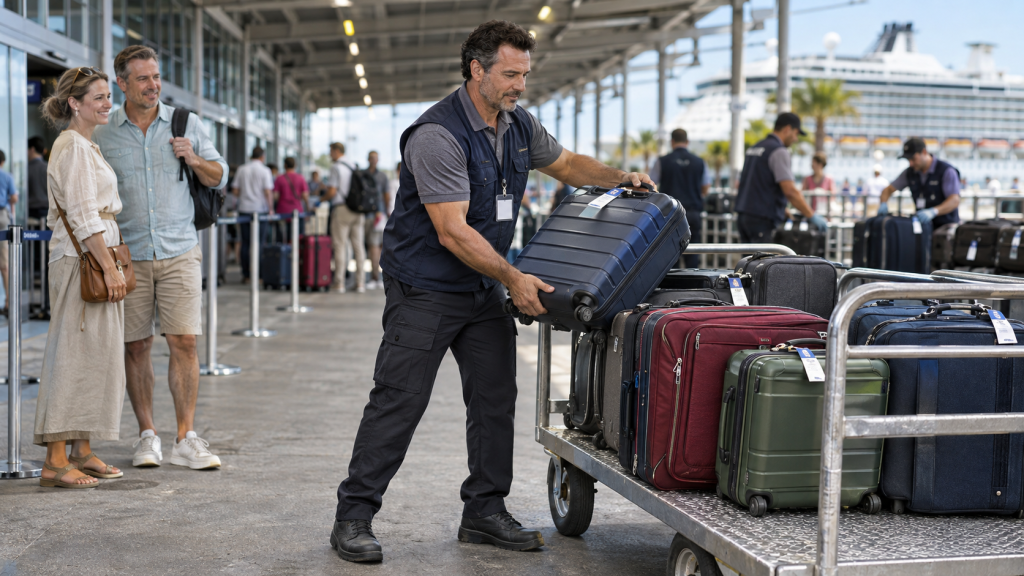
A porter is a worker at the cruise port who takes your large suitcases at the curb, checks that they are tagged with your cabin number and name, and loads them onto luggage carts.
They rely on tips and save you from hauling heavy bags through security and long hallways.
When you arrive, you roll your big suitcases to a porter, confirm your ship and cabin, and hand the bags over.
Each large suitcase should have a printed luggage tag with your name and cabin number attached firmly to the handle.
The porter loads your tagged bags onto a cart, you tip them, and those suitcases disappear into the back-of-house system.
From there, your checked luggage is scanned for security and sorted by deck and cabin.
Crew members take the loaded carts through service corridors you never see.
Later in the afternoon, they line those tagged bags up in the hallway outside each matching cabin door.
While this is happening, you keep a smaller carry-on and a personal item with you.
On a cruise, a carry-on is the bag you keep in your own hands from the curb all the way to your cabin.
It goes through security with you, sits by your chair in the waiting area, and rolls down the halls when you first board.
This might be a small roller bag or spinner plus a backpack or tote.
An easy-rolling, upright carry-on—like a 21–22 inch Travelpro spinner with a stable handle—makes this part much smoother because it glides beside you rather than fighting every turn.
The Luggage Journey In Simple Language
Porters Take Over Heavy Suitcases
You give large, tagged bags to porters at the curb so you only manage smaller bags inside.
The Ship’s System Moves Checked Bags Behind The Scenes
Your checked suitcases are scanned, sorted by cabin, and rolled along crew-only corridors to your deck.
Bags Appear Later In Your Hallway
Crew line tagged bags up outside your cabin door so you can pull them inside and unpack.
Your Carry-On Stays With You As Your Backup
A compact, well-organized carry-on—ideally a Travelpro spinner—keeps essentials within reach until your big bags arrive.
How Much To Tip Porters With Confidence
Tipping porters is a small moment that can feel awkward if you do not know the norm.
Porters usually are not cruise line employees, and they rely on tips as a significant part of their income.
They handle heavy suitcases in all kinds of weather and help ensure your bags join the ship’s system correctly.
A simple guideline works well in most U.S. cruise ports.
Online‑Only Cruise Offers You Won’t Find Elsewhere
Unlock special pricing and start planning the sailing that matches your perfect itinerary

A standard tip is about $2 per checked bag for normal suitcases.
If a bag is extremely heavy, oversized, or tricky—like a double stroller or sports gear—tipping $3–$5 per bag is fair.
If your family checks three big suitcases, handing the porter $6–$10 in total is typical and appreciated.
You give the tip directly to the porter after they have loaded your bags onto the cart.
Bringing small bills makes this easy so you are not searching for change while others wait.
If you decide to roll every bag yourself and skip porters, you will not tip at the curb, but you should be realistic about how many bags you can comfortably push through security and crowded elevators.
Tipping Porters Without Guessing
Use A Simple Per-Bag Rule
Plan on about $2 per regular suitcase and more for very heavy or unusual items.
Tip After Bags Are Safely On The Cart
Hand the porter cash directly once your tagged bags are loaded and confirmed.
Keep Small Bills Handy
Carry singles and fives so tipping is quick and smooth at the curb.
Choosing The Right Bags for Embarkation Day

The bags you bring shape how embarkation feels from the moment you leave your hotel or car.
You do not need a closet full of luggage styles; you just need clear roles for each piece.
You have three main categories: checked suitcases, your carry-on, and your personal item.
Checked bags are your “closet.”
They hold the bulk of your clothes, shoes, and non-essential items that can wait until later.
Because those bags will be stacked, rolled, and moved with thousands of others, durability matters.
Sturdy checked suitcases from travel-focused brands—like full-size Travelpro uprights with reinforced corners and strong wheels—handle this environment better than fashion-only bags.
Your carry-on is your “day kit.”
It should be light enough to handle yourself but big enough to hold what you need before your checked bags arrive.
A 21–22 inch Travelpro spinner works well here, especially if it has four wheels and a solid telescoping handle.
You can roll it beside you through the terminal, onto the ship, and down the cabin hallways without straining.
Your personal item is your “control center.”
A backpack or slim Travelpro underseat bag with multiple pockets is ideal.
This is where you keep passports, phones, glasses, chargers, printed confirmations, and travel insurance documents from companies like VisitorsCoverage, World Nomads, Ekta, or Insubuy.
When everything has a specific place, you no longer need to dig through big suitcases to find important items at the worst possible moment.
Clear Roles Make Bags Easier To Manage
Let Checked Bags Hold Long-Term Items
Put bulk clothing and non-urgent items in sturdy checked suitcases instead of your carry-on.
Use Your Carry-On As A First-Day Kit
Pack medications, documents, a change of clothes, and small toiletries into a manageable Travelpro carry-on.
Keep Your Personal Item As Your Command Center
Store passports, phones, and papers in a compact bag with organized pockets for easy access.
Common Luggage Mistakes First-Time Cruisers Make

Most first-time cruisers repeat the same luggage patterns, and each one has an easy fix.
One major mistake is trying to keep all suitcases with you “just to be safe.”
That instinct often leads to dragging several heavy bags through security and into elevators.
Hallways feel tighter, lines feel slower, and every turn becomes a small struggle.
Another mistake is packing crucial items—medications, passports, electronics, or printed policy confirmations—inside checked bags instead of your carry-on.
If a checked suitcase arrives late, you are now waiting on something you absolutely need.

Luxury Cruise Experiences at Smarter Prices
See premium sailings and upgraded cabins priced for travelers who know how to book well
A third mistake is overstuffing the carry-on itself and treating it like another checked bag.
That turns even a well-built bag into a burden when you are moving through crowds and waiting for cabins to open.
A fourth mistake is rushing through the curbside handoff without checking tags.
If you drop bags quickly and walk away, you miss the chance to verify that your cabin number and ship name are correctly printed and visible.
Avoidable Luggage Traps And Their Fixes
Carrying Every Suitcase Through The Terminal
Check the big bags and let porters move them; keep only what you can comfortably roll alone.
Hiding Essentials In Checked Luggage
Medications, passports, and valuables belong in your Travelpro carry-on or personal item, not in checked bags.
Turning Your Carry-On Into A Second Closet
Pack only what you need until dinner, not your entire wardrobe, so rolling your bag stays easy.
Skipping A Quick Tag Check
Confirm ship, cabin, and visible tags with the porter before you head inside the terminal.
Luggage Fears First-Time Cruisers Have (And What Really Happens)
Feeling nervous the first time you hand a suitcase to a porter is completely normal.
You may worry that your bag will be lost, damaged, or delivered to the wrong cabin.
You might also wonder if you tipped correctly or if your luggage will stand out in some embarrassing way.
In reality, cruise lines move thousands of bags each sailing using systems that have been refined over many years.
Suitcases are tracked by their tags and cabin numbers at several points along the way.
Do delays happen sometimes?
Yes.
But most bags appear in the hallway within a predictable window in the afternoon.
When a bag is delayed or misplaced, the tag information lets Guest Services and your cabin steward track it and reunite you with it.
This is where a well-packed carry-on becomes your safety net.
If you have medications, documents, a change of clothes, and simple toiletries in your Travelpro carry-on or underseat bag, a late suitcase is inconvenient rather than trip-ending.
Keeping your travel insurance documents in that same bag adds another layer of backup if something major interrupts your journey before you ever reach the port.
Turning Anxiety Into Informed Confidence
“If I Hand My Bag To A Porter, It Might Disappear.”
Porters and crew rely on tags and cabin numbers to move bags quickly into an organized system, not into a black hole.
“If My Checked Bag Is Late, My First Day Is Ruined.”
A thoughtfully packed carry-on lets you shower, change, and enjoy dinner even if a suitcase shows up later.
“Everyone Can Tell I Have No Idea What I’m Doing.”
Every experienced cruiser had a first luggage handoff; your plan just gets you to that same comfort faster.
Quick Luggage Game Plan For Embarkation Day
A clear luggage plan turns embarkation into a series of simple steps instead of a guessing game.
The night before, you attach printed luggage tags to your larger suitcases and double-check cabin numbers.
You pack a focused carry-on with essentials and organize your personal item so passports and confirmations are easy to reach.
When you arrive at the port, you roll your big bags to a porter, confirm your ship and cabin, and watch as they load your suitcases onto a cart.
You tip around $2 per standard bag, a bit more for very heavy pieces, and then walk into the terminal carrying only your Travelpro carry-on and personal item.

Sail Away to Paradise Without Overpaying
Find cruise deals that make it easy to escape, relax, and enjoy the ocean without stretching your budget
Through security and check-in, you move more freely because you are not wrestling with your entire wardrobe.
After boarding, you head to a quiet space—maybe the library or card room—to relax, have a bite to eat, and explore.
As the afternoon goes on, you return to your cabin and find your checked suitcases lined up in the hallway, ready to pull inside.
By then, you will have seen the luggage system work from start to finish, and what once felt confusing will feel like a routine you can easily repeat on your next cruise.
Luggage Steps That Keep Embarkation Manageable
Decide Each Bag’s Job Before You Travel
Assign “closet,” “day kit,” and “control center” roles so you are not repacking at the curb.
Use Porters And Fair Tipping To Save Energy
Let porters move heavy bags and thank them with a straightforward per-bag tip.
Trust A Well-Packed Carry-On To Back You Up
With essentials in a reliable Travelpro carry-on, you stay comfortable even if a checked bag takes longer.
FAQ – How Does Cruise Luggage Handling Work on Embarkation Day for First-Time Cruisers?
What Happens to Your Luggage When You Arrive at a Cruise Terminal?
At many cruise terminals, authorized porters accept checked suitcases and direct them into the baggage-handling process.
Those bags undergo screening and are transported to the ship for delivery according to the cruise line’s procedures.
You keep your carry-on and other permitted personal belongings with you through passenger security and boarding.
Always confirm the luggage drop-off location for your particular cruise terminal before handing over your bags.Do You Have to Give Your Suitcases to a Cruise Porter?
Not every cruise requires passengers to check their large suitcases with a porter.
Some operators allow guests to carry their own luggage onboard, provided the bags comply with applicable size, screening, and handling requirements.
However, carrying several heavy suitcases can be difficult when navigating security, boarding areas, and crowded corridors.
Check your cruise line’s policy before deciding whether to hand over luggage or manage it yourself.How Much Should You Tip Cruise Porters on Embarkation Day?
At U.S. cruise ports, a few dollars per checked suitcase is a commonly suggested gratuity for porter assistance.
Around $2 per ordinary bag is a practical starting point, although travelers may choose a different amount for particularly heavy luggage or extra assistance.
Tips should not be confused with mandatory cruise-line baggage fees.
Customs, expectations, and tipping practices can differ outside the United States.When Should You Tip a Cruise Porter?
If you choose to tip a porter, you can generally hand over the gratuity once the porter has accepted your tagged bags.
That gives you an opportunity to confirm that the luggage is going to the correct ship and through the appropriate drop-off process.
Bringing small bills can make the exchange simpler at busy U.S. terminals.
If you are uncertain about the procedure, ask the authorized porter or terminal staff rather than assuming a particular arrangement.Do You Need to Print Cruise Luggage Tags Before Embarkation?
Many cruise lines provide luggage tags as part of the documents available before sailing.
These tags usually identify information needed to direct your checked bags, such as the ship, sailing, and cabin assignment.
Royal Caribbean advises guests to prepare their luggage tags before arriving, although replacement tags may be available from porters at the pier.
Follow the instructions for your cruise line rather than relying on a generic tag design.What Happens if You Forget Your Cruise Luggage Tags?
Forgetting your printed luggage tags does not necessarily mean you cannot check your suitcases.
Some cruise operators, including Royal Caribbean, have arrangements for providing replacement tags at the pier.
However, the process can differ by cruise line and terminal, and obtaining replacements may add another step to embarkation.
Ask authorized luggage personnel for assistance and verify the information before handing over your bags.What Should You Keep in Your Cruise Carry-On Bag?
Your carry-on should contain the belongings you may need before your checked luggage arrives.
Important items include identification, travel documents, essential medications, valuables, electronics, and any personal necessities you cannot comfortably go without for several hours.
You may also want a change of clothes or swimwear if you plan to use onboard facilities before your cabin is ready.
Keep the bag small enough to manage comfortably through the terminal and ship.Can You Bring a Rolling Carry-On Suitcase Onto a Cruise Ship?
Many cruise lines allow passengers to bring rolling carry-on luggage onboard, subject to their baggage rules and security requirements.
However, the size permitted through terminal screening may differ from airline carry-on allowances.
You should also be prepared to manage the suitcase yourself until your cabin becomes accessible.
Check your cruise line’s current baggage guidance before choosing a particular bag.Is a 21-Inch or 22-Inch Spinner Suitable for Cruise Embarkation?
A spinner suitcase in that general size range can be convenient for carrying first-day essentials through a cruise terminal.
However, the advertised luggage size doesn’t automatically guarantee compliance with your cruise line’s baggage requirements.
Overall dimensions, including handles and wheels, can differ between products.
Verify the actual measurements and your operator’s restrictions before departure.When Will Your Checked Luggage Arrive at Your Cruise Cabin?
Checked luggage is commonly delivered after boarding, but there isn’t a universal delivery time across cruise lines and ships.
Some passengers receive their bags earlier in the afternoon, while others may need to wait until later, potentially after sailaway.
Royal Caribbean specifically advises that high luggage volumes can delay delivery beyond departure.
Pack essential items in your carry-on rather than depending on a particular arrival hour.What if Your Cruise Cabin Isn’t Ready When You Board?
Depending on the cruise line and your boarding arrangements, you may be allowed onto the ship before your cabin is available.
During that period, you may need to keep your carry-on luggage with you while visiting permitted public areas.
Carrying a smaller, manageable bag makes this more convenient than handling several large suitcases.
Follow your ship’s announcements and cabin-access instructions rather than assuming all staterooms open at the same time.What Should You Do if Your Checked Suitcase Doesn’t Arrive?
First, check the delivery guidance provided by your cruise line and allow for the normal luggage-handling process.
If the announced delivery period has passed and your suitcase is still missing, contact Guest Services or the department designated for luggage assistance.
Be ready to describe the suitcase and provide your cabin information and any baggage-identification details.
Keep essential items with you from the beginning so that a delayed suitcase does not prevent you from accessing medication, documents, or other necessities.Can You Put Prescription Medication in Checked Cruise Luggage?
Essential medications should remain with you rather than being packed in checked luggage that may be delayed or misplaced.
Royal Caribbean and other operators specifically advise passengers to carry needed medications in their hand luggage.
Where applicable, keep prescription medication in its original labeled packaging and follow the rules for any medical equipment or supplies.
If you have medication requiring special storage, contact your cruise line about appropriate arrangements before traveling.Are Cruise Luggage Rules the Same as Airline Baggage Rules?
No, cruise lines and airlines have separate baggage policies, even when a trip involves both types of travel.
A suitcase accepted as airline carry-on luggage may still need to satisfy different screening or handling requirements at the cruise terminal.
Likewise, some items permitted in airline checked baggage may be restricted by your cruise operator.
Review both sets of rules if you are flying to your departure port.How Can First-Time Cruisers Make Luggage Handling Easier on Embarkation Day?
Prepare the required luggage tags, separate checked belongings from carry-on essentials, and confirm your terminal’s baggage drop-off procedure before arriving.
Keep identification, medications, valuables, and first-day necessities accessible instead of handing them over with larger suitcases.
If you use a porter, verify that your bags are correctly tagged and going through the proper process.
Once boarding begins, follow the cruise line’s cabin-access and luggage-delivery instructions rather than worrying about where every suitcase is at every moment.
Plan Your Next Cruise!

Sail Into Timeless Luxury: Cunard Cruises for Transatlantic Elegance and Destination‑Rich Voyages
One Delay Can Cost Your Entire Cruise A quick coverage check now protects you from the problems no one sees coming….

From Icon to Oasis: Explore Royal Caribbean’s Groundbreaking Ships and Unforgettable Voyages
One Delay Can Cost Your Entire Cruise A quick coverage check now protects you from the problems no one sees coming….

Experience the Ultimate Vacation with Carnival Cruise Line’s Fun Ships, World‑Class Entertainment, and Relaxation
One Delay Can Cost Your Entire Cruise A quick coverage check now protects you from the problems no one sees coming….

Sail in Style: Oceania Cruises’ Culinary Excellence, Cultural Immersion, and Refined Luxury
One Delay Can Cost Your Entire Cruise A quick coverage check now protects you from the problems no one sees coming….
Explore More

Cruise Curfews for Minors — What Families Need to Know Before Sailing

Sleep Better at Sea: Cruise Pillow Types, Requests, and Allergy‑Safe Options

Discover How Cruise Ship Recycling Protects Oceans and Builds Traveler Trust