One Delay Can Cost Your Entire Cruise
A quick coverage check now protects you from the problems no one sees coming
Short Excerpt
- Cruise cabin upgrades can add comfort, space, and better views, but bidding programs and direct offers come with different costs and risks.
- Comparing upgrade prices, cabin locations, and fare restrictions helps you avoid paying extra for a stateroom that may not meet your expectations.
- Smart bidding, price monitoring, and a realistic spending limit can help you secure a better cabin without sacrificing the experiences you value most.
Quick Take
- Compare your upgrade options. Direct offers provide greater certainty, while bidding may deliver savings without guaranteeing acceptance.
- Check the total upgrade price. Some bidding programs calculate offers per person for two guests.
- Review cabin location risks before submitting a bid you cannot reverse.
- Monitor cruise fare changes because repricing or a direct upgrade may offer better value.
- Set a firm spending ceiling that protects your dining, excursions, and other vacation priorities.
Know Your True Upgrade Cost Before Saying Yes to a Better Cabin
A cruise cabin upgrade becomes a smart purchase when the improvement is worth more to you than the money you spend.
The challenge is determining that value before a promotional email, bidding invitation, or limited-time upgrade offer creates pressure to act.
One useful starting point is calculating the additional cost per night.
A $280 upgrade on a seven-night cruise adds $40 per night to your vacation budget.
Whether that feels worthwhile depends on what you receive and how often you expect to enjoy it.
A larger cabin may give two travelers more room to unpack, get ready for dinner, or relax between activities.
For families, additional storage and floor space can make daily routines noticeably easier.
Couples who enjoy quiet mornings may place greater value on a private balcony than passengers who spend nearly every waking hour elsewhere on the ship.
The length and style of the itinerary can also influence your decision.
A sailing with several sea days offers more opportunities to enjoy an upgraded cabin, while a port-intensive itinerary may leave relatively little time to appreciate its additional amenities.
Weather deserves consideration when evaluating balcony upgrades.
On itineraries with cooler temperatures, strong winds, or frequent rain, you may spend less time outdoors than anticipated.
A balcony can still provide daylight and views, but its practical value depends on the conditions you expect to encounter.
Another important question is whether the upgrade changes your actual comfort or simply moves you into a more expensive category.
A centrally located oceanview cabin might suit your needs better than a balcony far from the facilities you regularly use.
Before accepting an offer, compare the additional cost with the experiences that money could purchase elsewhere.
The same upgrade budget might cover specialty dining, an excursion you have wanted to try, or an extra hotel night before embarkation.
There is also an important distinction between upgrading for a special occasion and purchasing an improvement you will appreciate every day.
Both can be reasonable choices, but recognizing your motivation helps you establish an appropriate spending limit.
Finally, examine how the upgraded reservation affects your original booking.
Confirm whether existing promotional benefits remain in place, whether additional charges apply, and whether the upgraded cabin category includes the amenities you expect.
A worthwhile cruise cabin upgrade should improve your vacation without creating financial pressure or replacing experiences you would enjoy more.
Once you know what that improvement is worth, the different upgrade methods become much easier to evaluate.
Why the Right Cruise Cabin Upgrade Can Transform Your Vacation Without Overspending
A cruise cabin upgrade can transform your entire trip from day one.
You wake up happier because the space feels like yours.
You unpack without stress and stop wishing for the balcony you didn’t book.
You stop doing mental math every time you walk past the balcony doors on deck.
Top Cruise Deals From Trusted Cruise Lines
Compare exclusive online offers and find the fare that fits your trip and your budget
At the same time, upgrades are where advanced beginners accidentally overspend, because the excitement makes every option feel “worth it.”
That is the trap.
The goal is not upgrading at any cost.
The right upgrade strategy means paying less while landing a cabin you truly love.
Without a plan, excitement turns into overspending—and that’s the trap you’ll avoid here.
Choose Your Upgrade Path with Confidence Before Spending A Cent

Most cruisers talk about “getting an upgrade” like it is one thing.
It is not one thing.
It is a handful of very different paths with different rules, different certainty, and different risk.
Once you see the paths clearly, you stop reacting to random offers.
Instead, you start choosing the path that fits your priorities.
That is where confidence comes from.
Confidence also keeps you from paying more than you needed to pay.
Your first step is knowing the menu.
Upgrade Language
A bid upgrade is when you submit an offer to pay a set amount to move to a higher cabin category, and you only pay if the cruise line accepts the offer.
A bid upgrade is not guaranteed.
A bid upgrade is also not “a negotiation” in the way people imagine.
You are making an offer inside a program the cruise line controls.
If accepted, most programs charge you automatically and treat the payment as final.
That is why a bid should be intentional, not emotional.
A second term you will see is paid upgrade, which is a direct price difference offered by the cruise line or a booking partner.
A paid upgrade is usually guaranteed once you pay it.
The Five Common Upgrade Paths
Path one is booking the cabin you want from the beginning, then watching for price drops and repricing if your fare rules allow it.
Path two is paying a direct upgrade offer before sailing, which is the simplest “certainty” option.
Path three is using a bid upgrade program, which is the most exciting option and the easiest place to overspend.
Path four is upgrading after you board, which can happen when inventory shifts, yet it is not something you should bet your vacation on.
Path five is “getting lucky,” meaning a complimentary upgrade based on operational needs, which is real but not a strategy.
Strategies are repeatable.
Luck is not repeatable.
A smart cruiser uses strategies and treats luck as a bonus.
Upgrade Options Chart
| Upgrade Method | Typical Cost Feel | Certainty Level | Best For | Watch Outs |
|---|---|---|---|---|
| Book the cabin you want early | Higher upfront, fewer surprises | High | Travelers who hate uncertainty | You can overpay if you never compare later price drops |
| Track price drops and reprice | Often low to moderate | Medium | Advanced beginners who plan ahead | Fare rules may limit repricing or create fees |
| Pay a direct upgrade offer | Moderate to high | High | Those who want certainty fast | You can pay more than a smart bid would have cost |
| Bid upgrade program | Low to moderate, sometimes high | Low to medium | Flexible cruisers who can accept “no” | Accepted bids are usually final and can move you to a less ideal location |
| Upgrade at check-in or onboard | Varies widely | Low | Opportunists who already like their cabin | You might spend time chasing something that never appears |
The One Question That Keeps You from Overpaying
Ask yourself what you are truly buying with the upgrade.
Sometimes you are buying space.
Sometimes you are buying a view that changes how the cruise feels.
Sometimes you are buying a better location that saves your feet every day.
Online‑Only Cruise Offers You Won’t Find Elsewhere
Unlock special pricing and start planning the sailing that matches your perfect itinerary

Other times, you are buying the emotional feeling of “we did it,” which is valid but should still be priced.
The more honest you are about what you want, the better your upgrade decisions become.
A balcony can be life-changing for some cruisers.
A balcony can also be pointless for someone who lives on the pool deck.
Your habits decide the value.
Section Takeaways
Pick Your Path
Choosing an upgrade path first prevents panic spending later.
Define Bid Upgrade
Knowing what a bid upgrade is keeps you from treating it like a guaranteed deal.
Buy The Right Benefit
Upgrades are worth it when the upgrade matches how you actually cruise.
Bid Smarter and Avoid Regret with Cruise Upgrade Strategies
Bid upgrades are popular because they offer the possibility of paying less than the original price gap.
That possibility is real.
The risk is also real.
The risk is not only “you might lose.”
The more painful risk is “you might win and still feel disappointed,” because the cabin you won has tradeoffs you did not think through.
Advanced beginners are perfectly positioned to do this well, because you understand cabin categories better than first-timers.
You also know what it feels like to live in a cabin for a full week.
That lived perspective makes your bids smarter.
Now you just need a clean system.
How Bidding Usually Works
Most bid programs invite you after you have already booked a cabin.
You choose one or more higher categories you would accept.
You submit an offer amount.
If the cruise line accepts it, you are charged and reassigned.
If it is not accepted, you keep what you booked and you are not charged.
That “no harm done” feeling is why people overbid.
Overbidding happens when you forget the hidden truth.
A bid upgrade is still an extra purchase.
Program Reality Checks
Royal Caribbean’s RoyalUp explains that if your bid is accepted, you are charged, and if it is not accepted, you keep your stateroom with no additional charge.
Royal Caribbean also states that accepted upgrade payments are final and non-refundable.
Norwegian’s Upgrade Advantage FAQ explains that once an offer is accepted, your card is charged immediately and the upgrade amount is final and non-refundable.

Luxury Cruise Experiences at Smarter Prices
See premium sailings and upgraded cabins priced for travelers who know how to book well
That same FAQ notes you keep the promotions you already have, while additional promotions are not added.
Celebrity’s MoveUp describes the program as an opportunity to submit an offer, with participation and availability selected at the cruise line’s discretion.
This is the tone you should adopt when bidding.
Treat it as “optional and conditional,” not as “I found the cheat code.”
A cheat code mindset leads to sloppy decisions.
Bid Amount Logic
Start with the number that would still feel like a win if you get the least ideal cabin location within that category.
That sentence matters.
Category wins can include cabins you would not personally choose on a deck plan.
Some balconies have partial obstruction.
Some cabins sit under noisy public areas.
Some cabins have connecting doors that pass sound more easily.
You cannot always control that outcome with a bid program.
So your bid should be sized to the worst reasonable version of the category you are bidding for.
That keeps regret low even when you “win.”
Timing That Helps
Bids can be accepted at different times, sometimes fairly close to sailing.
That timing matters because your ability to pick dining times, onboard packages, and excursion planning can be affected by cabin changes.
A smart move is treating your current cabin as your real plan until you receive an acceptance notice.
Keep planning as if you will stay where you booked.
If an upgrade hits, let it be a bonus.
Planning this way keeps you steady.
It also keeps you from building your whole week around a balcony that may never happen.
Hope is fine.
Dependence creates stress.
Bid Strategy That Feels Responsible
Pick one “stretch” category and one “practical” category instead of bidding for everything.
Too many bids increase the chance you get something you did not truly want.
Focus on the upgrade that changes your experience most, not the upgrade that sounds most impressive.
An oceanview can be the perfect midpoint for many cruisers.
A balcony can be perfect for people who love quiet mornings and private wind-down time.
A suite can be amazing, yet it is also the place where bids can spiral into “I basically paid suite price anyway.”
Your system is simple.
Bid for the life upgrade, not the status upgrade.
Section Takeaways
Price The Worst Case
A winning bid should still feel good even if location is not ideal.
Keep Planning Steady
Plan your cruise as booked, then treat an upgrade acceptance as a bonus.
Bid With Purpose
One practical bid and one stretch bid beats emotional bidding across the whole menu.
Save Big with Non-Bid Upgrade Tactics That Actually Work
Bid upgrades get the spotlight because they are dramatic.
The quieter upgrade methods are often more consistent.
Consistent is what advanced beginners value, because you like wins you can repeat.
These methods also protect you from the emotional rollercoaster of waiting for a bid decision.
They are not as exciting.
They are often more financially responsible.
A smart cruiser uses the quiet methods first.
Then they bid only if the quiet methods do not deliver.
Price Drop Tracking
Cruise fares move.
Promotions change.
Category pricing shifts as ships fill and as cruise lines adjust demand.
When your fare rules allow it, monitoring pricing can create opportunities to reprice or upgrade more cheaply than you expected.
This is especially powerful when you booked early and demand later softens.
A practical approach is checking pricing at predictable moments, like after major promotion launches or after final payment windows when inventory reshuffles.
A second practical approach is using one trusted booking channel so you can compare “apples to apples” without confusing package bundles.
Confusion is where people assume they got a deal when they did not.
Direct Upgrade Offers
Sometimes you will receive an offer to pay a specific amount to move to a better category.
This is not bidding.
This is a straight offer.
The advantage is certainty.
The tradeoff is that you may pay more than a smart bid would have cost.
The best way to evaluate a direct offer is comparing it to the difference you would have paid if you booked that category from the start.
If the offer is meaningfully less, it can be a strong value move.
If the offer is close to the original difference, you are mostly paying for convenience.
Convenience can be worth it, yet you should know what you are paying for.
The Budget Protection Move Most People Forget
Upgrades do not happen in a vacuum.
Flights, hotels, and port spending are part of the same travel budget.
A “cheap” cabin upgrade can still break your bank if your travel edges are expensive.
Booking a pre-cruise hotel night can reduce the risk of missed embarkation and reduce the stress of travel day.
Booking.com, Trip.com, Agoda, and Tripadvisor can help you choose a port hotel with flexible cancellation terms, which is useful when plans shift.
Radical Storage can help when you arrive early and want to explore without dragging bags.
Those savings are not glamorous, yet they protect the cash you want to use for your cabin experience.
Budget protection is how you afford upgrades without feeling guilty.
That guilt is what ruins the fun.
Use Coverage As A Confidence Tool
When you upgrade, you increase the amount of money tied to the trip.
That can increase background anxiety, especially if you are sailing in seasons where travel disruptions happen more often.
Travel coverage is not only about disasters.
It can also be about reducing the mental load of “what if.”
VisitorsCoverage, World Nomads, EKTA, and Insubuy are options travelers compare when they want coverage aligned to their travel style.
If air travel becomes the weak link, Compensair can be relevant in some situations where eligibility for compensation exists after a disruption.
The right coverage choice depends on your trip details and your comfort level with risk.
The practical benefit is simple.
Less worry makes it easier to enjoy the upgrade you worked for.
Section Takeaways
Track Fares Intentionally
Price monitoring can create upgrade value without bidding stress.
Evaluate Direct Offers
A direct upgrade is worth it when the savings are real, not just convenient.
Protect The Edges
Hotel, luggage, and coverage planning keeps upgrade spending from wrecking your budget.
Pick The Perfect Cabin Location For An Upgrade That Feels Worth It
A category label is only part of the story.
The cabin’s location can matter just as much as the cabin’s size.
Advanced beginners know this, yet it is easy to forget when an upgrade email lands.
A balcony under a noisy deck is not the same experience as a balcony in a quieter zone.
A suite far from your daily routine can feel less convenient than an oceanview near the elevators you actually use.
Location affects sleep.
Location affects walking time.
Location affects how often you enjoy the cabin rather than escaping it.
If you want a cost-smart upgrade, you need a location filter.
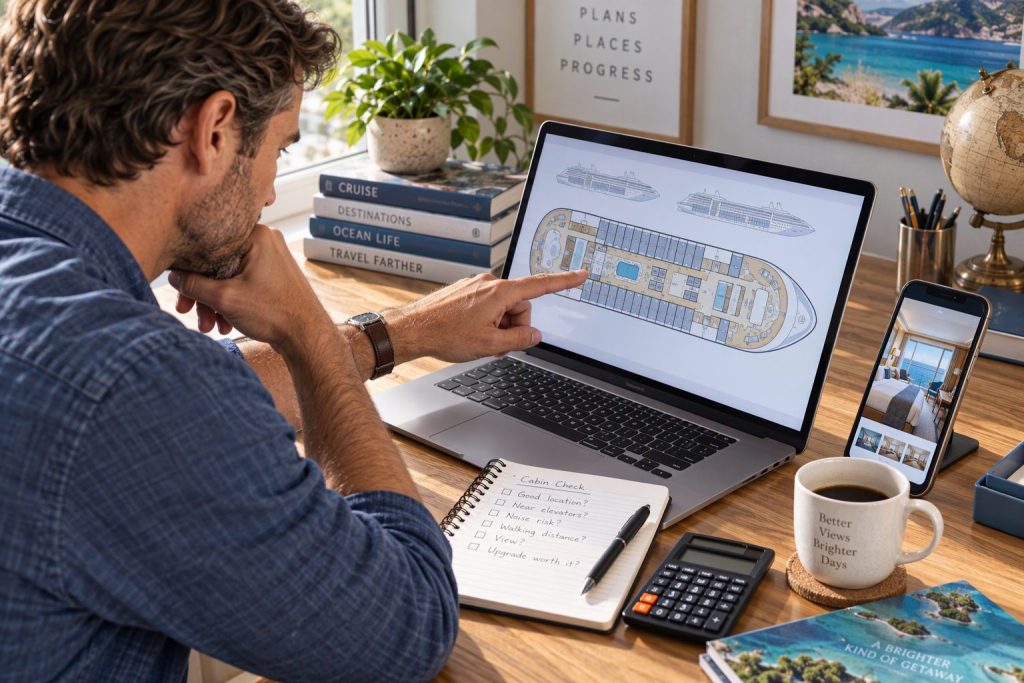
Read The Deck Plan Like A Buyer
Look above the cabin and below the cabin.
Public venues above you can mean chair dragging early in the morning.
A galley area can mean odd noises and service traffic.
A theater wall can create quiet, yet it can also create longer walking routes.
Being near elevators can be convenient, and it can also be loud at peak times.
Being far from elevators can be quiet, and it can also be tiring after a long port day.
No location is perfect.
A perfect location is simply the one that matches your habits.
Bid Programs And Location Risk
Bid programs usually bid by category, not by exact cabin number.
That reality increases location uncertainty.
If location is your top priority, a direct paid upgrade may fit you better than a bid.
If budget is your top priority and you are flexible, bidding can be a great tool.
Flexibility is the cost of the discount.
That tradeoff is fair when you accept it consciously.
It is frustrating when you did not realize you were making it.
A conscious trade feels like strategy.
An unconscious trade feels like bad luck.
Upgrade The Habit That Changes Everything
Make a short “must avoid” list before you upgrade.
List things like “under the pool deck,” “next to a nightclub,” or “next to a busy service area,” based on what you know bothers you.
Then ask support whether your upgraded category could include those locations.
You will not always get a promise.
You will often get guidance.
Guidance helps you decide whether to bid at all.
This is a powerful move because it protects sleep.
Sleep is what makes the cruise feel luxurious even when you did not buy luxury.
Better sleep is the cheapest upgrade on the ship.
Section Takeaways
Filter By Location
A great upgrade is the right cabin in the right place, not just a higher category.
Know The Tradeoff
Bidding can lower cost, yet it often increases location uncertainty.
Protect Your Sleep
A must-avoid list keeps you from “winning” into a cabin you regret.
Avoid These Costly Upgrade Mistakes And Cruise Stress-Free
Most upgrade mistakes happen in the gap between excitement and math.
Excitement says yes fast.
Math asks slower questions.
The goal is not killing the excitement.
The goal is pairing excitement with a quick sanity check.
That sanity check takes two minutes.
It prevents four days of regret.
Advanced beginners can handle the check.
You just need to remember to run it.
Mistake One, Forgetting Per-Person Pricing
Some upgrade programs price the bid per person for the first two guests.
That detail can double what you think you are bidding.
A bid that looks like a small splurge can quietly become a big purchase.
The solution is reading the bid screen as if it is a receipt.
If you cannot explain the final cost in one sentence, do not submit it yet.
Take a breath.
Do the math.
Then decide.
Mistake Two, Bidding Like A Lottery
A lottery mindset makes you chase the “big win” even when the “practical win” would improve your cruise more.
A practical win might be moving from interior to oceanview.
That can change your mornings.
That can change how spacious the cabin feels.
A big win might be chasing a suite even though you do not use suite perks.
That big win can also push you into spending you would not have approved in a calm spreadsheet moment.
Skip the lottery mindset.
Choose the upgrade that fits your real cruising behavior.
Mistake Three, Ignoring The Total Trip Budget
An upgrade is not “cheap” if it forces you to cut the parts of the trip you were most excited about.
If your favorite part is ports, protect your excursion budget.
If your favorite part is specialty dining, protect your dining budget.
If your favorite part is relaxation, protect your spa or quiet experiences budget.
A smart method is assigning your upgrade a maximum amount based on what you can spend without stealing from your priorities.
That maximum becomes your ceiling.
A ceiling prevents impulsive bidding.
Impulsive bidding is where people feel regret later.
Mistake Four, Hoping Policies Will Save You
If an upgrade is accepted, it is often treated as final.
That means you should never assume you can undo it later because you changed your mind.
Avoid the “I will fix it later” thought.
Fixing it later is often not an option.
A better approach is treating every acceptance as a permanent purchase.
Then only bidding amounts you would happily pay permanently.
This approach is not pessimistic.
This approach is responsible.
Section Takeaways
Double-Check The Math
Per-person pricing can turn a small bid into a bigger cost than expected.
Avoid Lottery Thinking
The best upgrade is the one you will actually use every day.
Set A Real Ceiling
A defined maximum protects fun in the rest of your cruise budget.
Upgrade With Confidence: Smart Moves That Keep Your Budget Safe
A cabin upgrade should make you feel excited, not tense.
If you feel tense, the amount is probably too high or the risk is too fuzzy.
That is useful information.
It means you should either lower the bid, choose a different category, or switch to a more certain upgrade path.
Advanced beginners sometimes assume they need to “play the game” to upgrade.
You do not.
You can choose a straightforward paid upgrade and still feel proud of the decision.
You can also keep your original cabin and still have an incredible cruise.
A cabin is a base, not the whole experience.
The Smart Mindset Shift
Think of upgrades as optional value moves.
Optional means you can walk away.
Value means you know why you are paying.
When you combine optional and value, you stop feeling pressure.
Pressure is what makes people overspend.
A low-pressure decision is usually the correct one.
Correct decisions feel good even months later.
That is the standard you want.
You want a choice you will still like after the glow fades.
A Simple Rebooking Checklist For Upgrades
Use this checklist whenever you are about to bid or accept a paid upgrade offer.
Treat it like a quick decision filter.
You do not need a long debate.
You need a short yes-or-no.
Short filters prevent emotional spirals.
That is why checklists work.
They keep you steady.
They also keep your bank account from surprise pain.
Upgrade Checklist
| Checkpoint | Your Quick Answer |
|---|---|
| Do I love my current cabin enough to stay. | Yes or no. |
| Would the upgraded category improve my daily routine. | Yes or no. |
| Could I accept a less ideal location within the new category. | Yes or no. |
| Do I understand the final cost after per-person rules. | Yes or no. |
| Does this spend steal from my top cruise priority. | Yes or no. |
| Would I still be happy if the payment is final. | Yes or no. |
Section Takeaways
Keep It Optional
Walking away is part of the strategy, not a failure.
Buy A Daily Upgrade
Spend only when the upgrade changes your day-to-day experience.
Use The Checklist
A quick filter keeps excitement high and regret low.
Make Your Cabin Upgrade a Victory Without Breaking the Bank
Upgrading without breaking the bank is not about secret tricks.
It is about choosing the right upgrade path, sizing your bid based on the least ideal version of the category, and protecting your total trip budget.
Bid upgrades can be an excellent tool when you treat them like conditional offers, not guaranteed bargains.
Price tracking and direct upgrade offers can be even more consistent when you want certainty.
Location strategy turns “higher category” into “better experience,” which is the whole point.
A simple checklist keeps you from overspending when excitement is high.
Pick your path, set your ceiling, and let the upgrade be a bonus instead of a burden.
That is how you step onboard feeling proud of your choice.
Featured Image Prompt
Image Prompt: A confident cruiser reviewing a cabin upgrade offer on a smartphone beside a deck plan and a simple budget notebook, soft daylight in a cruise cabin, excited expression, no text.
Alt Text: Advanced beginner cruiser using a bid upgrade strategy and deck plan to upgrade a cruise cabin without overspending.
FAQ – How Can You Upgrade Your Cruise Cabin for Less Without Making an Expensive Mistake?
What Is the Most Affordable Way to Upgrade Your Cruise Cabin?
The most affordable method depends on the cruise line, available inventory, and the rules attached to your original reservation.
Monitoring fare reductions can reveal opportunities to reprice or move into a higher category without paying the original difference.
Direct upgrade offers provide a known price, while bidding programs may produce savings if your offer is accepted.
Compare all available methods before choosing, because the lowest advertised upgrade amount is not necessarily the best overall deal.How Does Cruise Cabin Upgrade Bidding Work?
Cruise upgrade bidding allows eligible passengers to offer an additional amount for a higher stateroom category after booking their original cabin.
Programs such as Royal Caribbean’s RoyalUp, Norwegian’s Upgrade Advantage, and Celebrity’s MoveUp use their own eligibility requirements, deadlines, and acceptance conditions.
When an offer is accepted, the passenger is generally charged and reassigned to an available cabin in the new category.
If the bid is unsuccessful, the traveler typically keeps the original stateroom without paying for the proposed upgrade.How Much Should You Bid for a Cruise Balcony Upgrade?
Start by comparing your current cabin with the price of booking a balcony directly on the same sailing.
Decide how much the additional space and private outdoor access would genuinely improve your vacation, then account for potential location disadvantages.
A bid should remain attractive even if the cruise line assigns a balcony with a partially obstructed view or another feature you would not have selected independently.
Set your maximum amount before opening the bidding screen so the suggested bidding ranges do not determine your budget.Are Cruise Cabin Upgrade Bids Charged Per Person or Per Cabin?
Many major upgrade programs calculate bids on a per-person basis using two guests, even when the cabin contains a different number of occupants.
For example, an advertised $150-per-person bid could result in a $300 upgrade charge before any applicable additional costs.
However, the exact calculation depends on the cruise line and the program’s current terms.
Always review the final total displayed during submission rather than treating the suggested per-person amount as the complete upgrade price.Can You Choose Your Stateroom After Winning a Cruise Upgrade Bid?
Most bidding programs allow passengers to select a desired category but not the specific cabin they will receive.
The cruise line may assign any eligible available stateroom within that category, including locations that would not have been your first choice.
This can matter when you want to avoid noisy public areas, obstructed balconies, or long walks from elevators.
Travelers who require a specific location or cabin feature may be better served by a direct upgrade that allows room selection.Can You Cancel a Cruise Upgrade After Your Bid Is Accepted?
Accepted upgrade bids are generally treated as final and nonrefundable under the major programs discussed in this article, subject to their specific terms and exceptions.
Once accepted, the designated payment method may be charged automatically, leaving little opportunity to reconsider the purchase.
Passengers should also understand that the assigned upgraded cabin may not be changeable simply because its location is disappointing.
Review the program conditions carefully and submit only amounts you are prepared to pay permanently.Is a Direct Paid Cabin Upgrade Better Than Bidding?
A direct paid upgrade is generally more suitable when certainty matters more than potentially obtaining the lowest price.
Depending on availability and booking conditions, you may be able to confirm a particular category or select the exact stateroom before paying.
Bidding can be attractive when you are flexible about location and willing to accept the possibility that your offer will not succeed.
Compare the full direct-upgrade price against your intended bid and decide whether the potential savings justify the additional uncertainty.Can You Upgrade Your Cruise Cabin When Prices Drop After Booking?
Some cruise lines allow eligible reservations to be repriced or changed to a higher stateroom category when fares decrease.
However, your ability to make changes can depend on the original fare rules, booking channel, promotions, and whether final payment has been completed.
Repricing may also affect included perks or introduce different cancellation conditions.
Ask for a complete comparison of the current and proposed reservations before approving any change.When Is the Best Time to Check for Cruise Cabin Upgrade Offers?
Cruise cabin upgrade opportunities may appear after booking, during promotional pricing changes, or closer to sailing when available inventory shifts.
There is no guaranteed period when bids will be accepted more frequently or direct upgrade prices will reach their lowest point.
Checking periodically can help you recognize attractive opportunities without making the upgrade process consume your vacation planning.
Continue preparing for your original cabin until the cruise line confirms a new assignment.Is Upgrading from an Interior Cabin to an Oceanview Worth the Extra Money?
An oceanview upgrade can provide natural light and exterior views without requiring the higher cost of a balcony cabin.
This may be particularly appealing to travelers who dislike completely enclosed accommodations or enjoy seeing daylight when waking up.
However, the actual window size, view, and cabin configuration vary between ships and categories.
Compare the additional cost against your likely cabin usage before deciding whether the upgrade provides meaningful value.Is a Balcony Cabin Upgrade Worth Paying More for on a Seven-Night Cruise?
A seven-night cruise can provide several opportunities to enjoy a private balcony, particularly when the itinerary includes relaxing sea days.
Travelers who enjoy breakfast outdoors, quiet reading, or watching the ship approach ports may find the added expense worthwhile.
The value can be lower when you spend most of your time in public areas or when the itinerary involves weather that limits balcony use.
Calculate the additional cost per night and consider how frequently you expect to use the space.Do Cruise Suite Upgrades Include the Same Perks as Booking a Suite Directly?
Not every promotion or amenity associated with a higher stateroom category necessarily transfers to a reservation upgraded through bidding.
Some programs retain your original booking promotions without adding the promotional benefits normally offered with new suite reservations.
Other services and amenities may depend on the ship, suite category, and particular program rules.
Verify the exact benefits attached to your upgraded reservation before assuming that every advertised suite privilege will be included.Which Cruise Cabin Locations Should You Avoid When Upgrading?
Cabins near busy entertainment venues, under pool decks, or beside heavily used service areas can be less suitable for travelers who prioritize quiet accommodations.
Staterooms close to elevators may offer convenience but can experience additional hallway traffic at certain times.
Some balconies also have partially obstructed views, while connecting cabins may allow more sound to pass between rooms.
Review the ship’s deck plans and identify your personal deal-breakers before purchasing an upgrade or submitting a category bid.Can Families Lose Connecting or Nearby Cabins After Winning Upgrade Bids?
Yes, separate upgrade requests may be accepted independently, potentially placing family members or friends in different areas of the ship.
Being linked under a group reservation does not necessarily guarantee that upgraded cabins will remain adjacent or even on the same deck.
This presents particular concerns for passengers who need connecting staterooms, accessible accommodations, or proximity to children and caregivers.
When location relationships are essential, contact the cruise line before bidding and avoid arrangements that cannot guarantee your group’s requirements.Is It Possible to Get a Free Cruise Cabin Upgrade Without Bidding?
Complimentary upgrades sometimes occur when cruise lines adjust stateroom assignments for operational or inventory reasons.
However, these opportunities are not predictable, and eligibility is controlled by the cruise line.
Asking about availability may be reasonable, but passengers should not expect a free upgrade simply because higher-category rooms appear unsold.
The safest strategy is booking an original cabin you would genuinely enjoy and treating any complimentary improvement as an unexpected benefit.What Is the Biggest Mistake People Make When Bidding on Cruise Cabin Upgrades?
A major mistake is treating an accepted bid as a guaranteed bargain without considering the final cost or possible cabin location.
Travelers may focus on the excitement of winning while overlooking per-person pricing, limited room selection, or nonrefundable payments.
Others bid on expensive suite categories without considering whether they will actually use the additional space and amenities.
Choosing a realistic maximum amount and evaluating the least desirable possible cabin within the category helps prevent regret.How Can You Tell Whether a Cruise Cabin Upgrade Is Worth the Money?
Identify the specific improvement the upgrade provides, such as more space, private outdoor access, better views, or a more convenient location.
Next, calculate the additional cost and consider how often you will benefit from that improvement during the sailing.
Compare the expense against other vacation priorities, including dining, excursions, transportation, and pre-cruise accommodations.
An upgrade is worthwhile when you value the added comfort enough to justify the price without compromising the experiences that attracted you to the cruise.
Plan Your Next Cruise!

Unlock The Viking Ocean Experience: Elegant Ships, Cultural Immersion, And Unrushed Travel
One Delay Can Cost Your Entire Cruise A quick coverage check now protects you from the problems no one sees coming….

From Icon to Oasis: Explore Royal Caribbean’s Groundbreaking Ships and Unforgettable Voyages
One Delay Can Cost Your Entire Cruise A quick coverage check now protects you from the problems no one sees coming….

Sail Smart: Discover The Real Cost of Luxury Cruises and Maximize Your Travel Value
One Delay Can Cost Your Entire Cruise A quick coverage check now protects you from the problems no one sees coming….
Experience the Ultimate Vacation with Carnival Cruise Line’s Fun Ships, World‑Class Entertainment, and Relaxation
One Delay Can Cost Your Entire Cruise A quick coverage check now protects you from the problems no one sees coming….
Explore More

Experience the Perfect Blend of Disney Magic, Luxury Cruising, and Family Adventure at Sea
Experience Cruise Culinary Programs: Cooking Classes, Wine Pairings, and Chef Secrets

Unlock Seabourn’s World: Yacht‑Like Luxury, Exclusive Destinations, And Unmatched Comfort