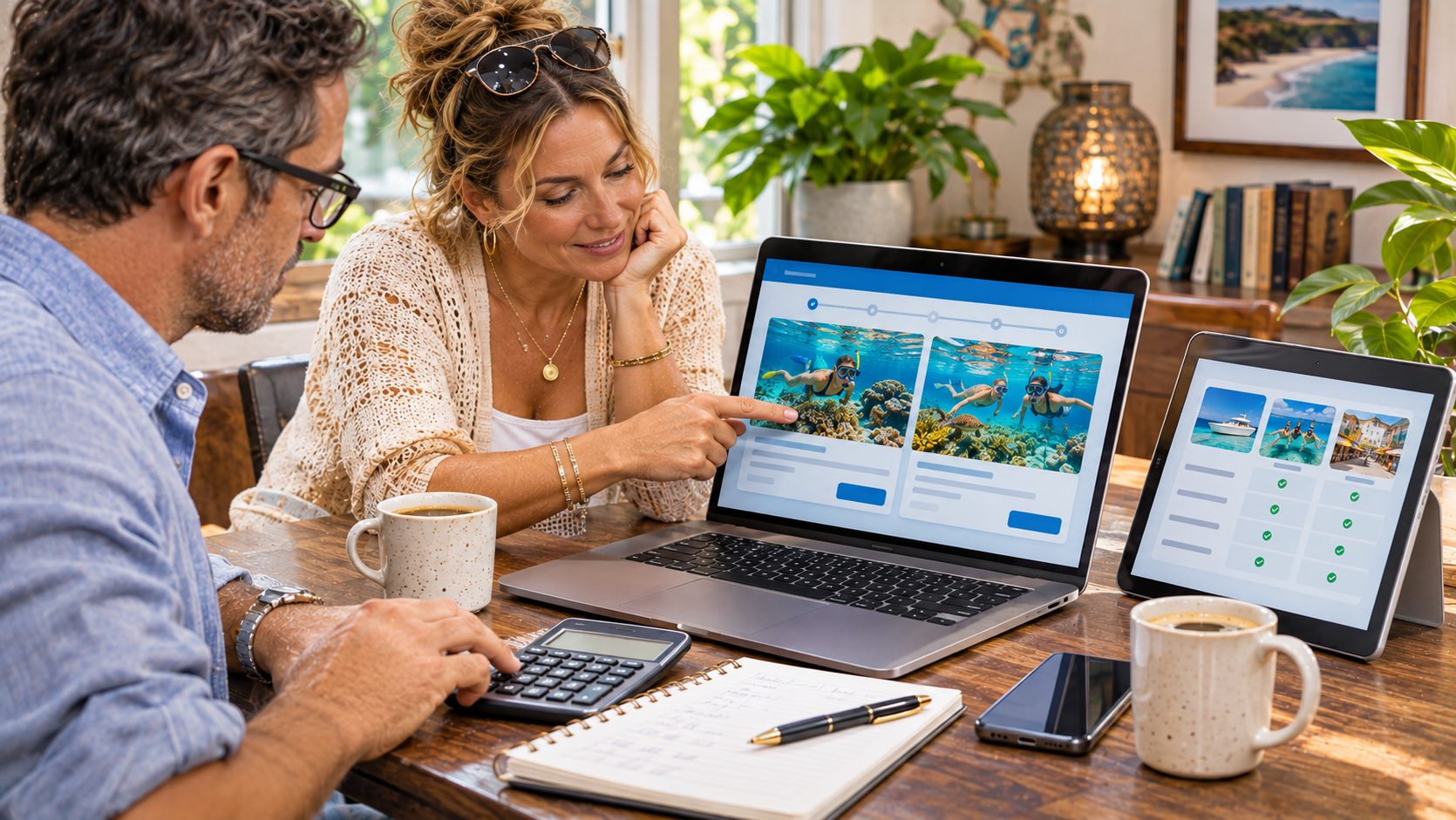
One Delay Can Cost Your Entire Cruise
A quick coverage check now protects you from the problems no one sees coming
Short Excerpt
- Shore excursions can become one of the biggest unexpected expenses on your first cruise, especially when you book without comparing similar activities.
- Cruise-line tours, independent excursions, and exploring ports yourself can have very different costs, inclusions, and return-time risks.
- Use the interactive excursion comparison calculator to evaluate total costs before booking and avoid paying more for an experience that doesn’t offer additional value.
Quick Take
- Compare the complete cost. Include transportation, entrance fees, equipment, food, and other expenses rather than comparing advertised prices alone.
- Understand what the cruise-line premium provides. Organized transportation and cruise-specific scheduling may justify a higher price in complicated ports.
- Give yourself a generous return buffer. Know the ship’s official all-aboard time and account for traffic, tender operations, and unexpected delays.
- Book one main experience per port. Avoid adding activities simply because you’re worried about missing something.
- Use the calculator before committing. An independent tour isn’t necessarily cheaper once every expense is included.
How to Save Money on Your First Cruise Excursions Without Risking Your Port Day
You’ve booked your first cruise and started looking at everything you can do when the ship reaches its destinations.
A snorkeling adventure sounds incredible, a guided city tour promises to show you the highlights, and a private beach escape might be exactly what you’ve been imagining.
Then you start adding up the prices.
A couple traveling together could spend several hundred dollars on shore excursions before accounting for transportation, meals, tips, or extra activities.
Families may face even larger totals because each person needs admission or a tour reservation.
The temptation is to book through the cruise line immediately.
After all, the tour is listed in your cruise planner, the departure time appears coordinated with your ship, and you’re understandably concerned about getting back before it sails.
That convenience can have real value. However, it doesn’t automatically mean the cruise line’s excursion is the best choice for every port.
You might find a comparable experience from an independent operator for less money.
In another destination, a cruise-line tour could provide transportation and scheduling support that make its higher price worthwhile.
The challenge for first-time cruisers is understanding which difference matters.
You don’t want to spend more simply because you’re unfamiliar with a destination, but saving a small amount isn’t worthwhile if it introduces complicated transportation or an unrealistic return schedule.
Compare the Real Cost of Your First Shore Excursion
Before booking anything, separate the price of the activity from the other expenses required to enjoy it.
A cruise-line snorkeling excursion might include round-trip transportation, equipment, and admission.
A similar independent tour could advertise a lower price but require you to pay for transportation separately.
The same principle applies to beach clubs, guided city tours, and attractions that charge admission.
Rather than trying to remember every possible expense, use the calculator below to compare the full cost of three choices: booking through your cruise line, reserving an independent excursion, or exploring the port yourself.
Enter the prices you’ve found, add transportation and extras, and compare the results for your entire traveling party.
First-Cruise Shore Excursion Cost Comparison Calculator
First-Cruise Excursion Cost Calculator
Compare the real cost of three ways to enjoy a port. Enter quotes for your group, not just advertised prices.
Illustrative prices only. Per-person costs are multiplied by travelers; transport and extras are group totals. The lowest price is not necessarily the best value. Confirm inclusions, cancellation terms, accessibility, port meeting points, and the ship’s all-aboard time. Independent excursions do not carry an automatic guarantee that the ship will wait.
What the Calculation Means for Your First Port Day
The lowest total isn’t automatically your best choice.
An independent snorkeling tour might save your family money, but the amount saved needs to be weighed against the quality of the experience, transportation arrangements, and how much time you’ll have before the ship departs.
A cruise-line excursion may cost more because it includes transportation, scheduling coordination, and operational assistance when an excursion runs late.
The exact protections depend on the cruise line and the circumstances, so review its policies instead of assuming every delay is covered.
Third-party tour operators can also offer excellent experiences.

Some provide smaller groups, more flexible itineraries, and cruise-specific return policies, but those promises should be verified before paying.
For a first-time cruiser, the best comparison balances three things: the true total cost, what you’ll receive for the price, and whether the schedule leaves enough time to return safely.
If an independent option saves a meaningful amount and has a reliable return plan, it may deserve serious consideration.
When the savings are small and the logistics are complicated, the cruise-line option may provide better overall value.
Check the Ship’s All-Aboard Deadline Before Comparing Savings
Every port visit has a deadline, and it’s important to understand that the ship’s scheduled departure time isn’t necessarily the time passengers must return.
Your cruise line will communicate an all-aboard time, which can be earlier than departure.
That deadline should guide any independently arranged excursion.
Top Cruise Deals From Trusted Cruise Lines
Compare exclusive online offers and find the fare that fits your trip and your budget
Aiming to return at least an hour before all-aboard can be a useful conservative planning target, but it’s not a universal guarantee of safety.
Longer transfers, traffic, tender operations, unfamiliar transportation systems, or unpredictable conditions may require a much larger buffer.
Before booking, compare the operator’s scheduled return with the actual time you need to be back aboard.
You should also confirm whether the tour leaves from the cruise terminal, another meeting point, or a location requiring additional transportation.
If the timing only works when every connection goes perfectly, reconsider the excursion.
The money you save isn’t worthwhile if the schedule creates a realistic risk of missing your ship.
Compare Equivalent Experiences Before Booking
You can use excursion marketplaces such as Viator, GetYourGuide, and Klook to research tours offered around your scheduled ports.
However, comparing listings requires more than matching their titles.
Look at the duration, group size, transportation, included activities, equipment, meals, admission fees, and cancellation conditions.
A less expensive tour may offer only a short activity, while another provides more time at the destination or additional services.
Likewise, a higher-priced excursion isn’t necessarily better because the operator markets it as premium or exclusive.
For your first cruise, identify the experience you’re most interested in and then compare the available ways to enjoy it.
That approach makes it easier to recognize genuine savings rather than selecting whichever listing displays the lowest starting price.
Decide Which Ports Deserve a Cruise-Line Excursion
There’s no reason to use the same booking strategy for every destination on your first cruise.
A port with a long transfer to a distant attraction may justify paying extra for a cruise-line excursion with organized transportation and schedule coordination.

Another stop could have restaurants, beaches, and attractions close enough to the terminal that you can explore without purchasing a formal tour.
You might also find a reputable independent excursion offering a small group and a straightforward return plan.
Consider the complexity of each port separately.
The goal isn’t to avoid cruise-line excursions entirely. It’s to use their convenience where it genuinely improves your experience while taking advantage of simpler options when appropriate.
Make One Meaningful Experience the Center of Each Port Day
First-time cruisers sometimes overbook activities because they worry they’ll never return to the destination.
That can make port days more expensive and less enjoyable.
Instead, identify one activity that would make each destination memorable, then decide whether there’s enough time for something smaller afterward.
Online‑Only Cruise Offers You Won’t Find Elsewhere
Unlock special pricing and start planning the sailing that matches your perfect itinerary

A guided snorkeling trip might be the highlight of one port, while another could be best enjoyed with a walk through a historic district and lunch at a local restaurant.
This approach gives your day a clear purpose without creating pressure to complete several expensive activities.
It also leaves more flexibility if transportation takes longer than expected or the weather changes.
You don’t have to experience everything in a destination to have an excellent first cruise.
How to Avoid Overpaying for Shore Excursions Without Putting Your First Cruise at Risk
If you are planning your first cruise and worried about paying too much for excursions, you are not alone.
Excursions can feel like the part you “cannot mess up.”
That pressure is exactly what makes people overpay.
Not because you are careless, but because you are trying to protect your vacation from uncertainty.
Cruise lines know port days are emotional.
Port days can feel high-pressure, and that pressure often leads to overspending.
You want a memorable experience, you want it to be safe, and you want it to fit the ship’s schedule.
So the first option you see can feel like the smartest option.
In reality, you can keep the same fun and reduce the cost by learning how excursion pricing really works.
This guide gives you a clear, supportive plan for booking smartly, avoiding beginner traps, and still stepping off the ship excited.
A “shore excursion” is simply an activity you do in port while the ship is docked.
It can be anything from a snorkeling trip to a city tour to a beach day.
Cruise lines sell shore excursions directly, but they are not the only source.
Third-party tour companies and local operators often offer similar experiences at different price points.
The key is comparing correctly, because the cheapest option is not always the best value.
Timing, transportation, cancellation policies, and group size can matter more than a small price difference.
Once you compare excursions like a confident traveler, you stop paying extra just to feel safe.
That is when your first cruise starts to feel easier.
This guide shows you how to compare tours, book smart, and enjoy every port without blowing your budget.
Why Excursions Feel Expensive and How First-Time Cruisers Can Save
Excursions often look expensive because they bundle more than the activity itself.
A cruise line price can include transportation, a guide, logistics support, and a timing structure designed around the ship.
That convenience has value, especially for first-time cruisers.

Luxury Cruise Experiences at Smarter Prices
See premium sailings and upgraded cabins priced for travelers who know how to book well
The problem starts when you pay cruise-line pricing for an experience that does not actually include those extras.
Another common problem is paying for convenience you do not need.
If the port is walkable and you are comfortable navigating, the “bundled transport” premium may not be worth it.
If the port is complicated or far from the activity, that same premium might be a relief.
Overpaying usually happens when you do not know which situation you are in.
Hidden Markups
A cruise line excursion can carry a premium for simplicity and schedule fit.
That premium can be worth it when the day has real timing risk.
It can feel painful when the day is straightforward and you could have arranged the same plan easily.
The mistake is assuming the premium is always earned.
Sometimes it is.
Sometimes it is just the price of convenience, packaged as certainty.
Once you recognize the difference, you can spend with confidence rather than anxiety.
Convenience Bundling
Excursion pricing often bundles your “decision burden.”
You do not have to research transport, meeting points, or return timing.
That is real value for a first port day.
The pitfall is paying for that value on every single port, even when the port is simple.
Many first-time cruisers do better choosing one cruise line excursion for the most complex day, then booking smarter options for easier days.
That approach keeps you protected without overspending across the whole itinerary.
Selective convenience is usually the sweet spot.
Know The Pattern
Overpaying is usually not one big mistake.
It is three small decisions that stack.
You book a cruise line tour “just in case.”
You add an extra activity because you worry you will waste the day.
You buy transportation add-ons because you did not plan the basics.
A simple comparison framework prevents those stacked decisions.
That framework is what this post gives you.
Once you have it, port days feel less stressful.
Price Is Not Value
The most expensive tour is not automatically the best tour.
Selective Convenience
Use cruise line simplicity where it truly protects your day.
Comparison Removes Stress
A clear checklist prevents “panic booking” in the moment.
Compare Excursions Confidently So You Avoid Overpaying
Most first-time cruisers compare excursions by price alone.
That approach is understandable, but it is incomplete.
Two tours can look similar and deliver very different experiences.
To compare correctly, you want to separate the activity from the logistics.
Then you want to price the logistics honestly.

Sail Away to Paradise Without Overpaying
Find cruise deals that make it easy to escape, relax, and enjoy the ocean without stretching your budget
Finally, you want to evaluate timing risk.
When you do this, “overpriced” becomes obvious.
Even better, “worth it” becomes obvious too.
Compare The Core
Start by identifying the core experience.
Snorkeling at a specific reef is the core.
A beach day at a specific island is the core.
A city highlights loop with a guide is the core.
Once the core is clear, you can search for the same experience sold in different ways.
That is when you can compare like with like.
If the core is not the same, the comparison is not fair.
A short, crowded snorkel trip is not the same as a longer trip with fewer people.
Price The Logistics
Now price what it takes to do that core experience.
Transportation is the biggest hidden variable.
Some ports are walkable.
Some ports require taxis, shuttles, or long transfers.
A tour that looks cheaper can become expensive once you add round-trip transport for your group.
Also consider what is included onboard the tour itself.
Equipment, entrance fees, food, and drinks can change the real cost.
A higher-priced tour that includes gear, fees, and lunch may be better value than a cheaper tour that adds those costs later.
Evaluate Timing Risk
Timing is the part beginners underestimate.
Every port day has a hard deadline set by the ship.
All-aboard time is the deadline for passengers to be physically back on the ship.
It is not the time you should arrive at the pier.
A strong beginner habit is planning to be back on the ship no later than one hour before all-aboard time.
That buffer protects you from traffic, tender delays, long lines, and small surprises that become big problems.
If you are booking outside the ship, timing discipline matters even more.
Your savings are not real savings if you create a high-risk return plan.
Compare The Core
Match the same activity first, then compare quality and structure.
Price The Logistics
Add transport and add-ons so the “real total” is honest.
Respect The Clock
Returning early protects your wallet and your vacation at the same time.
Smart Booking Strategies That Keep Your First Cruise Affordable
A first-time cruiser can save money on excursions without becoming a research detective.
You need a few high-impact habits that prevent expensive default choices.
The habits below are simple, repeatable, and beginner-friendly.
They also reduce stress, which is important.
Stress is often what drives overspending.
When you feel confident, you book fewer things and enjoy each thing more.
That is how both your budget and your trip improve.
Book Early With Intention
Early booking gives you options.
Options keep you from grabbing the first expensive tour that still has availability.
The point is not locking every port day months in advance.
The point is identifying the one or two “must do” experiences you care about and securing them.
Then you can leave space for spontaneous exploring in easier ports.
A good first-cruise pattern is one anchor experience per port, not three.
Overbooking creates rushed days and higher spending.
Balanced days create better memories and lower totals.
Use A Comparison Baseline
Before you commit to a cruise line excursion, check what similar tours cost elsewhere.
This is where platforms like Viator can help you see typical pricing, reviews, and inclusions in one place.
For example, if your itinerary includes Cozumel and you are considering a snorkel day, you can compare experiences like the El Cielo Cozumel Snorkeling Tour and see what is included in that style of trip. (Viator)
If you are sailing to Grand Cayman and Stingray City is on your list, reviewing options like the StingrayCity, Coral Garden & Starfish Tour gives you a baseline for duration, structure, and typical inclusions. (Viator)
If Nassau is on your route and you are tempted by a packaged beach day, a listing like the Blue Lagoon Island Beach Day from Nassau shows how “all-inclusive” is defined for that product. (Viator)
This comparison does not force you to book anywhere specific.
It simply keeps you from paying a premium without understanding what you are buying.
Don’t Pay For Fear
Fear-based booking is the biggest money leak.
A beginner worries the port will be confusing, so they buy the most expensive “easy” option.
A beginner worries they will miss something, so they book multiple tours in one day.
A beginner worries the ship will leave, so they avoid anything not sold by the cruise line.
The truth is more balanced.
Some days are worth the cruise line premium, especially when transportation is long or the schedule is tight.
Other days are straightforward, and paying the premium does not buy you much.
The win is using cruise line excursions strategically, not automatically.
One Anchor Plan
Pick one main experience per port.
Then build the rest of the day around simple, low-cost choices like walking, local food, and ship time.
This makes port days feel less rushed.
It also reduces your transportation spending, because you are not bouncing between multiple paid activities.
Most first-time cruisers enjoy port days more when they are not sprinting.
That calmer pace also makes it easier to return early without stress.
You end up saving money and feeling better.
That is a rare combination, and it is very achievable.
Early Options
Booking one priority experience early prevents last-minute premium prices.
Baseline Pricing
Checking comparable tours helps you spot true value quickly.
Anchor Experiences
One meaningful activity often delivers more joy than a packed schedule.
The Excursion Cost Comparison Chart You Actually Need
Comparing excursion costs works best when you compare total cost, not sticker price.
This chart shows the typical categories that change the real total.
The numbers below are examples to demonstrate the structure, not promises of exact pricing.
Use the structure and plug in your real quotes.
That single step prevents most overpaying.
It also helps you explain choices to travel partners without arguments.
Clarity keeps group decisions peaceful.
| Cost Category | Cruise Line Excursion | Third-Party Tour | DIY Day |
|---|---|---|---|
| Base activity price | Higher | Mid | Lower |
| Transport included | Often yes | Sometimes | No |
| Entrance fees | Often yes | Sometimes | Yes |
| Equipment rental | Often yes | Sometimes | Yes |
| Food and drinks | Sometimes | Sometimes | No |
| Group size | Larger | Varies | You choose |
| Cancellation rules | Clear | Varies | You control |
| Timing structure | Built around ship | You manage | You manage |
| Return risk | Lower | Medium | Higher |
| Total cost clarity | High | Medium | Medium |
Total Cost Lens
The best deal is the best total, not the lowest sticker price.
Transport Matters
Transport is often the hidden cost that flips the value.
Risk Has Value
Lower return risk can justify a higher price on certain ports.
Avoid These Common Excursion Mistakes That Cost Beginners More
Most excursion mistakes are predictable.
They come from trying to make port days perfect.
Perfection is expensive.
A better goal is a port day that feels easy, safe, and memorable.
The habits below protect you from paying too much while still keeping the day fun.
They also reduce stress, which is the emotional goal.
Stress makes people rush, and rushing makes people overspend.
Slowing down is often the smartest savings move you can make.
Mistake One
Booking without reading what is included is a common first-timer error.
A tour title can sound all-inclusive while still leaving out fees, gear, or food.
Reading the inclusions section takes two minutes and can save real money.
This is also where you notice important details like meeting points and pickup requirements.
If you are comparing two tours, inclusions often explain the price difference.
A tour that includes transportation and gear may legitimately cost more.
You want to pay for value, not for vague promises.
Clarity prevents regret.
Mistake Two
Overbooking excursions in one day is another classic problem.
Multiple tours can make the day feel frantic.
It can also force you into expensive transportation because you are constantly moving.
First-time cruisers often book too much because they fear wasting the port.
In reality, a slower day often feels more memorable.
One anchor experience plus relaxed exploring can be the best version of a port.
This also makes returning early easier and less stressful.
Your budget and your mood both improve.
Mistake Three
Ignoring return timing is the mistake with the highest stakes.
All-aboard time is not a suggestion.
Your plan should include a buffer that protects you from surprises.
Returning no later than one hour before all-aboard time is a strong, beginner-safe habit.
That buffer is not wasted time.
It is the price of staying relaxed.
It also protects you from the most expensive travel problem a cruiser can face.
Savings are meaningless if you create a crisis.
Read Inclusions
Two minutes of reading can prevent the most common overpaying mistake.
Keep It Simple
A lighter port plan often feels better and costs less.
Return Early
An early return buffer protects both your money and your peace of mind.
Defuse the Fears That Push First-Time Cruisers to Overspend
Excursion spending is emotional.
First-time cruisers are not only buying an activity.
They are buying reassurance.
That is why the fears matter.
If you understand the fears, you can solve them without throwing money at them.
This is supportive advice, not judgment.
Those fears are normal.
The goal is turning them into practical decisions.
Fear Of Missing Out
FOMO can make any port feel like a once-in-a-lifetime moment.
That emotion pushes people to book multiple tours and spend heavily.
A better approach is choosing one meaningful experience and treating it as your win.
Then let the rest of the day be flexible.
Flexibility creates room for small surprises that feel special, like a local meal or a quiet beach walk.
Those moments are often more memorable than a rushed schedule.
When you define your “win” in advance, you stop buying extra activities out of fear.
Your spending becomes calmer.
Fear Of Getting Lost
Ports can feel unfamiliar, especially if you have never traveled internationally.
That discomfort can push you toward expensive tours you do not even want.
A smarter approach is planning the basics so the port feels predictable.
Have your meeting point saved.
Have a map available.
Consider a travel eSIM like Airalo or Yesim so you have data for maps and messaging in port.
This often reduces the need for expensive “everything handled” packages.
Confidence is cheaper than panic.
A simple connectivity plan can remove a lot of stress.
Fear Of Missing The Ship
This fear is the most rational one.
The ship will not wait for you.
That is why timing discipline matters.
If you book outside the ship, return early.
Aim to be back on the ship no later than one hour before all-aboard time.
Treat that rule as non-negotiable.
If a tour schedule makes that impossible, the tour is not a good fit for a first-timer.
Your peace of mind is worth protecting.
FOMO Needs A Win
Define one must-do experience and let the rest stay light.
Predictability Helps
Maps and connectivity reduce stress and prevent panic spending.
Timing Protects You
An early return rule is the simplest way to reduce risk.
How Smart Planning Tools Can Save Money On Excursions
Saving money is easier when you can compare options quickly.
Comparison reduces stress, and lower stress reduces impulse purchases.
That is where planning tools fit naturally into a first cruise.
You are not trying to turn your cruise into a research project.
You are trying to remove uncertainty so you stop paying for reassurance.
A few well-chosen tools can do that with minimal effort.
The right tool use saves time and money at the same time.
Tour Market Clarity
Viator is useful because it shows tours, reviews, and inclusions in a consistent format.
That helps first-time cruisers compare without getting lost.
It can also help you spot “same experience, different price” situations quickly.
If your itinerary includes a major city port in Europe, tours like the Colosseum Underground Full Experience show how a structured, timed admission product is priced and packaged. (Viator)
That matters because cruise lines often sell similar “skip-the-line” experiences with added transportation.
Sometimes that premium is worth it.
Sometimes you can arrange your own transport and keep the same core experience.
Seeing both options clearly is how you avoid overpaying.
Protect The Trip Cost
Excursion spending connects to a bigger worry.
First-time cruisers often feel anxious about what happens if something disrupts the trip.
Travel insurance options like World Nomads, VisitorsCoverage, EKTA, and Insubuy can help protect prepaid costs for covered reasons and provide travel support.
That protection can make it easier to book the experience you truly want without fear.
If flight disruption affects your overall travel plan, services like Compensair and AirHelp can help travelers pursue eligible compensation in certain situations.
The goal is not buying everything.
The goal is choosing the right safety net so you do not spend money reactively onboard.
When stress drops, your decisions get better.
Compare Before Booking
A few minutes of comparison can prevent paying a premium unnecessarily.
Protect The Plan
A smart safety net reduces fear-based spending decisions.
Less Stress Saves
Confidence changes choices, and choices shape your final total.
Start Your Cruise Feeling Prepared
Avoiding excursion overpaying is not about finding the cheapest tour every time.
It is about understanding value, logistics, and timing so you spend with confidence.
When you compare the core experience, price the logistics honestly, and respect the return clock, most expensive mistakes disappear.
That is exactly what first-time cruisers want.
You want fun days in port without the nagging worry that you overspent or took a risk you did not understand.
With a simple framework, you can book smarter and enjoy the ship more.
FAQ – How Can First-Time Cruisers Save Money on Shore Excursions Without Missing the Ship?
How Can You Avoid Overpaying for Excursions on Your First Cruise?
Start by comparing the complete cost of cruise-line excursions, independent tours, and exploring ports yourself.
Include transportation, entrance fees, equipment, meals, and other charges rather than focusing only on the advertised price.
You should also compare the quality of the experience and whether its schedule allows a reliable return to your ship.
This approach helps first-time cruisers recognize genuine savings without automatically choosing the cheapest option.Are Cruise-Line Shore Excursions More Expensive Than Independent Tours?
Cruise-line excursions can cost more than comparable independently arranged activities, but that isn’t always the case.
Their prices may reflect included transportation, organized logistics, and cruise-specific scheduling arrangements.
Independent tours can offer better value when those services are unnecessary or available at a lower cost elsewhere.
Compare the complete experience and final price before deciding which arrangement makes more sense for your first cruise.Is It Safe to Book Independent Shore Excursions on Your First Cruise?
Independent shore excursions can be a reasonable choice when you select a reputable operator and verify the transportation and return arrangements.
However, their booking terms and protections may differ from excursions organized through your cruise line.
First-time cruisers should examine reviews, meeting points, cancellation policies, and any stated provisions for delayed returns.
Avoid tours whose schedules leave little room for unexpected traffic, transportation problems, or other disruptions.Will Your Cruise Ship Wait if an Independent Excursion Returns Late?
You should not assume the ship will wait for passengers returning late from independently booked excursions.
Cruise-line-organized excursions may receive special assistance or protections under the operator’s policies, but those arrangements are not universal guarantees.
Independent tour providers may advertise return-time commitments, although their remedies and responsibilities can differ.
Before your first port visit, confirm your ship’s all-aboard deadline and build a generous return buffer into your plans.How Early Should You Return from an Excursion on Your First Cruise?
Aiming to return at least an hour before the official all-aboard deadline can be a useful starting point for first-time cruisers.
However, that amount of time may be insufficient when excursions involve long transfers, heavy traffic, tender boats, or unreliable transportation.
The appropriate buffer depends on the port and the complexity of your plans.
Always use the ship’s announced all-aboard time, rather than its scheduled departure time, when deciding whether an excursion is practical.What Extra Costs Should You Include When Comparing Shore Excursions?
Include the advertised activity price, round-trip transportation, entrance fees, equipment rentals, meals, and any other required expenses.
You should also consider optional tips and the costs associated with getting to a tour’s meeting point.
For families, remember that per-person charges can increase the overall total considerably.
Adding these expenses before booking makes comparisons between cruise-line and independent options more meaningful.Is It Cheaper to Explore Cruise Ports Without Booking an Excursion?
Exploring independently can be less expensive in destinations with convenient attractions, walkable areas, or affordable transportation.
However, some ports require substantial transfers or have limited nearby sightseeing options, which can make a do-it-yourself day more costly than expected.
First-time cruisers should research the distance from the terminal to their intended activities and calculate the full cost of transportation.
Independent exploration is most appealing when it offers a manageable schedule and worthwhile experiences without unnecessary logistics.Should You Book Shore Excursions Before Your First Cruise?
Booking important excursions before departure can provide more choices and help you avoid discovering that a popular activity has sold out.
It also gives you time to compare inclusions, transportation, reviews, and cancellation terms.
However, reserving every available activity isn’t necessary, especially in ports you can explore independently.
Prioritize the experiences you genuinely want and leave flexibility for simpler destinations.How Many Shore Excursions Should You Book for Each Port on Your First Cruise?
One primary activity per port is a practical starting point for many first-time cruisers.
It gives you time to enjoy a meaningful experience without filling the entire day with complicated transportation and tight schedules.
You can add a smaller activity when the location and available time make it sensible.
Booking several major tours in one day can increase both costs and the risk of returning late.Are Third-Party Excursion Websites Worth Checking Before Booking?
Yes, comparison platforms can help first-time cruisers evaluate tour prices, durations, inclusions, and customer experiences.
Services such as Viator, GetYourGuide, and Klook may offer activities similar to those advertised through cruise lines.
However, you should verify whether each tour accommodates cruise passengers, how far its meeting point is from the ship, and what happens if the ship changes its schedule.
Comparing listings is useful research, but the lowest advertised price isn’t necessarily the best booking.How Can First-Time Cruisers Tell Whether Two Excursions Are Really Comparable?
Begin by checking whether the tours visit the same attraction or provide essentially the same activity.
Then compare duration, group size, transportation, equipment, admission fees, meals, and any restrictions that could affect your experience.
A shorter activity with additional transportation costs isn’t necessarily equivalent to a more comprehensive tour.
First-time cruisers should compare what they’ll actually receive rather than relying on similar-sounding excursion titles.Is a Cruise-Line Excursion Worth Paying Extra for in a Complicated Port?
It can be worthwhile when an activity involves long transportation distances, unfamiliar logistics, or a tight schedule.
The higher price may include organized transfers and cruise-specific coordination that would otherwise require additional research and planning.
However, those benefits vary by cruise line and excursion, so check the actual terms before purchasing.
For your first cruise, a strategic mix of organized and independent activities may provide better value than choosing only one booking method.What Happens if Your Cruise Ship Skips a Port Where You Booked an Independent Tour?
The outcome depends on the independent operator’s cancellation and refund policies.
Some providers offer refunds or alternative arrangements when a cruise ship cannot dock, while others have restrictions that may affect your booking.
Before paying, check whether the policy specifically addresses cruise itinerary changes and missed ports.
First-time cruisers should retain the booking confirmation and understand any deadlines for notifying the provider.Do Shore Excursion Prices Usually Include Transportation?
Some excursions include round-trip transportation, while others require passengers to arrange their own travel to the activity or meeting point.
Cruise-line tours often incorporate organized transport when it’s necessary, but you should verify the specific listing.
Independent operators may offer hotel or cruise-terminal pickup, charge separately, or meet participants elsewhere.
Check these details before your first cruise so a lower tour price doesn’t become more expensive after adding taxi or shuttle fares.How Can Families Save Money on Shore Excursions During Their First Cruise?
Families can reduce excursion spending by comparing group totals instead of individual ticket prices.
Look for family rates, suitable age restrictions, included transportation, and activities that don’t require several additional purchases.
A walkable destination or independently arranged beach day may offer better value than a packaged excursion, depending on the port.
Avoid filling every stop with expensive activities when your family would also enjoy exploring at a more flexible pace.Should You Book a Beach Day Through the Cruise Line or Arrange It Yourself?
That depends on the beach’s location, transportation options, available facilities, and how easy it is to return to the ship.
A cruise-line beach excursion may include transfers, admission, or amenities that simplify the day.
Independent beach visits can be less expensive when the destination is accessible and you can arrange reliable transportation.
First-time cruisers should compare the total costs and confirm what beach access, seating, food, and equipment are included.How Can You Avoid Missing the Ship When Exploring a Port Independently?
Know your ship’s official all-aboard time and use it to establish a conservative deadline for returning to the terminal.
Research transportation in advance, save the terminal location, and allow additional time for traffic, queues, or tender operations.
Having suitable mobile connectivity can help with navigation, although you should also keep essential directions accessible offline.
Don’t choose an activity that requires every part of your return journey to go exactly as planned.Is Travel Insurance Useful for Shore Excursions on Your First Cruise?
Travel insurance may provide benefits for certain prepaid excursion losses or travel disruptions, depending on the plan and covered circumstances.
However, not every policy covers independently booked activities, missed cruise departures, or itinerary changes in the same way.
First-time cruisers should review the specific provisions, exclusions, and claim requirements before relying on a policy.
Insurance is a potential financial safeguard, not a substitute for reliable excursion transportation and return-time planning.What Are the Most Common Shore Excursion Mistakes First-Time Cruisers Make?
Common mistakes include comparing only advertised prices, overlooking transportation costs, and assuming that all tours with similar names provide the same experience.
Others involve booking too many activities in one day, ignoring cancellation terms, or choosing a schedule that leaves insufficient time to return to the ship.
Some travelers also purchase expensive excursions simply because they feel uncertain about exploring independently.
Researching the actual costs, inclusions, and logistics helps prevent these avoidable problems.What Is the Best Way to Plan Affordable Shore Excursions for Your First Cruise?
Choose one main experience you’d like to enjoy at each port, then compare the cruise-line option with reputable independent tours and suitable do-it-yourself alternatives.
Calculate the entire cost for your traveling party, including transportation and extras, before making a reservation.
Evaluate the reliability of the return arrangements and understand the cancellation terms. By balancing price,
experience quality, and schedule safety, you can create memorable first-cruise port days without spending more than necessary.
Plan Your Next Cruise!

Experience the Perfect Blend of Disney Magic, Luxury Cruising, and Family Adventure at Sea
One Delay Can Cost Your Entire Cruise A quick coverage check now protects you from the problems no one sees coming….

Sail in Style: Oceania Cruises’ Culinary Excellence, Cultural Immersion, and Refined Luxury
One Delay Can Cost Your Entire Cruise A quick coverage check now protects you from the problems no one sees coming….

Sail Into Sophistication: Holland America Cruises for Luxury, Culture, and Unforgettable Journeys
One Delay Can Cost Your Entire Cruise A quick coverage check now protects you from the problems no one sees coming….

From Icon to Oasis: Explore Royal Caribbean’s Groundbreaking Ships and Unforgettable Voyages
One Delay Can Cost Your Entire Cruise A quick coverage check now protects you from the problems no one sees coming….
Explore More

Get Approved to Cruise with Your Pet: Kennels, Paperwork, and Service Animal Policies Explained

Cruise Cannabis Policies: Zero‑Tolerance Rules, Port Laws, and Passenger Consequences

Cruising While Pregnant: The Rules, Risks, and Relaxation You Need to Know