

One Delay Can Cost Your Entire Cruise
A quick coverage check now protects you from the problems no one sees coming
Short Excerpt
- Understand the differences between cruise carry-on and checked luggage before your first sailing.
- Learn how cruise terminal luggage handling, baggage tags, and security screening work.
- Find out which items must stay with you and how airline baggage rules affect your cruise packing.
- Prepare for embarkation and disembarkation with fewer luggage complications and unnecessary surprises.
Quick Take
- Most first-time cruisers benefit from using a carry-on for important belongings and checked luggage for clothing and other nonessential items.
- Cruise terminals commonly use authorized porters to collect checked suitcases, which are delivered to cabins later.
- Check your cruise line’s luggage-size and weight guidelines before departure. Airline carry-on dimensions don’t automatically determine what your cruise ship accepts.
- Prepare the correct cruise luggage tags and attach them securely before handing your suitcases to porters.
- If you’re flying, spare lithium batteries and power banks must remain in your airline cabin baggage, subject to applicable battery restrictions.
- Decide how you’ll handle luggage when leaving the ship, too. Self-assist disembarkation may require carrying every bag without assistance.
Should You Carry On or Check Your Luggage for Your First Cruise?
Choosing between carry-on and checked luggage for your first cruise isn’t quite the same as making that decision for an ordinary flight.
At an airport, the distinction is relatively familiar.
You either keep your bag in the cabin or check it through to your destination.
At a cruise terminal, however, you may hand your larger suitcases to authorized porters before entering the building, pass through security with your remaining belongings, and board a ship where your stateroom isn’t immediately available.
Your checked luggage follows a separate handling process and may not reach your cabin until later.
That difference makes your luggage decision more important than simply choosing between a suitcase and a backpack.
You also need to understand the ship’s baggage rules, how luggage tags work, and whether you’ll be comfortable carrying a bag around the vessel before your room opens.
For most first-time cruisers, the practical solution isn’t choosing one type of luggage exclusively.
It’s understanding which belongings should remain accessible and which can safely wait for cabin delivery.
Before exploring the packing strategies later in this guide, there are several cruise-specific details worth understanding.
How Cruise Carry-On and Checked Luggage Rules Differ
Cruise lines generally distinguish between baggage you carry aboard yourself and luggage handled through the terminal’s checked-baggage process.
However, the rules aren’t identical across cruise lines, and they shouldn’t be confused with airline baggage allowances.
For example, Royal Caribbean allows guests to bring a reasonable amount of personal luggage but advises limiting the number of pieces for convenience.

Bags brought through the passenger terminal must fit through security screening equipment, whose dimensions can vary by port. (Royal Caribbean — Onboard Luggage Policy)
Carnival provides more specific luggage guidelines, including recommended quantities based on sailing length and size and weight guidance for individual bags. (Carnival — Luggage Information)
These distinctions matter because a suitcase sold as an airline carry-on isn’t automatically suitable for every cruise terminal’s screening equipment.
Can You Bring Your Entire Suitcase Onboard Yourself?
Some passengers prefer to keep their belongings with them rather than hand a suitcase to terminal porters.
This may be possible if your luggage meets your cruise line’s requirements and can pass through the terminal’s screening equipment.
However, you must also consider whether you can comfortably manage the bag without assistance.
A large suitcase may be awkward in security lines, crowded elevators, dining areas, and corridors.
Top Cruise Deals From Trusted Cruise Lines
Compare exclusive online offers and find the fare that fits your trip and your budget

If your stateroom isn’t ready when you board, you may need to keep your belongings with you until access is permitted.
For someone traveling with only a small suitcase, carrying everything aboard may be convenient.
For someone with multiple large bags, checking the bulkier luggage may be more practical.
The important consideration is what your cruise line permits and what you can realistically manage through the boarding process.
What Happens When You Give Your Luggage to Cruise Terminal Porters?
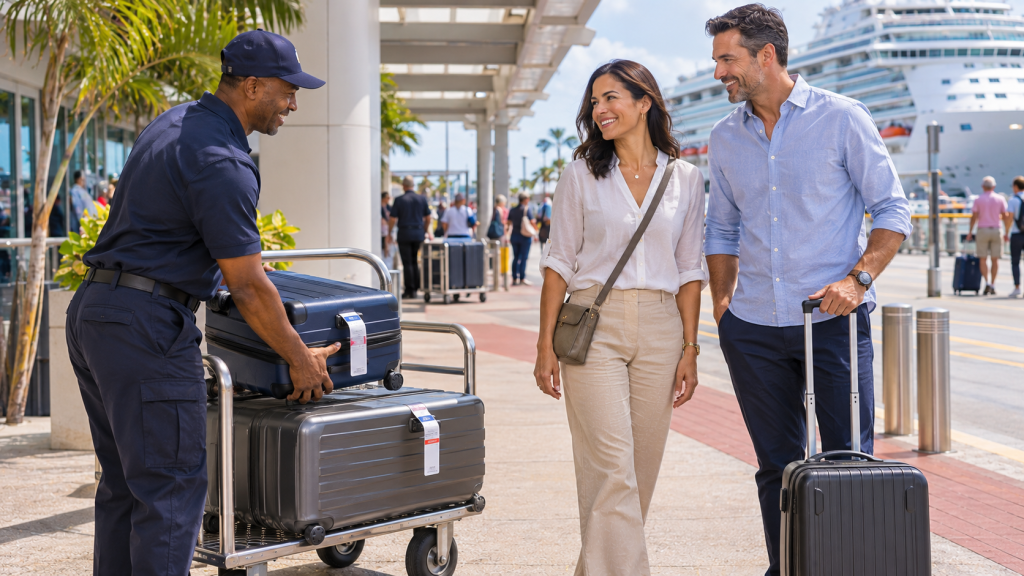
Many first-time cruisers are unfamiliar with the process of handing their suitcases to porters before entering the cruise terminal.
At ports where this service is available, authorized porters collect properly tagged checked luggage and arrange for it to enter the ship’s baggage-handling system.
Passengers then continue through check-in and security with their carry-on belongings.
The checked suitcases are transported separately and delivered to the appropriate staterooms.
Royal Caribbean specifically advises that checked luggage may arrive after the ship has sailed because of the volume of bags processed on embarkation day. (Royal Caribbean — When Will My Luggage Arrive?)
That doesn’t automatically mean your suitcase is missing. It means luggage delivery and passenger boarding follow different schedules.
Why Cruise Luggage Tags Matter
Cruise luggage tags help the baggage-handling team identify the ship, sailing, and stateroom associated with each checked suitcase.
Royal Caribbean provides guest-specific tags through its electronic cruise documents, including information such as the ship, departure date, cabin, and deck. (Royal Caribbean — How to Get Luggage Tags)
Some cruise lines allow you to print these tags at home.
Others may provide additional labeling options during check-in or at the terminal.
Before handing your bags to a porter, confirm that each suitcase has the correct tag securely attached.
Include your personal contact information inside the bag as an additional precaution in case an external tag becomes detached.
What If You Forget Your Cruise Luggage Tags?
Forgetting luggage tags doesn’t necessarily mean you won’t be able to check a suitcase.
Royal Caribbean states that passengers who forget their tags can obtain generic luggage tags from porters at the pier, although the cruise line recommends preparing them before leaving home. (Royal Caribbean — Replacement Luggage Tags)
Other cruise lines may have different procedures.
If you arrive without the required tags, ask an authorized terminal representative or porter for instructions rather than attaching an improvised label containing incomplete information.
Preparing correctly labeled bags in advance makes the handoff more straightforward.
Why Airline Carry-On Rules Don’t Determine Cruise Luggage Rules
If you’re flying to your departure port, your luggage must satisfy the requirements of both the airline and the cruise line.
These rules cover different parts of your journey.
Airlines impose baggage allowances that may include size, weight, quantity, and fee restrictions.
Airport-security regulations also determine which items can travel in the aircraft cabin or checked baggage.

Luxury Cruise Experiences at Smarter Prices
See premium sailings and upgraded cabins priced for travelers who know how to book well
Cruise lines apply their own policies for luggage screening, onboard safety, and prohibited belongings.
A bag accepted by your airline may still be inconvenient or unsuitable for carrying through a cruise terminal.
Conversely, a suitcase permitted by your cruise line may exceed your airline’s checked-baggage allowance.
Where Should You Pack Portable Power Banks?
Portable power banks are an important exception to treating electronics simply as belongings you want nearby.
The Federal Aviation Administration requires spare lithium batteries, including portable power banks, to travel in airline carry-on baggage rather than checked baggage.
Applicable capacity restrictions also apply. (FAA — Lithium Battery Rules)
If your carry-on is unexpectedly checked at the airport gate, remove spare batteries and power banks so they remain with you in the aircraft cabin.
Your cruise line may have additional restrictions on electrical equipment, so confirm those separately.
A convenient packing arrangement is one that satisfies both transportation providers without requiring you to reorganize essential belongings at the last minute.
Your Luggage Decision Also Matters When Leaving the Cruise Ship
Most luggage discussions focus on embarkation, but disembarkation presents another decision.
Depending on your cruise line and ship, passengers may be offered a choice between placing tagged suitcases outside their cabins for collection and carrying their own luggage off the ship.
These options affect how much luggage you need to manage on your final morning.
Self-Assist Disembarkation
Self-assist disembarkation generally allows passengers to keep their suitcases and transport them off the ship themselves.
This can be convenient for travelers who prefer to maintain control of their belongings or who have onward transportation arrangements.
However, you may need to move every suitcase through hallways, elevators or stairs, and terminal facilities without porter assistance during the shipboard portion of the process.
Carnival identifies self-assist as an option for guests who can carry their own luggage off the vessel. (Carnival — Preparing for Debarkation Day)
Before choosing this arrangement, consider the combined weight of your bags and whether everyone in your traveling party can manage their own belongings.
Checked Luggage During Disembarkation
Some cruise lines offer a checked-luggage collection process before the final morning.
Passengers receive instructions about tagging their bags and placing them outside their cabins for collection at the designated time.
They later retrieve those suitcases at the terminal according to the ship’s disembarkation procedures.

Sail Away to Paradise Without Overpaying
Find cruise deals that make it easy to escape, relax, and enjoy the ocean without stretching your budget
This can reduce the amount of luggage you need to move through the ship, but you’ll still need to retain overnight and morning essentials.
Royal Caribbean describes luggage collection, numbered tags, and terminal retrieval as part of its disembarkation procedures. (Royal Caribbean — Disembarkation Tips)
The best arrangement depends on your luggage volume, physical comfort, transportation schedule, and the procedures available on your sailing.
Choose Your Luggage Strategy Based on the Entire Journey
Before deciding how many bags to bring, consider the complete route your luggage will follow.
Will you be flying to the departure port, staying at a hotel the night before, or driving directly to the terminal?
Will you be traveling alone, with a partner, or with children who need assistance carrying their belongings?
Think about your return journey as well.
You may need to transport bags through customs and immigration, find ground transportation, or meet airline baggage limits after purchasing souvenirs.
A carry-on-only approach can work for travelers with modest packing needs who are comfortable managing everything themselves.
A checked-luggage approach can be useful when clothing, shoes, or other belongings make a larger suitcase necessary.
For many first-time cruisers, combining a manageable carry-on with appropriately sized checked luggage offers the most flexibility.
With the terminal procedures and baggage rules established, you can now focus on the practical packing decisions that make each approach work.
The Cruise-Specific Difference That Changes Everything
Choosing between carry-on and checked luggage for a cruise feels simple—until you picture embarkation day.
It sounds like a simple luggage decision.
Flights, terminals, ship rules, and a cabin smaller than a hotel room all collide.
That’s when stress sneaks in.
One choice can make embarkation day feel smooth.
The other choice can make you feel like you are waiting on your own stuff.
This guide makes the decision predictable, not emotional.
By the end, you will know exactly what to carry, what to check, and why that plan works.
Here is the reassuring truth.
Most first-time cruisers do best with a hybrid strategy, not an extreme.
Carrying the right essentials prevents the most common “day one” frustrations.
Checking the right items keeps your shoulders and patience intact.
Your goal is not to be a minimalist traveler.
Your goal is to start the cruise calm and stay comfortable all week.
A simple system can protect you from delays, long lines, and cabin clutter.
That system is what we are building together below.
The Cruise-Specific Difference That Changes Everything
Cruise luggage works differently than airline-only travel.
At the airport, a checked bag usually arrives fairly soon after landing.
At a cruise terminal, checked luggage is handed to porters and delivered later to your cabin.
That delay can be a few hours, and sometimes longer on busy sailings.
Meanwhile, you still need basics, because your stateroom might not be ready immediately.
That is why a smart carry-on matters more on a cruise than many people expect.
The second difference is that ships can have stricter rules about certain items, especially heat tools and some beverage policies.
A calm plan accounts for delivery timing and rules at the same time.
Terminal Timing
Embarkation day has a rhythm.
You check in, clear security, and step onto the ship.
After that, there is often a window where you are onboard but not fully “settled.”
Pool decks open.
Food is available.
Rooms may still be turning over.
This is when first-time cruisers get annoyed if swimsuits, medications, chargers, or documents are buried in checked luggage.
A carry-on prevents that annoyance.
Cabin Reality
Cruise cabins are efficient, not spacious.
Overpacking creates clutter fast.
Clutter raises stress in a small space, even when you are on vacation.
A checked bag can encourage overpacking because you have more room.
A carry-on can encourage smart packing because space is limited.
The best approach uses each bag for the role it plays best.
That is how you keep comfort high and frustration low.
Section Takeaways
Delivery Delays Matter
Checked luggage often arrives later, so carry-on essentials protect your first hours onboard.
Rules Feel Different
Cruise security focuses on onboard safety, so some items that feel normal at home may be restricted.
Bag Roles Win
Using each bag for a specific purpose prevents both overpacking and day-one irritation.
Carry-On Benefits That Make Embarkation Feel Easy
Carry-on bags shine on cruises because they keep your essentials in your control.
That control is calming on a first trip.
It also protects you if flights run late, luggage is delayed, or porters are backed up.
Another quiet benefit is that carry-on forces discipline.
You pack what you will actually use, not what you fear you might need.
That discipline keeps cabins livable and mornings smoother.
Finally, carry-on lets you handle fragile items and paperwork without risk.
When you are new, removing small uncertainties makes the whole experience feel friendlier.
What Goes In Carry-On
Medications belong with you, not in a bag you cannot access.
Travel documents belong with you for the same reason.
A phone charger and a small power bank help you stay calm if boarding takes longer than expected.
Swimwear is worth carrying because it lets you start relaxing even before your cabin is ready.
One change of clothes matters if your checked bag arrives late.
Toiletries that you cannot function without should stay with you too.
If you wear glasses or contacts, keep backups in your carry-on.
A simple “first six hours” kit prevents most first-day stress.
Carry-On Restrictions Explained
Carry-on restrictions are the rules that limit what you can bring in a carry-on bag.
Airlines set size and liquid rules for flights.
Cruise lines set safety rules for the ship.
Those rules overlap, but they are not identical.
The simplest approach is packing carry-on items that are safe in both contexts.
Avoid packing anything that heats, flames, or looks like a tool.
Keep liquids airline-compliant for flights, then stay within cruise policy once you board.
When you respect both sets of rules, security becomes routine instead of tense.
Section Takeaways
Control Creates Calm
A carry-on keeps your essentials in your hands, which reduces day-one uncertainty.
Pack For Hours
The goal is comfort for the first six hours onboard, not an entire week in one bag.
Follow Two Rulebooks
Airline rules and cruise rules both matter, so choose items that stay safe in both worlds.
Checked Bag Benefits That Protect Your Energy
Checked bags are not “bad” for cruises.
They are useful when used correctly.
Heavy items, bulkier clothing, and extra shoes become annoying if you carry them through a terminal.
That annoyance can start your trip with friction.
Checked luggage also helps when you need multiple climate options, formalwear, or specialty items.
The key is checking the right things, not everything.
When you check smartly, your carry-on stays light and your body stays relaxed.
That physical comfort matters more than people admit, especially on travel day.
What Belongs In Checked
Bulkier clothing usually belongs in checked luggage.
Extra shoes belong there too, as long as you can live without them for a few hours.
Toiletries you do not need immediately can ride in checked.
Formal outfits often do better in checked when packed carefully with structure.
If you bring a steamer or heat device, do not, because many ships restrict them.
A checked bag is also a better place for packing cubes and wardrobe organization tools.
The real goal is keeping your carry-on from becoming heavy and chaotic.
A lighter carry-on makes the whole day easier.
What Should Not Be Checked
Medications should not be checked.
Travel documents should not be checked.
Anything you would be upset to lose should not be checked.
Electronics you need right away should not be checked.
One change of clothes should not be checked if you are flying in the day before the cruise.
Port-day essentials should not be checked if you plan to explore immediately after boarding.
The calm rule is simple: if you need it to feel okay today, it stays with you.
Everything else can wait for cabin delivery.
Section Takeaways
Save Your Shoulders
Checking bulk keeps you from hauling weight through airports and terminals.
Check The Right Items
Clothing, extra shoes, and non-urgent toiletries fit checked luggage best on cruises.
Protect Essentials
Anything you truly need on embarkation day should remain in your carry-on.
The Best Choice For Most First-Time Cruisers
Most first-time cruisers get the best outcome from a hybrid plan.
Carry-on for comfort and control.
Checked bag for bulk and convenience.
This plan reduces worst-case scenarios without creating more work for you.
It also makes boarding day smoother because you are not dragging heavy luggage around the ship.
A hybrid approach protects you from delayed cabin access and delayed bag delivery at the same time.
It also keeps your cabin less cluttered because each bag has a job.
When bags have jobs, your brain stops spinning.
That is the feeling you want on your first cruise.
The Hybrid Blueprint
Carry-on holds your “today” items.
Checked luggage holds your “week” items.
Your carry-on should be something you can lift easily and roll smoothly.
Your checked bag should be stable, roomy, and organized inside.
Packing cubes help, but only if you do not use them to justify overpacking.
A simple checklist protects you from forgetting essentials while still packing light.
The hybrid blueprint works because it respects real cruise timing.
It also respects your energy.
Packing Comparison Chart
| Category | Carry-On Works Best For | Checked Bag Works Best For | Calm Recommendation |
|---|---|---|---|
| Embarkation comfort | Meds, documents, chargers, swimwear, one outfit | Extra clothes, extra shoes | Keep “first six hours” with you |
| Risk protection | High-value items you cannot lose | Low-risk items you can wait for | Do not check essentials |
| Convenience | Quick access in terminal and ship | Less lifting and easier walking | Use both with clear roles |
| Overpacking control | Forces discipline and clarity | Can encourage “just in case” items | Limit checked to planned needs |
| Formalwear | One backup shirt or top | Main formal outfit in garment folder | Hang items once onboard |
| Weather variety | Light layers, packable shell | Bulkier warm items if needed | Pack for range, not extremes |
| Liquids and rules | Airline-compliant liquids | Non-urgent toiletries | Keep policies in mind for both |
Section Takeaways
Hybrid Feels Easiest
Most first-timers feel calmer when carry-on and checked luggage each have a clear purpose.
Essentials Stay Close
Anything you would panic without stays in carry-on, even if you are a “checked bag person.”
Plan Beats Guessing
A simple blueprint prevents last-minute repacking and that anxious “did I forget something” loop.
Travelpro Picks That Truly Help Cruisers
The right luggage makes this decision easier because it removes friction.
Smooth wheels matter because terminals can be long walks.
Smart compartments matter because cruise cabins are small.
Lightweight construction matters because lifting a bag into a car trunk or shuttle can feel harder than expected.
Durability matters because luggage gets handled by many hands between airport and ship.
Travelpro is a practical choice for cruises because many of their bags focus on organization and easy rolling, which is exactly what first-timers need.
Below are options that fit real cruise scenarios without overcomplicating your packing.
When luggage works with you, you feel calmer immediately.
Easy Carry-On Setup
A lightweight Travelpro carry-on spinner is a strong pick if you want an easy roll from airport to terminal.
Look for a model with solid interior compression and a front pocket that can hold documents and chargers.
That front-pocket access matters when you are moving through checkpoints.
If you prefer even less lifting, a Travelpro underseat bag can work as your “first six hours” kit.
Underseat bags make sense on cruises because they keep essentials reachable while your larger bags are delivered to the cabin.
A small tote or underseat option also keeps you from overstuffing a backpack.
Overstuffed backpacks often become shoulder pain by noon.
Comfort is a valid packing goal.
Smart Checked Bag Choice
For checked luggage, a medium-size Travelpro spinner is often the sweet spot for cruises.
It gives you enough space for layers and dinner outfits without tempting you into bringing your entire closet.
Interior organization matters here, especially separate compartments that keep shoes away from clothing.
A built-in suiter feature or garment fold section helps if you pack formalwear.
Formal night becomes easier when your outfit arrives less wrinkled.
A stable, easy-to-roll bag also helps in terminals where floors are not perfectly smooth.
When the bag behaves, you stay calm.
Organization Add-Ons
Travelpro packing cubes can help if you use them to simplify, not to expand.
A cube for tops, a cube for bottoms, and a cube for undergarments keeps cabin drawers from becoming chaos.
A garment folder is especially helpful for dress shirts, dresses, and nicer separates.
If you like a truly calm routine, keep one cube as your “port day” kit with sunscreen, a hat, and basics.
That lets you grab and go without rummaging.
Rummaging is where stress quietly starts.
Simple systems prevent that.
Section Takeaways
Rolling Ease Matters
Smooth luggage removes travel-day friction, which helps first-timers feel more in control.
Size Controls Overpacking
A medium checked bag is often enough, and it prevents the “I brought too much” regret.
Organization Creates Calm
Cubes and garment folders reduce cabin clutter and make getting ready feel effortless.
Avoid Cruise Luggage Mistakes That Create Stress
Mistakes happen because the cruise environment is unfamiliar.
The most common mistake is checking the very items you need first.
The second mistake is carrying too much weight through the terminal.
The third mistake is assuming your cabin will be ready immediately.
A fourth mistake is overpacking “options” instead of packing a plan.
Another frequent issue is forgetting that cruise security may restrict certain items like heat tools or certain power strips.
These are not moral failures.
They are beginner patterns.
Once you see the patterns, you avoid them easily.
Checking Essentials
When you check medications, chargers, and swimwear, you create a waiting problem.
Then you board the ship and feel stuck.
That stuck feeling is what makes embarkation stressful.
A carry-on essentials kit fixes this completely.
Keep the items that stabilize your day in your control.
Everything else can arrive later without drama.
This is the single best upgrade you can make.
It is simple, and it works.
Overloading Carry-On
Dragging a heavy bag through airports is exhausting.
Dragging that same heavy bag onto the ship can feel even worse.
First-time cruisers often do this because they fear checking anything.
The calmer approach is using checked luggage for bulk and carry-on for essentials.
That way, you do not punish your body for being prepared.
Preparation should feel supportive, not heavy.
When your body feels good, your mood stays good.
Section Takeaways
Essentials Stay With You
Your carry-on should protect your comfort, not just your valuables.
Avoid Heavy Hauling
Let checked luggage do the bulk work so you do not start vacation tired.
Plan For Timing
Assume you will wait a bit for cabin access and bag delivery, then pack accordingly.
First-Time Cruise Luggage Fears—and How to Fix Them
Fears are usually about control.
You fear losing a bag.
You fear being underprepared.
You fear being stuck without essentials.
Those fears make sense when you are new.
The solution is not packing more.
The solution is packing smarter.
A simple hybrid plan answers most fears without adding weight or clutter.
Once your plan is set, your brain stops running emergency scenarios.
Fear Of Lost Bags
Lost luggage is rare, but the anxiety is real.
A carry-on essentials kit reduces the impact if something is delayed.
Keeping medications and documents with you is the most important move.
Packing one outfit and basic toiletries in carry-on also helps you stay comfortable.
That comfort keeps you from spiraling if a bag arrives late.
If you want extra peace of mind, travel insurance is not required, and many people cruise without it.
Still, first-time cruisers often like knowing they have support if delays, interruptions, or medical issues disrupt plans.
World Nomads, VisitorsCoverage, EKTA, and Insubuy are options travelers compare for that “breathing room” feeling.
Fear Of Not Boarding Smoothly
Embarkation day can feel like a lot because it is new.
A light carry-on makes lines easier.
A clear document pocket makes check-in faster.
A simple essentials kit makes the first hours enjoyable even if your cabin is not ready.
Once you eat lunch and settle into the rhythm, the anxiety usually disappears.
Your job is getting yourself to that moment calmly.
The hybrid strategy does that reliably.
Reliable is what first-time cruisers need.
Section Takeaways
Control The Basics
Keeping essentials with you is the fastest way to reduce luggage anxiety.
Smooth Boarding Is Buildable
A light carry-on and a simple system make embarkation easier than you expect.
Peace Of Mind Helps
Optional coverage can feel reassuring because it protects your travel chain, not just the cruise itself.
Board With Less Stress And More Confidence
Carry-on versus checked is not a battle.
It is a strategy choice.
Carry-on protects comfort and control on embarkation day.
Checked luggage protects your energy and keeps bulky items off your shoulders.
Most first-time cruisers feel best with a hybrid plan that gives each bag a clear role.
When you pair that plan with organized luggage, the day becomes smoother.
Travelpro-style rolling ease and interior structure can make that smoother still, especially if you use organization tools to reduce cabin clutter.
With the right system, luggage becomes boring.
That is exactly what you want.
FAQ – What Should First-Time Cruisers Know About Carry-On and Checked Luggage?
Is it better to carry on or check your luggage for a cruise?
For many first-time cruisers, using both carry-on and checked luggage provides a practical balance between convenience and accessibility.
A carry-on keeps important belongings available during embarkation, while a checked suitcase holds clothing and other items you won’t need immediately.
Carrying everything yourself can work if your luggage meets terminal requirements and you can manage it comfortably.
The better choice depends on your cruise length, baggage volume, and personal preferences.Can you bring a full-size suitcase onto a cruise ship yourself?
Some cruise lines permit passengers to carry their own suitcases aboard, provided the bags meet security-screening requirements.
However, a large suitcase may be difficult to maneuver through terminal lines, elevators, and crowded public areas.
You may also need to keep it with you until your stateroom becomes available.
Check your cruise line’s luggage-size guidance and consider whether you can comfortably handle the bag without assistance.Are cruise carry-on size limits the same as airline limits?
Cruise carry-on size requirements aren’t necessarily the same as airline baggage limits.
Airlines establish their own dimensions and allowances, while cruise terminals must accommodate bags through their security-screening equipment.
Royal Caribbean notes that screening-machine dimensions can vary between departure ports.
Review both transportation providers’ rules if you’re flying to your cruise rather than assuming an airline-approved suitcase will automatically be suitable for shipboard embarkation.How many checked suitcases can you bring on a cruise?
Cruise luggage allowances vary between operators, and some lines provide recommended quantities rather than one universal baggage limit.
Carnival, for example, recommends limiting luggage to approximately one bag per person on shorter cruises and two on longer sailings.
Your airline may impose additional baggage fees or restrictions if you’re flying to the departure port.
Check your particular cruise line’s guidance and choose luggage you can reasonably transport and store inside your cabin.Do you have to check your luggage with cruise terminal porters?
Not every passenger must necessarily hand their luggage to terminal porters.
Many cruise lines allow guests to carry suitable bags through security and onto the ship themselves, subject to applicable restrictions.
However, checking larger suitcases can make boarding more convenient, particularly when cabins aren’t immediately available.
Use authorized terminal personnel and follow your cruise line’s instructions when deciding whether to check a bag.Do cruise terminal porters charge to handle checked luggage?
Porter arrangements vary by departure port, and baggage-handling services may be included as part of the terminal’s normal embarkation process.
Passengers sometimes give porters a gratuity for handling checked luggage, but customary amounts and local practices differ.
Carnival’s published embarkation guidance describes tipping as customary rather than establishing a universal cruise-port charge.
Check the procedures at your departure terminal and avoid assuming that every porter operates under the same rules.Do you need special luggage tags for checked cruise bags?
Most cruise lines use luggage tags to identify the correct ship, sailing, and passenger stateroom.
These tags help baggage handlers route checked suitcases to their intended cabins after embarkation.
Some cruise lines provide printable tags through electronic travel documents, while others offer additional options at the terminal.
Confirm that each checked bag has the correct label attached securely before handing it to a porter.What happens if you forget your cruise luggage tags?
Forgetting your luggage tags doesn’t necessarily prevent you from checking a suitcase.
Royal Caribbean, for example, states that generic luggage tags are available from porters at the pier when passengers forget their prepared labels.
However, other cruise lines may follow different procedures, and replacing tags can add an extra step during embarkation.
Ask an authorized terminal representative for instructions and make sure the replacement label contains the correct cabin information.How long does checked luggage take to reach your cruise cabin?
Checked luggage commonly arrives several hours after embarkation, although delivery timing varies by ship and sailing.
Royal Caribbean specifically advises that luggage can arrive after sailaway because of the large volume of suitcases handled on boarding day.
A delay during the afternoon doesn’t automatically mean your bag is missing.
Keep your essential belongings in your carry-on so you can enjoy the ship without waiting for suitcase delivery.What should you keep in your carry-on during embarkation?
Keep your required identification, travel documents, medications, valuables, and essential personal belongings with you.
A change of clothes, swimwear, chargers, and basic toiletries can also be convenient before your checked suitcase arrives.
If you’re flying, make sure any spare lithium batteries or power banks follow the applicable airline carry-on requirements.
Choose a bag that remains manageable while walking through the terminal and waiting for cabin access.Should prescription medications go in carry-on or checked luggage?
Prescription medications should generally remain in your carry-on so they stay accessible and aren’t affected by delayed or misplaced checked luggage.
Keep medications appropriately labeled and make sure you have enough for the cruise and a reasonable allowance for unexpected travel disruptions.
If you require refrigerated medication, medical equipment, or special storage arrangements, contact your cruise line before sailing.
Don’t assume that a checked suitcase will arrive in time for a scheduled dose.Can you pack toiletries in checked cruise luggage?
Most ordinary toiletries can travel in checked cruise luggage, provided they comply with the cruise line’s policies and applicable transportation rules.
Items such as shampoo, conditioner, and other nonurgent personal-care products are often more convenient in larger suitcases.
If you’re flying, airport-security restrictions on liquids in airline carry-ons may affect how you divide your toiletries.
Keep any personal-care products needed immediately after boarding accessible in your smaller bag.Can you bring a portable power bank in checked luggage?
If you’re flying, spare lithium batteries and portable power banks must remain in your airline carry-on baggage rather than checked luggage.
The FAA also establishes battery-capacity restrictions, and airlines may apply additional requirements.
Cruise lines can have separate rules governing electrical equipment and battery-powered accessories.
Check both sets of policies before departure rather than assuming that an item accepted by one transportation provider is automatically accepted by the other.What if your cruise carry-on is too large for security screening?
A carry-on that exceeds the terminal’s screening requirements may need to be handled through a different baggage process or may not be accepted as hand luggage.
Available alternatives depend on the cruise line, the terminal’s equipment, and the instructions of security personnel.
This can become inconvenient if the oversized bag contains documents or other essentials you need during check-in.
Verify the relevant dimensions before traveling and keep important belongings in a smaller bag that can remain with you.Can you bring only carry-on luggage for a seven-night cruise?
A carry-on-only approach may work for a seven-night cruise if your clothing needs are modest and your bag meets the applicable restrictions.
Coordinated outfits, limited footwear, and access to appropriate laundry services can make traveling with fewer belongings more practical.
However, longer itineraries, changing weather, or specialized excursions may require additional clothing and equipment.
Consider whether the smaller packing volume is worth the tradeoffs for your particular sailing.Is checked luggage safer than carrying everything yourself?
Neither luggage approach guarantees that belongings will remain completely protected from loss, damage, or theft.
Keeping valuables and essential items with you reduces your dependence on baggage handling, while checking larger suitcases can make transportation more manageable.
Secure your luggage appropriately and follow the cruise line’s procedures for reporting missing or damaged belongings.
Travel documents, medication, cash, and other valuable possessions are generally better kept in your personal custody.What should you do if your checked suitcase doesn’t arrive?
First, check whether the ship is still within its normal luggage-delivery period, since suitcases can arrive well after passengers board.
If delivery appears unusually delayed, contact guest services and provide your cabin number and luggage-identification details.
Staff can explain the ship’s process for locating baggage that hasn’t reached the correct stateroom.
Keeping essential items in your carry-on helps you remain comfortable while the situation is investigated.Can you carry your own luggage off the cruise ship?
Many cruise lines offer a self-assist disembarkation option for passengers who can transport their own luggage off the ship.
This arrangement may allow you to retain your suitcases overnight rather than placing them outside your cabin for collection.
However, you’ll need to manage the bags through designated departure routes and the terminal, which may involve crowded areas or additional walking.
Check your cruise line’s instructions and choose self-assist only if everyone in your party can handle their belongings safely.What happens to checked luggage on the last night of a cruise?
Some cruise lines ask passengers using the checked-luggage disembarkation service to attach departure tags and place their suitcases outside their cabins by a designated time.
Crew members then collect the bags for transfer to the terminal, where passengers retrieve them according to the ship’s procedures.
You’ll need to retain medication, travel documents, sleepwear, toiletries, and other overnight necessities in a separate bag.
Review the final disembarkation instructions carefully because collection times and baggage procedures vary.What is the easiest luggage strategy for a first-time cruiser?
For many first-time cruisers, a manageable carry-on paired with a checked suitcase is a practical starting point.
The carry-on keeps essential belongings accessible, while the larger suitcase holds clothing, extra shoes, and other items that can wait for cabin delivery.
This arrangement also avoids requiring you to move all your luggage through the ship before your room is ready.
Adjust the strategy to your sailing length, transportation plans, physical comfort, and cruise line’s requirements.
Plan Your Next Cruise!

Unlock Seabourn’s World: Yacht‑Like Luxury, Exclusive Destinations, And Unmatched Comfort
One Delay Can Cost Your Entire Cruise A quick coverage check now protects you from the problems no one sees coming….

Unlock The Viking Ocean Experience: Elegant Ships, Cultural Immersion, And Unrushed Travel
One Delay Can Cost Your Entire Cruise A quick coverage check now protects you from the problems no one sees coming….

Sail in Style: Oceania Cruises’ Culinary Excellence, Cultural Immersion, and Refined Luxury
One Delay Can Cost Your Entire Cruise A quick coverage check now protects you from the problems no one sees coming….

Sail Into Sophistication: Holland America Cruises for Luxury, Culture, and Unforgettable Journeys
One Delay Can Cost Your Entire Cruise A quick coverage check now protects you from the problems no one sees coming….
Explore More

Maximize What’s Included in Your Cruise Fare—From Meals to Entertainment and Beyond

Sail Smoothly: What Snacks, Soda, and Alcohol You Can Bring on a Cruise Without Hassle

Who Really Runs Your Cruise? The Vital Roles of Crew Members at Sea